Odometer disclosure statement? It's a claim, not a check.
Federal law makes the seller write the mileage on the title at every transfer. The form records what they say. The readings logged at past transfers are what test it — and those cost $14.99 to see.
Check the mileage the records actually hold
17 characters in — recorded odometer readings, title brands and accident records for any VIN.
Free preview · no card, no account
Quick Answer
- What is an odometer disclosure statement?
- A written, signed mileage declaration made at transfer of ownership.Federal law requires the seller to state the mileage on the title when a vehicle changes hands, and to say so in writing if the reading is not the actual mileage. On most modern titles it's a box on the document itself rather than a separate form.
- When is a disclosure required?
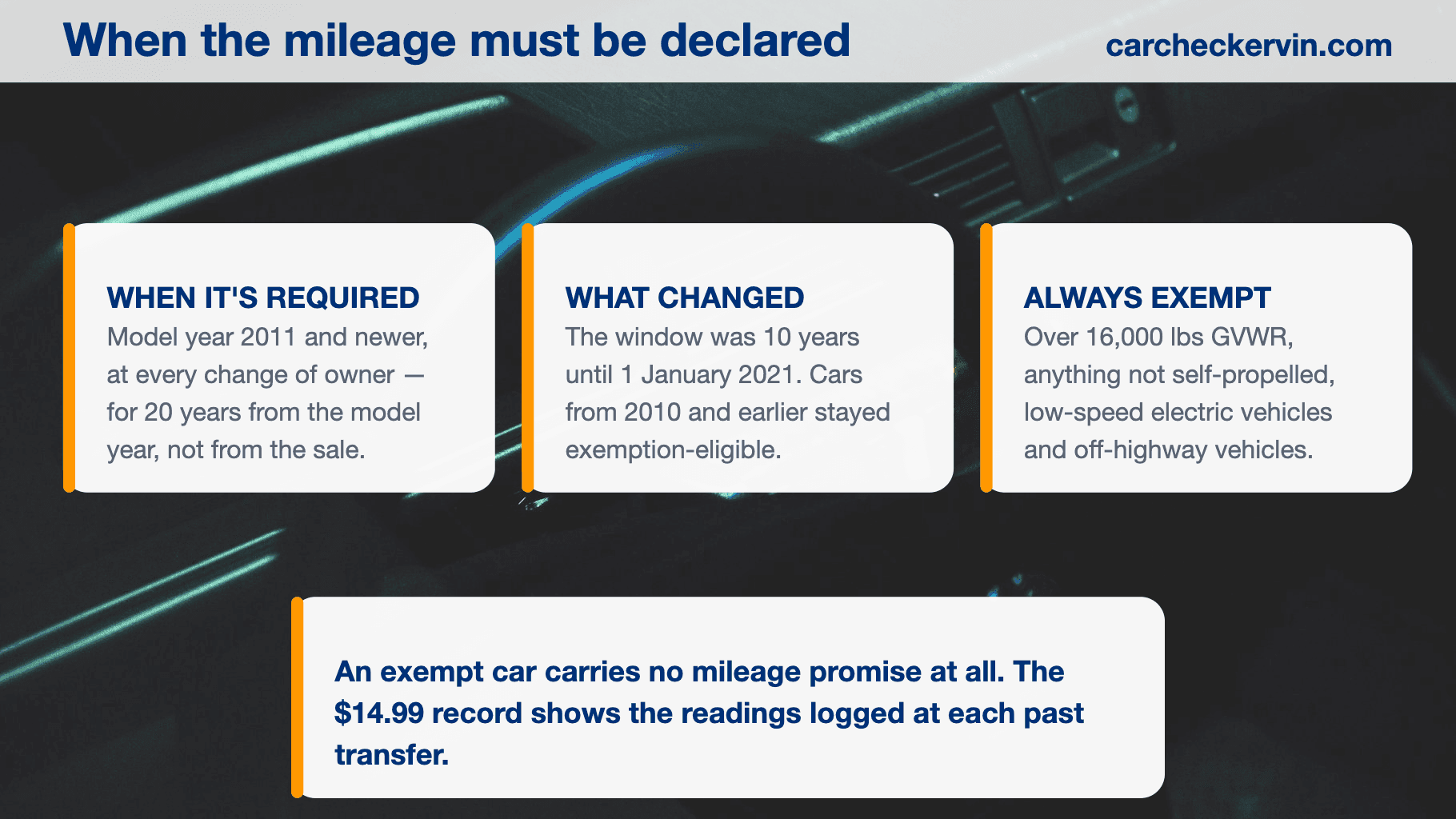
- For model year 2011 and newer vehicles, at every change of ownership. Since 1 January 2021 the exemption window runs 20 years from the model year— so a 2011 car doesn't age out until 2031. Vehicles from 2010 and earlier stayed under the old 10-year rule and are exemption-eligible.
- Does the statement prove the mileage is real?
- No. It records what the seller declares — a claim, signed under penalty, but still a claim. What tests it is the sequence of readings captured at previous transfers. Pull those for $14.99 and compare: a number that goes backwards is the fraud this form exists to expose.
What the document actually is
Strip away the state-by-state form numbers and the federal requirement is short — four things, and only four:
| The requirement | What it means | Who it binds |
|---|---|---|
| A written mileage figure | The mileage registered on the odometer, provided on the title by the seller to the purchaser | The seller, at transfer of ownership |
| A signature | The declaration is signed — that's what turns a number into a legal statement | Both parties, typically on the title itself |
| A truth flag | If the reading is not the actual mileage, the law requires a statement to that effect on the title | The seller, who must know and disclose it |
| A permanent record | The figure travels with the title and is captured when the state processes the transfer | Every future owner who looks it up |
That fourth row is the useful one. Each disclosure becomes a dated reading in the vehicle's record — which is precisely why a rollback shows up later as a number that fell.
When it's required, and when it isn't
The rule changed on 1 January 2021 and the change still catches people out — including sellers who assume their car aged out:
Model year 2011 and newer
Disclosure is required at every change of ownership, for 20 years measured from the model year — not from when you bought it. A 2011 vehicle doesn't become exempt until 2031.
The window doubled
Before 2021 the exemption arrived at 10 years. The federal rule extended it to 20 for model year 2011 onward, so a whole generation of cars that expected to age out simply didn't.
2010 and earlier, plus four categories
Vehicles from 2010 and earlier stayed under the old rule and are exemption-eligible — EXEMPT gets written in the odometer area of the title. Also always exempt: anything over 16,000 lbs GVWR, vehicles that aren't self-propelled, low-speed electric vehicles and off-highway vehicles.
Why “exempt” is a warning label for buyers
Exempt doesn't mean the mileage is fine. It means nobody had to vouch for it. On an older car that word changes what you're buying:
No declaration, no recourse
With no signed mileage statement there's no false statement to point at later. The seller never promised a number, so a wrong number isn't a broken promise — it's your assumption.
The dash is not evidence
A five-digit mechanical odometer rolls over on its own, and a digital cluster can be rewritten in minutes with tools sold openly. What the gauge shows today proves only what it was set to show.
The paper trail still exists
Exempt from disclosure isn't exempt from history. Readings captured at earlier transfers, while the car was still inside its window, remain in the record — often enough to bracket what the mileage should be now.
Test the number before you sign anything
Free preview first: recorded odometer readings, title brands and accident flags for any 17-character VIN.
How to read a disclosure like a buyer
You're holding a signed number. Four checks turn it from a formality into an actual verification:
Compare it with the dash
The declared figure should match what the cluster reads today, allowing for the miles driven since the form was filled in. A gap of thousands needs an explanation before anything else happens.
Look for the “not actual” flag
Federal law requires a statement when the reading isn't the true mileage. If that box is marked — or a previous title carried it — the car's mileage is officially unknown, whatever the dash says now.
Put the readings in order
Pull the recorded readings from past transfers and lay them out by date. Mileage only moves one way; a later reading lower than an earlier one is a rollback, not a typo.
Check the pace between readings
Even without a reversal, a car that covered 15,000 miles a year and then apparently 800 during a two-year gap is telling you something — usually that a reading is wrong or the car sat broken.
Match it to the wear
Pedal rubbers, seat bolsters, steering wheel finish and tyre history should agree with the number. Cheap replacements of exactly those parts on a low-mileage claim is its own signal.
Keep your copy
The signed disclosure is your evidence if the number turns out to be false. Photograph it with the title and the dash on the day you buy, and keep all three together.
None of these require expertise — they require the earlier readings, which is the one part a seller can't hand you and can't edit.
If you're the seller
The form is short, but it's signed, and a wrong entry is the kind of mistake that follows a sale. Three rules keep it clean:
Write what the odometer reads
Not the mileage at the test drive, not a rounded figure, not what the buyer would prefer. The reading on the day of transfer, exactly as displayed, with no digits added or dropped.
Flag it if you know it's wrong
Replaced cluster, a period when the odometer wasn't working, an inherited car with unclear history — say so on the title. Disclosing an unknown mileage is legal; declaring a number you know is false is not.
Run your own report first
Buyers check. If a previous transfer recorded something you can't explain, better to find it yourself and have the answer ready than to discover it while someone is standing in your driveway with a printout.
Related odometer and title checks
The rest of the mileage question, in the same plain terms.
افحص رقم الشاصي دائماً قبل الشراء
المعاينة المجانية تُظهر علامات سند الملكية وحالة السرقة والاستدعاءات المفتوحة خلال ثوانٍ، وتُشير إلى وجود سجلات حوادث أو عدّاد من عدمه. التقرير الكامل بـ 14.99 دولاراً — دفعة واحدة، بلا اشتراك.
Odometer disclosure — the questions people ask
Straight answers, including where the paperwork can't protect you.
What is an odometer disclosure statement?+
It's the written mileage declaration federal law requires a seller to give a buyer when a vehicle changes ownership. The figure goes on the title and is signed, and if the reading isn't the vehicle's actual mileage the law requires a statement saying so. On modern titles it is usually a printed section of the document rather than a separate sheet, though some states also use a standalone form.
Which vehicles need an odometer disclosure?+
Model year 2011 and newer vehicles, at every transfer of ownership. Since 1 January 2021 the exemption window has been 20 years measured from the model year, so a 2011 vehicle remains covered until 2031. Vehicles from model year 2010 and earlier fell under the previous 10-year rule and are exemption-eligible, with EXEMPT entered in the odometer area of the title.
What vehicles are always exempt?+
Four categories sit outside the requirement regardless of age: vehicles with a gross vehicle weight rating over 16,000 lbs, any motor vehicle that isn't self-propelled, low-speed electric vehicles, and off-highway vehicles. If you're buying in one of those categories, no mileage declaration is coming — plan your verification accordingly.
Does a signed disclosure mean the mileage is genuine?+
It means someone put their name to it, which matters legally but proves nothing mechanically. The statement records a claim. What tests the claim is the sequence of readings captured at previous transfers: mileage only increases, so a later reading below an earlier one is evidence of a rollback no signature can explain away.
What does “not actual mileage” mean on a title?+
It's the flag federal law requires when the odometer reading doesn't reflect the true distance travelled — a replaced or broken cluster, or a known discrepancy. Once that brand appears it stays with the vehicle, and it means the mileage is formally unknown. The car can still be worth buying, but never at a low-mileage price.
I'm buying a car that's exempt. How do I check the mileage?+
Use the readings from before it aged out. A 2010 vehicle was inside the disclosure window for years, so transfers in that period captured dated readings that bracket what today's figure should plausibly be. Pair that with physical wear — pedals, seat, steering wheel — and with service records if any exist.
What if I discover the mileage was false after buying?+
Keep the signed disclosure, the title and photographs of the dash — that paperwork is the basis of any claim, which is exactly why the form exists. Our odometer-fraud page covers what recourse looks like. The cheaper path is the one before signing: pull the recorded readings for $14.99 and compare them with the number you're being asked to accept.
They declare it. You verify it.
Recorded odometer readings, title brands and accident history for any VIN — in under a minute, for less than a tank of fuel.
فحوصات رقم الشاصي ذات الصلة
أدوات إضافية للتحقق من تاريخ أي مركبة