What is an emissions test?
A check that a car's emissions controls still work. The part nobody explains is why you need one and somebody two counties over does not — and that answer is in federal air-quality rules rather than anything about your car.
Buying a car that has to pass?
Check the history before the test becomes your problem.
No account · Nothing stored · $14.99 only for the full report
Quick Answer
- What is an emissions test?
- A check that a vehicle's emissions controls are working. On a 1996 or newer car that usually means plugging into the diagnostic port and reading the car's own self-diagnosis rather than measuring the exhaust. Older cars get the tailpipe test.
- Why do I need one when my friend doesn't?
- Because it is an air-quality rule attached to a place. Federal rules require inspection and maintenance programmes in ozone and carbon monoxide nonattainment areas, by population and classification — so whether you test depends on where the car is registered, not on the car.
- What happens if it fails?
- You cannot usually complete registration until it passes. The underlying fault has to be repaired and the car retested — which is why a check engine light on a used car you are about to buy is a cost question, not a cosmetic one.
Why you, and not your neighbour
This is the question behind almost every search for the term, and it has a precise answer. Emissions testing is not a vehicle rule that some states happen to enforce. It is an air-quality programme triggered by the air where the car lives:
“Inspection/maintenance (I/M) programs are required in both ozone and carbon monoxide (CO) nonattainment areas, depending upon population and nonattainment classification or design value.”
So two identical cars, same year and same condition, can face completely different obligations depending on where each is registered. Nothing about the car changed; the county did.
Why they plug in instead of testing the exhaust
If you expected a probe up the tailpipe and got a laptop, this is why. The rule lets states drop the tailpipe test entirely for modern cars:
“States may also exempt MY 1996 and newer OBD-equipped vehicles that receive an OBD-I/M inspection from the tailpipe, purge, and fill-neck pressure tests (where applicable) without any loss of emission reduction credit.”
The reasoning is that a modern car monitors its own emissions continuously and stores what it finds. Reading that record is a better test than a single sample taken while the car idles on a ramp.
A car that cannot pass is a car you cannot register
Check the history before the repair bill becomes yours — $14.99, no account.
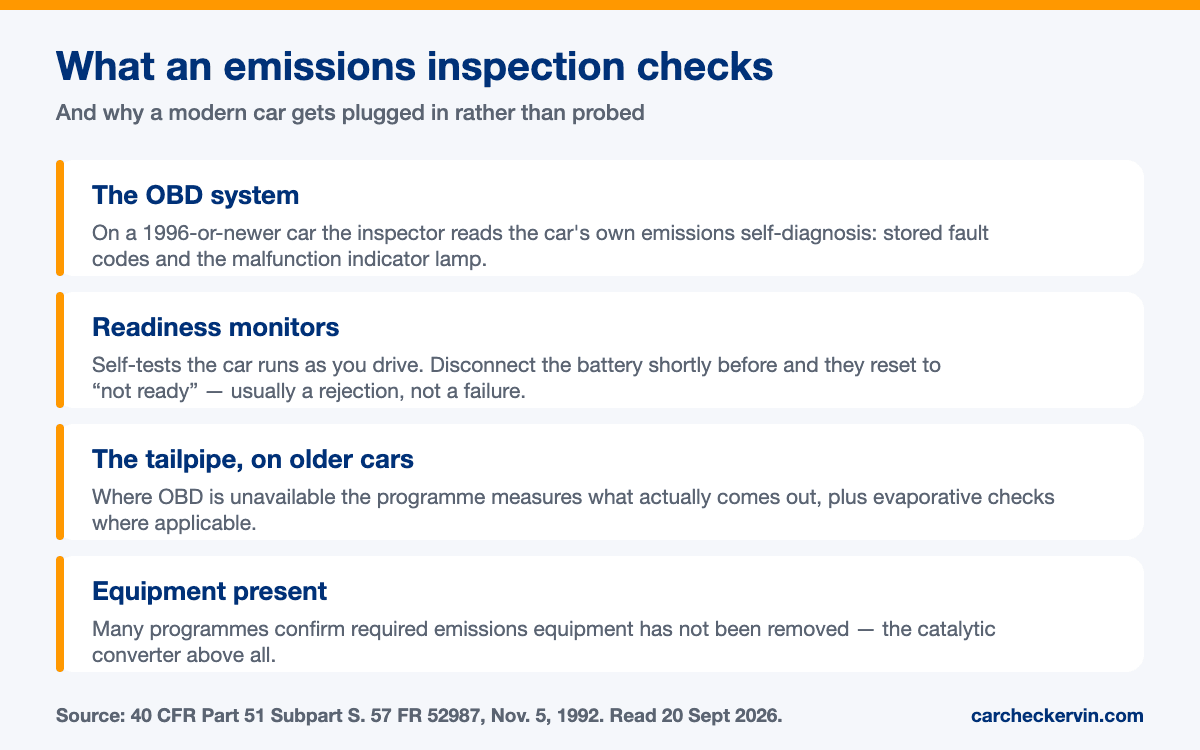
What the test actually looks at
1The OBD system
On a 1996-or-newer car the inspector plugs into the diagnostic port and reads the car's own emissions self-diagnosis — stored fault codes, the malfunction indicator lamp, and whether the readiness monitors have completed.
2Readiness monitors
Self-tests the car runs as you drive. If the battery was recently disconnected they reset to 'not ready', and a car with too many incomplete monitors is usually rejected without being failed — drive it and come back.
3The tailpipe, on older cars
Where OBD is not available the programme falls back to measuring what comes out of the exhaust, plus evaporative checks on the fuel system where applicable.
4Visual equipment checks
Many programmes confirm that required emissions equipment is present and has not been removed or tampered with — the catalytic converter above all.
Annual, biennial, or not at all
Test frequency is not arbitrary either, though it looks that way from the outside. The federal performance standard assumes annual testing, and states may depart from it if they still hit the emission targets:
“The performance standards for I/M programs assume an annual test frequency; other schedules may be approved if the required emission targets are achieved.”
We deliberately publish no county-by-county table of who tests, how often, or what it costs. Those come from each state's own implementation plan and no single authoritative source lists them all — a table assembled from secondary sources would be wrong somewhere and you would not know where. Check your state's programme directly.
What this means when you are buying
- 1
Ask where it last passed
A car that passed in an area with no programme has not been tested at all. What matters is whether it can pass where you will register it.
- 2
Treat a check engine light as a price
On an OBD inspection an illuminated lamp is generally a straight fail. The repair behind it is yours if you buy the car.
- 3
Be suspicious of freshly cleared codes
If the monitors read 'not ready', the codes were cleared recently. That can be innocent — or it can be a fault reset the morning you came to look.
- 4
Check the emissions equipment is there
Many programmes verify that required equipment has not been removed. A missing catalytic converter is an expensive discovery after purchase.
- 5
Run the VIN anyway
An emissions pass says the car met an air-quality standard on one day. It says nothing about title brands, flood history or mileage — that is the $14.99 check.
Sources
- 40 CFR Part 51, Subpart S — Inspection/Maintenance Program Requirements
Which areas must run an I/M programme, what an OBD inspection may replace, and the assumed test frequency. 57 FR 52987, Nov. 5, 1992. Read 2026-09-20.
- NHTSA Recalls by VIN
The federal safety-recall lookup: free, by VIN, covering unrepaired recalls.
- NMVTIS — U.S. Department of Justice
The Justice Department's consumer entry point for the National Motor Vehicle Title Information System. Read 19 September 2026.
- 49 CFR Part 565 — Vehicle Identification Number Requirements
The federal rule fixing the VIN at 17 characters and defining each position. Read 19 September 2026.
افحص رقم الشاصي دائماً قبل الشراء
المعاينة المجانية تُظهر علامات سند الملكية وحالة السرقة والاستدعاءات المفتوحة خلال ثوانٍ، وتُشير إلى وجود سجلات حوادث أو عدّاد من عدمه. التقرير الكامل بـ 14.99 دولاراً — دفعة واحدة، بلا اشتراك.
Keep reading
Frequently asked questions
Why are emissions tests required in some places and not others?+
Because the requirement follows air quality, not vehicles. The federal rule states: "Inspection/maintenance (I/M) programs are required in both ozone and carbon monoxide (CO) nonattainment areas, depending upon population and nonattainment classification or design value." So two identical cars can face completely different obligations depending on where each is registered.
What pulls an area into the programme?+
Classification and population. The rule requires enhanced I/M in any metropolitan statistical area, or portion of one, within an ozone transport region with a 1990 population of 100,000 or more, regardless of that area's attainment classification. Other areas are covered based on their nonattainment classification or design value.
Why did they plug into my car instead of testing the exhaust?+
Because on a modern car the computer already knows. The rule permits states to "States may also exempt MY 1996 and newer OBD-equipped vehicles that receive an OBD-I/M inspection from the tailpipe, purge, and fill-neck pressure tests (where applicable) without any loss of emission reduction credit." So the inspector reads the car's own emissions self-diagnosis instead of sampling what comes out of the pipe.
Which model years get the OBD test?+
It depends on when the area came into the programme. For areas that implemented enhanced I/M before designation under the 8-hour ozone standard, the standard covers model year 1996 and later OBD-equipped light-duty vehicles and trucks; for areas designated under the 8-hour standard, model year 2001 and later.
What are readiness monitors, and why was I turned away?+
They are self-tests the car runs as you drive. Disconnect the battery or clear codes shortly before a test and they reset to 'not ready'. A car with too many incomplete monitors is normally rejected rather than failed — you drive it for a while and come back.
Is an emissions test annual or every two years?+
It varies, and the rule explains why: "The performance standards for I/M programs assume an annual test frequency; other schedules may be approved if the required emission targets are achieved." So a state can run biennial testing if it still hits the emission targets, which is why neighbouring states differ.
Does a check engine light mean an automatic fail?+
On an OBD-based inspection, an illuminated malfunction indicator lamp is generally a fail regardless of what else the car does, because the lamp is the car reporting an emissions-related fault itself.
What does this mean when I'm buying a used car?+
Ask whether the car has passed recently in the area where you will register it. A car with an active check engine light, or one whose monitors have just been cleared, may be a car that cannot be registered until something is repaired — and the seller may know exactly why.
Does a smog check tell me anything about the car's history?+
Only about its emissions compliance on the day. It says nothing about title brands, accident history or mileage — those come from the federal title record, which is the $14.99 check.
Check the car's history
Title brands, flood records and open recalls — $14.99.
فحوصات رقم الشاصي ذات الصلة
أدوات إضافية للتحقق من تاريخ أي مركبة