Abandoned Car on My Property — what you may do with it, and what you may not.
A car left in your driveway, field or lot is still someone else's property, and probably a lender's too. You cannot drive it, sell it, strip it for parts or push it into the street. What you can do is report it, have it removed under your state's towing statute, or, in Texas, apply to dispose of it. Here is the sequence in Texas, California and Florida, with the hours, notices and sign rules each statute sets, and why the VIN is the first thing to read.
Read the VIN Before You Call Anyone
A free preview shows whether the car carries a salvage brand or a recorded lien, which tells you whether a lender will want it back. Police check theft records; a history report does not.
Free preview · No sign-up · No owner or personal data
Quick Answer
- What can I do with an abandoned car on my property?
- Report it to the police non-emergency line with the VIN and plate, then follow your state's route: in Texas a law enforcement agency may take an abandoned vehicle into custody from private property after 48 hours (ch. 683), or you may apply to TxDMV to dispose of it to a demolisher for $2; in California and Florida you may have it towed by a towing company under the private-property towing statute. You may not drive, sell, dismantle or keep it.
- How long until a car on private property is abandoned?
- Texas says 48 hours "without the consent of the owner or person in charge of the property" (§ 683.002(a)(3)). California's § 22658 does not use a clock for a single-family lot; it allows removal 96 hours after a parking-violation notice or 24 hours after police are told about a vehicle missing major parts. Florida's § 715.07 lets a property owner have an unauthorized vehicle removed by a towing business at any time if the statute's conditions are met.
- Can I keep or sell a car left on my land?
- No. The title stays with the registered owner and any lienholder until a statutory process moves it. Texas makes the point by giving landowners only a disposal route: the VTR-71-2 application produces a certificate of authority to scrap the vehicle, not a title. A title comes from the law-enforcement auction, where you may bid.
Five steps when a car appears on your property
In this order: identify, document, report, then the lawful removal route your state provides.
- 1Read the VIN and plateThe VIN plate is at the base of the windshield, driver's side. Photograph it, the plate and the car's condition.
- 2Run the VINA free preview shows title brands and recorded liens. A lienholder usually comes for a financed car.
- 3Call the non-emergency linePolice identify the owner from the registration, check theft records, and in Texas may take the car into custody.
- 4Use the towing statuteCalifornia § 22658 and Florida § 715.07 let a towing company remove it at the owner's expense if the conditions are met.
- 5Or the Texas disposal routeForm VTR-71-2, $2; TxDMV notifies the owner, waits 20 days, then issues a certificate of authority to scrap.
What You May Not Do
The car is not yours and will not become yours by sitting there. Driving it means operating an unregistered, uninsured vehicle you do not own; selling it or stripping it is converting someone else's property; and pushing it onto the public road creates the abandonment the statutes punish the owner for. In Texas, a junked vehicle visible from a public place is a public nuisance (§ 683.072), and the person who "maintains" it, which can be the landowner, commits a misdemeanor with a fine of up to $200 (§ 683.073).
Charging the owner storage is not a landowner's right either. Texas limits storage fees to law enforcement agencies, garagekeepers and licensed storage facilities, and makes charging a storage fee for an unauthorized period a misdemeanor with a fine of $200 to $1,000 (§§ 683.033, 70.004(f)). The lawful tools are the police, the towing statute and, in Texas, the disposal application.
Texas: 48 Hours, Then Chapter 683
A vehicle "that has remained on private property without the consent of the owner or person in charge of the property for more than 48 hours" is abandoned (§ 683.002(a)(3)), and a law enforcement agency "may take into custody an abandoned motor vehicle ... found on public or private property" (§ 683.011). From there the agency's process runs: notice within 10 days, 20 days to claim, auction. If the agency will not collect it, § 683.051 lets the owner of the property the car sits on apply to TxDMV for authority to dispose of it to a demolisher: Form VTR-71-2, a $2 fee, the VIN and the car's location. TxDMV sends first-class notice to any owner or lienholder in its records, or publishes on its website if it has none, and anyone who fails to claim the car within 20 days waives their interest. The certificate of authority that follows is accepted by a demolisher in place of a title.
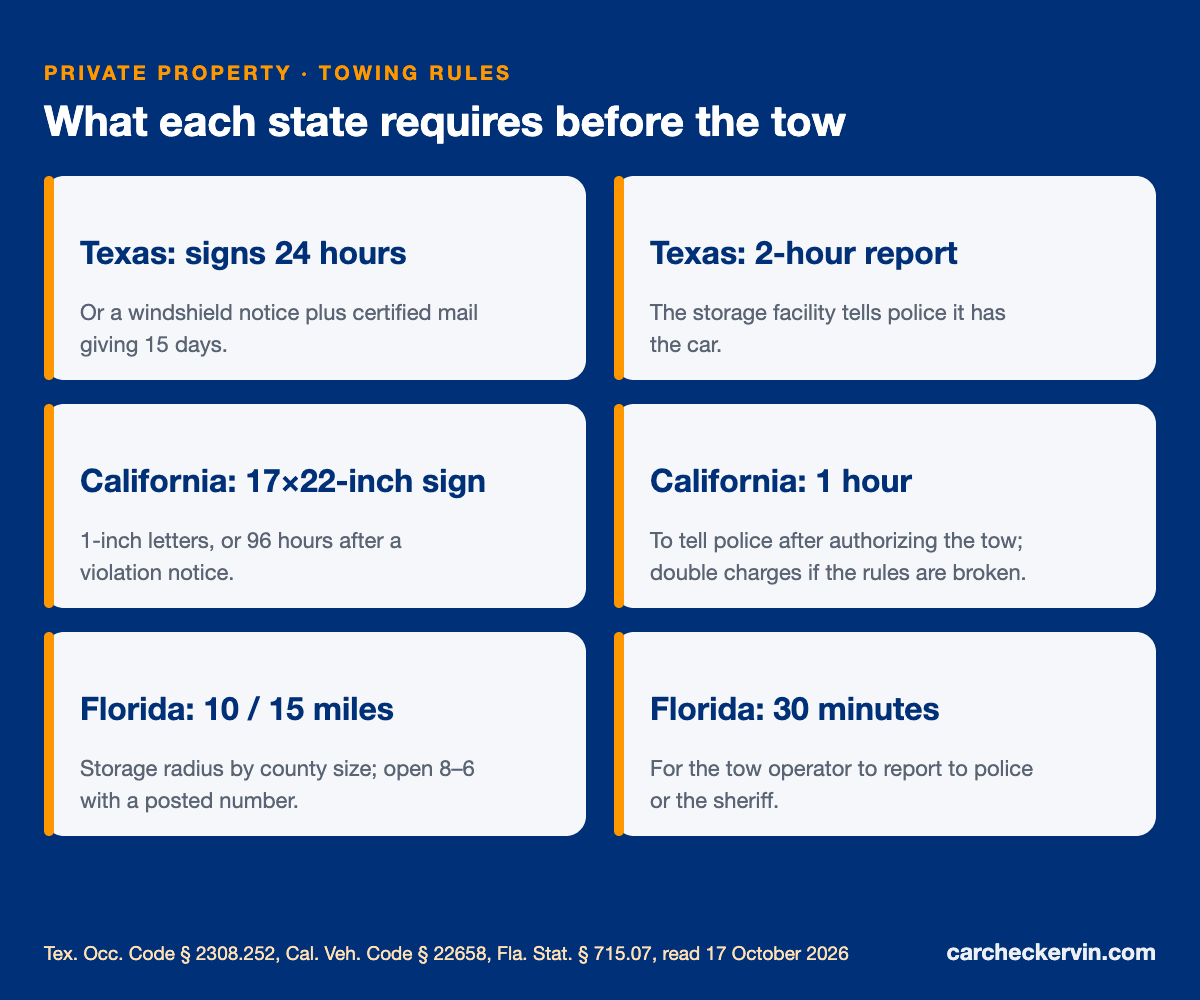
Towing a vehicle off a parking facility without the owner's consent is governed by Occupations Code ch. 2308: signs complying with Subchapter G must have been posted for the preceding 24 hours (18 by 24 inches, the towing symbol, a 24-hour phone number), or the owner must have received actual notice, or a windshield notice followed by certified mail giving 15 days (§ 2308.252). An apartment complex may not tow a car merely for an expired plate unless the lease says so and 10 days' written notice is given (§ 2308.253). The storage facility that receives a towed car reports it to police within 2 hours (§ 2308.2565).
Texas, in order
- 48 hours: without your consent, the car is abandoned.
- Police: may take custody from private property.
- VTR-71-2: $2, 20 days' notice, then scrap authority.
- Junked vehicle: inoperable 30 days on private property with no valid plate = nuisance.
Private-Property Towing Rules Compared
What each statute demands before a tow truck can take a car off private land: Texas's signs and notices for parking facilities, California's four circumstances and one-hour police call, Florida's storage radius and 30-minute report.
Every figure is read from the section cited beside it on the date shown.
California: Vehicle Code § 22658
The owner or person in lawful possession of private property may have a vehicle removed to a storage facility in four circumstances. The duties that follow are strict.
A posted sign
At every entrance, at least 17 by 22 inches with 1-inch lettering, prohibiting public parking, warning of removal at the owner's expense, and giving the police and towing company numbers.
96 hours after a notice
The vehicle has been issued a notice of parking violation and 96 hours have passed.
24 hours, missing parts
The vehicle lacks an engine, transmission, wheels, tires, doors, windshield or another major part, you have told the local traffic law enforcement agency, and 24 hours have passed.
A single-family lot
The lot or parcel is improved with a single-family dwelling. No sign or waiting period is required.
Tell police within 1 hour
The person authorizing the tow must notify the local traffic law enforcement agency within one hour, and the tow company needs written authorization from someone present.
The penalties
Double the towing and storage charges for a tow outside the first three circumstances; 4× damages for an excessive rate; a $1,000 infraction for an owner who skips the authorization rules; $2,500 misdemeanors for operators.
Florida: § 715.07 and Where Chapter 705 Stops
Florida's abandoned-property chapter, 705, applies to property left on public property, so a car in your yard is handled under § 715.07 instead. The owner or lessee of real property may have a vehicle parked there without permission removed "by a person regularly engaged in the business of towing vehicles", without liability for the costs or for damage, if the statute's conditions are met: the car must be stored within 10 miles of the point of removal in a county of 500,000 people or more and 15 miles in a smaller county (20 and 30 if no closer yard exists); the storage site must be open for release from 8 a.m. to 6 p.m. and post a number answered at all times, with the operator returning within 1 hour of a call; and the tow operator must report the tow to the municipal police or sheriff within 30 minutes.
A driver who returns while the car is being hooked up must be allowed to pay a drop fee of no more than half the posted rate and keep the car. Signage requirements apply to lots and parking areas but not to "property appurtenant to and obviously a part of a single-family residence". Violations are misdemeanors or third-degree felonies depending on the condition broken. Once the car is in the tow yard it is the operator's lien under § 713.78, and the operator, not the landowner, runs the sale.
Florida's conditions
- Who tows: a business regularly engaged in towing.
- Where it goes: 10 / 15 miles, open 8–6, posted number.
- 30 minutes: to report the tow to police or the sheriff.
- Drop fee: at most half the posted rate if the driver returns.
Find Out What the Car Is Before You Act
Enter the VIN for a free preview of title brands and recorded liens. A financed car usually goes back to the lender; a salvage-branded one may be worth only its scrap.
If the Owner Turns Up
Most abandoned cars are not mysteries: the registration and the lien record identify someone, and the notices reach them. If the owner or a lienholder arrives before the process ends, they are entitled to the car on payment of the lawful charges, and you have no claim on it beyond what the statute gives the tow yard or storage facility. Keep your photographs and the dates you reported it; in Texas a garagekeeper who delays the report past 7 days loses the right to storage reimbursement (§ 683.032(b)), and a landowner's record of prompt reporting is the equivalent protection.
If nobody turns up, the statute's clock decides the outcome: a Texas auction you may bid at, a California or Florida lien sale run by the tow yard, or, in Texas, the scrap certificate. What never happens is the car becoming yours by waiting. The companion page on abandoned vehicle titles walks through each of those endings.
Related Checks and Guides
How the title is actually issued, the lien sales, and the checks to run on the VIN.
Where These Facts Come From
From the Texas, California and Florida statutes, read on 17 October 2026. Cities and counties add ordinances; confirm with local law enforcement before you act.
CarCheckerVIN is not affiliated with any state agency or towing company. This page is general information, not legal advice; municipal ordinances add rules the statutes allow.
افحص رقم الشاصي دائماً قبل الشراء
المعاينة المجانية تُظهر علامات سند الملكية وحالة السرقة والاستدعاءات المفتوحة خلال ثوانٍ، وتُشير إلى وجود سجلات حوادث أو عدّاد من عدمه. التقرير الكامل بـ 14.99 دولاراً — دفعة واحدة، بلا اشتراك.
Abandoned Car on My Property — Frequently Asked Questions
What landowners ask most.
Can I have a car towed off my property?+
Yes, through a towing company and under your state's statute: California § 22658 (sign, 96-hour notice, missing-parts report or a single-family lot, then police told within an hour), Florida § 715.07 (a towing business, storage within the radius, police told within 30 minutes), Texas ch. 2308 for parking facilities. Report the vehicle to police first.
Can I charge storage for a car left on my land?+
Not as a private landowner. Texas limits storage fees to law enforcement, garagekeepers and licensed storage facilities and fines unauthorized storage charges $200 to $1,000. A tow yard that takes the car charges under its own lien statute.
What is a junked vehicle in Texas?+
A self-propelled vehicle that is wrecked, dismantled or discarded, or inoperable for more than 72 hours on public property or 30 days on private property, and that shows no valid license plate. Visible from a public place it is a public nuisance; cities and counties abate them with 10 days' notice, and the car may not be put back on the road.
Does Florida's abandoned property law cover my yard?+
No. Chapter 705 defines abandoned property as property left on public property. A car on your private land is removed under § 715.07's towing rules, and any sale is the tow yard's lien sale under § 713.78.
Can I apply for a title to a car left on my property in Texas?+
No. Texas gives the landowner a disposal route, Form VTR-71-2 for $2, which ends in a certificate of authority to scrap the car. A title is issued to the buyer at a law-enforcement auction.
Should I check the VIN of an abandoned car?+
Yes, before anything else. The free preview shows title brands and recorded liens, so you know whether a lender is likely to claim it and whether the car is worth more than scrap. Police check it against theft records when you report it.
Run the VIN on the Car in Your Driveway
Enter any 17-character VIN for a free preview. The full report lists title brands, NMVTIS junk and salvage records, insurance total-loss records, odometer readings, and auction records with the damage the auction recorded and its photos.
CarCheckerVIN is an independent vehicle-history service and is not affiliated with any state motor vehicle agency, law enforcement body or towing company. Rules are summarized from public statutes and are not legal advice. Records in our reports reflect what was reported to our data providers. Our reports do not include police or repair-shop accident entries.
فحوصات رقم الشاصي ذات الصلة
أدوات إضافية للتحقق من تاريخ أي مركبة