Police Car Auctions — how they work, and what to check first.
Police and city auctions sell cars that were towed and never claimed, seized, or retired from the fleet. The ones we checked are open to the public, and their terms explain the prices: the car is sold as is, you often cannot drive it or even open it before bidding, and you pay on the spot. Here is how they run, using the published rules of New York City, Los Angeles and Houston, and the check to make before you raise your hand.
Check the VIN on the Auction List
Most cities publish the list before sale day. Enter a VIN for a free preview of its title, odometer and auction records.
Free preview · No sign-up · No owner or personal data
Quick Answer
- Are police car auctions open to the public?
- In the cities we checked, yes. Houston says its auctions are open to the general public, Los Angeles' 18 Official Police Garages say theirs are open to the public, and New York City's Sheriff and marshals auction seized and abandoned vehicles. Houston sells salvage vehicles only to licensed salvage dealers.
- Can you inspect a police auction car before bidding?
- Barely. Los Angeles does not allow preview inspection before sale day. Houston limits you to a short visual inspection while officers are present, and the car may not be operated. New York provides no keys.
- How do you get a title for a police auction car?
- You get a sale document, not a title. New York issues one Certificate of Sale, which you take to the DMV, and the DMV may treat the car as salvage. Houston issues an Auction Sales Receipt for the county tax office; lose it and you need a bonded title.
Five steps, from the list to the title
Most of the risk is decided before you bid. The list, the VIN and the paperwork are what you can control.
- 1Find the agency that sellsPolice departments, sheriffs or contracted garages run the sales; check the city's own page.
- 2Get the list and the VINsCities publish what is scheduled. Copy each VIN you care about.
- 3Check each VINTitle brands, total losses and odometer history, before sale day.
- 4Bring ID and paymentCash in New York and Houston; Los Angeles varies by garage.
- 5Arrange the tow and the paperworkNo keys, short removal windows, and a sale certificate to take to the DMV.
Where Police Auction Cars Come From
Most cars at a police auction were towed and never claimed. Houston auctions unclaimed vehicles from storage facilities as required by Chapter 683 of the Texas Transportation Code. New York City auctions vehicles that were seized or abandoned: the owner has to pay all judgment tickets, penalties and interest to get the car back, and if it is not redeemed within 10 business days of the tow, it is sold. In Los Angeles, the 18 Official Police Garages hold lien sale auctions.
Some are the police cars themselves, retired from the fleet. The California Highway Patrol, for example, lists its vehicle sales on GovDeals, an online marketplace.
How Three Cities and One State Run Them
From each agency's own page, read on 16 October 2026. Local rules differ, so always read the page for the auction you plan to attend.
New York City
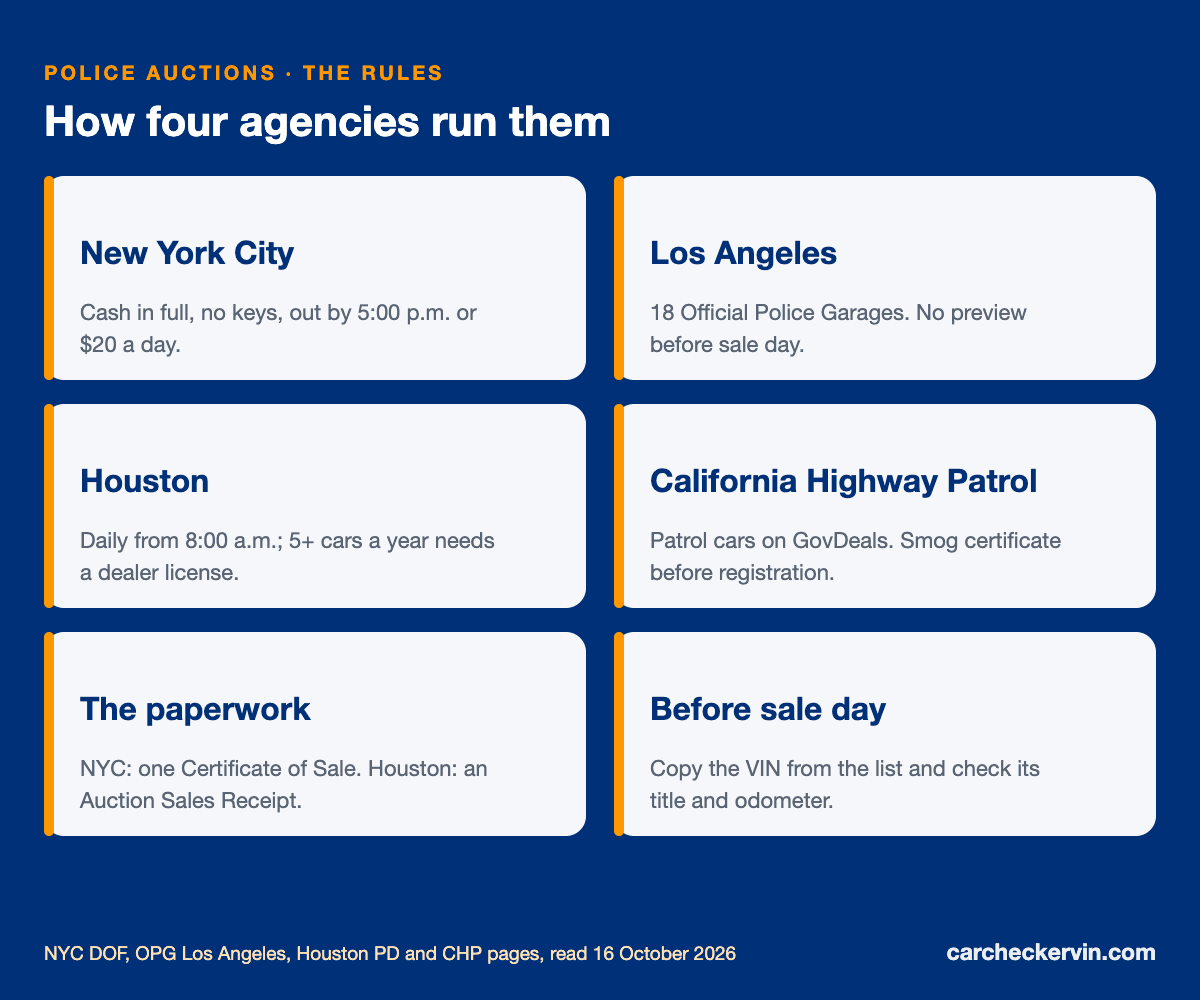
Sheriff's Office and city marshals. Cash in full when the sale is final; no keys; remove by 5:00 p.m. or pay $20 a day.
Los Angeles
18 Official Police Garages. Open to the public; no preview before sale day; pay on the day; payment types vary by garage.
Houston
Daily from 8:00 a.m. at storage facilities. Cash to the highest bidder; 5+ purchases a year need a dealer license.
California Highway Patrol
Patrol vehicles listed on GovDeals; no warranty; a smog certificate is required before registration.
What "As Is, Where Is" Means at a Police Auction
Every one of these sales is final and without warranty. Los Angeles sells "AS IS, WHERE IS" and with all faults; Houston says the buyer takes the vehicle "as is, where is" and all sales are final; New York sells "as is" and the buyer collects the car where it is.
In practice, that means you are buying what you can see from the outside. Houston allows a visual inspection only, during the short time officers are present, and the car may not be operated. New York provides no keys and you may need a tow to get the car out of the yard.
Costs beyond the bid
- Storage: $20 a day in NYC after 5:00 p.m. on auction day; abandoned after 96 hours.
- Tow fee: the NYC tow yard may charge to remove a purchased car.
- Taxes: Houston buyers pay them at the county tax office, as with any car sale.
- Repairs: unknown until the car is out of the yard.
The Rules Side by Side
Access, payment, inspection and the deadline to remove the car, from each agency's own page.
The one constant: you are buying blind, which is why the VIN on the auction list is worth checking before sale day.
The Paperwork: a Sale Certificate, Not a Title
In New York you receive a Certificate of Sale, which you take to the DMV to have a title issued in your name. The city issues only one certificate per owner and no duplicates. The DMV may consider the vehicle as salvage, which can mean an examination before a new title or registration is issued, and until then you cannot drive it or park it on the street.
In Houston the winning bidder receives an Auction Sales Receipt from the police department, which goes to a county tax office to transfer the title. If you lose it, the Texas DMV's position is that you will need a bonded title; Houston will not reissue it.
Buying a Retired Police Car
Retired patrol cars are sold by the agencies that ran them. The California Highway Patrol lists its vehicles on GovDeals, reserves the right to reject any bid, and makes no warranty about condition or completeness.
California adds one more step: under Vehicle Code 24007.5, every buyer must get a smog certificate of compliance before registering the car. Budget the inspection, and any repair it reveals, into your bid.
Check the Car Before Sale Day
Enter a VIN from the auction list for a free preview of its title brands, odometer readings and earlier auctions.
What the Auction Tells You, and What It Doesn't
The auction gives you a lot number and a look. A report tells you what the car has been through.
Police auction listing
- Lot number, and usually the VIN
- A short visual inspection, if any
- No keys, no driving, no warranty
- A sale certificate after you pay
Our full report
- Title brands and NMVTIS junk and salvage records
- Insurance total-loss records and odometer readings
- Auction records with the recorded damage and photos, where the car was auctioned
- $14.99 after a free preview, or $9.00 each in a 10-pack
Our report does not include police or repair-shop accident entries.
Related Checks and Guides
More on buying cars at auction and checking their history.
Where These Facts Come From
The rules on this page come from each agency's own website, read on 16 October 2026. They change, and each city runs its auctions differently.
CarCheckerVIN is not affiliated with any police department, city or auction platform. Check the selling agency's page for current dates and terms.
افحص رقم الشاصي دائماً قبل الشراء
المعاينة المجانية تُظهر علامات سند الملكية وحالة السرقة والاستدعاءات المفتوحة خلال ثوانٍ، وتُشير إلى وجود سجلات حوادث أو عدّاد من عدمه. التقرير الكامل بـ 14.99 دولاراً — دفعة واحدة، بلا اشتراك.
Police Car Auctions — Frequently Asked Questions
What first-time bidders ask most.
Are police car auctions open to the public?+
In the cities we checked, yes: Houston's and the Los Angeles Official Police Garages' auctions are open to the public. Houston sells salvage vehicles only to licensed salvage dealers, and buyers of 5 or more cars a year need a dealer license.
Can I test drive a police auction car?+
No. Houston limits you to a visual inspection and the car may not be operated; New York provides no keys; Los Angeles allows no preview before sale day.
How do I pay at a police auction?+
New York and Houston take cash, in full, on the day. Los Angeles requires payment on the day of sale, with accepted forms varying by garage.
How do I get the title?+
Take the sale document to the DMV or county tax office: a Certificate of Sale in New York, an Auction Sales Receipt in Houston. New York's DMV may treat the car as salvage.
What if I lose the paperwork?+
New York issues one Certificate of Sale and no duplicates. In Houston, per the Texas DMV, a lost Auction Sales Receipt means applying for a bonded title.
Are police auction cars a good deal?+
That depends on the car, and the terms put the risk on you: sold as is, often without keys or an inspection. Check the VIN first: our report lists title brands, NMVTIS junk and salvage records, insurance total-loss records, odometer readings, and auction records with the damage the auction recorded and its photos.
Check the VIN Before You Bid
Enter any 17-character VIN for a free preview. The full report lists title brands, NMVTIS junk and salvage records, insurance total-loss records, odometer readings, and auction records with the damage the auction recorded and its photos.
CarCheckerVIN is an independent vehicle-history service and is not affiliated with any police department, city, state agency or auction platform. Agency rules are summarized from their public pages for reference. Records in our reports reflect what was reported to our data providers. Our reports do not include police or repair-shop accident entries.
فحوصات رقم الشاصي ذات الصلة
أدوات إضافية للتحقق من تاريخ أي مركبة