Government Car Auctions — where federal, state and local vehicles are sold.
The government auctions thousands of vehicles each year, according to USA.gov. Some are government-owned and in prime condition; others were seized and may need many repairs. They are sold online, in person or by mail-in bid, by the agency itself or an auction company it hires. Here is where each kind is sold, what the official pages say, and the check that separates a retired fleet car from a seized one.
Check the VIN Before You Bid
Auction listings show the car; a VIN check shows its title brands, odometer readings and earlier auctions. The preview is free.
Free preview · No sign-up · No owner or personal data
Quick Answer
- Where can I buy a government car at auction?
- USA.gov lists four federal channels: GSA Fleet Vehicle Sales, GSA Auctions, U.S. Marshals Service and U.S. Treasury. States and cities run their own sales; the California Highway Patrol, for example, lists its vehicles on GovDeals.
- Are government auction cars in good condition?
- It depends on where they came from. USA.gov says government-owned vehicles may be in prime condition, and describes GSA fleet sales as vehicles in good condition and ready to drive, while seized vehicles may need many repairs.
- Are U.S. Marshals auctions open to the public?
- Yes. The Marshals Service says it holds hundreds of online and live auctions every year that are open to the public, run by contracted companies such as Apple Auctioneering, Gaston & Sheehan Auctioneers and Skipco Auto Auction.
Five steps before you bid
The channel tells you what kind of car you are likely to get. The VIN tells you which car you are actually getting.
- 1Pick the channelFleet surplus, excess property, or seized and forfeited assets.
- 2Read the lotPhotos, description and the VIN, where the listing shows it.
- 3Check the VINTitle brands, total losses and odometer history.
- 4Read the sale termsMost sales carry no warranty; agencies can reject any bid.
- 5Plan registrationSome states add steps; California requires a smog certificate.
Surplus Cars and Seized Cars Are Different Buys
USA.gov draws the line itself: some government vehicles are government-owned and in prime condition, others were seized and may need many repairs. A retired fleet car was owned by an agency, and USA.gov describes GSA fleet sales as vehicles in good condition and ready to drive. A car forfeited in a criminal or tax case comes with whatever history its previous owner left behind.
Either way, auctions may be online, in person or by mail-in bid, and the agency that owns the vehicles may run the auction or hire an auction company to do it.
The Four Federal Channels
As listed by USA.gov (last updated March 2, 2026) and read on 16 October 2026.
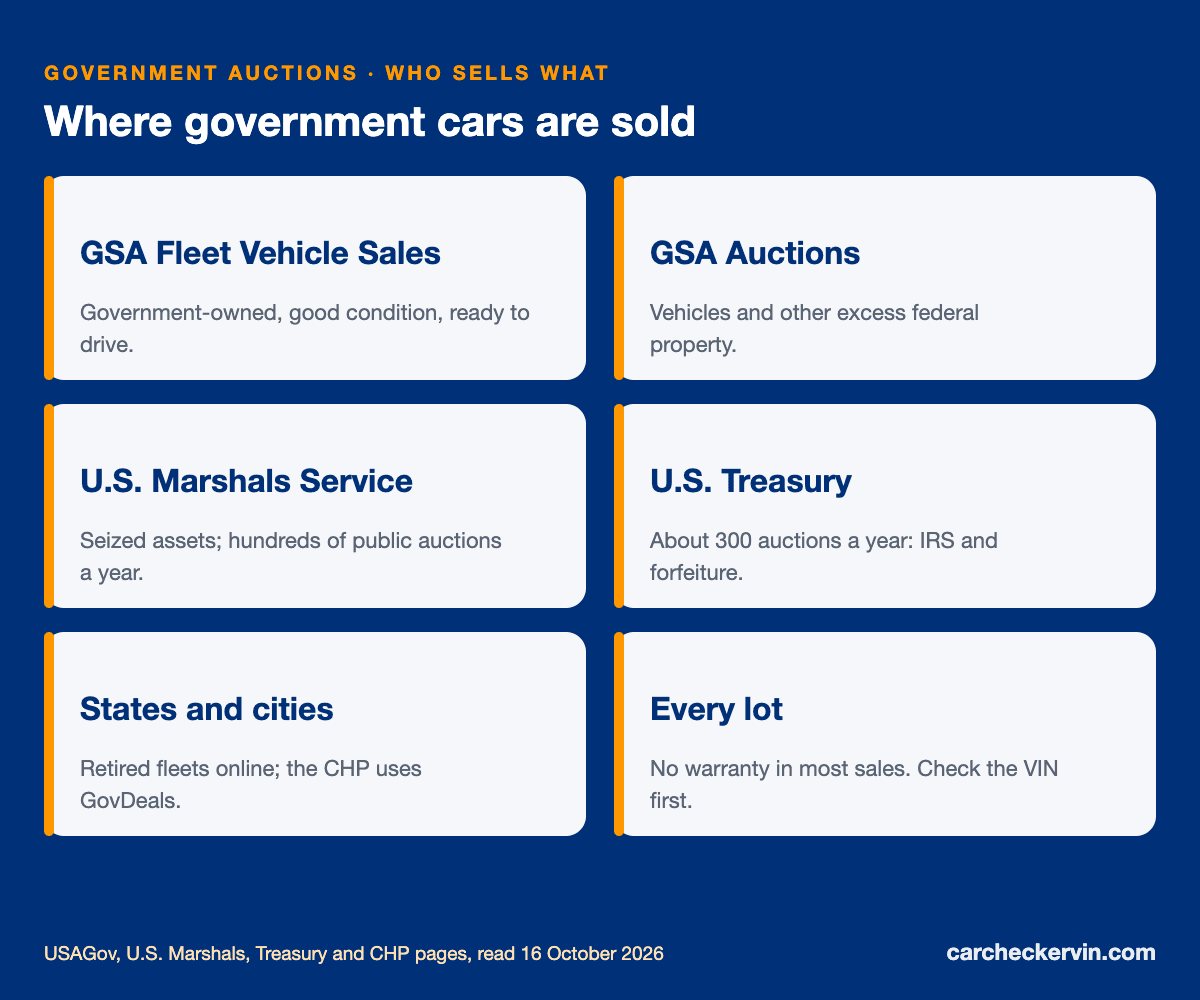
GSA Fleet Vehicle Sales
Government-owned vehicles in good condition and ready to drive, per USA.gov.
GSA Auctions
Vehicles and other government-owned excess property.
U.S. Marshals Service
Vehicles and other property seized by Justice Department and other federal agencies.
U.S. Treasury
Property forfeited for tax evasion or other violations of Treasury law.
U.S. Marshals and Treasury Auctions
The U.S. Marshals Service manages and sells assets seized under the Justice Department's Asset Forfeiture Program, including vehicles, vessels, aircraft, jewelry and art. It says it features hundreds of online and live auctions every year that are open to the public, often including collectible vehicles. When we checked, its current auctions ran through Apple Auctioneering, Gaston & Sheehan Auctioneers, Skipco Auto Auction and Ambyth Auctions, among others.
The Treasury runs about 300 public auctions a year across the U.S. and Puerto Rico, selling property forfeited for violations of laws it enforces or for unpaid IRS taxes. The IRS sells real estate and vehicles through IRS Auctions; the Treasury Executive Office for Asset Forfeiture sells property seized under Treasury and Homeland Security laws, and proceeds go to the Treasury Forfeiture Fund.
Before bidding on a seized car
- Expect repairs: USA.gov warns seized vehicles may need many.
- Expect no history: the previous owner is not there to ask.
- Check the title: brands and total losses follow the VIN, not the seller.
- Read the auctioneer's terms: each contracted company sets its own.
Which Channel Sells What
The image maps the federal channels USA.gov lists, plus state and local sales, to the kind of vehicle each one usually sells.
It is a starting point, not a guarantee: every lot still needs its own check.
State and Local Government Sales
States, counties and cities sell their own retired vehicles. The California Highway Patrol, for example, lists its vehicle sales on GovDeals. Its terms are typical of government sales: the state can reject any or all bids, minimum bids apply when shown, and it makes no warranty about condition or completeness.
Local police departments also auction towed and abandoned cars, under different rules again: cash, short inspection windows and a sale certificate instead of a title. Those sales have their own guide.
Look Up a Listed Vehicle by VIN
Enter the VIN for a free preview of its title brands, odometer readings and earlier auctions.
Fleet Surplus vs Seized Vehicles
Both are sold at government auctions. They are not the same purchase.
Fleet surplus
- Government-owned
- USA.gov: may be in prime condition
- GSA fleet sales: good condition, ready to drive
- Sold by the agency or an auction company it hires
Seized or forfeited
- Taken in criminal or tax cases
- USA.gov: may need many repairs
- History unknown to the seller
- Sold through contracted auctioneers
What the Listing Shows, and What It Doesn't
A government listing describes the car on the lot. A report tells you what the car has been through.
Government auction listing
- Photos and a short description
- The VIN, on most listings
- Sale terms, usually without warranty
- Pickup and payment rules
Our full report
- Title brands and NMVTIS junk and salvage records
- Insurance total-loss records and odometer readings
- Auction records with the recorded damage and photos, where the car was auctioned
- $14.99 after a free preview, or $9.00 each in a 10-pack
Our report does not include police or repair-shop accident entries.
Related Checks and Guides
More on buying cars at auction and checking their history.
Where These Facts Come From
Everything on this page comes from official government pages, read on 16 October 2026. GSA Auctions blocked our reader, so its description is USA.gov's.
CarCheckerVIN is not affiliated with any government agency or auction company. Check the selling agency's or auctioneer's page for current listings and terms.
افحص رقم الشاصي دائماً قبل الشراء
المعاينة المجانية تُظهر علامات سند الملكية وحالة السرقة والاستدعاءات المفتوحة خلال ثوانٍ، وتُشير إلى وجود سجلات حوادث أو عدّاد من عدمه. التقرير الكامل بـ 14.99 دولاراً — دفعة واحدة، بلا اشتراك.
Government Car Auctions — Frequently Asked Questions
What buyers ask before bidding on a government vehicle.
Where are government cars auctioned?+
At the federal level, through GSA Fleet Vehicle Sales, GSA Auctions, U.S. Marshals Service and U.S. Treasury, per USA.gov. States and cities run their own sales, often online; the California Highway Patrol uses GovDeals.
Are government auction cars a good deal?+
It depends on the car and the terms: most sales carry no warranty and limited inspection, and USA.gov warns that seized cars may need many repairs.
What is the difference between surplus and seized cars?+
Surplus cars were owned and maintained by an agency and retired; USA.gov says they may be in prime condition. Seized cars were taken in criminal or tax cases and may need many repairs.
How many auctions does the Treasury hold?+
About 300 public auctions a year across the U.S. and Puerto Rico, through IRS Auctions and the Treasury Executive Office for Asset Forfeiture.
Do I need a license to buy at a government auction?+
Not for most public sales. Local rules can add limits: Houston, for example, requires a dealer license for 5 or more purchases a year at its police auctions.
How do I check a government auction car's history?+
Run the VIN from the listing. Our report lists title brands, NMVTIS junk and salvage records, insurance total-loss records, odometer readings, and auction records with the damage the auction recorded and its photos.
Check Any Government Auction Car by VIN
Enter any 17-character VIN for a free preview. The full report lists title brands, NMVTIS junk and salvage records, insurance total-loss records, odometer readings, and auction records with the damage the auction recorded and its photos.
CarCheckerVIN is an independent vehicle-history service and is not affiliated with USAGov, GSA, the U.S. Marshals Service, the Treasury, any state agency or auction company. Agency information is summarized from their public pages. Records in our reports reflect what was reported to our data providers. Our reports do not include police or repair-shop accident entries.
فحوصات رقم الشاصي ذات الصلة
أدوات إضافية للتحقق من تاريخ أي مركبة