Accident Reported on Carfax — What It Really Means.
“Accident reported” tells you a crash reached Carfax, and sometimes where the car was hit and how hard. It does not tell you how the car was repaired, and it cannot show a crash nobody reported. Here is how to read the entry, who reports accidents to Carfax, and what to check before you buy.
Check the Damage Records Free
Enter the 17-character VIN for a free preview of the records on file. The full report lists insurance total-loss records, salvage and junk records, and auction damage with photos.
Free preview · No sign-up · No owner or personal data
Quick Answer
- What does “accident reported” on Carfax mean?
- One of Carfax's sources reported a collision involving the car. When the source sent the details, the report shows where the car was hit on an overhead diagram, how severe it was, and whether the airbags deployed. It says a crash was reported, not how well it was repaired.
- Who reports accidents to Carfax?
- Carfax lists more than 151,000 sources, including state agencies, police and fire departments, auto auctions, and fleet and rental companies. Carfax also says not every accident is reported, and not every report reaches it.
- Should I buy a car with an accident on Carfax?
- Often yes, if you know what was damaged and it was fixed properly. Carfax puts the average price hit at about $500, rising to $1,700 for severe damage. Ask for the repair records and have a mechanic inspect the car before you pay.
How an accident gets onto a Carfax report, in five steps
Each step is a place where the record can stop. Knowing the chain explains both why an entry can be vague and why a crash can be missing altogether.
- 1The car is hitA rear-end tap, a side-swipe in a parking lot, a deer at dusk. Carfax’s own data says rear-end and side-swipe collisions make up most of the crashes with a described cause.
- 2Someone writes it downA police officer files a crash report, a state agency records the damage, or a body shop, an auction or a fleet company logs it. If nobody writes it down, there is nothing to find later.
- 3The record reaches CarfaxCarfax receives the record from one of its sources and ties it to the VIN. Carfax says plainly that not every reported accident is passed on to it.
- 4The report shows the entryYou see a line such as “accident reported” or “damage reported”, with the impact point and severity if the source included them. Older crashes tend to carry less detail.
- 5You check the car itselfThe entry tells you where to look, not what the repair was like. That part takes the seller’s paperwork and a mechanic with the car on a lift.
What an Accident Entry Can Tell You
Carfax describes six kinds of detail an entry may carry. “May” matters: what you get depends on what the source sent, and different states report very different amounts.
Where the car was hit
Carfax often shows an overhead diagram of the car with the damaged area shaded, so you can see whether it was the front, a corner or a side.
A severity grade
In some cases the entry carries a severity rating. It reflects what the source reported, not an inspection of the repair.
Airbag deployment
When the information is available, Carfax notes whether the airbags went off. That usually points to a harder hit than the diagram alone suggests.
Whether it was driveable
Also shown when the source recorded it. A car towed from the scene is a different case from one driven home.
State damage disclosures
Carfax notes that some states require damage above a set dollar amount to be disclosed, which can add detail to an entry.
Damage with no crash
Not every entry is a collision. Backing into a pole or a falling branch can show up as damage, and minor damage may be cosmetic.
Accident Reported, Damage Reported and Total Loss Are Not the Same
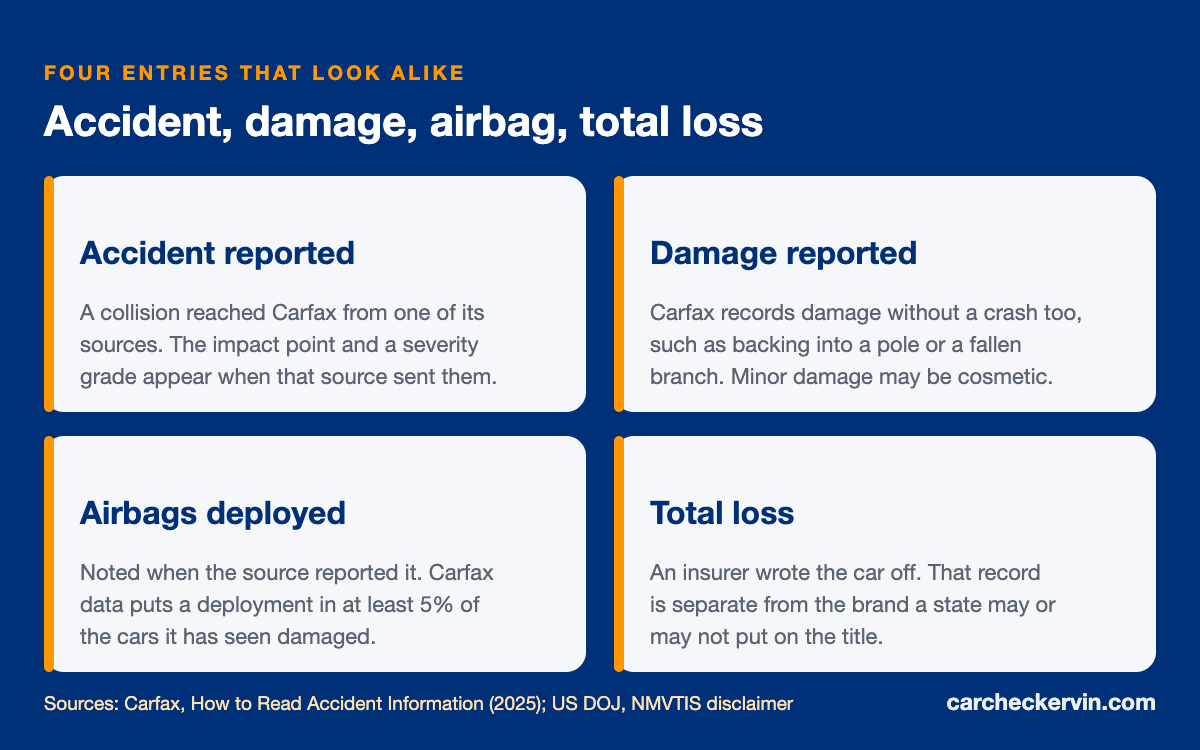
Buyers often read every line in the damage section as the same kind of warning. They are not. An accident entry records a collision. A damage entry can record an event that was not a crash at all: Carfax's own examples are backing into a pole and a tree limb falling on the car. An airbag deployment points to a harder hit, and a total loss means an insurer decided the car was not worth repairing.
That last one also sits in a different place. The US Department of Justice, which runs the federal title system, says damage reaches the title record only when an insurer declares a total loss or a state brands the title. A car can have several accident entries and a perfectly clean title, because a repairable crash triggers neither.
Who Reports Accidents to Carfax, and Who Doesn't
Carfax says it draws on more than 151,000 data sources. The ones that matter for crashes are state and federal agencies, police and fire departments, auto auctions, and fleet management and rental companies. Canadian provincial motor-vehicle agencies are on the list too.
What is missing from that list is just as useful. A driver who pays a local body shop in cash, never calls the police and never files a claim can leave no trace in any of those sources. Carfax's help center says it directly: not every accident or damage event is reported, and not all of those that are reported are provided to Carfax.
So a clean accident section means no crash was reported to Carfax. It is good news, but it is a different statement from “this car has never been hit”, and only an inspection can get you closer to the second one.
Three ways a crash goes missing
- The crash was never reported. A bumper swap paid in cash at an independent shop can leave no record anywhere. Carfax says not every accident or damage event is reported.
- It was reported, but not to Carfax. Carfax also says not all reported events are provided to it. Another history service may hold a record Carfax does not.
- The detail is thin. How much a state records varies, and older crashes often carry less. An entry with no diagram is not the same as a minor crash.
Check What Else Is on File Before You Decide
An accident line is one record. Enter the VIN for a free preview, then see whether the car also carries a total loss, a salvage record or an auction listing with photos of the damage.
How Common Accident Damage Is, by Carfax's Own Count
If a car you like shows an accident, you are in large company. These figures come from Carfax's own published data.
of US cars on the road have sustained damage, as many as 110 million
used cars for sale have sustained damage
of owners with a damaged car sell it within a year
average hit to retail price after severe damage ($500 overall)
Carfax adds that at least 5% of damaged cars had an airbag deployment, more than 5 million vehicles. It also found that a quarter of owners put a damaged car up for sale within a year, which is why so many cars on dealer lots carry an entry.
Where a cause was reported, rear-end and side-swipe collisions make up 91.6% of the crashes between them. More than half of the damage Carfax sees lands on the front of the car, and the driver's side takes more than the passenger side.
Crash types, 2024
- Rear-end60.7%
- Side-swipe30.9%
- Single vehicle5.4%
- Side-impact1.8%
- Front-end1.2%
Share of 2024 accidents reported to Carfax with a described cause. Source: Carfax Accident & Damage Report 2025.
Should You Buy a Car With an Accident on Carfax?
Carfax's own answer is that an accident report should not scare you off a car, and its numbers back that up. The average hit to retail price is about $500, and about $1,700 for a car with severe damage in its past. A buyer who knows about the damage can pay the lower price; the one who overpays is the buyer who never read the report.
What changes the answer is the kind of damage. A shaded rear bumper with no airbag deployment and a car that drove away is a different purchase from a front-end hit with deployed airbags, a tow and structural repairs. The entry points you to the area; the repair order tells you what was replaced; a mechanic tells you whether it was done well.
Be more careful when the history does not add up: an accident entry, then a sale at auction within months, then a clean-looking listing. Auction and total-loss records are where a serious crash usually leaves its second trace.
A Carfax Accident Entry vs Our Damage Records
The two reports hold different records, and we would rather say so than blur it. Ours does not list police or repair-shop accident entries.
A Carfax report
- Accident and damage entries from police, state agencies, auctions, fleets and more
- Overhead damage diagram and severity when the source reported them
- Airbag deployment and driveability when available
- Service records and ownership history
- About $44.99 for a single report
Our full report
- Insurance total-loss records, with the date and what was reported
- NMVTIS junk and salvage records naming who reported the car
- Title brands such as salvage, flood and rebuilt
- Auction records with the recorded damage and listing photos
- $14.99 full report, or $9.00 each in a 10-pack
Where they help each other: a serious crash often leads to a total loss or an auction sale. If a car you are looking at has a Carfax accident entry, our report shows whether an insurer wrote it off and, if it went through auction, what the damage looked like in the listing photos.
What to Do When Carfax Shows an Accident
Four steps, all of them drawn from Carfax's own advice to buyers.
Ask the seller what happened
Carfax’s own advice is to ask about any damage and see whether the answer matches the report. A seller who knows the date, the damage and the shop is a good sign.
Get the repair paperwork
Ask for the repair order or the insurance estimate, and whether the work carries a warranty. The paperwork tells you what was replaced, not just that something was.
Pay for an inspection
Carfax puts a pre-purchase inspection at around $100. A mechanic can see whether the repair was done properly and spot damage that never made it into any record.
Use it in the price
Carfax found damage cuts retail value by about $500 on average and $1,700 after severe damage. A reported accident is a fair reason to negotiate.
If the entry is on your own car and looks wrong: Carfax's help center says you can send a police report or a repair order through its Data Research Request form, either to add detail to an entry or to flag an error. Keep the paperwork; a buyer will ask for it too.
Related Checks and Guides
This page covers reading a Carfax accident entry. These cover the lookups themselves and the other records a damaged car tends to leave.
Where These Facts Come From
What an accident entry contains, and the damage figures, come from Carfax's own published guides and data. The title-record rule comes from the US Department of Justice.
The Carfax price cited here is the single-report price quoted by other providers when we last checked; Carfax's own site does not respond to automated reads, and prices change without notice. CarCheckerVIN is not affiliated with Carfax.
افحص رقم الشاصي دائماً قبل الشراء
المعاينة المجانية تُظهر علامات سند الملكية وحالة السرقة والاستدعاءات المفتوحة خلال ثوانٍ، وتُشير إلى وجود سجلات حوادث أو عدّاد من عدمه. التقرير الكامل بـ 14.99 دولاراً — دفعة واحدة، بلا اشتراك.
Carfax Accident Reports — Frequently Asked Questions
What an accident entry means, where it comes from, and what to do about it.
What does accident reported mean on Carfax?+
It means one of Carfax's sources reported a collision involving the car. When the source sent the details, the entry shows where the car was hit on an overhead diagram, a severity rating, whether the airbags deployed and whether the car could still be driven. It does not tell you how well the car was repaired.
Who reports accidents to Carfax?+
Carfax says it has more than 151,000 data sources, including US federal and state agencies, Canadian provincial agencies, auto auctions, fire and police departments, and fleet management and rental companies. It also says not every accident or damage event is reported, and not every reported one is provided to Carfax.
Does every accident show up on Carfax?+
No. Carfax's help center says not every accident or damage event is reported, and not all of those reported reach Carfax. A repair paid privately at an independent shop can leave no record at all, which is why Carfax recommends a pre-purchase inspection alongside the report.
What is the difference between damage reported and accident reported on Carfax?+
An accident entry records a collision. A damage entry can come from events that were not crashes, such as backing into a pole or a tree branch falling on the car, and Carfax notes that minor damage may be only cosmetic. Both deserve the same questions: what was damaged, who repaired it, and is there paperwork.
How bad is a minor accident on Carfax?+
Often not very, but the grade reflects what the source reported, not an inspection of the repair. Carfax says minor damage may be cosmetic. Ask for the repair order and have a mechanic look at the area the diagram shades before you decide.
Should I buy a car with an accident on Carfax?+
It can be a good buy. Carfax data says about 1 in 4 used cars for sale have sustained damage, and the average hit to retail price is about $500, or $1,700 after severe damage. Know what was damaged, get the repair paperwork, pay for an inspection, and use the history in the price.
Can I get an accident added to or removed from a Carfax report?+
Carfax's help center says you can submit a police report or a repair order through its Data Research Request form to add details, and use the same route if you think a report has an error. Carfax reviews the request and replies.
Does your report show Carfax's accident entries?+
No. Our report does not include police or repair-shop accident entries. It shows insurance total-loss records, NMVTIS junk and salvage records, title brands, and auction records with the damage the auction recorded and its photos. Read it next to the Carfax entry: a total loss or an auction damage record adds to what a single accident line tells you.
Check a Car's Damage Records by VIN
Enter any 17-character VIN for a free preview. The full report lists insurance total-loss records, salvage and junk records, title brands and auction damage with photos.
CarCheckerVIN is an independent vehicle-history service and is not affiliated with Carfax. Carfax is a trademark of its respective owner and is referenced here for comparison only. Our reports show what was reported to our data providers and do not include police or repair-shop accident entries. No history service can show damage that was never reported.
فحوصات رقم الشاصي ذات الصلة
أدوات إضافية للتحقق من تاريخ أي مركبة