Is Carfax Accurate? What the Data Can and Cannot Prove
A Carfax report is accurate about the records it received, which is a narrower claim than most buyers hear when they read it. This page explains how an event reaches a vehicle history report at all, the three points where it can drop out of the chain, and how to verify a car independently before you hand over money.
Free VIN Preview — See the Records First
Enter the 17-character VIN to see how many title, brand, odometer and salvage records exist for it — before you pay for anything
Free preview · No card required · Instant result
Quick Answer
- Is Carfax accurate?
- Broadly yes, for the records it holds. Carfax is a long-established market leader, and the entries printed on a report came from a source that filed them — a state title office, an insurer, a police department, a participating shop. What no provider can print is an event nobody ever reported. That is a limit of the reporting chain, not a sign of bad data.
- Can a car have accident damage that a report does not show?
- Yes. A repair paid in cash at an independent garage, damage never claimed on insurance, or a collision with no police report may never enter any database at all. This is why “no accidents reported” is a statement about the records rather than a guarantee about the car.
- How do I check whether a report is complete?
- Verify it independently. Read the NMVTIS title brands, run a second report from a different data source, and pay for a pre-purchase inspection — a mechanic on a lift finds bodywork that never reached a database. Our free VIN preview shows the record counts before you pay anything.
Is Carfax Accurate? The Short Answer
Yes, with one qualification that changes how you should read every line of a report: Carfax is accurate about the records it received. It is a genuine market leader with a reporting network built over decades, and the entries on one of its reports are not invented. When a report shows a title transfer, a total-loss declaration or a service visit with the mileage on the clock, each of those came from a party that filed it.
The qualification is that no vehicle history provider generates data. Every one of them sits downstream. They collect what state motor vehicle agencies, insurers, police departments, auctions, repair shops and inspection stations choose to send, and they publish what arrives. If an event never enters that pipeline, no provider can print it — not Carfax, not AutoCheck, not us. The limitation is structural and it applies across the industry.
So the useful question is not whether Carfax is honest. It is what a specific line on the report actually claims. A clean report is real evidence and worth having. It is not proof. Everything below explains how records get in, where they fall out, and what you can do about the gap that remains.
The accuracy question, in one card
- Records it holds
Accurate - Events never filed
Absent - Very recent events
May lag - Title brands
Strongest
Accuracy and completeness are two different properties. A report can be fully accurate and still be incomplete.
How Data Gets Into a Vehicle History Report at All
Before you can judge whether a report is reliable, it helps to know where its contents physically come from. Six kinds of party supply almost everything you will ever read on one.
State motor vehicle agencies
Every title issued, transferred or branded is a government record. When a state applies a salvage, junk, flood or rebuilt brand, that filing is the sturdiest thing in the whole system, because it comes from a public office with a legal duty rather than a voluntary participant.
Insurance companies
When an insurer opens a claim, pays out on damage, or declares a vehicle a total loss, that decision creates a record. Insurance data is the backbone of accident reporting — which is precisely why an accident that was never claimed leaves nothing behind.
Police and accident reports
A collision serious enough to bring out an officer usually produces a filed report. Coverage varies widely between jurisdictions, and many minor collisions are settled at the roadside with no report written at all.
Salvage auctions and dismantlers
Vehicles that pass through the large salvage auctions or reach a dismantler leave a trail. This is often where a flood car or a repaired total loss is caught, because the auction record predates the cosmetic repair.
Repair shops and dealerships
Shops with a data-sharing agreement report service visits and the mileage on the clock at the time. Independent garages generally have no such agreement, so work done there leaves no trace on any report — including a straightened panel.
Inspection and emissions stations
States that require periodic inspection capture an odometer reading at each visit. Those dated readings are what make a rollback detectable later, because they build a sequence that a tampered dashboard has to contradict.
Notice what all six have in common: each depends on a third party filing something. A report is the sum of those filings and nothing more — true of every provider on the market, at every price.
Why an Accident Can Be Missing — the Reporting Chain, Step by Step
An accident has to survive four separate links before a buyer can see it. Each link is a place where a real event stops being visible.
The event happens
A collision, a flood, hail, or a dent in a supermarket parking lot. At this moment the damage exists and nothing about it exists anywhere else — no file, no claim, no entry.
Someone creates a record
An officer files a report, an insurer opens a claim, or a participating shop logs the repair. This is the link that fails most often, because whether it happens at all is up to the people standing next to the damaged car.
The record reaches a provider
The filing has to be matched to the VIN and loaded into that provider's data feed. Not every filing agency supplies every provider, so a record can sit in one company's system and be entirely absent from another's.
It appears when you run the VIN
Only now is the event visible to a buyer. Everything before this point is invisible, and — this is the part that matters — the report gives no indication of how much never made it through.
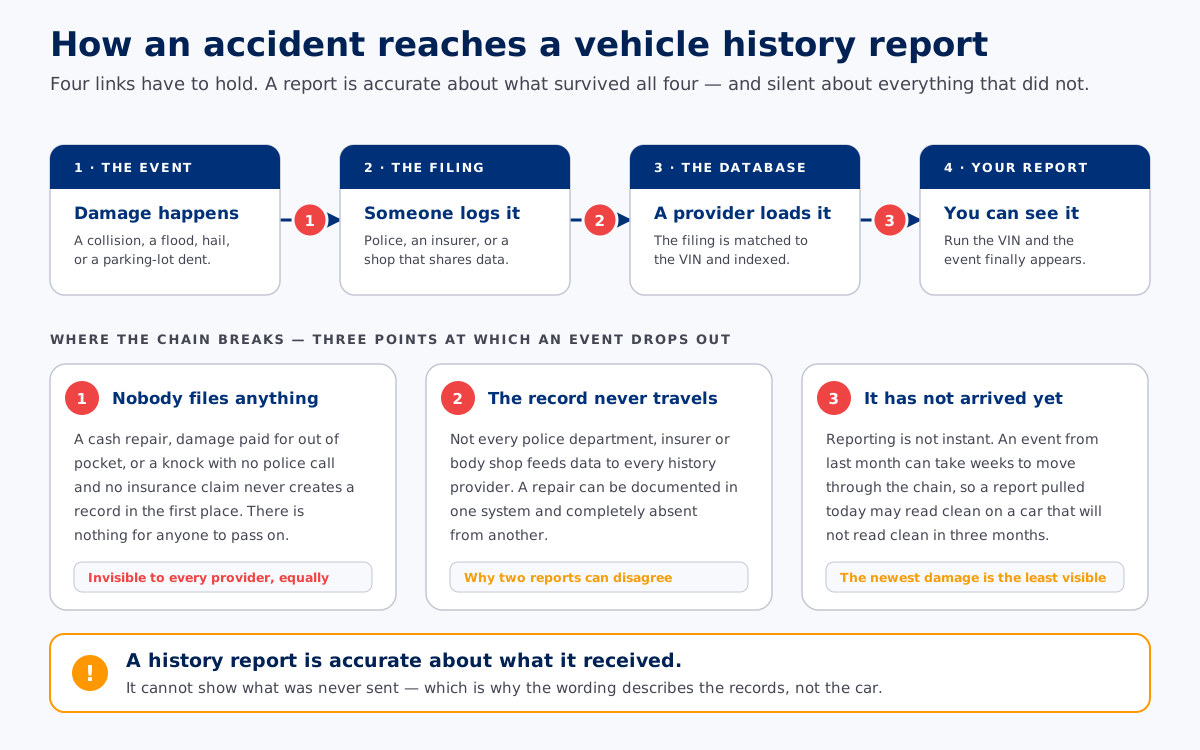
Read the diagram from left to right and the honest limits become obvious. Break one is a cash repair with no claim and no police call: there is nothing to report, so nothing is reported, and no provider anywhere in the market has an advantage. Break two is a filing that exists but never travels — a repair documented in one company's feed and missing from another's, which is exactly why two paid reports on the same VIN can disagree without either being wrong.
Break three is time, and the newest damage is always the least visible. None of the three is a criticism of Carfax specifically; they are properties of a system that runs on voluntary filings.
“No Accidents Reported” Is Not “No Accidents”
This is the single most misread sentence in the used-car market, and the wording is not an accident. Providers write "no accidents reported" rather than "no accidents" because the first is a claim they can stand behind and the second is a claim nobody could make. The phrase describes the contents of a database on the day you looked.
What it genuinely tells you is worth having. It means no qualifying accident record reached that provider's sources for that VIN — no insurance claim, no police report, no reported repair from a participating shop. On a car with a normal history that is a real, checkable fact, and most used cars do have unremarkable pasts.
What it does not tell you is whether the car was ever damaged. A rear quarter panel can be repaired, refinished and blended without any of it becoming a record. The seller may not even be hiding anything — plenty of owners settle a parking-lot scrape privately because a claim would push up their premium, and they have no idea a future buyer will read the absence as innocence.
The practical habit worth building is to read the report as a list of what is known rather than a certificate of what is true. If a line says a total loss was declared, treat that as settled. If a line says nothing was reported, treat that as an absence of evidence and go and get more evidence. See what a reported-accident check does and does not cover.
See What Is Actually on File for That VIN
Enter the 17-character VIN for a free preview of the title, brand, odometer, salvage and total-loss record counts. No card, no account — just what exists, so you know what you are buying before you pay for anything.
Reporting Lag: Why a Recent Event Shows Up Late
Even when every link in the chain holds, it holds slowly. A collision has to be attended, written up, filed, transmitted, matched to the VIN and indexed before it can be printed on anything. Each of those handoffs runs on somebody else's timetable, and none of them is designed around a buyer standing on a dealer lot this afternoon.
The consequence is specific and it catches people out. A report pulled today can read perfectly clean on a car that will not read clean in a few months, because the crash that changes it happened recently enough to still be in transit. Cars damaged and moved on quickly are the ones most exposed to it.
No amount of money spent on a bigger report defeats lag. The defense is a physical inspection, which sees the damage rather than the record of it. If a seller is unusually eager to close before you can arrange one, treat the hurry itself as information.
What Carfax Is Genuinely Strong At
A page that only listed limits would be misleading in the other direction. There are real reasons Carfax became the default name, and they are worth stating plainly.
A large, long-established reporting network
Carfax has been gathering data and signing supply agreements for decades. Breadth of sources is the whole game in this business, and a network built over that long is not something a newcomer can replicate quickly. On a car whose history did get filed, the odds that Carfax holds it are good.
Dealer and service-chain records
Data-sharing agreements with franchised dealers and service chains mean that a car maintained mostly at participating shops can show a genuinely dense maintenance history. That is the clearest thing a paid Carfax adds over a title-and-brand check, and for judging how a car was cared for it is useful.
Recognition at resale
Because buyers and dealers know the brand, a clean Carfax is currency when you come to sell. That is a market fact rather than a data-quality fact, but it is a real reason people buy one.
A readable ownership timeline
Title transfers, the states involved and the dates between them are presented in a way that makes a pattern easy to see. A chain of quick out-of-state transfers reads as a warning far faster in a timeline than in raw records.
None of this is undermined by the reporting-chain limits above. Both things are true at once: a strong network, and a network that still cannot see an event nobody filed. Whether that network is worth its price is a separate question, answered on its own page.
Title Brands and NMVTIS — the Federal Record That Is Hard to Hide
There is one category of record that behaves quite differently from the rest, and it is the one most worth understanding. NMVTIS — the National Motor Vehicle Title Information System, administered by the U.S. Department of Justice — pools title and brand reports from state motor vehicle agencies, insurers, junk yards and salvage auctions. It is a federal title system rather than a commercial product, and reporting into it is a legal obligation for the parties covered, not a courtesy.
That difference in obligation is why title brands are the sturdiest field on any report. A salvage, junk, flood, water-damage, lemon-law buyback or rebuilt brand is applied by a state office and follows the vehicle from state to state and sale to sale. It is far harder to lose than an accident that depended on somebody choosing to file a claim.
It is also the reason a cheaper report is not a weaker report where it matters most. Our own $14.99 report is NMVTIS-backed through a licensed provider, and it reads the same federal title and brand data that sits underneath the expensive ones. Carfax's own published price for a single report is currently around $44.99; what that buys is the proprietary network layered on top, not a different version of the federal record.
If a brand does show up, read what each salvage and rebuilt brand actually means before you decide the car is unbuyable — some are far more serious than others.
Odometer Rollback and How It Is Detected Across Records
Odometer fraud is the clearest illustration of how a history report actually works, because a report does not measure mileage. It collects readings that other people wrote down at particular moments — a title transfer, an emissions test, a state inspection, a service visit at a participating shop — and prints them in order with their dates.
Detection falls out of that sequence rather than from any single number. Mileage on a working car only climbs. A reading that sits flat across two years, or one that is lower than a reading taken before it, is arithmetically impossible and stands out immediately. This is why rollback is one of the frauds a report catches well: the fraudster has to alter a physical dashboard, but the record of what that dashboard said last year is already elsewhere.
The limit is equally clear. If a car has few recorded readings — no inspection requirement in its state, few title transfers, servicing at an independent garage — the sequence is too sparse to contradict anything. A gap in the readings is not evidence of fraud, but it does mean this particular check has less to work with, and the odometer is then something to judge against wear on the pedals, the seat bolster and the steering wheel. Read the mileage sequence for a VIN.
How to Verify a Car Beyond Any Report
Everything above points to the same conclusion: the report is one input, not the decision. These are the checks that see what a database cannot, in the order worth doing them.
Pay for a pre-purchase inspection
This is the highest-value money you will spend on a used car. An independent mechanic on a lift sees repaired structural work, weld marks, replaced panels, fresh undercoating hiding corrosion and evidence of water ingress — none of which required anyone to file anything. If a seller resists an inspection, you already have your answer.
Read the panel gaps
Walk the car and look along each seam. Factory gaps are even and consistent from one side to the other; a hood, door or fender that has been off and refitted rarely lines up quite as well. Uneven shut lines are one of the few signs of past repair that anybody can spot without tools.
Check the paint
In daylight, look along the car at a shallow angle for color or texture changing between adjacent panels, overspray on rubber seals and door shuts, and a finish that is orange-peeled on one fender and smooth on the next. A cheap paint-depth gauge settles it — filler and refinish read far thicker than factory paint.
Compare the mileage against wear
A low odometer reading on a car with a shiny steering wheel, a worn driver's seat bolster and polished pedal rubbers is a contradiction worth explaining. Physical wear is not something a dashboard change can undo.
Confirm the VIN matches the car
Read the 17-character VIN from the driver-side dashboard, then check it against the door-jamb sticker, the title and the registration. All four should match exactly. Every VIN from the 1981 model year is 17 characters, and a real one never contains the letters I, O or Q.
Stack the free public checks
NHTSA's recall lookup shows open safety recalls, which are repaired free of charge at a franchised dealer. The NICB's VINCheck flags a VIN reported stolen and not recovered, or reported as a salvage or total loss by a participating insurer. Both cost nothing and take a minute each.
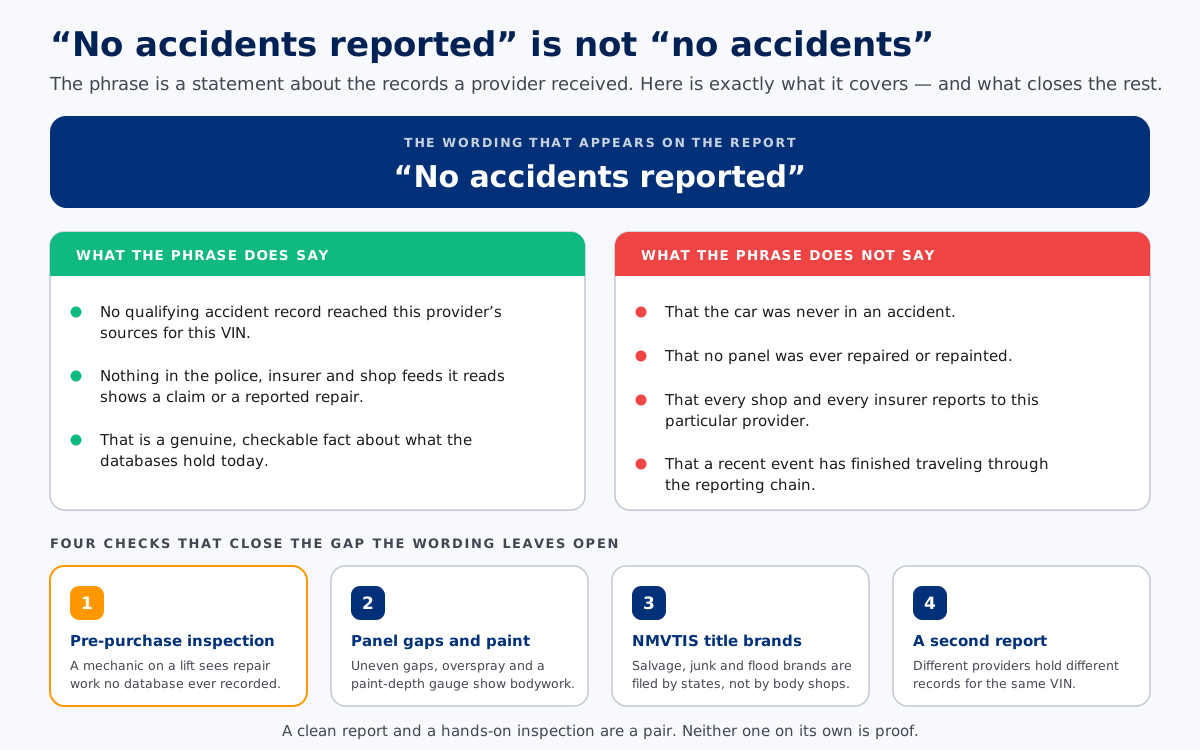
The free public tools are worth stacking because they cost nothing: NHTSA's recall lookup, the NHTSA vPIC decoder to confirm the VIN describes the car in front of you, and NICB VINCheck for theft and total-loss flags from participating insurers.
Why a Second Report From a Different Source Surfaces Different Records
Buyers who run two reports on the same car are sometimes surprised to find the contents do not match, and conclude that one of them must be wrong. Usually neither is. Providers hold overlapping but not identical data, because each has its own set of supply agreements with shops, insurers and auctions. A repair filed into one feed and not another appears on one report and not the other, exactly as the middle break point above predicts.
That is a practical argument for a second opinion on a car you are serious about — and a reason to check that the second report reads a different source rather than reselling the first one. What you are buying is a different set of supply agreements, not another copy of the same file. Who actually holds separate data is worth checking before you buy a second one.
It is also an argument for not spending twice at full price. A free VIN preview here shows the record counts — how many title, brand, odometer, salvage and total-loss entries exist for that VIN — with no card, which on its own often settles the question. If you want the underlying detail, the full NMVTIS-backed report is $14.99, or $35.99 for three, $54.99 for five and $89.99 for ten when you are working through a shortlist of cars.
A second opinion, priced sensibly
- Record-count preview
Free - Full report
$14.99 - Three reports
$35.99 - Ten reports
$89.99
The preview needs no card. Pay only when you want the dates, states and readings behind the counts.
What to Do If You Find a Report Was Wrong
Occasionally a report contains a genuine error — a record attached to the wrong VIN, a mileage figure with a transposed digit, a brand that was later cleared. Providers have correction processes for exactly this, and the sequence below is how to use them.
Gather the documents that contradict it
Get the paperwork that proves the correct version: the title itself, a repair invoice, an inspection certificate with the real reading, or the insurer's letter closing a claim. A dispute supported by documents moves; a dispute supported by an opinion does not.
Take it to the provider and to the source
Report the error to the provider that published it, and separately to whoever originally filed the record — the state agency, the insurer or the shop. Correcting only the provider leaves the bad record upstream, where it will be pulled again by the next report and by every other provider that reads that source.
Re-run the VIN once the correction lands
Corrections take time to propagate through the same chain that carried the original record. Pull a fresh report afterwards and keep a copy, along with the supporting documents, so you can show a future buyer both the correction and what it replaced.
Worth keeping in perspective: an outright error is far less common than an omission. Most of the time a report is not wrong about anything — it simply never received the event you are looking for.
Checks Worth Running Alongside a History Report
Accuracy questions get answered by stacking sources rather than by trusting one. These pages cover the individual checks, and the sibling pages answer the cost and value questions this one deliberately leaves alone.
افحص رقم الشاصي دائماً قبل الشراء
المعاينة المجانية تُظهر علامات سند الملكية وحالة السرقة والاستدعاءات المفتوحة خلال ثوانٍ، وتُشير إلى وجود سجلات حوادث أو عدّاد من عدمه. التقرير الكامل بـ 14.99 دولاراً — دفعة واحدة، بلا اشتراك.
Is Carfax Accurate? Frequently Asked Questions
The questions buyers ask most once they start wondering how much a clean report really proves.
Is Carfax accurate?+
Carfax is accurate about the records it received. It is a long-established market leader with a large reporting network, and the entries printed on a report came from a party that filed them — a state title office, an insurer, a police department or a participating repair shop. What no provider can print is an event that was never reported by anyone. That distinction matters because it means a report can be completely accurate and still be incomplete. Read a clean report as strong evidence rather than as proof, and pair it with a pre-purchase inspection before you buy.
Can a car have an accident that does not show on Carfax?+
Yes, and it is not unusual. If damage was repaired in cash at an independent garage, never claimed on insurance, and never attended by police, there is no record for any provider to collect. The same applies when a repair is logged by a shop that has no data-sharing agreement with that particular provider. None of this indicates a mistake by Carfax — it is a property of a system built on voluntary filings by third parties, and it affects every vehicle history company in the market equally.
Does "no accidents reported" mean the car was never in an accident?+
No, and the wording is careful for that reason. "No accidents reported" means no qualifying accident record reached that provider's sources for that VIN. It does not mean no accident occurred, that no panel was ever repaired or repainted, that every shop and insurer reports to that provider, or that a recent event has finished traveling through the reporting chain. Treat the phrase as an absence of evidence, then go and gather more evidence: an inspection, the panel gaps, the paint and the title brands.
How long does it take for an accident to appear on a vehicle history report?+
There is no fixed interval, because the delay is the sum of several independent handoffs. The event has to be attended and written up, the filing has to be transmitted, and the record has to be matched to the VIN and indexed before it can be printed. Each step runs on a different organization's timetable. The practical consequence is that a report pulled today can read clean on a car that will not read clean in a few months, so a physical inspection is the only reliable defense against very recent damage.
Is Carfax more accurate than other vehicle history reports?+
It is more a question of coverage than accuracy. Providers hold overlapping but not identical data because each has its own supply agreements with shops, insurers and auctions, so a record present in one feed can be absent from another. Carfax's decades-long network is genuinely broad, particularly for dealer and service-chain records. For state-applied title brands, salvage and total-loss records the underlying source is NMVTIS, the federal title system run by the U.S. Department of Justice, and any NMVTIS-backed report reads that same federal data.
How can I check whether a vehicle history report is missing something?+
You cannot detect an omission from inside the report — it looks identical to a car with nothing to hide. You detect it from outside. Book a pre-purchase inspection so a mechanic on a lift can see repaired structural work and replaced panels. Walk the car for uneven panel gaps, overspray and paint that changes texture between panels. Compare the odometer reading against wear on the pedals, seat and steering wheel. Then run a second report from a different data source, because a different set of supply agreements can surface a different set of records.
What should I do if a vehicle history report has wrong information about my car?+
Collect the documents that contradict it — the title, a repair invoice, an inspection certificate or an insurer's closing letter — then report the error both to the provider that published it and to whoever originally filed the record, whether that is a state agency, an insurer or a shop. Correcting only the provider leaves the bad record upstream, where the next report will pull it again. Once the correction propagates, run a fresh report and keep it with the supporting paperwork so you can show a future buyer what changed.
Is a cheaper report less accurate than an expensive one?+
Not for the fields that decide whether a car is safe to buy. Title brands, odometer readings recorded at title events, salvage-auction appearances and total-loss declarations come from NMVTIS, the federally administered title system, and an NMVTIS-backed report reads that same source regardless of price. Our full report is $14.99, and what a higher-priced report buys is the proprietary dealer and service-chain network layered on top, which is useful for judging how a car was maintained — not a different version of the federal record.
Check the Records Before You Trust Them
Enter a 17-character VIN for a free preview of the title, brand, odometer and salvage records on file. Then pair whatever you find with an inspection — that combination is what a report on its own cannot give you.
Title, brand, odometer and salvage records are sourced from NMVTIS via a licensed provider; recall data from NHTSA, and specifications from NHTSA vPIC. No history database is complete; pair any report with a pre-purchase inspection. CarCheckerVIN is not affiliated with Carfax or AutoCheck; those are trademarks of their respective owners.
فحوصات رقم الشاصي ذات الصلة
أدوات إضافية للتحقق من تاريخ أي مركبة