Florida VIN verification — form 82042, explained.
Bringing a car into Florida means someone authorized has to physically inspect its VIN — under the windshield and in the door jamb — and sign HSMV form 82042. Here's who can do it, what the form asks, and the check worth running before you sign an odometer declaration under penalty of perjury.
Check the VIN before you sign for it
Any 17-character VIN → title brands, odometer flags, accident records — free preview.
Free preview · no card, no account
Quick Answer
- What is a Florida VIN verification?
- A physical inspection of the VIN required before Florida will title a vehicle brought in from another state. Someone authorized looks at the VIN under the windshield and in the door jamb, confirms both match your paperwork, and signs HSMV form 82042 — which you submit to your local tax collector office.
- Who can verify a VIN in Florida?
- Five categories, per the form itself: a Florida notary, a Florida licensed dealer, a law enforcement officer, a military police officer, or a Florida compliance examiner/inspector (a Division of Motorist Services or tax collector employee). You cannot verify your own VIN in Part B — the owner only signs the affidavit in Part A.
- What am I actually signing?
- More than people realize. Part A is an odometer declaration made under penalty of perjury, and the form warns that a false statement may result in fines and/or imprisonment. Run the VIN's history before you sign — a rollback you didn't know about still becomes your signature.
Who can legally verify your VIN
Form 82042 names its own authorized verifiers, and a notary heads the list — which is why mobile notary services dominate this search. Any of these five can sign Part B:
A Florida notary
The form's default signer, with a space for the commissioned name, signature and seal. This is why mobile notaries advertise VIN verification across Florida — they can come to the car rather than the car coming to an office.
A compliance examiner or tax collector employee
A Florida Compliance Examiner/Inspector — a Division of Motorist Services or tax collector employee — can verify it when you bring the vehicle to a service center. The form itself is submitted to your local tax collector office either way.
Dealer, law enforcement, or military police
A Florida licensed dealer, a law enforcement officer, or a military police officer may all verify and sign, each with their own line on the form — dealer number, LEO badge number, or examiner badge and ID.
One person who can't sign Part B: you. The owner's job is Part A — the affidavit and odometer declaration, which the form says requires your own physical inspection of the vehicle first.
What form 82042 actually asks for
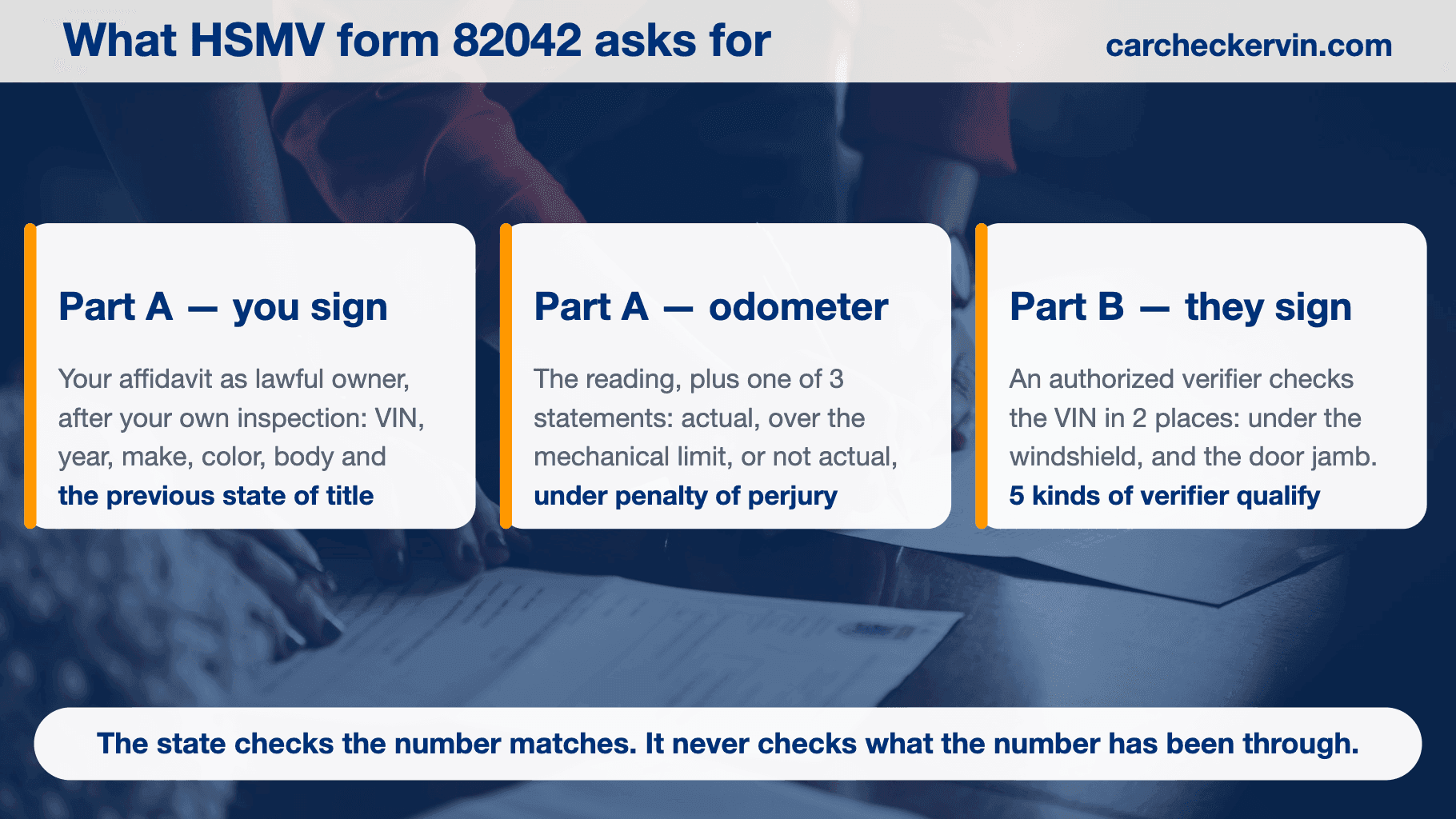
The form is two halves that do different jobs, and reading it before you show up saves a second trip:
The owner's affidavit
You certify you're the lawful owner and have physically inspected the vehicle, then record the VIN, year, make, color, body type and the previous state the vehicle was titled in.
The odometer declaration
A 5- or 6-digit reading plus exactly one of three statements: the reading reflects actual mileage, exceeds its mechanical limits, or is not the actual mileage. Federal and state law require it; a false statement can mean fines or imprisonment.
The physical VIN inspection
Your verifier certifies they inspected the VIN under the windshield and in the door jamb and found both identical to the number on the form. Vehicles built before 1955 have the motor number verified instead.
The signature block
Notary name, signature and seal — or, if someone else verified, a checked box and details for the dealer, law enforcement officer, military police officer, or compliance examiner who did.
Two practical notes printed on the form: it goes to your local tax collector office, and any alteration or erasure may void the document. Fill it in carefully or start a fresh copy.
When Florida requires it
The rule is about where the vehicle was last titled, not how new it is:
Any used vehicle not currently titled in Florida
The form's own scope line: complete Part B on all used motor vehicles not currently titled in Florida — which is what makes this the standard step for anyone moving in with a car or buying one out of state.
Trailers at 2,000 pounds or more
Trailers count too. The form specifies trailers with a weight of 2,000 pounds or more, abbreviated 'TL', are included in the same requirement.
As part of the titling packet
FLHSMV allows the verification on either HSMV 82042 or the title application itself (HSMV 82040). For a vehicle without a lien, the packet also wants proof of identity for all owners, proof of Florida insurance, and the original out-of-state title.
Before you certify anything, read the record
Title brands, odometer history and accident records for any VIN — free preview, no card.
New to Florida? Two clocks start immediately
FLHSMV counts you as a Florida resident once you start work here, enrol children in public school, register to vote, file for a homestead exemption, or simply live in the state more than six consecutive months. From that point you have 30 days to get a Florida driver license, and 10 days to title and register your vehicles — with Florida insurance from a Florida-licensed agent already in place, because you need it to title and register at all. The VIN verification sits inside that 10-day window, which is why booking a mobile notary or a service-center appointment early matters more than the fee.
Sources: HSMV form 82042 (rev. 01/15/21) and FLHSMV's New Resident pages, both read August 23, 2026. State requirements change — the form and flhsmv.gov are the authority.
The odometer line is the one that bites
Everything else on 82042 is transcription. This part is a legal statement about a number you may have inherited from a seller:
Signed under penalty of perjury
The form states plainly that federal and state law require the mileage disclosure, and that failing to complete it or providing a false statement may result in fines and/or imprisonment. You're not just copying a dashboard number.
"Actual mileage" is a claim, not a reading
Ticking box one says the reading reflects actual mileage. If the car was rolled back before you bought it, that statement is now yours — made in writing, to the state, at the moment you title the car in Florida.
Check the recorded history first
An NMVTIS-backed report shows the odometer readings on file in sequence, along with title brands from every state. If a recorded reading is higher than today's dash, you know before you sign — not after.
Titling a car in Florida — the rest of it
The neighbouring steps, each with its own page.
افحص رقم الشاصي دائماً قبل الشراء
المعاينة المجانية تُظهر علامات سند الملكية وحالة السرقة والاستدعاءات المفتوحة خلال ثوانٍ، وتُشير إلى وجود سجلات حوادث أو عدّاد من عدمه. التقرير الكامل بـ 14.99 دولاراً — دفعة واحدة، بلا اشتراك.
Florida VIN verification — asked and answered
Straight answers, taken from the form and FLHSMV's own pages.
What is a VIN verification in Florida?+
It's a physical inspection confirming that the vehicle identification number on the car matches the number on your paperwork, required before Florida will title a vehicle that isn't currently titled in the state. An authorized person inspects the VIN under the windshield and in the door jamb, certifies they found both identical to the number recorded, and signs HSMV form 82042 — the Vehicle Identification Number and Odometer Verification — which is submitted to your local tax collector office.
Who can perform a VIN verification in Florida?+
Form 82042 lists five categories. A Florida notary is the default signer, with a block for the commissioned name, signature and seal. If someone other than a notary performs it, the form allows a Florida licensed dealer, a law enforcement officer, a military police officer, or a Florida compliance examiner/inspector — a Division of Motorist Services or tax collector employee. The vehicle's owner completes Part A but cannot sign the Part B verification.
Which form do I need — 82042 or 82040?+
Either can carry the verification. FLHSMV states the physical VIN inspection may be completed on the Application for Certificate of Title With/Without Registration (HSMV 82040) or on the separate Vehicle Identification Number and Odometer Verification (HSMV 82042). The standalone 82042 is the practical choice when a notary or officer verifies the car before you sit down to file the title application.
Does a Florida VIN verification cost anything?+
The form itself is free to download from FLHSMV, and a compliance examiner verifying it while you're at a service center is part of that visit. What varies is convenience: mobile notaries who travel to your vehicle set their own fees, which is a private service charge rather than a state fee. We quote only what the state publishes, so ask your notary or county tax collector office for the current figure.
Which vehicles need it?+
The form's scope line covers all used motor vehicles not currently titled in Florida, which is why it applies to anyone moving into the state with a car or buying one from out of state. Trailers are included when they weigh 2,000 pounds or more. Vehicles manufactured before 1955 are handled slightly differently: the motor number is verified instead of a modern VIN.
How long do I have to do this after moving to Florida?+
FLHSMV treats you as a resident once you start work in the state, enrol children in public school, register to vote, file for a homestead exemption, or live here more than six consecutive months. From then you have 10 days to title and register your vehicles and 30 days to obtain a Florida driver license, and you need Florida insurance from a Florida-licensed agent in order to title and register at all. The VIN verification has to happen inside that 10-day window.
Why check the vehicle's history before the verification?+
Because Part A of the form is an odometer declaration you sign under penalty of perjury — the form warns that a false statement may result in fines and/or imprisonment — and ticking "reflects actual mileage" makes a previous owner's rollback your written statement to the state. A $14.99 NMVTIS-backed report, or $13.49 with the one-time VIN10 code, shows the recorded odometer readings in sequence and any title brands from other states. The free preview shows whether such records exist at all, before you pay anyone.
Verify the paperwork. Then verify the past.
The state checks that the VIN on the car matches your form. It doesn't check what that VIN has been through — that's a free preview, and a $14.99 full report when it matters.
فحوصات رقم الشاصي ذات الصلة
أدوات إضافية للتحقق من تاريخ أي مركبة