Form 130-U — the Texas title application, box by box.
Form 130-U is the Application for Texas Title and/or Registration, the form every private buyer in Texas fills out to put a car in their name. It goes to the county tax assessor-collector with the signed title, proof of insurance if you're registering, and the tax: 6.25% of the price less any trade-in. The 38 boxes ask for the vehicle, you, any lender and the money. Here is what each one wants, the fees printed on the form, and the 30-day deadline that comes with penalties, from TxDMV's own form and instructions.
Check the Car Before You Sign the 130-U
Box 1 is the VIN. Enter it here first for a free preview of the title brands, salvage records and odometer readings on file.
Free preview · No sign-up · No owner or personal data
Quick Answer
- What is Form 130-U?
- TxDMV's Application for Texas Title and/or Registration (Rev 05/26). You use it to apply for a Texas title and registration, a title only, registration only (Registration Purposes Only) or a nontitle registration, and to correct a title record. It goes to your county tax assessor-collector with the assigned title, the fees, proof of insurance if registering, and any motor vehicle tax due.
- Where and when do I file Form 130-U?
- At a county tax assessor-collector's office, within 30 days of the sale: in the county where the sale happened, where the lienholder is, where you live, or any county willing to accept it. The tax is due within 30 days of purchase; after that a 5% penalty applies, then 10%, and a delinquent transfer penalty of up to $250.
- Does the seller have to sign Form 130-U?
- The form has a signature block for the seller, donor or trader, and TxDMV accepts the seller's signature reproduced or faxed. The buyer's signature must be original. Every applicant also needs one of the government photo IDs listed in Box 15.
Five parts of the form, in order
The boxes run top to bottom in the order the county will check them.
- 1Pick the application typeTitle & Registration, Title Only, Registration Purposes Only, or Nontitle Registration.
- 2Boxes 1–12: the vehicleVIN, year, make, body, model, colors, plate, odometer and its brand, weight and carrying capacity.
- 3Boxes 13–29: youApplicant type, photo ID, legal name, address, county, the seller, and optional contact details.
- 4Boxes 30–34: any lienThe lender's name and address, or "NONE"; an e-title needs the 11-digit lienholder ID.
- 5Boxes 35–38: the moneyTrade-in, the tax computation, any special tax, and the signatures.
What Form 130-U Is For
Form 130-U, the Application for Texas Title and/or Registration, is how a vehicle gets a Texas title in a new owner's name. TxDMV's current version is Rev 05/26. The form "must be completed and submitted to a county tax assessor-collector's office" along with the application fee, supporting documents, any registration fee and any motor vehicle tax due. It can be reproduced or faxed, but the buyer's signature must be original; the seller's may be a copy. Every title application must include one of the photo IDs listed in Box 15.
A separate document, Form VTR-130-UIF, gives box-by-box instructions, and this page follows it. Two other forms come up often alongside it: Comptroller Form 14-317 for a $10 gift transfer, and Form VTR-267 if there is more than one lien. For the fees and tax in your own county, our Texas tax, title and license calculator does the arithmetic; this page explains what the form is asking for.
The Four Application Types
The first choice on the form, from Form 130-U page 2 (Rev 05/26).
| Type | Use it when | What to know |
|---|---|---|
| Title & Registration | You're titling and registering the car in Texas | The usual choice after a purchase |
| Title Only | You want the title but won't register it | Surrender earlier plates and stickers where required; not for golf carts, farm equipment, construction machinery or a suspended or revoked title |
| Registration Purposes Only | You want Texas registration but keep an out-of-state title | Don't surrender the out-of-state title; no Texas title is issued; foreign vehicles attach DOT HS-7 or Customs CF-7501 |
| Nontitle Registration | Certain trailers, farm equipment, machinery | Registration without a title; a lien can't be recorded |
A corrected title or registration uses the same form: tick the reason (vehicle description, add or remove a lien, or other).
Form 130-U Box by Box
What each group of boxes asks for, from TxDMV's detailed instructions (VTR-130-UIF, Rev 05/26).
| Boxes | What goes in them | Watch for |
|---|---|---|
| 1–8 | VIN, year, make, body style, model, major and minor color, Texas plate | The VIN must match the title and the car; Form VTR-249 lists the body-style codes |
| 9–10 | Odometer reading and its brand | Whole miles, no tenths; tick Not Actual, Exceeds Mechanical Limits or Exempt exactly as the seller disclosed |
| 11–12 | Empty weight and carrying capacity | Empty weight in pounds, rounded up to the next 100 |
| 13–15 | Applicant type, photo ID number or FEIN/EIN, ID type | Individual, business, government, trust or non-profit |
| 16–19 | Applicant and co-applicant legal names, mailing address, county of residence | Legal names, not nicknames |
| 20–22 | Previous owner (the seller), dealer GDN, fleet unit number | The seller's name as it appears on the assigned title |
| 23–29 | Renewal recipient, phone, email, military status, communication impediment, vehicle location | Mostly optional; a communication impediment needs Form VTR-216 |
| 30–34 | Additional liens, e-title request, lienholder ID, first lien date, first lienholder | Write "NONE" if there's no lien; an e-title needs the 11-digit lienholder ID and can't be combined with Box 30 |
| 35–37 | Dealer or lessor tax statement, trade-in, additional trade-ins | Box 35 is for dealers, lessors and rental companies only |
| 38 | Sales and use tax computation and special taxes | Price, trade-in, taxable amount, tax, any penalty, tax paid elsewhere |
Signatures go at the bottom: the seller, donor or trader; the applicant; and any additional applicants, each with a printed name and date. Falsifying information is a third-degree felony.
Form 130-U Tax and Fees at a Glance
Every tax, fee and penalty printed on the form, on one card.
From TxDMV Form 130-U and its instructions (Rev 05/26), read on the date shown.
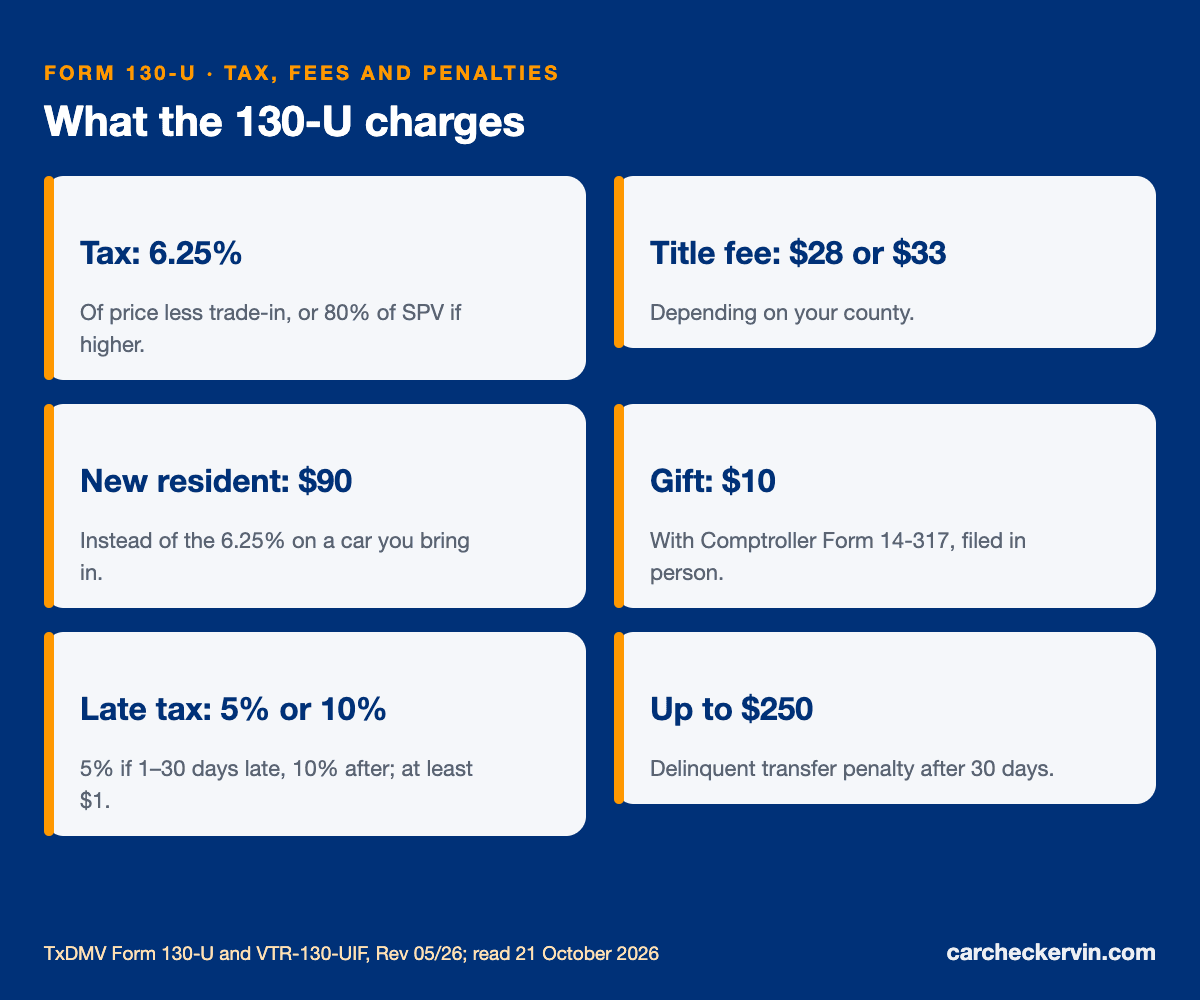
The Tax and Fees on Form 130-U
Printed on Form 130-U, Rev 05/26, read on 21 October 2026. Your county adds its own registration fees.
| Item | Amount | When it applies |
|---|---|---|
| Motor vehicle sales and use tax | 6.25% | Price less trade-in, for vehicles used in Texas or brought in by a Texas resident |
| Standard presumptive value (SPV) | Tax on the greater of the price or 80% of SPV | Private-party sales of most used vehicles |
| New resident tax | $90 | A vehicle you registered in another state or country before moving here, instead of the 6.25% |
| Even trade tax | $5 | Two vehicles traded with no money changing hands |
| Gift tax | $10 | A gift from immediate family, a guardian, an estate or a 501(c)(3); needs Form 14-317, filed in person |
| Rebuilt salvage fee | $65 | Titling a rebuilt salvage vehicle |
| Title application fee | $28 or $33 | Every title application; your county tax office tells you which |
| Registration transfer fee | $2.50 | Moving current registration to the new owner |
| Diesel emissions fee | 2.5% or 1% | Diesels over 14,000 lb: 1996 and older, or 1997 and newer |
| Late tax penalty | 5%, then 10%; at least $1 | 1–30 days late, then more than 30 |
| Delinquent transfer penalty | Up to $250 | No title application within 30 days of the title assignment |
A transfer with no payment that doesn't qualify as a gift is taxed as a sale, on the standard presumptive value.
Filling In Box 1? Check That VIN First
The 130-U is the moment the car becomes yours on paper. Enter the VIN for a free preview of the title brands, junk and salvage records and odometer readings on file before you file it.
Who Signs, and Where It Goes
Three signature blocks close the form: the seller, donor or trader; you as applicant; and any additional applicants. TxDMV accepts a reproduced or faxed seller signature, but the buyer's must be original. Each signer prints their name and dates it, and the certification above the signatures warns that state law makes falsifying information a third-degree felony. If you physically inspected the car and verified its VIN, there's a box for that too.
Then take it, with the properly assigned title and proof of insurance in your name if you're registering, to a county tax assessor-collector's office. The instructions allow the county where the sale took place, where the lienholder is located, where you live, or any county willing to accept it. You have 30 days from the date of sale. New Texas residents also have 30 days from establishing residency, and their vehicle's VIN must be verified first, either through an emissions inspection at a state-appointed station or by self-certifying on this form.
Bring with the 130-U
- The title: properly assigned to you.
- Photo ID: one of the types in Box 15.
- Insurance: in your name, if registering.
- Payment: title fee, registration, tax.
Mistakes That Send a 130-U Back
Each one comes straight from the form or its instructions.
Tenths on the odometer
Box 9 takes whole miles only. And Box 10's brand must match what the seller disclosed on the title.
A VIN that doesn't match
Box 1 must be the VIN on the title and on the car: the door frame, the dashboard, or the engine block on some older vehicles.
Blank lien box
If there's no lien, Box 34 says "NONE". An e-title request in Box 31 needs the lender's 11-digit ID in Box 32.
A gift by mail
The $10 gift tax needs Comptroller Form 14-317 signed by both sides, and the application must be filed in person.
Surrendering the wrong title
On a Registration Purposes Only application, don't hand in the out-of-state title. No Texas title is issued.
Filing on day 31
The tax becomes late after 30 days, and a delinquent transfer penalty of up to $250 can follow.
Title & Registration or Title Only
The most common choice on the form, and the one with consequences.
Title & Registration
- Puts the car in your name and lets you drive it.
- Needs proof of insurance in your name.
- Registration fees on top of the $28/$33 title fee.
- A $2.50 fee moves current registration to you.
Title Only
- Puts the car in your name without registering it.
- Plates and stickers are surrendered if required.
- Not available for golf carts, farm equipment or construction machinery.
- Not available on a suspended or revoked title.
If you'll drive the car on Texas roads, you need registration as well as the title.
Related Checks and Guides
The Texas fee calculator, the other Texas title pages, and the California form guides.
Where These Facts Come From
From TxDMV's Form 130-U and its detailed instructions, Rev 05/26, read on 21 October 2026. Fees change; confirm with your county tax assessor-collector before you file.
CarCheckerVIN is not affiliated with the Texas Department of Motor Vehicles or any county tax office, and does not file title applications. This page is general information, not legal advice.
Form 130-U — Frequently Asked Questions
What Texas buyers ask most about the title application.
Do I need Form 130-U if I have the title and a bill of sale?+
Yes. The signed title is your proof of ownership; the 130-U is the application that asks the state to issue a title, and registration, in your name. It's submitted with the assigned title to the county tax assessor-collector.
How much does it cost to file Form 130-U?+
The title application fee is $28 or $33 depending on the county, plus 6.25% tax on the price less trade-in (or $90, $5 or $10 in the special cases), plus registration fees if you're registering, and $2.50 to transfer current registration.
What is standard presumptive value on Form 130-U?+
For most private-party sales of used vehicles, Texas taxes the greater of the sales price or 80% of the vehicle's standard presumptive value on the day you apply. It stops a low price written on the title from lowering the tax.
Can someone else file my Form 130-U?+
The form itself sets no agent rule: it needs the buyer's original signature and one of the photo IDs listed in Box 15, so ask your county tax office before sending someone in your place. A gift-tax application is different: it must be filed in person by the donor or the recipient.
What happens if I file Form 130-U late?+
A late tax penalty of 5% if the tax is paid 1–30 days late and 10% after that, at least $1, plus an escalating delinquent transfer penalty of up to $250 for not applying within 30 days of the title assignment.
Is Form 130-U the same as VTR-130-U?+
TxDMV publishes the application as Form 130-U, currently Rev 05/26, with separate instructions numbered VTR-130-UIF. Older copies circulating online carry earlier revision dates; get the current one from TxDMV's forms page.
Run the VIN Before Box 1
Enter any 17-character VIN for a free preview. The full report lists title brands, NMVTIS junk and salvage records, insurance total-loss records, odometer readings, and auction records with the damage the auction recorded and its photos.
CarCheckerVIN is an independent vehicle-history service and is not affiliated with the Texas Department of Motor Vehicles. This guide summarizes TxDMV's published Form 130-U and its instructions and is not legal or tax advice. Records in our reports reflect what was reported to our data providers. Our reports do not include police or repair-shop accident entries.
فحوصات رقم الشاصي ذات الصلة
أدوات إضافية للتحقق من تاريخ أي مركبة