Free VIN check in Germany: what you can look up, and what costs money
Buying a car in Germany without reading German is doable — if you know what a VIN can tell you here, what the registries will never tell you, and which piece of paper the seller has to hand over. This is that guide. The free part starts in the box below.
Enter the VIN — decode and recall check are free
Make, model, plant and engine right away, and whether any records exist for this car before you pay for anything.
No account · Nothing stored · €19.95 only for the full report
Quick Answer
- Is there a free VIN check in Germany?
- Yes, for three things: the decode (make, model, plant, engine), the Kraftfahrt-Bundesamt's recall database, and — with us — a preview of whether anything is on file for that VIN. The history itself (accidents, mileage readings, theft, previous registrations) comes from paid registry queries, with every provider.
- Can I find the owner from a German VIN?
- No. Under § 39 StVG, the registration office and the KBA release keeper data only to someone who states a legal claim arising from road traffic — an accident, for instance. Wanting to buy the car is not a claim. Any site promising a German owner's name for a VIN is promising something it can't legally deliver.
- German car or import — does it matter?
- A lot. A German car from one owner with a stamped service book leaves almost no trace in registries, so a history report stays thin. A car that has lived in several EU countries leaves a trail in each. A US or Canadian import carries a title history — salvage, rebuilt, flood, auction — that never reached any European registry; that's where a NMVTIS-backed report earns its price.
What "free VIN check" means in Germany — and where the line is
Every provider draws the same line, whether or not they say so. What's in the number itself, or in a public official database, can be given away. What happened to the car since it left the factory lives in registries, insurers' files and inspection records — each query carries a licence fee, so the history costs money everywhere. A site that appears to give it away is paid some other way.
Free
- Decode the VIN: make, model line, plant, enginehere, or any decoder
- Open recalls for the vehiclethe KBA recall database (official, free)
- EU safety alerts for the modelSafety Gate, shown in our preview
- See whether anything is on file for this VINour preview, before you pay
- Match the VIN on the car to the registration certificateyourself — field E, Teil I
In the report — or not at all
- Reported accidents and damageregistry and insurer records, licensed
- Recorded mileage readingsinspection and service records — this is how rollbacks show
- Theft check, previous registrations by countryregistry queries with licence fees
- US title status on imports (salvage, rebuilt, flood)the US federal NMVTIS database
- The keeper's name or addressnot available to buyers anywhere — § 39 StVG
Why no site can tell you who owns a German car
If you're used to US or UK services, this is the biggest difference. Keeper data sits in the central vehicle register at the Kraftfahrt-Bundesamt and with the local registration offices, and § 39 of the Road Traffic Act (StVG) says who gets it: someone who, quoting the plate or the VIN, shows they need the data to pursue, secure or defend a legal claim arising from road traffic — the "einfache Registerauskunft". Wanting to buy the car is not a claim.
So a legitimate report will tell you how many previous registrations there were, and sometimes in which countries, but never a name. Any service promising a German owner for a VIN is promising something it cannot legally deliver — treat that as a signal about the service, not about the car.
The three pieces of paper, and where the VIN is on them
German sellers still use the old names. Here is what each document is, what it proves, and what it doesn't.
Zulassungsbescheinigung Teil I
The registration certificate — what older listings still call the Fahrzeugschein. The VIN is in field E. It must match the number stamped on the car to the last character. It stays in the car; the seller should show it before anything else.
Zulassungsbescheinigung Teil II
The ownership document (formerly Fahrzeugbrief). Whoever holds it can register the car. A seller who can't produce Teil II may be selling a financed car or one that isn't theirs — walk away or wait.
Scheckheft and HU report
The stamped service book and the last Hauptuntersuchung (TÜV/DEKRA) report with its recorded mileage. Together with the VIN decode, these cover the German chapter of the car's life. What they don't cover is anything that happened abroad.
Decode first. Decide after.
The preview shows what the number says and whether any records exist for this car. No records, no report, no charge.
Reading a German VIN: 17 positions, one trap
The layout is the same worldwide (ISO 3779). The trap is the check digit, which online calculators treat as universal. It isn't.
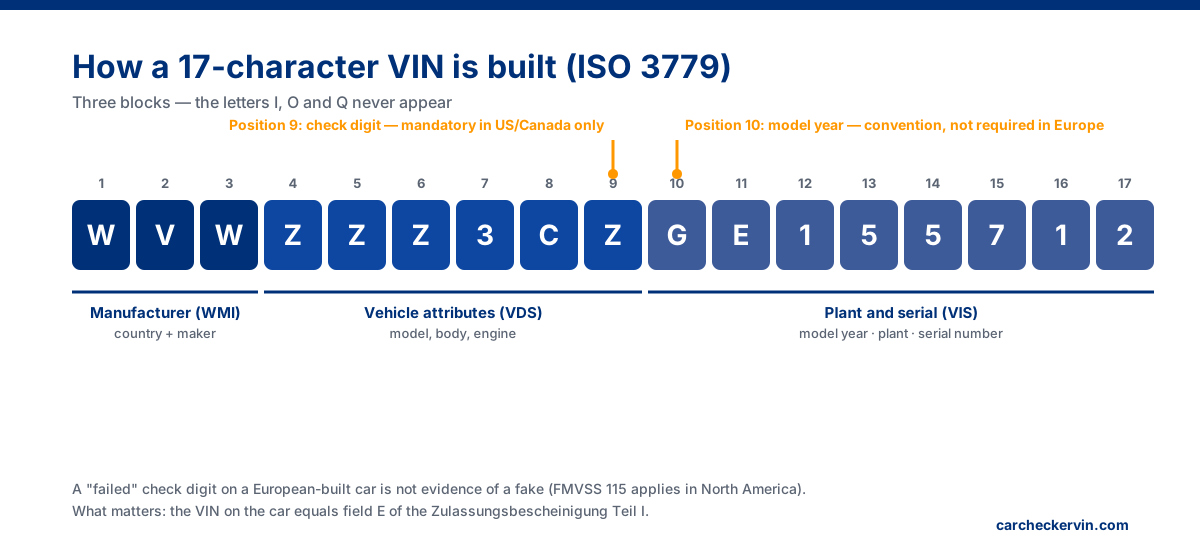
Position 1–3
WMI — manufacturer
Country and maker. W is Germany. A prefix that doesn't match the badge ends the check right there.
Position 4–9
VDS — vehicle attributes
Model line, body, engine, restraint system — each maker uses these six positions differently; German makers often pad with Z.
Position 9
Check digit — North America only
Mandatory in the US and Canada (FMVSS 115). A German-built car will routinely "fail" an online check-digit calculator and still be genuine.
Position 10–17
VIS — plant and serial
Position 10 carries the model year in North America (common but not required in Europe), 11 the plant, 12–17 the serial.
How to check a VIN in Germany, in three steps
The order matters: the free part first, then a decision about whether the paid part is worth it for this particular car.
1
Read the VIN off the car, then off the paper
Stamped in the engine bay or under the boot floor, on the B-pillar plate, and behind the windscreen. Then field E of Teil I. All must agree. A one-character difference is the signature of a cloned car, not a typo.
2
Decode it and check recalls — free
Enter it here for make, model, plant and engine, and to see whether anything is on file. Check open recalls in the KBA database. Compare the decode with the listing: a "2.0 TDI" whose VIN says 1.6 is a conversation to have before the test drive.
3
Decide whether the history is worth the report
If records exist — imports and multi-country cars especially — the full report shows them for €19.95, once, no subscription. If nothing is on file, keep the money and book the inspection instead.
When the paid report is worth it — and when it will be thin
Whether a history report shows anything depends less on the provider than on where the car has been. Three cases, three very different hit rates.
German car, one owner, full Scheckheft
The paperwork covers nearly everything. A VIN check here is mostly about authenticity; the history report will likely be thin, and that is good news about the car.
Car that has lived in several EU countries
Each registration and each reported claim sits in a different national registry. This is where a European history report most often shows something the German papers don't.
US or Canadian import
Salvage, rebuilt and flood titles, auction sales and odometer readings live in NMVTIS and never crossed the Atlantic. A German HU stamp says nothing about a car that was written off in Florida.
The report costs €19.95, once, no subscription, and shows what has been recorded for the car — only that. If nothing was ever recorded, it stays thin, which is good news about the car rather than bad news about the report. That is why the preview comes first: you see whether records exist before you pay. Taking a car out of Germany? Export plates (Ausfuhrkennzeichen) are covered separately, in German.
Five things that should stop the purchase until they're explained
- The VIN on the car differs from field E of the Teil I — even by one character
- The seller can't produce the Teil II, or offers to "send it later"
- The decode returns a different engine or model line than the listing
- The HU report's mileage is higher than what the odometer shows now
- The report shows a foreign registration the seller never mentioned
Sources
The statute, the official database and the standard — the three things that hold regardless of which provider you use.
§ 39 StVG — transmission of vehicle and keeper data
The legal basis for owner lookups in Germany: only via the registration authority or the KBA, and only on a stated legal claim. Read 2026-09-16.
Kraftfahrt-Bundesamt — recalls and the recall database
The official, free recall check, independent of any commercial report.
ISO 3779 — vehicle identification number structure
The standard behind the 17 positions: WMI, VDS, VIS, and the exclusion of I, O and Q.
NMVTIS — consumer portal (USA)
The US federal title and odometer database our report draws on for imported vehicles.
Read next
VIN checks in Germany — common questions
What exactly is free when I check a VIN in Germany?
The decode — make, model line, plant, engine — plus the Kraftfahrt-Bundesamt's recall database, EU Safety Gate alerts for the model, and with us a preview showing whether any records exist for that VIN. Everything after that, the history itself, comes from licensed registry queries and costs money with every provider.
Can I look up the owner of a car in Germany by VIN or plate?
Not as a buyer. § 39 StVG lets the registration authority and the KBA release keeper data only to someone who states a legal claim arising from road traffic — for example after an accident. A history report shows how many previous registrations there were, and sometimes in which countries, but never a name or address.
My VIN fails the check-digit calculator. Is the car fake?
Probably not. The calculated check digit in position 9 is a North American rule (FMVSS 115). European manufacturers use that position differently, so a car built in Wolfsburg or Stuttgart routinely "fails" online calculators while being entirely genuine. What matters is that the VIN on the car matches field E of the registration certificate.
What is the difference between Teil I and Teil II?
Zulassungsbescheinigung Teil I is the registration certificate (the old Fahrzeugschein) — it lives in the car and carries the VIN in field E. Teil II is the ownership document (the old Fahrzeugbrief) — whoever holds it can register the car. A private seller must hand you both; a missing Teil II usually means a financed or disputed car.
The car is a US import. Will a German check show its American history?
No German document will. Salvage and rebuilt titles, insurance write-offs, auction sales and odometer readings from the US live in the federal NMVTIS database and never reach a European registry. That is exactly what our report retrieves for imported vehicles, and it's the case where a report is most likely to change a decision.
Do I still need a TÜV or DEKRA inspection if the report is clean?
Yes. A data report cannot see rust, hear an engine or spot a badly repaired front end, and privately repaired damage never enters any database. A clean report is a good sign about the car's recorded past; the inspection covers its physical present. They answer different questions.
What does the report cost, and is it a subscription?
€19.95 in Europe, paid once, no subscription. It includes the vehicle data and — where recorded — accident and damage records, theft check, mileage readings and a market value; for US imports, the NMVTIS title history. The decode, recalls and the preview before it are free.
Check the number before you check the car.
Decode and recalls are free. The full report with the car's recorded history costs €19.95 — once, no subscription, delivered instantly.
No auto-renewal · No hidden fees
فحوصات رقم الشاصي ذات الصلة
أدوات إضافية للتحقق من تاريخ أي مركبة