Honda Pilot Years to Avoid — the stalling years and the safe bets.
Skip the 2016 and 2017 Pilot if you can: they drew 1,730 and 942 complaints to NHTSA, the two highest totals of any year, and 537 describe the engine stalling or shutting off. Older Pilots from 2003 to 2005 come next, for transmissions.
Found a Pilot You Like?
Enter its VIN for a free preview of title brands, salvage and total-loss records and odometer readings before the test drive.
Free preview · No sign-up · No owner or personal data
Quick Answer
- What Honda Pilot years should you avoid?
- The 2016 and 2017. They drew 1,730 and 942 NHTSA complaints, and 312 and 225 of them describe the engine stalling or shutting off, often when the auto idle-stop should have restarted it. The 2019 (929) is next. Among older Pilots, the 2003–2005 drew 435 complaints naming the transmission.
- What are the best years for a used Pilot?
- Among Pilots from 2004 to 2021, 2015 (109), 2010 (111), 2014 (116) drew the fewest complaints. Owners in the comments below name the 2013–2015 most often, and the 2015 drew 109 against 1,730 for the 2016 that replaced it.
- Do 2009–2015 Pilots burn oil?
- Some owners say theirs did, and blame VCM, the system that shuts off cylinders to save fuel. NHTSA's records are much quieter: of 1,209 complaints on 2009–2015 Pilots, 39 describe oil burning and 43 name VCM. Check the oil level and ask how often it is topped up.
Five checks for a used Pilot, whatever the miles
Owners in the comments below report Pilots past 300,000 miles. The year tells you what to look for; these checks tell you whether this one has it.
- 1Read the year from the VINThe 10th character is the model year; a 2016 and a 2018 look much the same.
- 22016–2019: let it restart at a stopLet auto idle-stop shut the engine off, then make sure it fires straight back up.
- 32009–2015: check the oil levelA low dipstick between changes is the oil use owners blame on VCM.
- 4Salt-belt cars: look under the rearRecall 26V365000 covers rear subframe corrosion on 2016–2022 Pilots.
- 5Check title and mileage recordsThe recorded mileage should only ever go up; a gap is worth a question.
Avoid: the 2016 and 2017 Pilot
The third-generation Pilot arrived for 2016, and the complaint count jumped from 109 for the 2015 to 1,730 for the 2016, the most of any Pilot year. The engine is the component owners named most (784 complaints). The 2017 drew 942, still the second-highest.
312 of the 2016's complaints and 225 of the 2017's describe the engine stalling, dying or shutting off. 277 and 215 mention the auto idle-stop, which turns the engine off at a light and should start it again as you pull away; owners describe it not restarting and leaving them stuck in traffic. Another 92 complaints on the 2016 and 55 on the 2017 mention fuel injectors.
The 2018 drew fewer (443), but the 2019 climbed back to 929, with the electrical system named most. If you want a third-generation Pilot, the later years have had less time to collect complaints, so check any you are offered on its own merits.
What the 2016–2019 complaints say
- 312 · 225 · 83 · 127 complaints on the 2016, 2017, 2018 and 2019 describing the engine stalling or shutting off.
- 492 on the 2016–17 mention the auto idle-stop system.
- Recall 23V751000: 2016 and 2018–2019 Pilots, a connecting rod bearing that may wear and seize; dealers inspect the engine and replace it if needed.
- Recall 17V219000: 2016 Pilots with fuel tanks that may leak; dealers replace the tank.
Do 2009–2015 Pilots Burn Oil? Owners and NHTSA Disagree
Ask Pilot owners online about the second generation and the answer is oil. Several commenters below say their 2009–2012 Pilot uses oil, one from around 100,000 miles, and blame VCM, the variable cylinder management that shuts down cylinders on a light throttle. Some fitted plug-in devices that keep it from switching on; one says Honda's answer was new piston rings.
NHTSA's records are far quieter. Of the 1,209 complaints filed on 2009–2015 Pilots, 39 describe oil burning and 43 name VCM. A complaint count only shows who filed one, so the oil reports may be real and simply unfiled. On paper, though, the whole seven-year generation drew fewer complaints than the 2016 alone.
If you are looking at a 2009–2015, ask how often it needs oil between changes, pull the dipstick, and ask whether it has had misfire codes or new spark plugs; oil-fouled plugs and misfires are the signs owners describe.
Every Honda Pilot Model Year Compared
NHTSA complaints and recall campaigns for every Pilot from 2003 to 2026, read from NHTSA's public records on 12 November 2026. The component is the one owners named most.
| Year | Generation | Complaints | Crash · fire reports | Recalls | Most-cited component |
|---|---|---|---|---|---|
| 2003 | 1st | 746 | 43 · 12 | 14 | Power Train |
| 2004 | 1st | 544 | 29 · 14 | 13 | Power Train |
| 2005 | 1st | 679 | 42 · 8 | 15 | Power Train |
| 2006 | 1st | 268 | 23 · 7 | 10 | Air Bags |
| 2007 | 1st | 211 | 9 · 5 | 9 | Air Bags |
| 2008 | 1st | 133 | 11 · 3 | 9 | Air Bags |
| 2009 | 2nd | 134 | 9 · 4 | 9 | Engine |
| 2010 | 2nd | 111 | 11 · 1 | 10 | Air Bags |
| 2011 | 2nd | 293 | 29 · 5 | 11 | Air Bags |
| 2012 | 2nd | 173 | 18 · 3 | 9 | Engine |
| 2013 | 2nd | 273 | 12 · 4 | 6 | Engine |
| 2014 | 2nd | 116 | 8 · 0 | 3 | Engine |
| 2015 | 2nd | 109 | 7 · 1 | 4 | Engine |
| 2016 | 3rd | 1,730 | 23 · 10 | 8 | Engine |
| 2017 | 3rd | 942 | 10 · 5 | 4 | Engine |
| 2018 | 3rd | 443 | 9 · 2 | 7 | Engine |
| 2019 | 3rd | 929 | 13 · 6 | 13 | Electrical System |
| 2020 | 3rd | 497 | 10 · 5 | 11 | Electrical System |
| 2021 | 3rd | 459 | 14 · 2 | 10 | Electrical System |
| 2022 | 3rd | 175 | 7 · 0 | 5 | Forward Collision Avoidance |
| 2023 | 4th | 151 | 3 · 1 | 6 | Seat Belts |
| 2024 | 4th | 119 | 2 · 1 | 7 | Seat Belts |
| 2025 | 4th | 217 | 11 · 0 | 5 | Forward Collision Avoidance |
| 2026 | 4th | 31 | 0 · 0 | 1 | Steering |
Complaints are unverified reports owners file with NHTSA and are not divided by sales. Recall counts include multi-model campaigns, such as the airbag-inflator recalls, that name the Pilot among many cars.
Fewest vs. Most Pilot Complaints
The five Pilot years from 2004 to 2021 with the fewest NHTSA complaints, against the five with the most. The newest years are left out of "fewest" because they have had less time on the road.
Fewest complaints (2004–2021)
- 2015: 109 complaints, 4 recalls
- 2010: 111 complaints, 10 recalls
- 2014: 116 complaints, 3 recalls
- 2008: 133 complaints, 9 recalls
- 2009: 134 complaints, 9 recalls
Most complaints
- 2016: 1,730 complaints, 8 recalls
- 2017: 942 complaints, 4 recalls
- 2019: 929 complaints, 13 recalls
- 2003: 746 complaints, 14 recalls
- 2005: 679 complaints, 15 recalls
Recall counts include multi-model campaigns.
Pilot Complaints by Generation
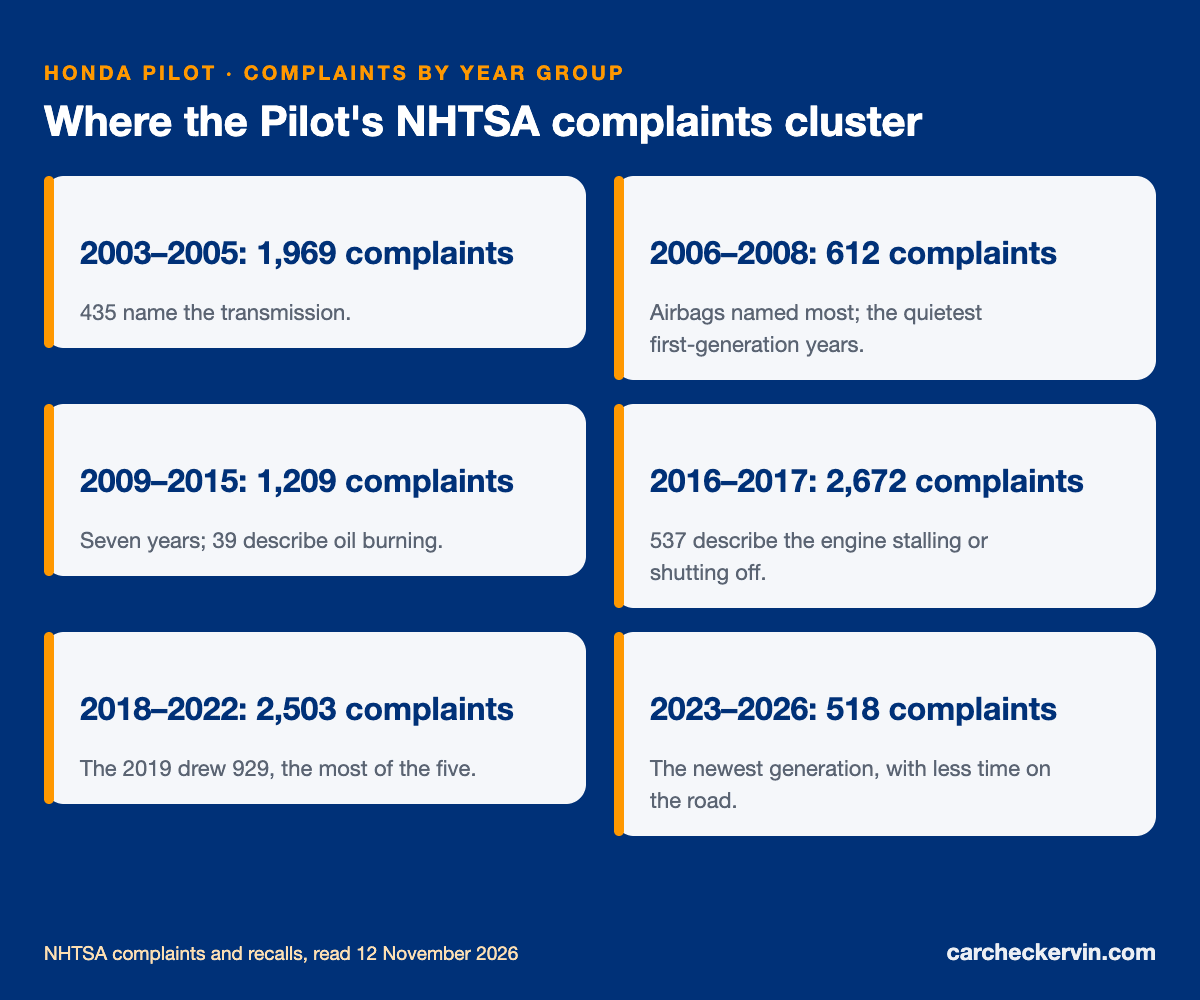
By generation, the third (2016–2022) carries the most complaints, most of them on its first two years. The first generation's are concentrated in 2003–2005, which drew 1,969 between them, and the second generation is the quietest of the three.
What Pilot Owners Say on Reddit and YouTube
Pilot owners are mostly fans, and the comments are full of first- and second-generation Pilots with very high mileage. The complaints cluster where the federal data does: the 2016–2017, and transmissions on the early cars, plus a running argument about oil on the 2009–2015.
In owners' words (paraphrased)
- r/hondapilot: a commenter would avoid the 2016–2017 if there are other options, citing problems in the first two years of the direct-injection engine.
- r/hondapilot, on the 2007: asked whether 2007 was a good year, a commenter says yes, but at this age condition and maintenance history matter more.
- YouTube, 2007 Pilot: an owner says theirs has 385,000 miles and, as far as they know, the original transmission.
- YouTube, 2010 and 2015 Pilots: an owner says the 2010 began burning oil around 100,000 miles, so they fitted a device to keep it out of ECO mode, and did the same to the 2015 straight away.
- YouTube, second generation: a commenter describes misfires from oil-fouled plugs that kept coming back, and says Honda's answer was new piston rings for about $3,500.
- YouTube, 2017 Pilot: an owner says the engine failed at 70,000 miles, after rough downshifts and a screen that froze.
- YouTube, 2014 Pilot: a family that paid $10,000 for one with 160,000 miles says their research pointed to it as one of the soundest years.
- YouTube, 2006 Pilot: an owner says the transmission slipped at 200,000 miles and cost $5,000 to replace; they bought a 2015 next.
Looking at a Used Pilot?
Enter the VIN for a free preview: title brands, junk and salvage records, total-loss records and odometer readings, before you hand over a deposit.
Pilot Recalls Worth Checking by VIN
A recall is free at a Honda dealer whenever it was issued. These are the ones that matter most on a used Pilot.
2016–2022: rear subframe rust
Recall 26V365000, for Pilots sold in salt-belt states: dealers inspect and fit a reinforcement kit.
2003–2004: transmission gears
Recall 04V176000: heat could chip or break second gear; the fix improves lubrication.
2016 and 2018–2019: rod bearings
Recall 23V751000: a bearing that may seize; the engine is inspected or replaced.
2023–2024: steering rack
Recall 23V735000: a loose ball bearing can lock the steering; the rack is replaced.
2023–2025: stalling software
Recall 25V031000: a fuel-injection software error may stall the engine; dealers reprogram it.
2003–2015: airbag inflators
15 inflator recall campaigns name Pilots from these years; check each VIN.
Which Pilots Our Visitors Check
Between 11 June 2026 and 11 November 2026, visitors ran 681 different Honda Pilot VINs through our free preview. 108 of them (16%) were 2016 or 2017 models, the two years with the most NHTSA complaints, and the single most-checked year was the 2016, at 56 VINs.
Another 179 (26%) were 2009–2015 Pilots, the generation owners argue about. Plenty of shoppers are looking at the warning years, so the checks below matter more than the model's reputation.
Checks Before You Buy a Used Pilot
What to look at, by the year you are considering.
2016–2019: the idle-stop
Sit at a stop until the engine shuts off, then pull away. It should restart at once.
2016–2017: injector records
Ask for any fuel-injector or engine work in the service history.
2009–2015: oil use
Check the dipstick and ask how often it's topped up between changes.
2003–2005: the shifts
Shifts should be smooth from cold; a flare or slip between gears is the warning.
Salt-belt 2016–2022: the subframe
Ask whether recall 26V365000 has been done.
Any year: VIN records
Open recalls, title brands and odometer history.
Reading Pilot Complaint Numbers
NHTSA complaints are reports owners type in themselves. They are not verified and not divided by sales, so compare Pilot years with each other: the jump from 109 for the 2015 to 1,730 for the 2016 says more than either number alone.
The fault counts come from searching the words owners used. 312 complaints on the 2016 describe stalling, but an owner who wrote that the car "lost power" without more is not counted, so treat these figures as a minimum. The newest Pilots have had a year or two to collect complaints, which is why the "fewest" list stops at 2021.
Related Checks and Guides
Recalls, history checks and the Pilot's rivals.
Where These Facts Come From
Complaint and recall figures are NHTSA's own records. Owner experiences are linked so you can read them in full.
NHTSA records read 12 November 2026. Written by the CarCheckerVIN editorial team with AI assistance, from NHTSA's complaint and recall records, our own preview logs and the owner posts linked above; figures checked November 2026. CarCheckerVIN is not affiliated with Honda.
Honda Pilot Years to Avoid — Frequently Asked Questions
The worst years, the best years and what to check.
What is the worst year for the Honda Pilot?+
By NHTSA complaint count, the 2016 (1,730), then the 2017 (942) and the 2019 (929).
What is the most reliable Pilot year?+
No year is proven most reliable, because complaints are not divided by sales. Among 2004–2021 Pilots, 2015 (109), 2010 (111), 2014 (116) drew the fewest, and owners often name the 2015.
Why do 2016 and 2017 Pilots stall?+
Owners describe the engine dying while driving or failing to restart after the auto idle-stop shuts it off; 537 complaints on the two years describe stalling. Some also mention fuel injectors. Ask for the service history and test the idle-stop on a drive.
Which Pilot years have transmission problems?+
The 2003–2005 most clearly: 190, 103 and 142 complaints name the transmission, and recall 04V176000 covers 2003–2004 Pilots whose second gear could break.
Is a high-mileage Pilot worth buying?+
It can be. Owners report first- and second-generation Pilots well past 300,000 miles. Records matter more than the odometer: regular oil and transmission fluid changes, and the recalls done.
Does your report show Pilot problems?+
No report shows mechanical faults. Ours lists title brands, NMVTIS junk and salvage records, insurance total-loss records, odometer readings, and auction records with the damage the auction recorded and its photos for the specific VIN. Recalls are free to check on NHTSA's site.
Check the Pilot, Not Just the Year
A well-kept 2016 can beat a neglected 2015. Enter the VIN for a free preview; the full report is $14.99 and lists title brands, NMVTIS junk and salvage records, insurance total-loss records, odometer readings, and auction records with the damage the auction recorded and its photos.
Complaint and recall figures are NHTSA's public records as read on 12 November 2026; complaints are unverified owner reports. Owner quotes are paraphrased from the linked posts. CarCheckerVIN is not affiliated with Honda. Records in our reports reflect what was reported to our data providers. Our reports do not include police or repair-shop accident entries.
فحوصات رقم الشاصي ذات الصلة
أدوات إضافية للتحقق من تاريخ أي مركبة