How to check a car's history — every route, priced.
Checking a used car's history is a fifteen-minute job if you run the routes in the right order: free decode and counts first, free theft flags second, one paid report last — and only when the car earns it. Here's the whole ladder with every price verified, not guessed.
Run the first check now — it's free
Any 17-character VIN → decoded vehicle, photos on file, recall count, and record counts.
Free preview · no card, no account
Quick Answer
- What's the best way to check a car's history?
- In layers, cheapest first.Decode the 17-character VIN and pull the free counts and flags (this page's form does both), run the free NICB theft and total-loss check, then buy one full NMVTIS-backed report — $14.99 here, $29.99 at AutoCheck, $39.99–$44.99 at Carfax — only for the car you're serious about.
- Can I check a car's history completely free?
- Partly. Free gets you the decoded vehicle, open-recall counts, NICB theft and total-loss flags, and — here — how many title and auction records exist. Line-item history always costs money because the federal NMVTIS system charges its providers for it. One exception: Indiana residents get five full AutoCheck reports a year from their Secretary of State.
- How long does a proper check take?
- About fifteen minutes of screen time: a minute to read the VIN off the windshield or door jamb, a few minutes for the free checks, under a minute for a paid report to deliver, and the rest for reading the odometer timeline and title records like a dealer would. The test drive and mechanic's inspection come after — not instead.
Every way to check a car's history, priced
Six real routes exist. Every price below was read off the seller's own page or the state's own site — most on August 23, 2026 — not repeated from a listicle.
| The route | What it shows | Verified price |
|---|---|---|
| Free preview (here) | Decoded specs, photos on file, open-recall count, title & auction record counts | $0No card, no account |
| NICB VINCheck | Active theft records and insurer total-loss declarations | $0Daily lookup cap |
| State programs | Indiana's SOS gives residents full AutoCheck reports | $0 · 5 per yearIndiana residents, via Access Indiana |
| Full NMVTIS report (here) | Title brands, odometer timeline, accidents, salvage, auction photos | $14.99$13.49 with the one-time VIN10 code |
| AutoCheck | The 1–100 Score and deep auction-lane records | $29.99$23.99 via TrueCar · 21-day window |
| Carfax | The famous brand, plus dealer service-visit records | $39.99–$44.99Franchised dealers often attach one free |
Notice the shape: everything above the paid tiers is a flag-and-count layer, and every paid tier stands on the same federal NMVTIS title system. Price buys presentation and extras — the deal-breaker records underneath don't change with the logo.
The fifteen-minute method, in four steps
Run it in this order and you never pay to learn something a free layer would have told you:
Read the VIN off the car itself
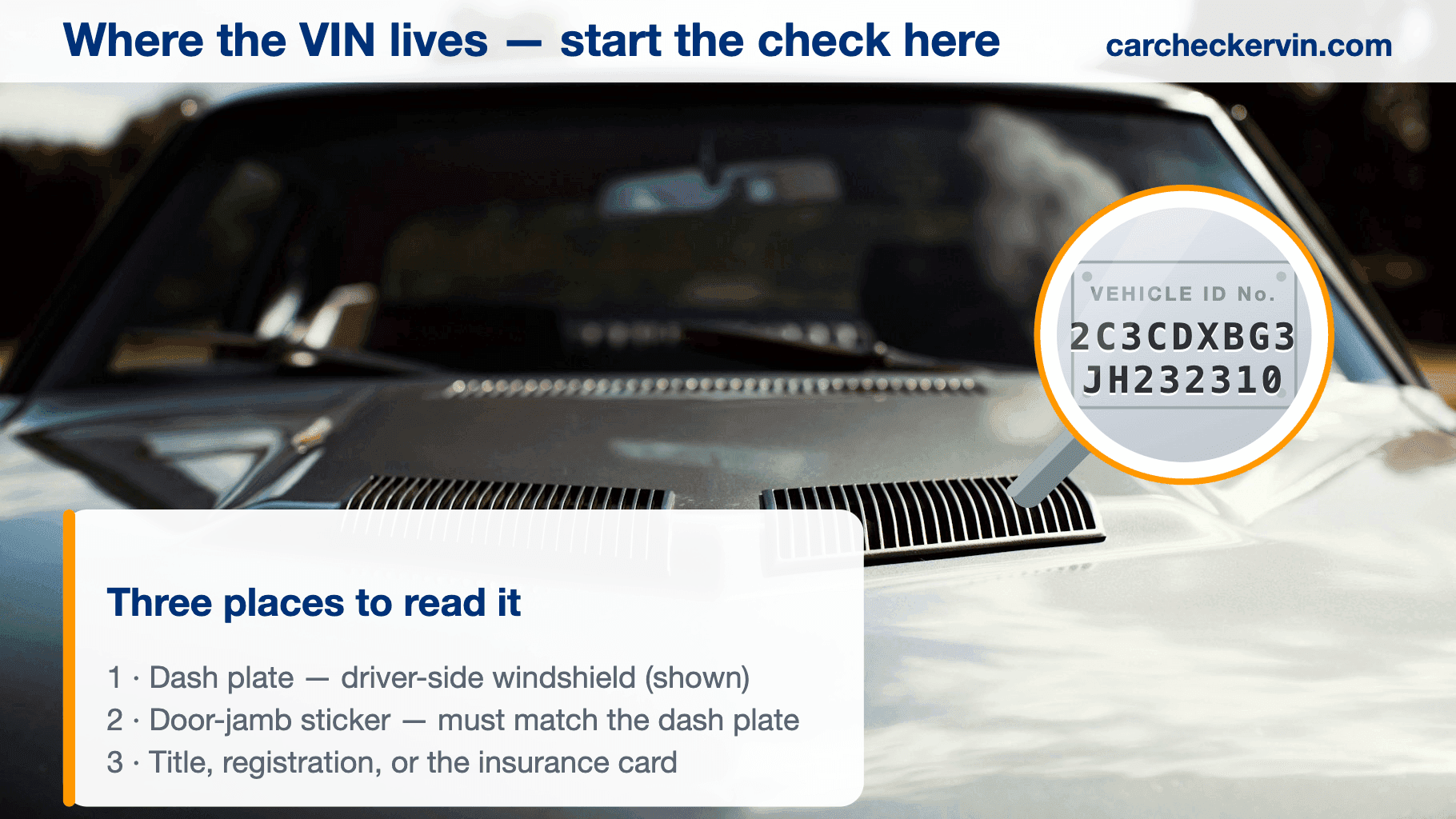
Lower driver-side windshield, driver's door jamb, title, or insurance card — 17 characters, never with the letters I, O, or Q. Take it from the metal, not the listing: a mismatch between the two is itself a finding.
Run the free layers
Enter the VIN above for the decode, photos, recall count and record counts, then run NICB's free VINCheck for theft and total-loss flags. A branded preview or a theft flag ends the conversation before any money moves.
Buy one report, once it matters
When the free layers show records — or you're about to negotiate — unlock the line items: odometer timeline, title chain, accidents, auction photos. $14.99 here on the same NMVTIS core the $29.99 and $44.99 brands use.
Verify in the physical world
Match auction photos against today's panels, check the odometer against the recorded timeline, and book a pre-purchase inspection. A report can only contain what was reported — the car itself is the last document.
Fifteen minutes starts with a free minute
Decode any VIN and see the record counts before deciding whether this car deserves a paid report at all.
What a history check can — and can't — tell you
A VIN check is the cheapest leverage in a used-car deal, as long as you know where its edges are:
Title brands & washing
Salvage, rebuilt, flood and lemon brands across states — including the paper trail when a branded car is re-titled somewhere looser. This is the check that kills the worst deals.
Odometer truth
Every recorded reading in sequence. A number lower than the one before it is a deal-ender you can spot in five seconds of scrolling.
Accident & damage records
Reported collisions with dates and severity where recorded — strongest when paired with auction photos of the car unstaged.
Auction history & photos
When and where the car crossed a lane, often with the photos to prove what it looked like that day. The cheapest lie detector against a shiny listing.
Open recalls
Free, from the manufacturer feed — with the NHTSA campaign numbers to hand a dealer for no-cost repair work.
The blind spot
A repair paid in cash off the record will not appear on any report — ours, AutoCheck's, or Carfax's. That's why step four is a mechanic, not another PDF.
Three mistakes first-time checkers make
Each of these costs real money, and each is avoidable with the method above:
Trusting the seller's copy alone
A report the seller hands you is real evidence — of the report they chose to show. Run one independent check on the same VIN; two sources agreeing is confidence, two sources disagreeing is your negotiation.
Paying retail out of habit
The $44.99 reflex buys the same federal title, brand and odometer data the $14.99 tier reads. Pay a premium deliberately — for the Score, for dealer service records — not because the logo was familiar.
Stopping at a clean report
Clean means nothing was reported, not that nothing happened. The report's job is to disqualify bad cars cheaply; the mechanic's job is to qualify the good one. Skipping the inspection because the PDF was clean inverts the logic.
What checking costs, by the kind of shopper you are
Real budgets for the whole job, using only the verified prices above:
$0 – $14.99
Free decode, counts and NICB flags on the shortlist; one full report on the finalist — $13.49 if you use the VIN10 code the preview offers. Most single-car purchases never need more.
$54.99 — $11.00 a car
The 5-pack, with credits that stay valid 12 months while your search meanders. AutoCheck's five cost $59.99 and expire together in 21 days.
$0 × 5
Five full AutoCheck reports a year from the Secretary of State, free. If that's you, spend the savings on the pre-purchase inspection.
$23.99 – $44.99
AutoCheck via TrueCar at $23.99, or Carfax at $39.99–$44.99 — worth it when a negotiation leans on the Score or on dealer service records. Ask the dealer for their Carfax first; franchised lots often attach it free.
Keep reading before you spend anything
The deeper dives behind each step of the method.
افحص رقم الشاصي دائماً قبل الشراء
المعاينة المجانية تُظهر علامات سند الملكية وحالة السرقة والاستدعاءات المفتوحة خلال ثوانٍ، وتُشير إلى وجود سجلات حوادث أو عدّاد من عدمه. التقرير الكامل بـ 14.99 دولاراً — دفعة واحدة، بلا اشتراك.
Checking a car's history — asked and answered
Straight answers, including the ones that don't favor us.
How do I check a car's history for free?+
Stack the free layers: decode the 17-character VIN here for the vehicle's identity, photos on file, open-recall count and title & auction record counts; run NICB's VINCheck for active theft records and insurer total-loss declarations (free, with a daily lookup cap); and if you live in Indiana, claim one of the five free AutoCheck reports your Secretary of State provides each year. What free never includes — anywhere legitimate — is the line-item NMVTIS record detail.
What's the cheapest full history report?+
Among the verified prices: $14.99 here — $13.49 with the one-time VIN10 code the free preview offers — against $29.99 at AutoCheck ($23.99 if you arrive via TrueCar) and $39.99–$44.99 at Carfax. All three stand on the same federal NMVTIS title system for brands, salvage and odometer records; the premium tiers add the AutoCheck Score and Carfax's dealer service records respectively.
Where do I find the VIN to check?+
Lower driver-side corner of the windshield, the driver's door-jamb sticker, the title, the registration, or the insurance card. It's 17 characters and never contains the letters I, O or Q. Read it off the car itself rather than copying the listing — if the metal and the ad disagree, that mismatch is the first finding of your check.
Is a paid history report worth it if the seller already showed me one?+
Yes, and precisely because they showed you one. The seller's copy is evidence of the report they picked, from the day they pulled it. An independent $14.99 check on the same VIN either confirms it — real confidence — or surfaces a difference, which is exactly the information a negotiation runs on.
What does a history check miss?+
Anything nobody reported. A repair paid in cash off the record will not appear on any report — ours, AutoCheck's or Carfax's — and a recently issued title may not show last month's events yet. That's why the method ends in the physical world: match the auction photos to today's panels and put the car on a lift with a mechanic before money moves.
How long does a vehicle history check take?+
The screen work is about fifteen minutes: a minute to read the VIN, five for the free layers, under a minute for a full report to deliver (ours arrives in under 60 seconds), and the rest for reading the odometer sequence and title chain carefully. The pre-purchase inspection that should follow is an hour or so at a shop — scheduled, not skipped.
Should I check history on every car I look at?+
Run the free layers on every serious candidate — they cost nothing and disqualify the worst cars in minutes. Buy full reports the way the pack pricing suggests: one at $14.99 for a single finalist, or $35.99, $54.99 or $89.99 for 3, 5 or 10 credits ($12.00 down to $9.00 per car) when you're comparing a real shortlist. Credits here stay valid 12 months, so an unhurried search doesn't waste them.
Start the check. The first layer costs nothing.
Decoded specs, record counts, recalls and photos — free for any VIN. The full NMVTIS-backed report is $14.99 when a car earns the closer look.
فحوصات رقم الشاصي ذات الصلة
أدوات إضافية للتحقق من تاريخ أي مركبة