How to Find Car Deals — new or used, and how to tell a real one.
Most car "deals" are either timing or a reason. Timing works for used cars: federal price data shows September is the softest month of the year. New-car prices barely move by month, so there the deal comes from automaker incentives and leftover inventory. And a price far below the rest is often a reason, which is what the VIN check is for.
Found a Price That Looks Too Good?
Enter the VIN for a free preview of title brands, salvage records and odometer readings. A branded title explains a lot of low prices.
Free preview · No sign-up · No owner or personal data
Quick Answer
- When are used cars cheapest?
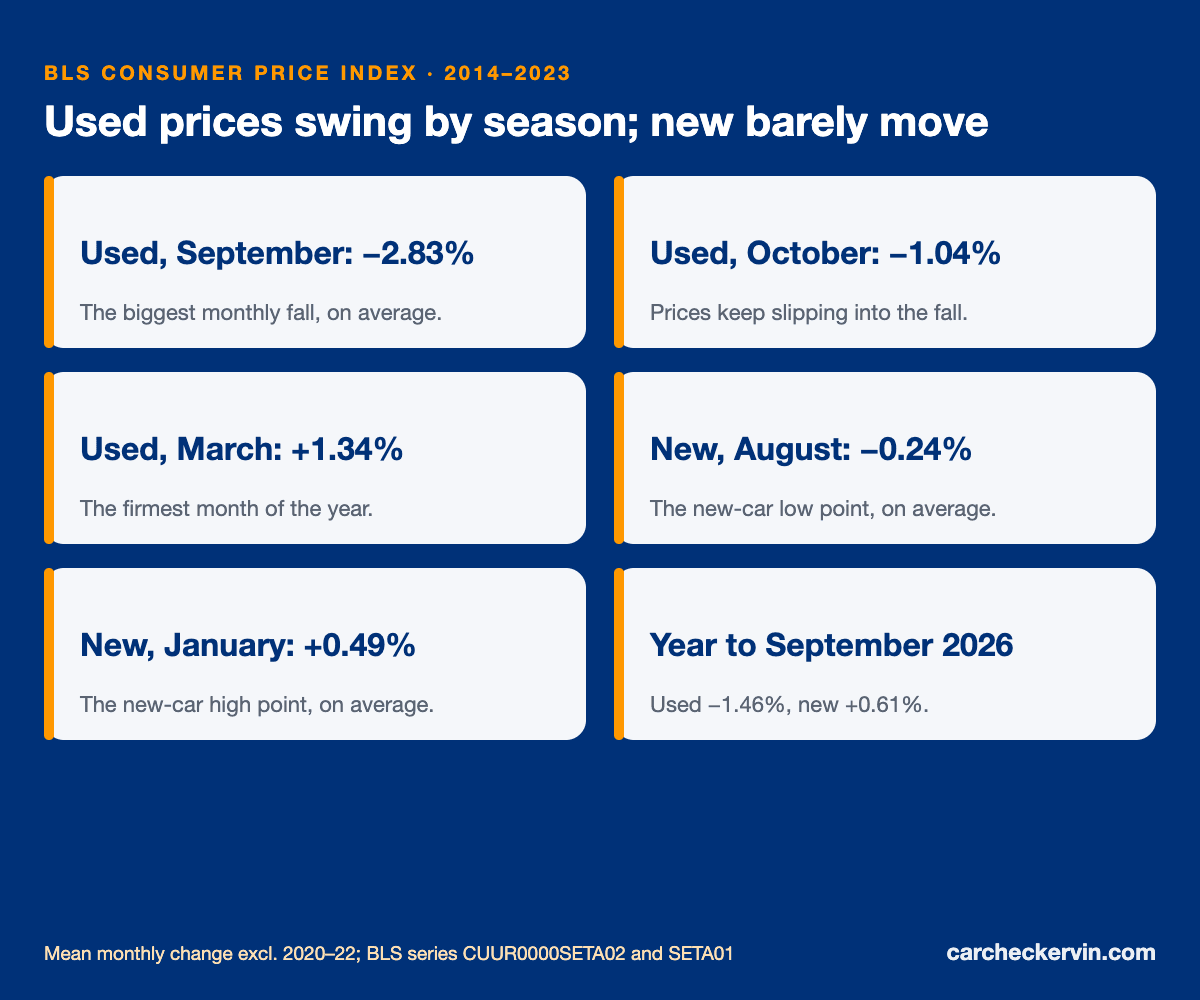
- In the fall. The Bureau of Labor Statistics' used-car price index fell 2.83% on average in September (2014–2023, leaving out 2020–2022), the biggest drop of any month, and kept slipping in October and November. March was the firmest month, at +1.34%.
- When are new cars cheapest?
- The new-vehicle price index barely changes by month: from −0.24% in August to +0.49% in January on the same window. New-car deals come from automaker incentives, which the makers publish on their own offers pages, and from leftover cars of the previous model year.
- How do I know if a car deal is real?
- Compare the out-the-door price, not the advertised price, against the same car elsewhere. Then check the VIN: a salvage or rebuilt brand, a rolled-back odometer or a past total loss explains many prices that look too good.
Five steps to a real deal
A good deal is a good car at a good out-the-door price. Each step checks one half of that.
- 1Set an out-the-door budgetPrice, tax, fees and destination: one number.
- 2Time itUsed: September to November. New: model-year changeover and incentives.
- 3Compare listingsSame model, similar miles; note how long each has been listed.
- 4Check the VINA low price with a branded title is not a deal.
- 5Negotiate on the totalBring the history and your own financing quote.
Where Car Deals Actually Come From
New cars and used cars get cheaper for different reasons. A new car's discount comes from the automaker or the dealer: cash rebates and low-rate financing that manufacturers publish on their own offers pages, and leftover cars from the previous model year that a dealer needs to move once the new year arrives. Those offers change month to month and region to region, so the only reliable figure is the one on the maker's site for your zip code.
Used cars have no incentives. Their price follows supply and demand, and that has a seasonal pattern you can measure. Beyond timing, the biggest swings come from the car itself: mileage, condition and history. Two identical-looking cars can be priced thousands apart because one has a salvage brand.
A deal is the out-the-door price
- Destination: on every new car, set by the maker.
- Dealer fees: documentation and prep fees vary by dealer.
- Add-ons: pre-installed extras you may not want.
- Financing: a low price at a high rate isn't cheap.
Used-Car Prices by Month
Average month-over-month change in the BLS used cars and trucks price index, January 2014 to December 2023, not seasonally adjusted. The second column leaves out 2020–2022, when prices moved for reasons that had nothing to do with the calendar.
| Month | Average change | Without 2020–2022 |
|---|---|---|
| January | −0.12% | +0.12% |
| February | +0.49% | +0.38% |
| March | +1.23% | +1.34% |
| April | +1.70% | +1.27% |
| May | +0.91% | +0.38% |
| June | +1.42% | +0.33% |
| July | +0.65% | +0.30% |
| August | +0.34% | −0.09% |
| September | −2.56% | −2.83% |
| October | −0.60% | −1.04% |
| November | −0.70% | −0.77% |
| December | −0.14% | −0.21% |
Source: BLS series CUUR0000SETA02. September is the softest month in both columns, and March and April are the firmest.
New-Car Prices Barely Move by Month
The same calculation on the BLS new-vehicles index. Compare the size of these numbers with the used-car table.
| Month | Average change | Without 2020–2022 |
|---|---|---|
| January | +0.49% | +0.49% |
| February | +0.26% | +0.26% |
| March | −0.02% | +0.06% |
| April | +0.13% | +0.01% |
| May | +0.25% | −0.02% |
| June | +0.13% | −0.16% |
| July | +0.11% | −0.21% |
| August | −0.05% | −0.24% |
| September | 0.00% | −0.20% |
| October | +0.24% | +0.01% |
| November | +0.20% | +0.08% |
| December | +0.33% | +0.18% |
Source: BLS series CUUR0000SETA01, January 2014–December 2023, pulled 7 November 2026. January averages nine changes. The index tracks prices across the market; a dealer's year-end push on one car won't show up here.
New vs Used: Where Timing Pays
Used-car prices give back 2.83% in an average September and 1.04% more in October. The new-car index never moves more than half a percent in any month, so for a new car, an incentive or a leftover model-year matters far more than the calendar.
Over the year to September 2026, used prices were −1.46% and new prices +0.61%.
Is the Low Price Hiding Something?
Enter the VIN for a free preview of the title brands, junk and salvage records and odometer readings on file before you negotiate.
When a Price Is Too Good: What Usually Explains It
Each of these is filed by VIN, which is why the check comes before the handshake.
Salvage or rebuilt title
The car was declared a total loss. Resale value and insurance both suffer.
Flood brand
Water damage that shows up on the title in many states.
Odometer problems
A reading lower than an earlier one is a rollback warning.
Auction history
Insurance-auction sales with recorded damage and photos.
Title not in the seller's name
A flipper who never registered it, or worse.
Washed title
A brand dropped by re-titling in another state.
Dealer Deal vs Private-Seller Deal
Private sellers often ask less, and you give up some protections for the lower price.
From a dealer
- A Buyers Guide on the car, if the dealer sells more than 5 used cars a year
- Financing and trade-in in one place
- Documentation and other dealer fees
- Room to negotiate on aged inventory
From a private seller
- No dealer fees, often a lower asking price
- Usually sold as is, with no Buyers Guide requirement
- You handle the title transfer and payment
- Every check is on you, starting with the VIN
Negotiating With a History Report
A history report is a negotiating tool, not just a safety check. Odometer readings that don't fit the asking price, a past auction sale or a title brand the seller didn't mention all give you a factual reason to offer less, or to walk away.
Bring a financing quote from your bank or credit union too. When the dealer knows you can pay without their loan, the conversation moves to the price of the car, which is where you want it.
Related Checks and Guides
Timing, pricing tools and the checks that protect a deal.
Where These Facts Come From
Price trends come from the Bureau of Labor Statistics consumer price index; dealer rules from the FTC.
Monthly averages are our calculation from the BLS series. They describe the market as a whole; one car's price depends on its condition, mileage and history.
Car Deals — Frequently Asked Questions
Timing, incentives and red flags.
What is the best month to buy a used car?+
September, on average. The BLS used-car index fell 2.83% in an average September over 2014–2023, leaving out 2020–2022, and October and November were also negative.
Is the end of the year the best time to buy a new car?+
The price index won't show it: new-car prices moved less than half a percent in every month on average. Year-end deals come from dealers clearing old stock and from automaker incentives, so compare the offers on the maker's site with the dealer's out-the-door price.
Where do I find new-car incentives?+
On the automaker's own website, usually a page called offers or special offers, filtered by your zip code. Incentives change monthly and differ by region.
Are used-car prices going down?+
Over the year to September 2026, the BLS used-car index was −1.46% and the new-vehicle index +0.61%. Monthly moves are bigger than that, so timing within the year still matters.
Why is this used car so much cheaper than the others?+
Check the VIN before you assume it's a bargain. A salvage, rebuilt or flood brand, a rollback or a past insurance total loss are the usual reasons.
Does a history report help me negotiate?+
Yes. A record the seller didn't mention is a factual reason to offer less. Our full report is $14.99 and lists title brands, NMVTIS junk and salvage records, insurance total-loss records, odometer readings, and auction records with the damage the auction recorded and its photos.
Check the Car Before You Call It a Deal
Enter any 17-character VIN for a free preview. The full report is $14.99 once and lists title brands, NMVTIS junk and salvage records, insurance total-loss records, odometer readings, and auction records with the damage the auction recorded and its photos.
Price trends are calculated from Bureau of Labor Statistics data and describe the market as a whole, not any one car. CarCheckerVIN does not sell cars or arrange financing. Records in our reports reflect what was reported to our data providers. Our reports do not include police or repair-shop accident entries.
فحوصات رقم الشاصي ذات الصلة
أدوات إضافية للتحقق من تاريخ أي مركبة