Maryland state inspection — when you need one, who pays, and what's checked.
Maryland doesn't inspect cars every year. Its safety inspection happens when a used vehicle changes hands, or when a used vehicle from another state is titled and registered here. In COMAR's words, "An inspection is required when a used vehicle is sold or ownership is transferred or when a used vehicle is to be titled and registered in the State." Usually the seller gets the certificate, it's good for 90 days, and there's no fixed state fee: stations bill set labor hours at their own rate. Here is who's exempt, what the inspector checks, what happens if the car fails, and how a buyer can check a VIN for a current inspection.
Buying a Used Car in Maryland?
A safety certificate covers brakes, tires and lights on the day. It says nothing about the title. Enter the VIN for a free preview of title brands, salvage records and odometer readings.
Free preview · No sign-up · No owner or personal data
Quick Answer
- When do you need a Maryland state inspection?
- When a used vehicle is sold or its ownership is transferred, and when a used vehicle is to be titled and registered in Maryland, which covers new residents bringing a car in. The MVA won't title and register a used vehicle without a valid inspection certificate, except a historic (Class L) vehicle. There's no annual safety inspection; a 2025 bill to add one every two years did not pass.
- How much is a Maryland state inspection?
- There's no fixed state price. The State Police say the fee "varies with the inspection station's labor rate": Maryland regulates the hours billed, not the rate. For a vehicle of 10,000 lb GVWR or less a station may bill 1.5 hours (including 0.4 hour for headlight adjustment), 2 hours with four-wheel drive or full-floating axles, and 0.75 hour for a motorcycle. The fee must be posted.
- How long is a Maryland inspection certificate good for?
- 90 days from the date it's issued. For a used vehicle in a licensed dealer's inventory, 6 months or until 1,000 miles are added, whichever comes first. A Maryland-titled vehicle can be transferred again within 30 days of its last inspection without a new one.
Four steps to a Maryland inspection
If you're selling, the certificate is usually yours to get. If you're buying, ask for it before you pay.
- 1Know who gets itUsually the seller. A dealer that's also a station prepares it for the cars it sells.
- 2Pick a licensed stationFees vary with each station's labor rate, which must be posted.
- 3Pass the inspectionBrakes, tires, lights, steering, suspension and the rest. Results go to the MVA electronically.
- 4Title within 90 daysThe certificate is valid for 90 days from issue.
How Maryland's Safety Inspection Works
The inspection is tied to the title. Transportation Article § 23-107 has the MVA require a valid inspection certificate before it titles and registers a used vehicle, other than a historic one, and the State Police put it plainly: a used vehicle must pass a safety inspection before it can be sold, bought or registered in Maryland. The Automotive Safety Enforcement Division of the State Police licenses the stations and enforces the rules.
Usually the seller (the transferor) obtains the certificate. A dealer that's also a licensed station prepares it for its own sales, or has another station do it. Once a car passes, "the inspector will electronically submit the information to the MVA," and a buyer can check whether a car has a current inspection with the Maryland inspection lookup: choose "Find an e-inspection" and enter the VIN.
Transfers That Don't Need an Inspection
From Transportation Article § 23-106 and COMAR 11.14.01, read on 22 October 2026. The statute's list is newer than the regulation's, so it's used here.
| Transfer | Note |
|---|---|
| To a licensed dealer or a foreign dealer | The dealer handles inspection before resale |
| Between spouses, or between a parent and child | COMAR adds former spouses under a settlement or order |
| Removing a co-owner's name from the title | Between co-owners |
| A used vehicle not being both titled and registered in Maryland | |
| Into a living trust where the transferor is the primary beneficiary | A written inter vivos trust |
| A leased vehicle bought by the lessee at lease end | Statute |
| A dissolving business's vehicle to its majority owner | Statute |
| A sale for rebuilding or dismantling | With the buyer's signed statement of purpose |
| Historic (Class L) vehicles of model year 1985 or earlier | Outside the inspection law's definition of vehicle |
Off-highway recreational vehicles are exempt too. Anything else that changes hands needs a certificate.
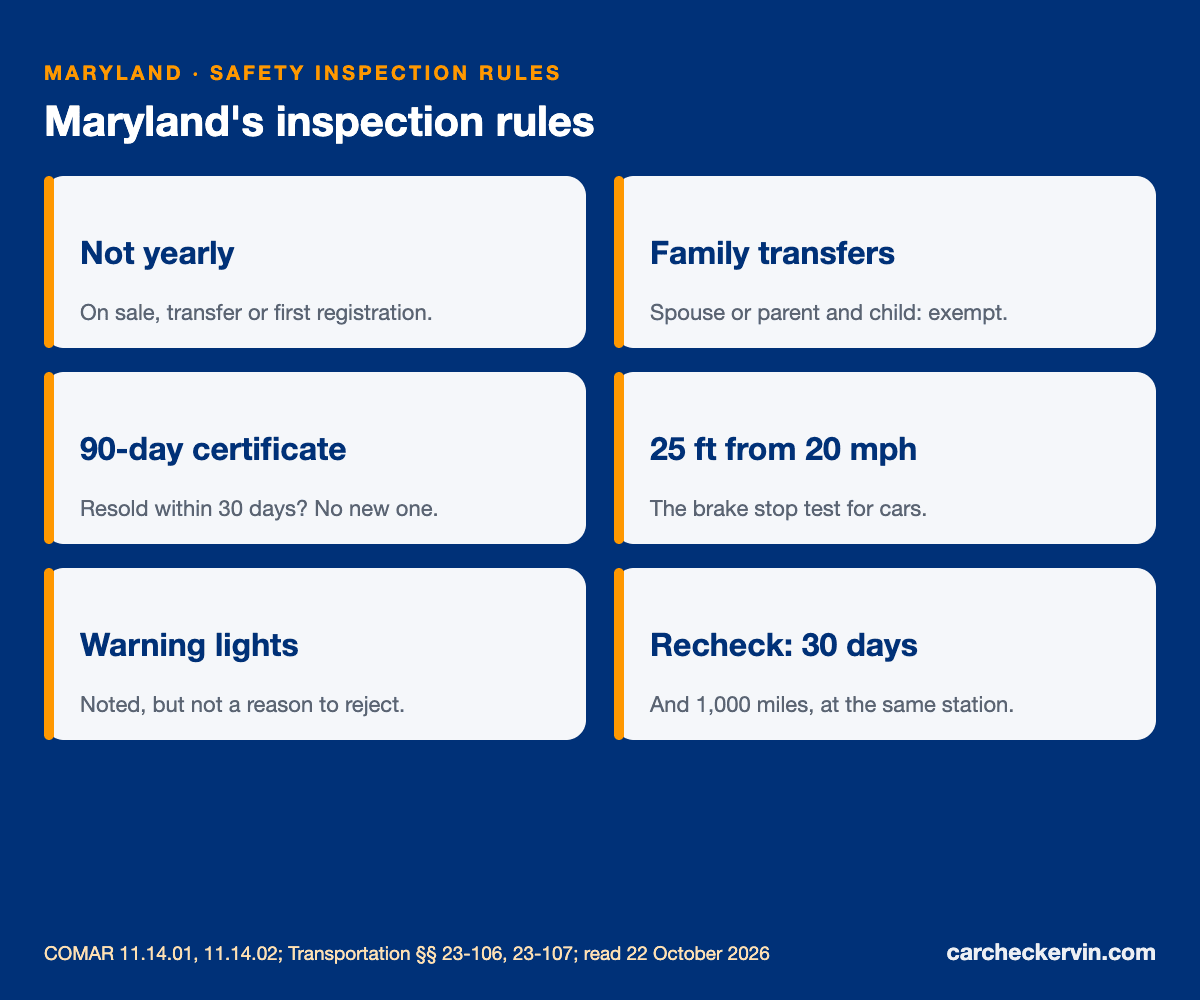
Maryland Inspection Rules at a Glance
When it's required, how long it lasts, the fee rule and the reinspection window, on one card.
From the Maryland State Police and COMAR 11.14.01, read on the date shown.
What the Inspector Checks
From the State Police and the COMAR 11.14.02 standards for passenger cars and light trucks up to 10,000 lb GVWR.
Brakes
From 20 mph a car must stop within 25 feet (30 for light trucks and vans). Pads under 2/32 inch fail.
Tires
Less than 2/32 inch of tread in any major groove, measured at three points, fails.
Lights and steering
Lights, steering and suspension are on the State Police's list of critical components.
Window tint
Passenger cars need at least 35% light transmittance on all side and rear windows.
Warning lights
A lit check-engine, airbag or ABS light is noted on the report but isn't a reason to reject the car.
Exhaust and bumpers
Exhaust changes are allowed only if they don't alter the emissions setup; bumper heights are limited by class.
How Stations Set the Fee
Maryland regulates time, not price. COMAR lets a station set its complete-inspection fee "based on the times listed in this section at the hourly flat rate charged for similar mechanical repairs." For a vehicle of 10,000 lb GVWR or less that's 1.5 hours, which includes 0.4 hour to adjust the headlights; 2 hours with four-wheel drive or full-floating axles; 0.75 hour for a motorcycle; and another 0.2 hour if the windows are tinted.
So two stations can charge different amounts for the same inspection. The State Police require the fee to be prominently displayed, and a station must justify any increase to the Automotive Safety Enforcement Division before charging it. Stations keep weekday hours of at least 8 a.m. to 4 p.m., and must honor appointments or rebook within three business days.
Billable hours
- Car or light truck: 1.5 hours.
- 4WD or full-floating axles: 2 hours.
- Motorcycle: 0.75 hour.
- Tinted windows: +0.2 hour.
Buying a Car With a New Maryland Certificate?
The inspection covers brakes and tires today. Before you pay, enter the VIN for a free preview of the title brands and junk and salvage records on file.
If the Car Fails
From COMAR 11.14.01 and the State Police inspection page.
You get the report
Pass or fail, the station must give you the inspection report listing any defective equipment.
Repair it anywhere
The owner, the inspecting station or another shop can do the repairs.
30 days and 1,000 miles
Back to the same station within both limits, and only the failed items are rechecked.
What a recheck costs
A prorated fee only for items that need jacking, lifting, measuring or testing. Visual items are free.
Miss the window
After 30 days or 1,000 miles you pay for a complete new inspection.
Salvage vehicles first
A car declared salvage must pass the State Police salvage inspection ($75) before a Maryland title.
Temporary Registration and Repair Orders
If you can't register because the car hasn't passed yet, the State Police describe a 30-day temporary registration that lets you drive to and from a station. It uses form VR-129, the Temporary State Inspection Waiver, which carries a non-refundable $50.00 fee and a reminder that "This vehicle must pass a MD safety inspection within 30 days." The same form covers Maryland residents in the armed forces stationed outside the state.
Police can also issue a Safety Equipment Repair Order on the road. The owner must have the equipment corrected "within 10 days from the issuance of the order" and send a repair certification to the State Police; if the order isn't complied with within 30 days, the registration is suspended. Driving without the required minimum equipment is a misdemeanor with a maximum $500 fine.
In short
- VR-129: $50, 30 days to pass.
- Military: inspect on return to Maryland.
- Repair order: fix within 10 days.
- Ignored: registration suspended after 30.
Safety Inspection or Emissions Test
Maryland runs two separate programs, and many cars need both at different times.
Safety inspection
- When a used car is sold, transferred or brought in.
- Any licensed station, at its labor rate.
- Certificate valid 90 days.
- Run by the State Police.
Emissions test (VEIP)
- Every two years, on a date the MVA mails you.
- 13 counties and Baltimore City.
- $30 since July 1, 2025.
- Run by the MVA.
The emissions test has its own guide on this site.
Related Checks and Guides
Maryland's emissions test, temporary tags, other state guides, and the checks worth running before you buy.
Where These Facts Come From
From the Maryland State Police's inspection pages and form VR-129, the official COMAR site, and the Maryland General Assembly's statutes and fiscal notes, read on 22 October 2026. The MVA's own pages couldn't be reached from here.
CarCheckerVIN is not affiliated with the Maryland State Police or the Motor Vehicle Administration, and does not perform inspections. This page is general information; the State Police and the MVA are the authorities on your vehicle.
Maryland State Inspection — Frequently Asked Questions
What Maryland buyers and sellers ask most.
Does Maryland require a yearly state inspection?+
No. Maryland requires a safety inspection when a used vehicle is sold or transferred, or titled and registered in the state for the first time. A 2025 bill (SB 742) to require an inspection every two years for vehicles at least six model years old did not pass.
Who pays for the Maryland inspection, the buyer or the seller?+
Usually the seller obtains the certificate. The State Police note that for some trucks and trailers either the buyer or the seller may get it, and a dealer that's a licensed station prepares it for its own sales.
Do I need an inspection to give my car to my child?+
No. Transfers between spouses and between a parent and child are exempt, and so is removing a co-owner's name from the title.
I'm moving to Maryland. Do I need a safety inspection?+
Yes, for a used vehicle you're titling and registering in Maryland. If you can't register yet, form VR-129 gives a 30-day temporary registration, for a non-refundable $50 fee, to get the car inspected.
Will a check engine light fail a Maryland safety inspection?+
No. The safety standards say engine, airbag and ABS warning lights aren't currently regulated; the inspector notes them on the report but they aren't rejectable items. The emissions test is another matter.
How can I tell if a car I'm buying has a current inspection?+
Use the Maryland inspection lookup the State Police link to: choose "Find an e-inspection" and enter the vehicle's VIN.
Check the VIN Before You Buy in Maryland
Enter any 17-character VIN for a free preview. The full report lists title brands, NMVTIS junk and salvage records, insurance total-loss records, odometer readings, and auction records with the damage the auction recorded and its photos.
CarCheckerVIN is an independent vehicle-history service and is not affiliated with the Maryland State Police, the MVA or the State of Maryland. This guide summarizes COMAR, the Transportation Article and the State Police's published pages and is not legal advice. Records in our reports reflect what was reported to our data providers. Our reports do not include police or repair-shop accident entries.
فحوصات رقم الشاصي ذات الصلة
أدوات إضافية للتحقق من تاريخ أي مركبة