REG 138 — the seller's release of liability in California.
When you sell, give away or otherwise dispose of a car in California, the law gives you 5 days to tell the DMV. REG 138, the Notice of Transfer and Release of Liability, is the paper version of that notice; the DMV's online form at dmv.ca.gov/nrl does the same job faster and gives you a receipt. Once the DMV records it, parking and traffic violations and civil claims from the car's use after the sale date become the new owner's problem. It doesn't transfer the title, though: the buyer still has to do that. Here's what the form asks, how to file it, and how to protect yourself.
Selling? Know What You're Selling
Buyers check the VIN; sellers can too. Enter it for a free preview of the title brands, salvage and odometer records on file.
Free preview · No sign-up · No owner or personal data
Quick Answer
- What is the REG 138 form?
- California DMV's Notice of Transfer and Release of Liability (Rev. 3/2024). The seller, or a lessee returning a lease, uses it to tell the DMV the vehicle has been sold, transferred or returned. California requires that notice within 5 days. Once recorded, liability for parking and traffic violations and civil litigation from the car's use after that date passes to the new owner.
- Is it better to file the release of liability online?
- The DMV says online filing at dmv.ca.gov/nrl is faster, and you can print a receipt for your records. A mailed REG 138 works too, but the DMV sends no confirmation that it arrived, so keep the stub at the bottom of the form.
- Does the REG 138 transfer the title to the buyer?
- No. The form says filing it does not count as applying to transfer ownership. The new owner must apply for the transfer using the title you signed over. Your name only comes off DMV records for the vehicle once that's done, even though the release of liability protects you from the date of sale.
Four steps to release your liability
Five minutes online, or one card in the mail. Either way, within five days.
- 1Write the buyer's detailsNew owner's name and address in the new-owner section, not yours. The DMV says to check you haven't swapped them.
- 2Odometer, date and priceWhole miles, the date of sale or lease return, and the price in whole dollars (0 for a gift).
- 3Identify the carPlate or CF number, make, year, model and the VIN or hull number.
- 4File within 5 daysOnline at dmv.ca.gov/nrl (print the receipt), or mail the top card and keep the stub.
What the DMV Needs on a REG 138
Every field on REG 138 (Rev. 3/2024), read on 28 October 2026. The form says that without accurate, legible details the record will not be updated or retained, and no notice will be sent.
| Field | What to write |
|---|---|
| Vehicle license or CF number | The plate (or a vessel's CF number) |
| Make or builder, year, model | As on the title |
| Vehicle ID or vessel hull number | The full VIN or hull number |
| Odometer reading | Whole miles, no tenths |
| Date of sale, transfer or lease return | Month, day, year |
| Selling price | Whole dollars, no cents; 0 for a gift |
| New owner | Last name (or company), first name, address |
| Seller or lessee | Last name (or company), first name, address, signature |
Use capital letters in black or blue ink. Selling several vehicles at once? Submit a separate form for each, with the right plate, VIN and owner on each.
How to File It, and What Happens Next
The DMV pushes online filing: the top of REG 138 says "Online filing is FASTER at dmv.ca.gov/nrl", and the instructions say to print a receipt for your records. If you use the paper form, complete it, detach the top card and mail it to the DMV, Notice of Transfer and Release of Liability, P.O. Box 942859, Sacramento, CA 94259-0001. Keep the bottom part. Don't mail a bill of sale or any other paperwork with it, and don't expect a reply: the DMV says no notification is sent confirming it received a mailed form.
Once the notice is properly completed and recorded, liability for parking or traffic violations and civil litigation from the operation of the vehicle after the date of sale, transfer or lease return becomes the new owner's. The form points to California Vehicle Code § 5602 for the requirements and for disputes about liability.
What the REG 138 doesn't do is transfer ownership. The new owner has to apply for the transfer with the title you signed over and complete every transfer requirement before your name comes off DMV records for that car. The DMV's title-transfer page gives the buyer 10 days to report a change of ownership, and repeats that sellers must submit the notice within 5 days.
REG 138 at a Glance
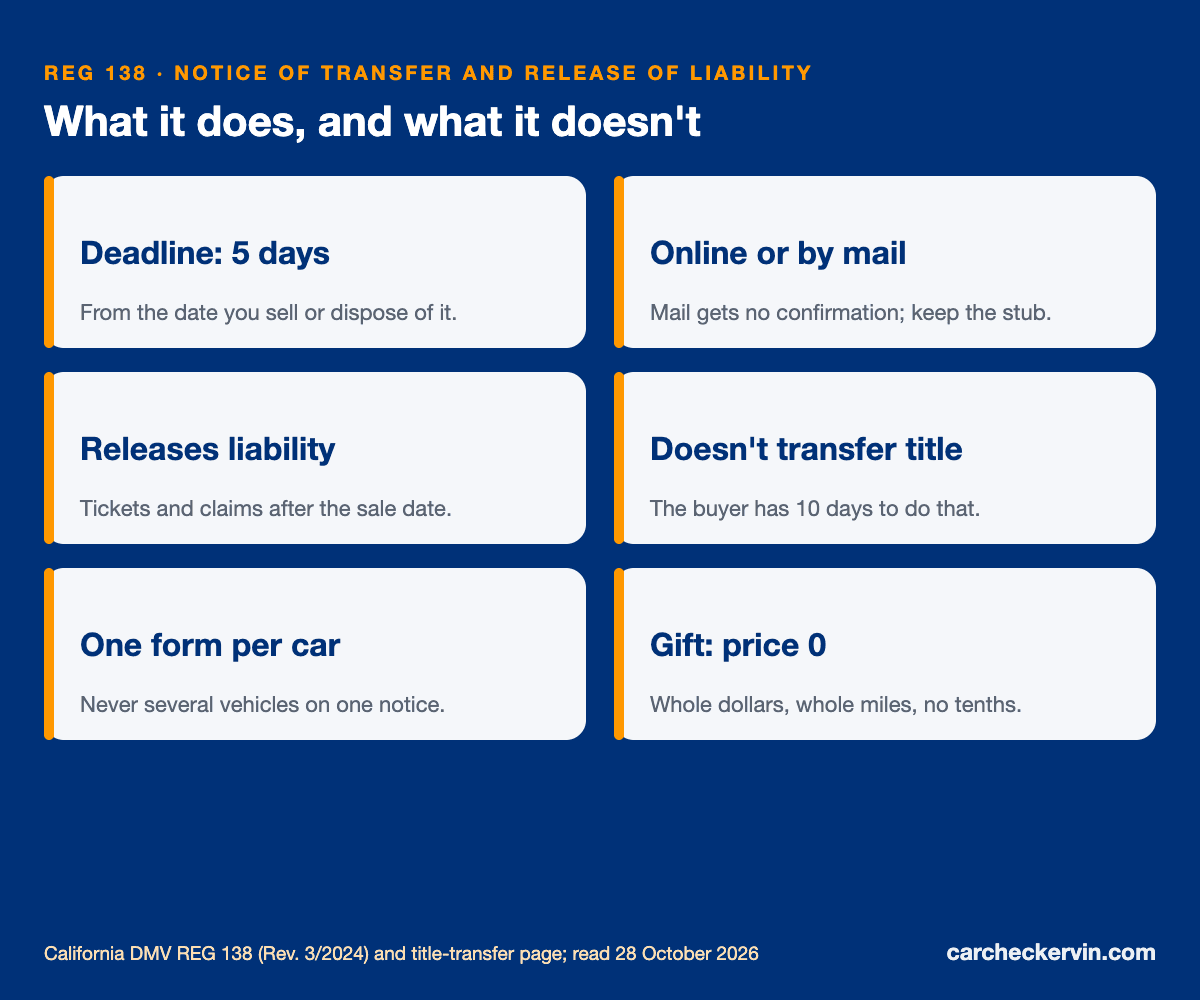
The deadline, the two ways to file and the limits of what it does, on one card.
From REG 138 (Rev. 3/2024) and the DMV's title-transfer page, read on 28 October 2026.
Protecting Yourself as the Seller
The DMV's own tips are short. Put the new owner's information in the new-owner section and yours in the seller section. Use one form per vehicle. File within five days. The DMV calls submitting the form "the best way to make sure the DMV receives your information."
The back of the form adds two more. You may want to check the buyer's identification so the name you report is accurate. And keep a copy of the completed form, because collection notices can arrive months or years after the sale. The DMV's advice is not to ignore them.
What gets a notice ignored
- Missing fields: the DMV won't update or keep a record without the vehicle, both parties and the date.
- Names in the wrong boxes: the buyer's details in the seller section, or the reverse.
- Several cars on one form: each vehicle needs its own notice.
- Illegible writing: capitals, in black or blue ink.
Selling? Check What the Buyer Will See
Most buyers run the VIN before they pay. Enter yours for a free preview of the title brands, salvage records and odometer readings on file.
When You Need a REG 138
The form covers more than a straightforward sale.
Private sale
Report the buyer, the price and the odometer reading.
Gift
Enter 0 for the selling price.
Lease return
The lessee reports the return date as the transfer date.
Several cars at once
One notice for each, never combined.
Vessels
The form covers vessels too, with the CF and hull numbers.
Within 5 days
Required by law from the date you sell or dispose of the vehicle.
REG 138 vs. the Title Transfer
Two separate jobs, done by two different people.
REG 138 (seller)
- Within 5 days of the sale.
- Online at dmv.ca.gov/nrl or by mail.
- Releases liability from the date of sale once recorded.
- No fee printed on the form.
Title transfer (buyer)
- Within 10 days, per the DMV's title-transfer page.
- The signed-over title, signatures and the transfer fee.
- Takes the seller's name off the vehicle record.
- Lost title? A REG 227 comes first.
Filing the REG 138 doesn't count as applying for a transfer of ownership.
Related Checks and Guides
The other DMV form guides, and the California pages they connect to.
Where These Facts Come From
From the California DMV's form and its title-transfer page, read on 28 October 2026.
CarCheckerVIN is not affiliated with the California Department of Motor Vehicles. This page is general information, not legal advice.
REG 138 — Frequently Asked Questions
What California sellers ask most.
How long do I have to file a release of liability in California?+
5 days. The form says you are required by law to notify the DMV within 5 days of the date you sell or dispose of a vehicle or vessel.
Where do I mail the REG 138?+
To the DMV, Notice of Transfer and Release of Liability, P.O. Box 942859, Sacramento, CA 94259-0001. Mail only the top card, with nothing else attached, and keep the bottom part. The DMV doesn't confirm receipt of mailed forms.
Can I file the release of liability online?+
Yes, at dmv.ca.gov/nrl. The DMV says it's faster and you can print a receipt, which a mailed form doesn't give you.
Is there a fee for the REG 138?+
The form prints no fee and asks for no payment. Fees in a sale go with the buyer's title transfer.
Does filing the REG 138 take my name off the car?+
It releases your liability from the date of sale once the DMV records it, but your name comes off DMV records for the vehicle only after the new owner applies for the transfer with the signed title.
What if I still get a ticket or toll notice after I sold the car?+
Keep your copy of the completed REG 138 or the online receipt. The DMV warns that collection notices can come months or years later and says not to ignore them. The form points to Vehicle Code § 5602 for liability disputes.
Know the Car's Record Before It Changes Hands
Enter any 17-character VIN for a free preview. The full report lists title brands, NMVTIS junk and salvage records, insurance total-loss records, odometer readings, and auction records with the damage the auction recorded and its photos.
CarCheckerVIN is an independent vehicle-history service and is not affiliated with the California Department of Motor Vehicles. This guide summarizes the DMV's REG 138 and title-transfer page and is not legal advice. Records in our reports reflect what was reported to our data providers. Our reports do not include police or repair-shop accident entries.
فحوصات رقم الشاصي ذات الصلة
أدوات إضافية للتحقق من تاريخ أي مركبة