MVR-180 — North Carolina's odometer statement, and who's exempt.
MVR-180 is NCDMV's Odometer Disclosure Statement: one page where the seller writes the mileage, certifies it's the actual mileage (or ticks one of two warning boxes) and signs, and the buyer signs to acknowledge it. It sits beside the MVR-1 title application and the MVR-181 damage disclosure in a North Carolina transfer. Its header says what matters most: alterations or erasures void the form. The bottom lists the 5 transfers that need no reading at all. For a car, the age rule changed with model year 2011. Here's each part, and how to tell whether your car is exempt.
Signing Off on the Miles?
The statement is only as good as the seller's honesty. Enter the VIN for a free preview of the odometer readings, title brands and salvage records on file.
Free preview · No sign-up · No owner or personal data
Quick Answer
- What is an MVR-180 form?
- North Carolina DMV's Odometer Disclosure Statement (Rev. 04/26). The seller prints their name, states the odometer reading in whole miles and certifies it reflects the actual mileage, unless they tick that it exceeds the odometer's mechanical limits or isn't the actual mileage. Both seller and buyer give their address, sign and date it. Alterations or erasures void it.
- Which vehicles don't need an MVR-180?
- The form lists them: a vehicle over 16,000 lb gross vehicle weight rating; one that isn't self-propelled; an old enough vehicle (model year 2010 or older at 10 years, model year 2011 or newer at 20 years); a new vehicle before its first transfer for a purpose other than resale; and a new vehicle sold directly by the manufacturer to a U.S. government agency.
- Does the MVR-180 need to be notarized?
- The form has no notary section. The seller signs to certify the reading and the buyer signs to acknowledge it, each with an address and date. In a North Carolina sale, it's the title assignment and the MVR-1 title application that go before a notary.
Four steps to an MVR-180
The seller makes the statement and the buyer acknowledges it. No corrections allowed.
- 1Describe the vehicleYear, make, body style, series, model and the full VIN.
- 2Seller states the milesWhole miles, no tenths, and tick a box only if the reading isn't the actual mileage or is over the limit.
- 3Both sign and dateSeller certifies; buyer acknowledges. Each prints a name and address.
- 4No correctionsAn alteration or erasure voids the form. Start a fresh one.
Does Your Vehicle Need an MVR-180?
The five exemptions printed on MVR-180 (Rev. 04/26), with the federal rule they follow (49 CFR 580.17), read on 28 October 2026.
| Vehicle | Odometer statement needed? |
|---|---|
| Model year 2010 or older | No. Exempt once 10 years old, which every one of them now is. |
| Model year 2011 or newer | Yes, until 20 years old. The first exempt ones are 2011s, from 2031. |
| Gross vehicle weight rating over 16,000 lb | No, at any age |
| Not self-propelled (a trailer, for example) | No |
| New vehicle, before its first transfer for a purpose other than resale | No |
| New vehicle sold by the manufacturer directly to a U.S. government agency | No |
Federal rule: a vehicle from model year 2011 or later is exempt when transferred at least 20 years after January 1 of its model year. The rule's own example: for transfers in 2031, model year 2011 and older vehicles are exempt.
What's on the MVR-180
Rev. 04/26 is a single page. Its header warns that alterations or erasures void the form, and that federal and state laws require you to state the mileage on a transfer of ownership; failing to complete it or giving a false statement may result in fines or imprisonment. Federal rules require that warning on any odometer disclosure document (49 CFR 580.5(d)).
The Vehicle Section takes the year, make, body style, series, model and VIN. The Disclosure Section is the seller's statement: "I, (seller's printed name) state that the odometer now reads (miles, no tenths) miles and to the best of my knowledge that it reflects the actual mileage of the vehicle described above, unless one of the following statements is checked." Statement 1 certifies the reading is the mileage in excess of the odometer's mechanical limits. Statement 2 certifies the reading is not the actual mileage, under the heading "WARNING – ODOMETER DISCREPANCY."
The Seller Section is the seller's signature certifying the reading, printed name, address and date. The Buyer Section is the buyer's signature acknowledging the reading as certified, printed name, address and date. The federal rule says the same: the person transferring signs and prints their name, the person receiving signs and prints theirs, and the transferor gets a copy. When more than one person is selling, only one of them needs to sign the disclosure.
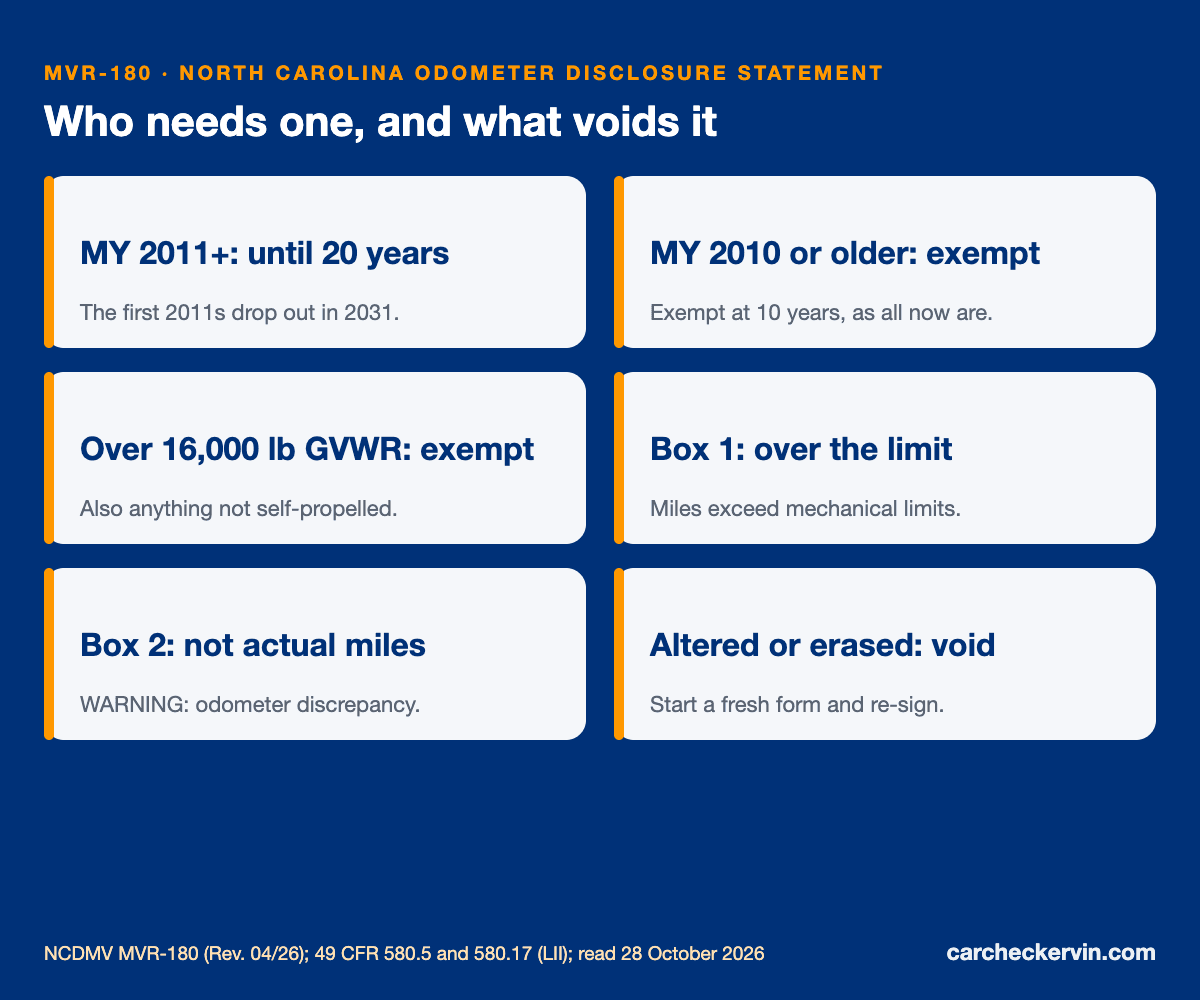
MVR-180 at a Glance
Who signs, which boxes mean trouble and who is exempt, on one card.
From MVR-180 (Rev. 04/26) and 49 CFR 580.5 and 580.17, read on 28 October 2026.
Title Box or a Separate MVR-180?
Federal rules put the disclosure on the title when they can. An owner whose name is on the title makes the disclosure on that title (paper or electronic), not on a separate reassignment document (49 CFR 580.5(c)). A separate document carries it when the vehicle has never been titled, and separate reassignment documents can be used for later transfers only after the titled owner has disclosed on the title (580.5(g)).
Whichever document carries it, the disclosure must show the reading without tenths, the date of transfer, both parties' printed names and current addresses, and the vehicle's make, model, year, body type and VIN, which is exactly the set of fields on the MVR-180. No one may sign as both seller and buyer in the same transaction except under the federal power-of-attorney rules. NCDMV lists MVR-180 among its title and registration forms; if you aren't sure your transaction needs it as well as the title's odometer section, ask a license plate agency before signing.
What voids it, or makes it a red flag
- Any alteration or erasure: the form says it's void. Start a new one.
- Statement 2 ticked: the seller is telling you the reading isn't the real mileage.
- Statement 1 ticked: the odometer has rolled past its mechanical limit.
- Seller signs both lines: not allowed outside the federal POA rules.
Check the Miles Before You Sign the Buyer Line
The buyer's signature acknowledges the reading, it doesn't verify it. Enter the VIN for a free preview of the odometer readings on file.
Mistakes on an Odometer Statement
From the form and the federal disclosure rule.
Writing tenths
Whole miles only; the form and 49 CFR 580.5 both say no tenths.
Correcting a figure
Alterations or erasures void the MVR-180.
Buyer doesn't sign
The buyer's signature acknowledges the reading; both are required.
Missing addresses
Federal rules need both parties' current addresses.
Assuming 10 years exempts a 2011+
From model year 2011, the cutoff is 20 years.
Ignoring a ticked box
"Not the actual mileage" means the reading can't be relied on.
MVR-180 vs. MVR-181
Two one-page disclosures that often travel together in a North Carolina transfer.
MVR-180: Odometer Disclosure
- The mileage, certified by the seller.
- Two exception statements: over the limit, not actual.
- Buyer acknowledges the reading.
- Exempt: over 16,000 lb GVWR, not self-propelled, old enough, some new vehicles.
MVR-181: Damage Disclosure
- The vehicle's damage history, disclosed by the seller.
- Asks about salvage, flood and other damage.
- A separate NCDMV form with its own rules.
- Filed in the same transfer as the MVR-1.
Both are listed on NCDMV's title and registration forms page.
Related Checks and Guides
The other DMV form guides, and the North Carolina and odometer pages they connect to.
Where These Facts Come From
From NCDMV's form and forms page and the federal odometer disclosure rules on Cornell's Legal Information Institute, read on 28 October 2026.
CarCheckerVIN is not affiliated with the North Carolina Division of Motor Vehicles or NHTSA. This page is general information, not legal advice.
MVR-180 — Frequently Asked Questions
What North Carolina buyers and sellers ask most.
Where do I get an MVR-180?+
NCDMV posts it as a PDF (Rev. 04/26) on its title and registration forms page. Print it and complete it in full; any alteration or erasure voids it.
Is a 2012 car exempt from the odometer statement in North Carolina?+
Not yet. From model year 2011, a vehicle is exempt only once it's 20 years old, so a 2012 needs a disclosure until 2032. Model year 2010 and older vehicles are exempt because the 10-year rule applies to them.
What does "WARNING – ODOMETER DISCREPANCY" mean?+
It's the heading on statement 2. The seller has certified that the odometer reading is not the actual mileage. Under the federal rule that statement warns the buyer the reading shouldn't be relied on.
Can I fix a mistake on the MVR-180?+
No. The form says alterations or erasures void it. Complete a new MVR-180 and have both parties sign it again.
Does a trailer need an MVR-180?+
No. A vehicle that isn't self-propelled is one of the exemptions printed on the form, as is any vehicle with a gross vehicle weight rating over 16,000 lb.
Can two sellers both sign the MVR-180?+
There's one seller signature line. The federal rule says that when more than one person is transferring the vehicle, only one of them needs to sign the disclosure.
Run the VIN Before You Acknowledge the Miles
Enter any 17-character VIN for a free preview. The full report lists title brands, NMVTIS junk and salvage records, insurance total-loss records, odometer readings, and auction records with the damage the auction recorded and its photos.
CarCheckerVIN is an independent vehicle-history service and is not affiliated with the North Carolina Division of Motor Vehicles. This guide summarizes NCDMV's form and the federal odometer disclosure rules and is not legal advice. Records in our reports reflect what was reported to our data providers. Our reports do not include police or repair-shop accident entries.
فحوصات رقم الشاصي ذات الصلة
أدوات إضافية للتحقق من تاريخ أي مركبة