North Carolina car title search? NCDMV plus the feds.
North Carolina is unusual: it brands a car at 75% of fair retail value whether or not an insurer ever called it a total loss, and it notarizes the title itself rather than a bill of sale. Here's how to read both — and the multi-state half NCDMV's paper can't show. Preview any VIN free.
Preview any VIN — the multi-state half, free
17-character VIN → title records, brand flags and history counts from the federal file.
Free preview · no card, no account
Quick Answer
- How do I run a car title search in North Carolina?
- Two halves. The official half is NCDMV— North Carolina's own title record for the vehicle. The other half is the multi-state NMVTIS file, previewed free below for any 17-character VIN, covering the other 49 states the car may have lived in. In a state that borders four others and takes Gulf-and-Atlantic storm cars, that second half is where the surprises are.
- What makes North Carolina’s salvage rule different?
- The arithmetic brands the car, not the insurer. North Carolina brands at 75% of fair retail value as stated in the NADA Pricing Guide Book, and the test applies whether or not an insurance company ever declared a total loss. An owner who quietly repairs a badly wrecked car out of pocket does not escape the brand.
- Does a North Carolina title have to be notarized?
- Yes — and this is the detail that catches buyers. North Carolina notarizes the title itself, not a bill of sale: NCDMV says if the original title is a North Carolina title, it must also be notarized, and the MVR-1 Title Application must be signed before a notary. An unnotarized assignment is not a completed transfer.
The 75% rule — why North Carolina brands cars other states wouldn’t
In most states a title brand starts with an insurance adjuster: the insurer declares a total loss, and the brand follows. North Carolina works the other way round — the state measures repair cost against fair retail value in the NADA Pricing Guide Book, and at 75% the car is a Salvage Motor Vehicle regardless of what any insurer did or didn't decide (N.C. Gen. Stat. §§ 20-4.01, 20-71.3).
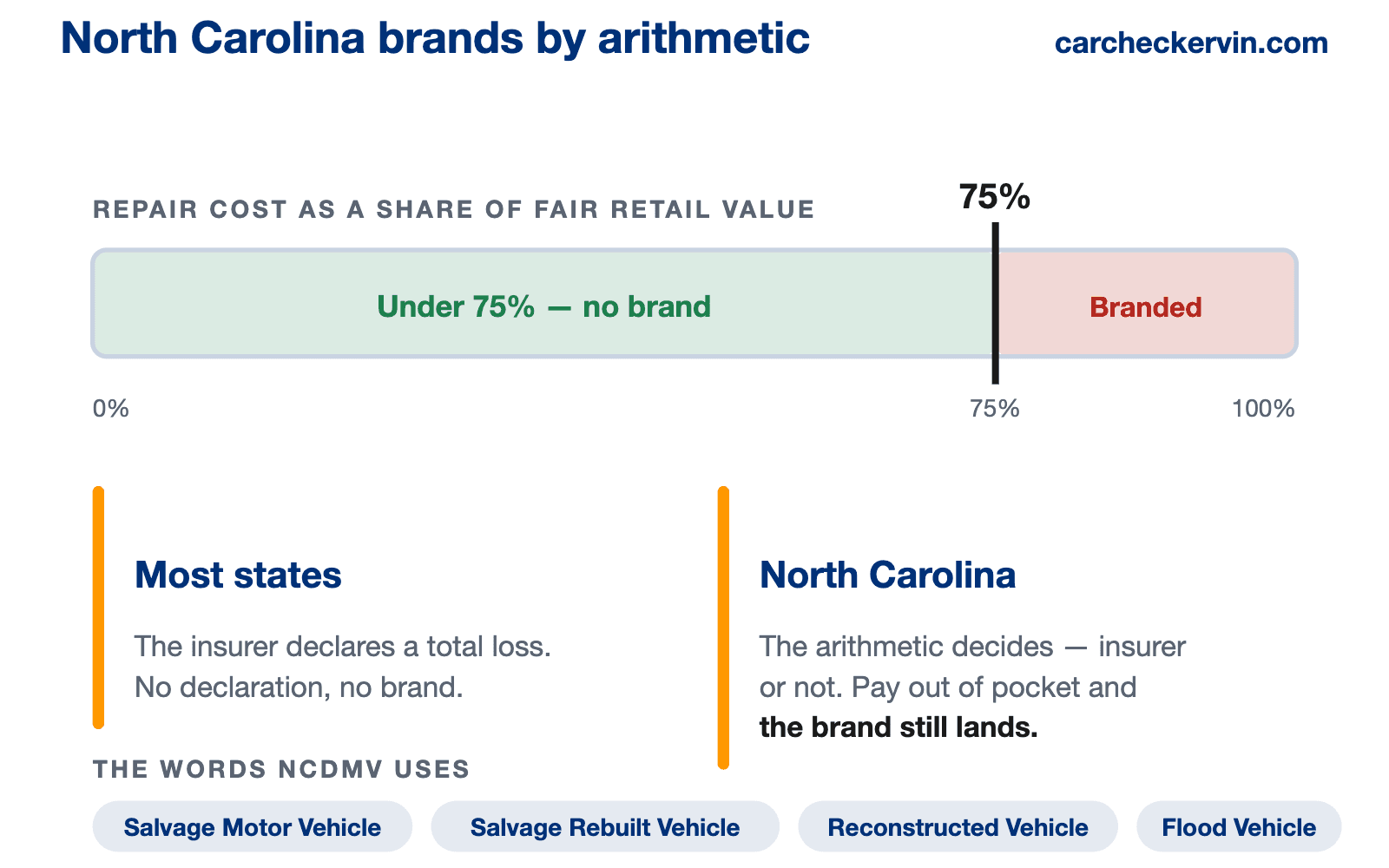
Two consequences for a buyer. First, a North Carolina car with heavy repair history is more likely to carry a brand than the same car repaired in an insurer-trigger state. Second — and this is the one that costs money — an owner who paid cash for repairs and never filed a claim still can't hand you a clean title if the arithmetic crossed the line. The federal file is where you find out whether it did.
The words NCDMV actually uses
North Carolina's vocabulary is more granular than most states', and the distinctions are not cosmetic:
Salvage Motor Vehicle
The base brand once repair cost reaches 75% of fair retail value. Not road-legal as-is; the car has to be repaired and re-titled before it can be registered and driven.
Salvage Rebuilt vs Reconstructed
North Carolina keeps these as two separate brands. Salvage Rebuilt is a wreck that was repaired. Reconstructed means the vehicle was materially altered by removing, adding or substituting major components — a different event entirely, and worth asking which one you're looking at.
Flood Vehicle & Non-U.S.A. Vehicle
Both are branded separately in North Carolina rather than folded into salvage. Flood is self-explanatory and brutal on value; Non-U.S.A. flags a vehicle built for another market, which affects parts, recalls and resale.
A brand on the North Carolina record ends the negotiation or resets the price. A clean North Carolina record on a car that arrived from another state last year settles nothing — which is exactly what the second half of the check is for.
The notarized title — and the trap it creates
North Carolina notarizes the title, not a bill of sale. NCDMV's position is plain: if the original title is a North Carolina title, it must also be notarized, and the MVR-1 Title Application has to be signed in front of a notary. No bill of sale — notarized or otherwise — is required for a private sale. The practical trap: a seller who hands you a signed-but-unnotarized title has not transferred anything. If that title was itself assigned to them without notarization, you may be looking at a car whose paper chain broke one owner ago — and the person selling it may not legally own it. Check the notary block before you check anything else, then run the VIN to see whether the history matches the paperwork.
Reading a North Carolina odometer disclosure
North Carolina uses a stand-alone form and three-letter brand codes, so buyers scanning for a spelled-out warning miss it:
The disclosure form
North Carolina's stand-alone Odometer Disclosure Statement. It carries “ALTERATIONS OR ERASURES VOID THIS FORM” across the top — a struck-through digit is not something to accept and initial, whatever the seller says.
When the title isn’t there
If the title is with a lienholder or lost, the seller declares the reading in Part A of MVR-63A, and the buyer — as attorney-in-fact — copies that reading onto the real title when it arrives. That's a lot of trust to place in a stranger's arithmetic.
The three codes
Not Actual Mileage, Exceeds Mechanical Limits, Odometer Not Certified. NAM is permanent — the state's title manual allows a brand to be updated to a newer statement unless the brand is not actual mileage. ONC can clear at the next sale once buyer and seller both verify the reading. EML isn't a warning at all; it's a five-digit cluster that rolled over.
Three steps, standing in the seller’s driveway
Minutes of homework against the most expensive paperwork mistake in the state.
Check the notary block, then the VIN
An unnotarized North Carolina title isn't a transfer. Read the VIN off the dash and door jamb and confirm it matches the title in front of you — never type a VIN from a listing.
Preview the federal half
Enter the VIN above: records found, title and brand flags from the multi-state file, before any payment. NCDMV's own record covers the North Carolina half.
Unlock the file when it matters
Dates, states, brands and the ownership timeline in under 60 seconds — including the brands another state applied before the car ever reached North Carolina.
Looking at a North Carolina listing right now?
Run the free federal preview — title records, brand flags and history counts for any 17-character VIN.
What each route shows — honestly
All three have a job. Here’s the split:
| Route | What it covers | What it can’t show |
|---|---|---|
| NCDMV title record (official) | North Carolina's own title status and brands for the vehicle | Nothing from the other 49 states — where a washed past hides |
| The paperwork in the seller’s hand | Whether the title is notarized, and what the MVR-180 disclosure says | Only what this seller chose to show you, on paper that can be redone |
| Full NMVTIS report ($14.99, preview free) | Title events and brands from all reporting states, ownership timeline, salvage and flood declarations | Thin-history vehicles can return limited records — the free preview shows what exists before you pay |
The money-saving order: free preview first, NCDMV's record alongside, and the paid file only for the car you're actually about to buy.
Comparing several North Carolina listings?
Previews are free on every VIN. For the finalists, bundles drop the full report to $12.00 each for 3, $11.00 for 5, $9.00 for 10 — credits sit on your account and spend on any VIN, in the Carolinas or out of them.
Related checks for North Carolina buyers
The rest of the Tar Heel homework, one click each.
افحص رقم الشاصي دائماً قبل الشراء
المعاينة المجانية تُظهر علامات سند الملكية وحالة السرقة والاستدعاءات المفتوحة خلال ثوانٍ، وتُشير إلى وجود سجلات حوادث أو عدّاد من عدمه. التقرير الكامل بـ 14.99 دولاراً — دفعة واحدة، بلا اشتراك.
North Carolina title searches — what buyers ask
Including the answers where NCDMV’s own route is the right call.
How do I check a car title in North Carolina?+
NCDMV holds the state's own title record — status and brands for a North Carolina-titled vehicle. The free federal preview here covers the other half: records found and brand flags from the multi-state NMVTIS file for any 17-character VIN. The complete multi-state file, with title events from all reporting states, is $14.99, and the preview tells you first whether there's anything worth paying for.
What is North Carolina's 75 percent salvage rule?+
North Carolina brands a vehicle as a Salvage Motor Vehicle once repair cost reaches 75 percent of its fair retail value as stated in the NADA Pricing Guide Book (N.C. Gen. Stat. §§ 20-4.01, 20-71.3). The unusual part is that the test applies whether or not an insurance company ever declared the vehicle a total loss — in most states the insurer's decision is the trigger; in North Carolina the arithmetic is. An owner who repairs a badly damaged car out of pocket does not escape the brand.
What's the difference between Salvage Rebuilt and Reconstructed in NC?+
North Carolina keeps them as two separate brands. Salvage Rebuilt Vehicle means a salvaged car was repaired. Reconstructed Vehicle means the vehicle was materially altered by removing, adding or substituting major components — which is not the same event as repairing a wreck. If a seller uses the two words interchangeably, ask which one the title actually says, because they describe different histories.
Does a North Carolina car title need to be notarized?+
Yes. North Carolina notarizes the title itself rather than a bill of sale: NCDMV states that if the original title is a North Carolina title, it must also be notarized, and the MVR-1 Title Application must be signed before a notary. No bill of sale is required for a private sale. A signed but unnotarized title means the transfer isn't complete — treat it as a stop sign, not a formality.
What do NAM, EML and ONC mean on a North Carolina title?+
They're North Carolina's odometer brand codes: Not Actual Mileage, Exceeds Mechanical Limits, and Odometer Not Certified. NAM is the serious one and it's permanent — the state's title manual allows a brand to be updated to match a newer odometer statement unless the brand is not actual mileage. ONC can be cleared at the next sale once seller and buyer both verify the reading. EML simply means a five-digit odometer rolled past its limit; it isn't an allegation of fraud.
The car just moved to North Carolina from another state — what should I check?+
This is the case the two halves exist for. The NCDMV record will show one fresh title line and little else, so the multi-state file does the real work: what brands, salvage declarations or flood records the car carried in its previous states. A newly issued North Carolina title on a recently arrived car is the document that proves the least.
I'm comparing several listings — what's the cheapest way to check them all?+
Free previews on every candidate, NCDMV's record alongside for anything already NC-titled, and bundles for the finalists: three full reports for $35.99, five for $54.99, ten for $89.99 — $9.00 each at the top pack, with credits that sit on your account until you spend them.
Check the notary block. Then check the VIN.
The federal preview is free on any VIN — title records, brand flags, history counts. The full multi-state file is $14.99 when the car earns it.
فحوصات رقم الشاصي ذات الصلة
أدوات إضافية للتحقق من تاريخ أي مركبة