What is a rebuilt title — and is it bad?
A rebuilt title means the car was totaled, branded salvage, repaired, and passed a state inspection to drive again. The brand is permanent — the only open question is what happened before it. That's what the records answer.
See what's behind any rebuilt title — free to start
17-character VIN → title chain, brands and flags, before any payment.
Free preview · no card, no account
Quick Answer
- What is a rebuilt title, in one paragraph?
- A rebuilt title is what a state issues when a car that was declared a total loss and branded salvagehas been repaired and passed the state's re-inspection. It means the car may be registered and driven again — and it means the brand, and the wreck behind it, are permanently attached to the VIN.
- Is a rebuilt title bad?
- It's a trade, not a verdict. Branded titles typically knock 30–50% off resale value, insurers vary in what they'll cover, and many lenders decline them — but a well-repaired rebuilt car at the right discount can be a rational buy. The entire question collapses into one thing: what actually happened before the rebuild.
- How do I find out what happened to a rebuilt-title car?
- The title says "rebuilt" — the records say why. Run the 17-character VIN above: the free preview shows the title chain and record counts, and the full report adds the original damage entries and auction photos of the car before repair— the evidence the shiny listing can't retouch.
What the brand changes about owning the car
A rebuilt title isn't just a word on paper — it reroutes almost every practical part of ownership. Side by side with a clean title:
| Part of ownership | Clean title | Rebuilt title |
|---|---|---|
| Registration & driving | Routine in every state | Allowed — that's what the rebuilt inspection unlocks; the salvage stage couldn't be registered |
| Resale value | Sets the market price guides quote | Typically 30–50% below the clean-title equivalent, permanently |
| Insurance | Full menu of coverage | Varies by insurer — some cover fully, some limit the policy types they'll write |
| Financing | Standard loan eligibility | Many lenders decline branded titles; expect fewer options |
| Selling it on | The whole market is your buyer pool | A smaller pool of informed buyers — and the same discount you got, passed along |
None of these lines is a reason to run — they're the price list. A rebuilt car bought at the right discount, with its history verified, is a deliberate trade. Bought at a clean-title price, it's just a loss with paperwork.
How a car earns a rebuilt title
"Rebuilt" is the last step of a sequence that starts with a wreck — and each step leaves records:
Totaled, and branded salvage
An insurer declares the car a total loss — crash, flood, theft recovery — and the title picks up a salvage brand. In this state the car generally can't be registered or driven; it's a repair project with a paper trail.
Repaired, by someone
A rebuilder — professional shop or ambitious amateur — buys the salvage car, often at auction, and repairs it. The quality of this step is the entire difference between a bargain and a liability, and the title says nothing about it.
Inspected, and rebranded
The state inspects the repaired car and, if it passes, issues the rebuilt (or reconstructed) title that makes it road-legal again. The inspection clears it to drive — it is not a certification that every repair was done well.
“Is it bad?” — the three questions that actually decide
The internet argues about rebuilt titles in the abstract. Buyers should ask three concrete questions about the one car in front of them:
What was the original damage?
A hail-total or theft recovery is a different animal from a frame-bending collision or a flood. The damage type and severity live in the records — and in the auction photos taken before anyone repaired anything.
Who rebuilt it, and how?
Ask for the repair invoices, parts receipts and the rebuilder's identity. A professional rebuild comes with paperwork; a driveway rebuild comes with a story. No documents, no benefit of the doubt.
Is the discount actually there?
The brand's price cut belongs to you, not the seller. If a rebuilt car is priced near its clean-title equivalent, the seller is keeping your risk premium — walk, or negotiate from the records.
The title says rebuilt. The records say why.
Title chain, brands and record counts for any 17-character VIN — free, before you fall for the paint.
Reading a rebuilt-title car's history
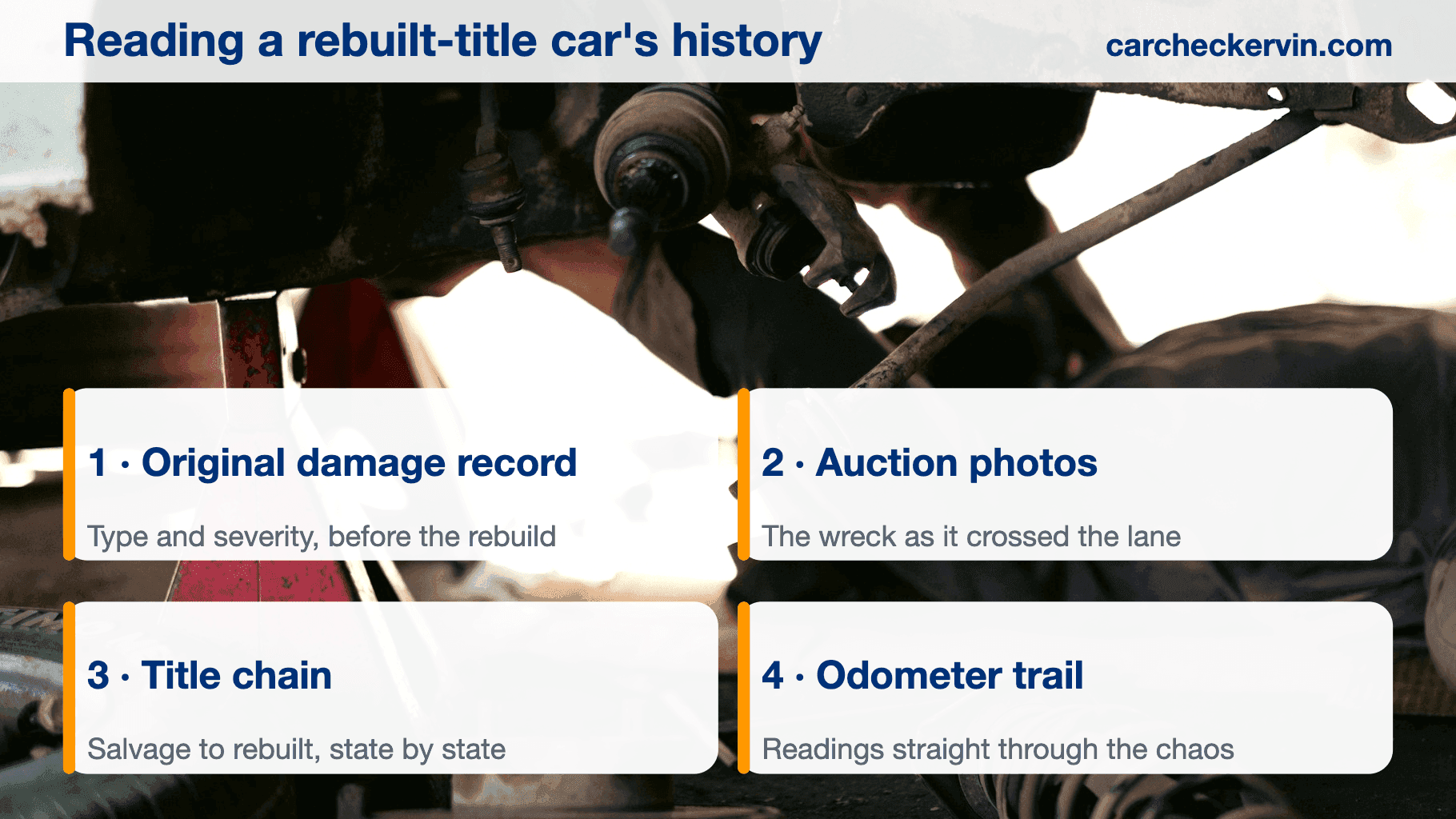
Everything the brand won't tell you sits in the vehicle's file. The sequence a careful buyer reads — original damage, the auction lane where the wreck sold, the title chain that carried the brand, and the odometer through all of it — is exactly what the report lays out, with the pre-repair photos doing the talking the listing never will.
What the report shows on a rebuilt candidate
Six sections of the $14.99 report carry the rebuilt-title story — the same federal NMVTIS data and supporting feeds, read in sequence:
The total-loss filing
The insurer's declaration that started it all — when the car was written off, and the loss type behind the salvage brand.
Damage records, with severity
Reported damage entries from before the rebuild — the difference between cosmetic hail and structural collision, on paper.
Auction photos, pre-repair
The wreck as it crossed the salvage lane, photographed before repair. No listing gallery can argue with these.
The full title chain
Salvage brand, rebuilt brand, and every state along the way — including moves that look like brand-washing attempts.
Odometer through the wreck
Readings across the total-loss, auction and re-title events — a sequence that catches rollbacks hiding in the chaos.
Recalls and factory specs
Open recalls and the build sheet for the exact VIN — what the car should be, to compare against what the rebuilder made it.
Comparing rebuilt candidates against clean ones?
Rebuilt-title shopping is comparison shopping by definition — the discount only makes sense against clean-title alternatives. Packs price the whole exercise:
At $9.00 a report on the 10-pack, verifying every candidate — rebuilt and clean alike — costs a fraction of the risk premium a single undocumented rebuild carries.
The rest of the branded-title map
Definition to decision, page by page.
افحص رقم الشاصي دائماً قبل الشراء
المعاينة المجانية تُظهر علامات سند الملكية وحالة السرقة والاستدعاءات المفتوحة خلال ثوانٍ، وتُشير إلى وجود سجلات حوادث أو عدّاد من عدمه. التقرير الكامل بـ 14.99 دولاراً — دفعة واحدة، بلا اشتراك.
Rebuilt titles — what buyers actually ask
Straight answers, including the ones that favor walking away.
What does a rebuilt title mean on a car?+
It means the car was declared a total loss by an insurer and branded salvage, then repaired and passed a state re-inspection that made it road-legal again. The rebuilt brand replaces the salvage brand's no-registration status — but it stays on the title, and the VIN, permanently. What it doesn't tell you is what the damage was or how well it was fixed; that lives in the records.
Can you register and daily-drive a rebuilt-title car?+
Yes — registration is exactly what the rebuilt inspection unlocks; that's the difference from the salvage stage, which generally can't be driven. Whether it makes a good daily depends on the rebuild, not the paperwork: a documented professional repair of moderate damage can serve for years, while an undocumented flood rebuild is a rolling gamble whatever the state inspection said.
Can you insure or finance a rebuilt title?+
Usually insurable, with caveats: insurers vary, and some limit which coverage types they'll write on branded titles — call yours before buying, not after. Financing is tighter still; many lenders simply decline branded titles, so budget for a cash purchase or expect fewer loan options. Both frictions are part of the discount math, not reasons to panic.
How much less is a rebuilt-title car worth?+
Branded titles — salvage or rebuilt — typically run 30–50% below the clean-title equivalent, and the discount follows the car for life: you should get it when you buy and expect to give it when you sell. If the asking price doesn't reflect it, the seller is pricing you into their risk. Negotiate from the records, or from the parking lot exit.
Does a rebuilt title ever go away or become clean?+
No — brands are permanent and follow the VIN across all reporting states through the federal NMVTIS system. A title that reads clean in a new state after reading rebuilt in the old one isn't a fresh start; it's brand-washing, and the federal record is precisely how buyers catch it. If the paper and the VIN's history disagree, believe the history.
What's the difference between salvage and rebuilt?+
Sequence. Salvage is the insurer's total-loss brand — the car generally can't be registered or driven in that state of life. Rebuilt is what the state issues after repair and re-inspection, restoring road legality. Same car, two chapters. Our salvage-vs-rebuilt page walks the whole sequence and everything downstream of it.
What should I check before buying a rebuilt-title car?+
Three things, in order: the records (original damage type and severity, total-loss filing, pre-repair auction photos — the free preview starts this, the $14.99 report completes it), the rebuild's paperwork (invoices, parts, the rebuilder's name), and an independent mechanic's inspection focused on structure and flood tells. If any of the three comes up empty, the price should fall — or you should walk.
Don't buy the brand's summary. Read the story.
Preview any 17-character VIN free — and when a rebuilt candidate gets serious, the full NMVTIS-backed report with pre-repair auction photos is $14.99.
فحوصات رقم الشاصي ذات الصلة
أدوات إضافية للتحقق من تاريخ أي مركبة