Frame damage? The records saw it first.
“Frame damage reported” is a flag, not a story. The story — which crash, how hard, what the auction photographed — lives in the records behind the VIN, and opening them costs $14.99.
Check any VIN for structural and damage records
17 characters in — the free preview flags title brands, damage records and odometer issues in seconds.
Free preview · no card, no account
Quick Answer
- What does “frame damage reported” mean?
- Somewhere in the car's paper trail, structural damage got recorded— in an accident report, an insurer's damage file, or a salvage auction's structural announcement. Listing sites surface the flag but not the story. The underlying records — which incident, how severe, what the auction photos show — are what a $14.99 VIN report opens.
- Can a car have a clean title and frame damage?
- Yes, and it's common enough that Georgia's consumer protection office warns about it: a clean title only means no lien and no brands — it does not certify the car was never damaged. Damage that never crossed an insurer's totaling threshold stays off the title while still sitting in the history records.
- Should you buy a car with frame damage?
- Only with eyes open: records pulled, repair documented, price cut to match, and the frame measured by a specialist shop — not judged by panel shine. Structural damage follows the VIN for the life of the car, so whatever discount you get walking in, expect to give back when you sell. For most buyers, walking away is the better trade.
Where “frame damage reported” actually comes from
The flag on a listing is the last stop of a paper trail. Four kinds of records feed it — and each one tells you something different about the car:
| The record | What it captures | Where you see it |
|---|---|---|
| Accident reports | Reported crashes with severity where recorded | History reports; the flag on listing sites |
| Insurance damage files | Claims, total-loss declarations, salvage handoffs | Total-loss records and, when branded, the title itself |
| Auction announcements | Salvage lanes disclose structural damage to bidders — with photos | Auction sale records and lane photos in the full report |
| State title brands | Salvage, rebuilt, junk — the official scarlet letters | NMVTIS title records, every state the car ever touched |
Note what's missing: a crash repaired quietly, with no insurer or auction involved, leaves no record at all — which is why the records check and the physical measurement are a pair, not alternatives.
Frame 101 — what actually bends
“Frame” means something different depending on what you're buying, and the difference decides how damage behaves:
Unibody — the body is the frame
Most passenger cars are unibody: shell and structure are one welded piece, so a hard hit anywhere can travel — a rear-corner impact can put the windshield opening out of square. There is no separate frame to swap.
Body-on-frame — bolted to a ladder
Trucks, buses and many large SUVs bolt the body onto a separate ladder frame. Damage localizes in the rails — and a bent rail can hide under a straight-looking bed. The frame is inspectable from underneath, which is where a lift check earns its fee.
Crumple zones are supposed to die
Modern structure sacrifices itself to protect the cabin. Good engineering, hard on repairs: once those zones have folded, the next crash starts from compromised metal unless the repair restored specification — which only measurement proves.
Clean title, bent frame — the disclosure gap
Georgia's consumer protection office spells out what buyers keep learning the hard way — the title and the truth are different documents:
What a clean title actually certifies
No lien and no brands — that's the whole promise. It is not a statement that the car was never crashed, and a car can carry an accident record and a clean title at the same time without anything illegal having happened.
What sellers must volunteer
Less than you'd hope: Georgia's guidance is that dealers generally don't have to disclose prior damage unless you ask. If nobody claims anything about the history, checking it is on you — ask directly, and get every answer in writing.
What protects you
The same office's advice matches this page's whole argument: pull the vehicle history from an NMVTIS source, then have the car independently inspected before you buy. Paper first, then measurement — neither one alone closes the gap.
Signs you can see on the car itself
Body shops publish the same visual checklist — here's what to look for on the walkaround, before any money is at stake:
Visible deformities
Dents, buckling or crumpling on structural areas — rails, aprons, pillars — rather than skin panels alone. Fresh underseal or paint in those zones asks its own question.
Doors and windows that fight you
Misaligned doors, hoods and trunks — anything that needs a slam, catches, or sits proud — hint that the openings they close into are no longer square.
Uneven panel gaps
Gaps that widen or pinch along one seam, or differ side to side, suggest the structure beneath has shifted. Compare left to right; the car is its own reference.
Noises that follow the chassis
Creaks, rattles and squeaks over bumps can be parts rubbing where the structure moved them. New noises on a freshly 'repaired' car deserve suspicion.
A car that won't track straight
Pulling, instability, vibration at speed, or a steering wheel that's off-center on a straight road — alignment symptoms that new tires won't cure if the mounting points moved.
Tires wearing unevenly
Bald shoulders, cupping, or one tire aging faster than its twin: the wheels aren't standing where the factory put them, and the reason may be structural.
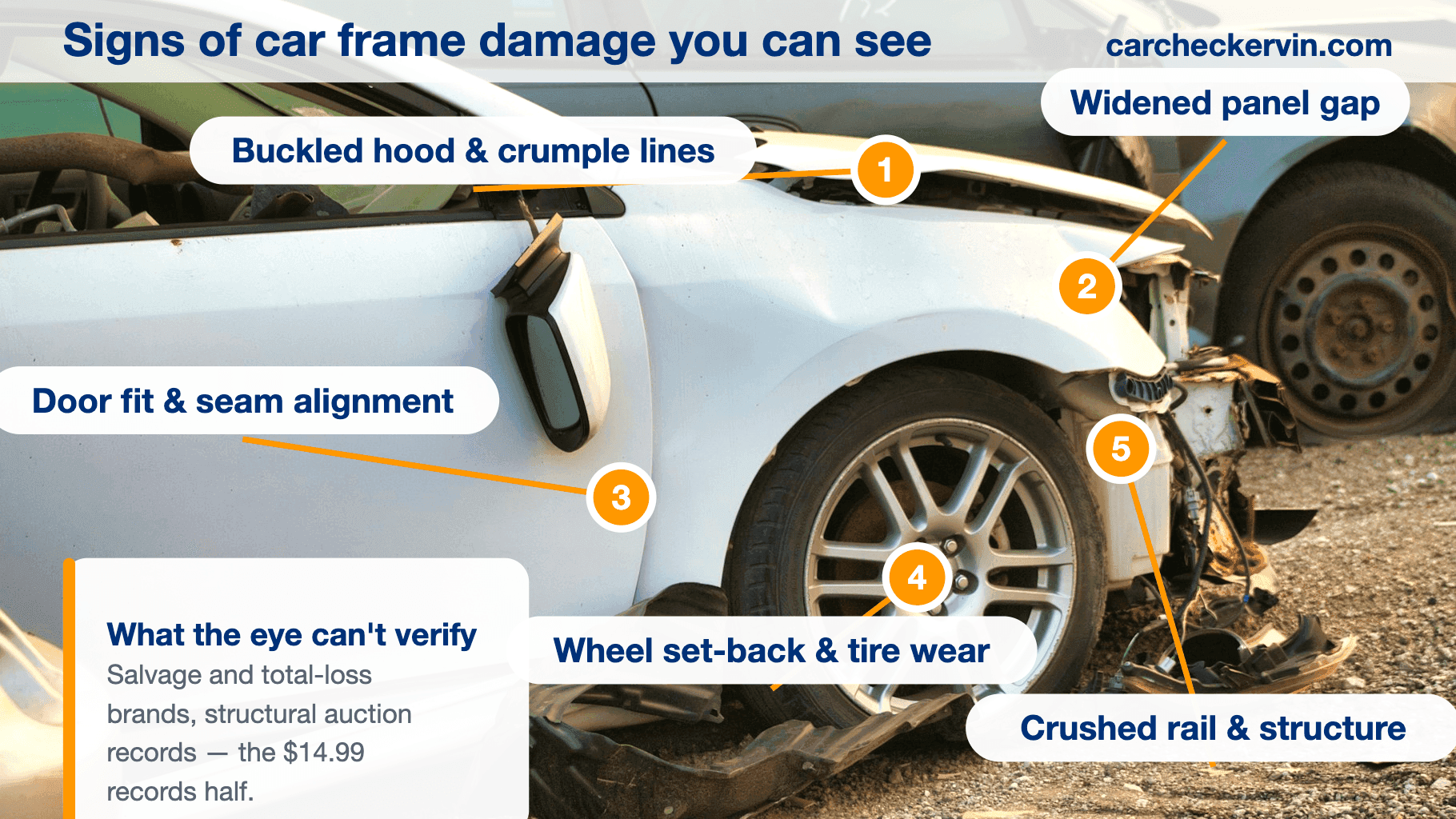
Every sign above can have an innocent cause — that's what makes them signs, not verdicts. The records show whether suspicion has a paper trail; a frame shop's measurement settles it.
Open the records before you fall for the paint
Free preview first: title brands, damage records and odometer flags for any 17-character VIN — the $14.99 full report only if the car needs explaining.
What the records show that your eyes can't
A walkaround sees this month's paint. The report sees the car's whole life — three record types do the structural talking:
Brands from every state
Salvage, rebuilt, junk and flood brands from every state the car was titled in. Re-registering elsewhere doesn't wash the federal record — brand-washing only works on buyers who never look.
Auction photos of the bad day
Cars that crossed a salvage lane were photographed there, structural announcements and all. Lane photos of the same VIN crumpled are the most honest before-picture a used car will ever have.
A timeline that has to add up
Titles, odometer readings and sales in sequence. A car that went quiet after an accident record, then reappeared two states away with clean paper, is telling its story whether the seller does or not.
Buy it, price it, or walk away
Frame damage isn't automatically fatal — it's automatically material. The decision tree is short:
Walk away
Undisclosed structural records, repairs nobody can document, or any mismatch between the records and the story. No discount is big enough for a car that starts with a lie.
Negotiate hard
Documented professional repair, records matching the seller's account, and a price cut well below clean-history examples. The flag follows the VIN forever — your discount going in must survive your resale going out.
Proceed — after measurement
Only when a frame shop has measured the car against factory specification and put the result in writing. That's the one document that outranks both the listing flag and the seller's optimism.
The three-step frame damage check
Cheapest step first — most damaged cars disqualify themselves on paper.
Pull the records for the VIN
Every state title and brand, accident and total-loss records, auction sales with photos, odometer timeline — delivered in under 60 seconds. The free preview alone shows whether damage records exist before you pay anything.
Follow the damage trail
Match what the records show against what the seller told you. A structural auction announcement, a salvage brand in a previous state, or lane photos that contradict the ad each end the conversation — or reset the price.
Put it on a frame bench
For a car you still want, pay a frame shop to measure it against factory datum points — the same trade that straightens frames can tell you whether it was done right. Written results only.
Related reading before you decide
The rest of the damage-history homework, in the same plain terms.
افحص رقم الشاصي دائماً قبل الشراء
المعاينة المجانية تُظهر علامات سند الملكية وحالة السرقة والاستدعاءات المفتوحة خلال ثوانٍ، وتُشير إلى وجود سجلات حوادث أو عدّاد من عدمه. التقرير الكامل بـ 14.99 دولاراً — دفعة واحدة، بلا اشتراك.
Frame damage — the questions buyers ask
Straight answers, including where our report can't help you.
What does “frame damage reported” mean on a listing?+
A record somewhere in the car's history mentions structural damage — an accident report, an insurer's damage or total-loss file, or a salvage auction's structural announcement. The listing shows the flag; the records show which incident, how severe, and what the auction photographed. Pull them before assuming the best or the worst.
The title is clean but frame damage is reported. Is that a scam?+
Usually not — both can be true at once. As Georgia's consumer protection office explains, a clean title certifies there's no lien and no brand, not that the car was never damaged. Damage below an insurer's totaling threshold never touches the title. The scam version — a washed brand — is what the multi-state title records in an NMVTIS-backed report exist to catch.
Is frame damage always a deal-breaker?+
No, but it's always a price-breaker. A properly repaired, professionally measured car can serve for years — at a discount that must persist when you sell, because the record follows the VIN. Walk away when the damage was undisclosed, the repair undocumented, or the story and the records disagree.
Can frame damage be repaired properly?+
Yes — collision shops straighten and realign structures on dedicated equipment. The honest caveat: quality varies enormously, and shine proves nothing. The only acceptable evidence is a frame measurement against factory specification, in writing, from a shop you chose.
Will the report always show frame damage?+
No — and distrust anyone who claims otherwise. Reports show reported damage: police-reported crashes, insurance claims, auction records, title brands. A crash repaired privately can leave no paper at all, which is why the records check pairs with a physical inspection instead of replacing it.
Does frame damage mean the car was totaled?+
Not necessarily. Totaling is an insurer's economic decision — repair cost against value — not an engineering verdict. A car can carry structural damage and stay under that threshold, which is how clean-title frame damage happens. A declared total loss, and any salvage brand it produced, belongs in the report.
How do I check a VIN for frame damage?+
Enter the 17-character VIN above. The free preview shows whether title brands, damage records and odometer flags exist on file — no card, no account. The full $14.99 NMVTIS-backed report opens the detail: every state title, accident and total-loss records, auction sales with photos, and the odometer timeline, delivered in under 60 seconds.
The frame can't talk. The records can.
Brands, damage records, auction photos and the odometer timeline for any VIN — in under a minute, for less than a tank of fuel.
فحوصات رقم الشاصي ذات الصلة
أدوات إضافية للتحقق من تاريخ أي مركبة