How to Buy a Car From a Private Seller (Safely)
Save thousands buying private — without getting scammed. Step-by-step guide to inspection, payment, and title transfer.
Check the car you're reading about
Free VIN decode and recall check
Factory specs and open NHTSA recalls in seconds. No sign-up.

Private-party prices on the same year/mileage car routinely run $2,000-$5,000 below dealer prices because there's no markup, no doc fee, no warranty padding. The catch: there's also no recourse if the car turns out to be broken. This guide gives you the framework to capture private-party savings without taking on private-party risk.
Why Private Saves $2,000-$5,000
Think about the 5-year picture, not the first month of ownership. The car that's $1,500 cheaper today but costs $4,000 more to maintain over 5 years isn't actually cheaper. The "boring" choice that holds resale value is often the smart financial choice. Buyers who optimize for the long term consistently end up with more money in their pockets — and ironically, just as much fun on the road.
Private Saves $2,000-$5,000 matters more than most car buyers realize. The decisions you make at this stage shape the next 5–10 years of ownership cost, reliability, and resale outcome. Skipping the homework here is exactly how buyers end up overpaying or, worse, locked into a vehicle that drains money for years.
In 2026, the used car market is in a different place than it was even two years ago. Inventory has loosened, off-lease vehicles are returning to dealer lots in large numbers, and average prices have softened from their pandemic peaks. That makes buying car from private seller a more rewarding question to answer in 2026 than at almost any time in the last five years — but only if you know what to look for.
Vetting the Seller Before You Drive Out
Before you commit to anything, run through a simple inspection routine. Walk the car from front to back. Check tire wear patterns (cupping or feathering points to alignment or suspension issues). Open the hood and look at the engine bay for oil leaks, corroded battery terminals, and aftermarket wiring that could indicate a poorly executed repair. Inside, sit in every seat, test every switch, and pay close attention to dashboard warning lights when you cycle the ignition.
Test drive for at least 30 minutes if the seller will allow it. Five-minute spins around the block hide everything that matters. You want time at highway speed (transmission shift quality, alignment pull, wind noise), time stopped (idle smoothness, AC performance), and time on rough pavement (suspension noises, steering feedback). Bring a notebook and write down anything that feels off — the human memory is bad at compiling minor issues into a clear picture.
What to test during your drive:
- Highway speed (60+ mph) for at least 10 minutes — listen for vibration, wind noise, transmission behavior
- Hard acceleration from a stop — confirms engine response and transmission shift quality
- Hard braking from 40 mph in a safe area — feel for pulsing or pulling
- Tight parking lot turns at low speed — listen for CV joint clicking
- Highway off-ramp at moderate speed — checks suspension and steering feel under load
What to Bring to the Meeting
A vehicle history report cuts through guesswork in seconds. Pulling a VIN check before you spend hours on a test drive lets you confirm reported mileage, ownership chain, title brand, accident records, and whether the vehicle has been declared a total loss in any state. The $7.99 spend has saved buyers from five-figure mistakes thousands of times — and at this point in the buying process there's no good reason to skip it.
Think about the 5-year picture, not the first month of ownership. The car that's $1,500 cheaper today but costs $4,000 more to maintain over 5 years isn't actually cheaper. The "boring" choice that holds resale value is often the smart financial choice. Buyers who optimize for the long term consistently end up with more money in their pockets — and ironically, just as much fun on the road.
In 2026, the used car market is in a different place than it was even two years ago. Inventory has loosened, off-lease vehicles are returning to dealer lots in large numbers, and average prices have softened from their pandemic peaks. That makes buying car from private seller a more rewarding question to answer in 2026 than at almost any time in the last five years — but only if you know what to look for.
Inspection Walk-Around Checklist
There are a few non-negotiable red flags worth memorizing. Mismatched paint between adjacent panels usually means collision repair. A musty interior smell almost always means water intrusion at some point. Uneven panel gaps suggest frame work. And any seller who refuses to share the VIN before you visit — or insists on a quick cash-only deal — has something to hide. Trust your instincts and walk away when something doesn't add up.
A vehicle history report cuts through guesswork in seconds. Pulling a VIN check before you spend hours on a test drive lets you confirm reported mileage, ownership chain, title brand, accident records, and whether the vehicle has been declared a total loss in any state. The $7.99 spend has saved buyers from five-figure mistakes thousands of times — and at this point in the buying process there's no good reason to skip it.
Knowing when to walk away is the most underrated skill in car buying. There is always another car. Whatever's making your gut uneasy — pressure tactics, missing paperwork, an inspection finding the seller dismisses — is information. Trust it. The buyers who get burned are nearly always the ones who knew something was off but talked themselves into the deal anyway.
What to look for during a walk-around inspection:
- Tire wear patterns (uneven wear points to alignment, suspension, or balance issues)
- Panel gaps and paint match across adjacent body panels
- Underbody for rust, fluid leaks, and aftermarket exhaust hangers
- Engine bay cleanliness, wiring tidiness, and coolant/oil color
- Interior for water-stain rings on carpet, headliner sag, and musty smells
Safe Payment Methods (and What to Avoid)
Get pre-approved before you set foot in a dealership. Credit unions consistently offer the lowest auto loan rates, often 1–3 points below dealer financing. Walking in with a pre-approval letter completely changes the dynamic — the F&I manager has to either beat your rate or lose the financing margin entirely. Either way you win. And never sign a contract you don't fully understand; ask the F&I manager to explain every line item.
Negotiation succeeds when you've done the homework everyone else skips. Know the model's market price range from KBB and Edmunds. Know what comparable cars are selling for in your zip code on AutoTrader. Know the dealer's invoice price (not just MSRP) on a new car or trade-in value on a used one. Walking in with that data turns a high-pressure sales pitch into a calm comparison conversation — and that's where the discount lives.
Safety isn't just an airbag count. Modern crash data from IIHS and NHTSA goes deeper: small overlap front, side impact, roof strength, head restraint geometry, and the effectiveness of standard active-safety features like automatic emergency braking and lane keep assist. The IIHS Top Safety Pick+ rating is the gold standard, and it filters out a surprising amount of the fleet — especially older sedans and budget compacts that aged out of current standards.
Standard active-safety features to look for on used purchases:
- Automatic emergency braking (AEB) — standard on most 2018+ models
- Forward collision warning
- Lane departure warning and lane keep assist
- Blind spot monitoring
- Adaptive cruise control with stop-and-go
Bill of Sale and Title Transfer in Each State
A vehicle history report cuts through guesswork in seconds. Pulling a VIN check before you spend hours on a test drive lets you confirm reported mileage, ownership chain, title brand, accident records, and whether the vehicle has been declared a total loss in any state. The $7.99 spend has saved buyers from five-figure mistakes thousands of times — and at this point in the buying process there's no good reason to skip it.
The paperwork that protects you most: signed bill of sale (with VIN, mileage, and price), original title (signed over by the seller), proof of any active liens being released, current registration, emissions certificate if your state requires one, and a receipt for any deposit. Take photos of all of it before you drive away. If the seller can't produce the title, do not buy the car — period.
No title, no deal
Never buy a car if the seller can't produce a clean original title in their name (or has a documented bonded-title process underway). Bills of sale alone do not transfer ownership — and recovering from this mistake can cost months and thousands of dollars.
Final Thoughts
The single most important step in any private-party purchase is the VIN check. It costs $7.99 and it tells you whether the seller is the actual owner, whether there's a loan against the title, and whether the car has hidden damage history. Skip it and you're trusting a stranger with $15,000 of your money.
About the author
CarCheckerVIN Editorial Team
In-house automotive research team
The CarCheckerVIN editorial team combines decades of automotive industry, dealer, and journalism experience to produce trustworthy buying, selling, and ownership guidance backed by NMVTIS, NICB, and manufacturer data.
Keep reading

Consumers Auto Loan: How to Finance Your Next Car Without Getting Burned
A consumers auto loan is the single biggest variable in your car deal — bigger than the sticker price. Here's how to lock in the best rate before you ever step on a lot.
Oct 16, 2026 · 10 min read
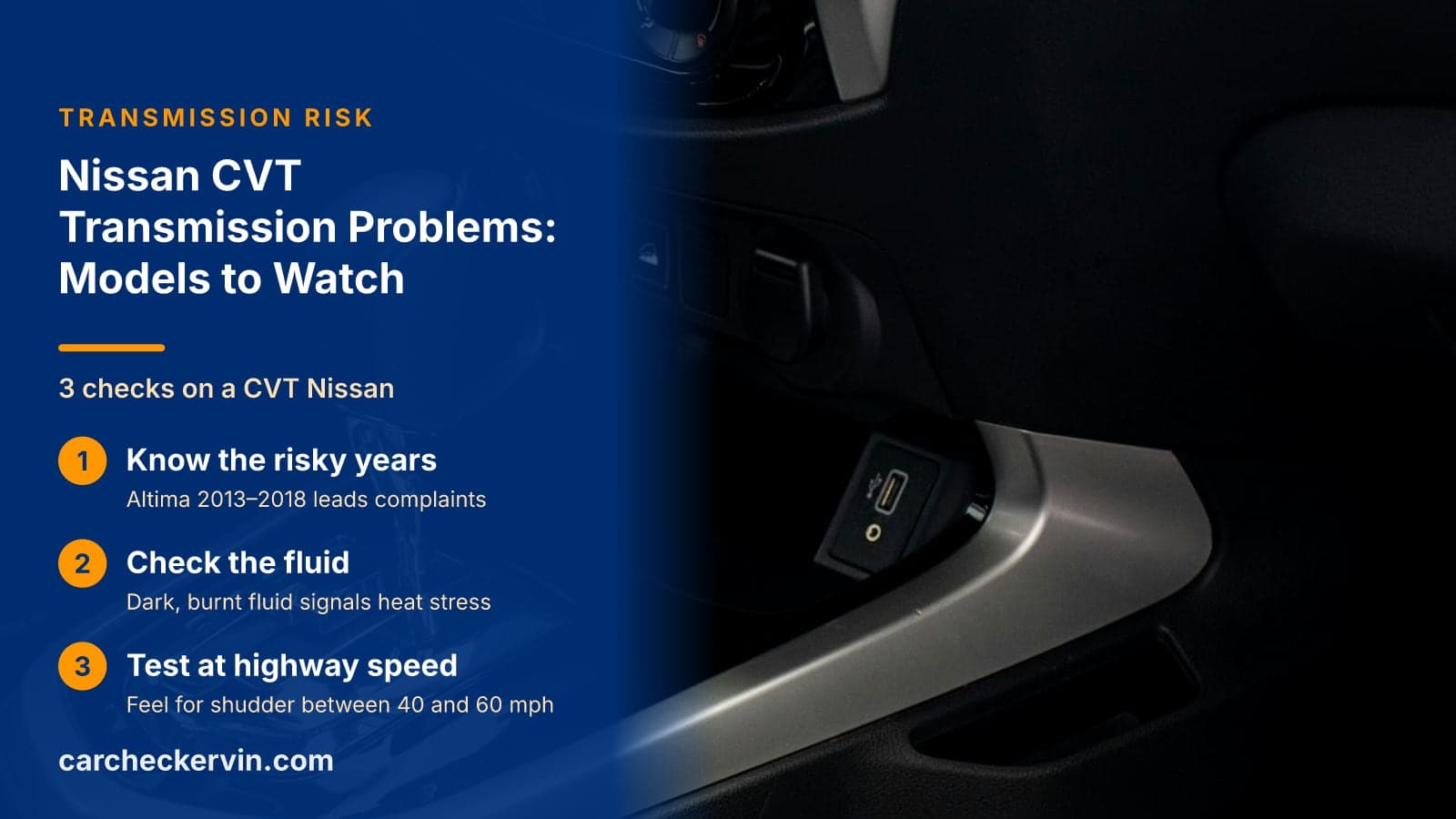
What Nissan Cars Have CVT Transmission Problems — And What to Do Before You Buy
CVT trouble is real across multiple Nissan models. Before you buy a used Altima, Sentra, or Rogue, know which years are risky, what repairs cost, and whether a Nissan CVT transmission recall covers it.
Oct 16, 2026 · 12 min read
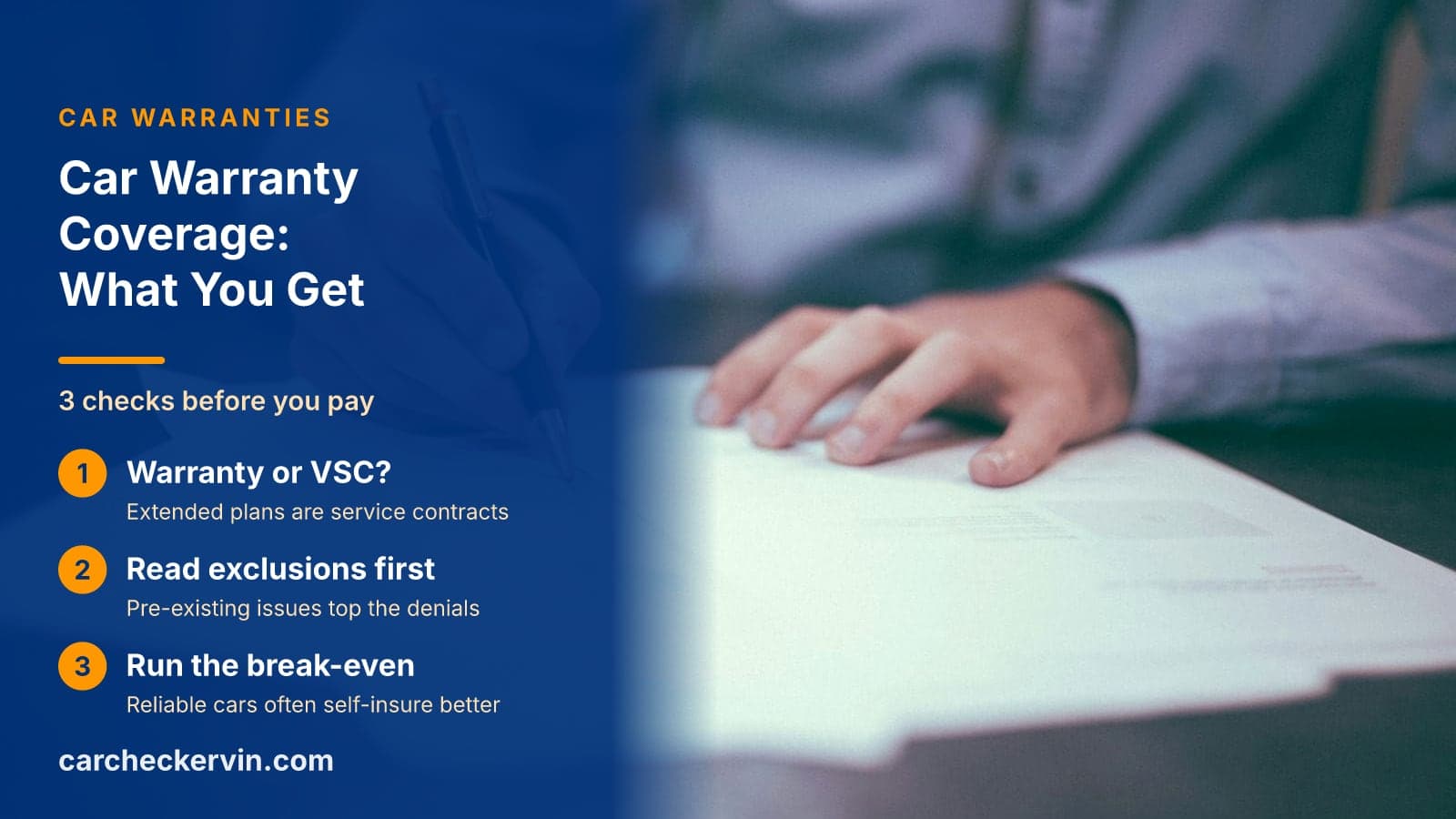
Car Warranty Coverage: What You Actually Get and What to Watch Out For
Before you buy a used car or sign an extended warranty contract, know exactly what car warranty coverage includes, what it excludes, and which plans deliver real value.
Oct 15, 2026 · 11 min read