Title washing — how a wreck gets clean paper.
A salvage car crosses a state line, gets re-titled, and comes back with a clean certificate. The federal system built to stop that is NMVTIS — and the catch is which reports actually contain it.
Check the VIN across every state at once
Any 17-character VIN → title brands from all reporting states, free preview.
Free preview · no card, no account
Quick Answer
- What is title washing?
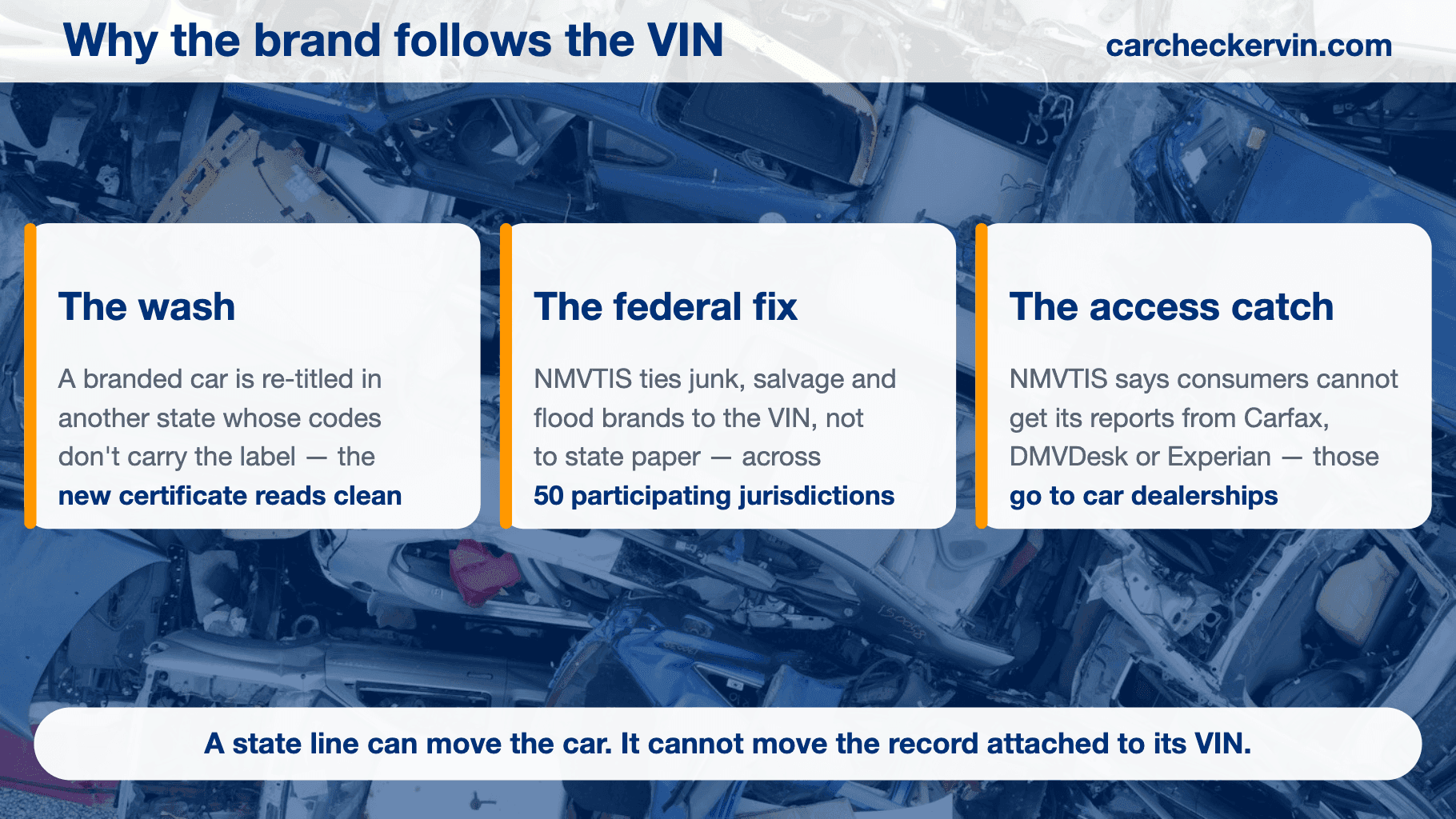
- Moving a branded vehicle between states until the brand falls off the paperwork. A car declared salvage in one state gets re-titled in another whose rules or codes don't carry that brand forward, and the new certificate comes back looking clean — same wreck, better-looking paper.
- What stops it?
- A federal database. NMVTIS — run by the U.S. Department of Justice — exists, in its own words, to protect consumers from fraud and unsafe vehicles and to help states deter title fraud. Brands reported into it stay attached to the VIN no matter which state issues the next certificate.
- Doesn't my usual report already cover that?
- Check which data you're actually buying. NMVTIS states plainly that consumers cannot receive NMVTIS reports from Carfax, DMVDesk or Experian— those firms supply that data to car dealerships. Our report is rendered from ClearVin, an Approved NMVTIS Data Provider on the government's own list.
How the trick actually works
Title washing isn't forgery. It exploits the fact that a certificate of title is, in the federal glossary's words, simply a document issued by a state showing ownership — and states don't all write the same words on it.
A brand is applied
An insurer or state declares the car salvage, junk or flood-damaged. NMVTIS defines a brand as a descriptive label regarding the status of a vehicle — junk, salvage and flood being the examples it gives.
The car moves
The vehicle is sold and re-titled in another jurisdiction. Brand names, thresholds and codes differ between states, so a label that exists in one place may have no exact counterpart in the next.
Clean paper comes back
The new certificate is issued without the old brand. Nothing about the car changed — the flood damage, the structural repair and the write-off are all still there. Only the paperwork improved.
What the brands actually mean
The federal definitions are stricter than the casual usage, and they explain why a washed title matters so much:
Salvage
A vehicle damaged by collision, fire, flood, accident, trespass or another event to the point where its salvage value plus repair cost would exceed what the car was worth immediately before the damage. In plain terms: economically written off.
Junk
A vehicle that cannot legally operate on public roads and has no value except as parts or scrap. A junk vehicle appearing for sale with a clean title is the most serious version of this problem.
Flood
Named directly in the federal definition of a brand. Flood cars are the classic washing target because the damage is invisible on a walk-around and spreads through electronics and wiring for years afterwards.
The federal answer: NMVTIS
The National Motor Vehicle Title Information System is run by the U.S. Department of Justice's Bureau of Justice Assistance, and its stated purpose is exactly this problem: it is designed to protect consumers from fraud and unsafe vehicles, to keep stolen vehicles from being resold, and to assist states and law enforcement in deterring and preventing title fraud. The mechanism is simple and hard to beat — brands reported into NMVTIS are attached to the VIN, not to a piece of state paper. A car branded salvage in one state carries that record when it turns up titled somewhere else. The system reached 50 participating jurisdictions in May 2022, which is why washing across state lines is far harder now than it was a decade ago.
Source: the National Motor Vehicle Title Information System (vehiclehistory.bja.ojp.gov), U.S. Department of Justice, Bureau of Justice Assistance, read August 23, 2026.
One VIN, every reporting state
The whole point of a federal record is that a state line doesn't erase it. See what's on file — free.
The part most buyers get wrong
Knowing NMVTIS exists isn't the same as having it. The government's own page on consumer access is blunt about who can sell you one:
Not available to consumers everywhere
NMVTIS states that consumers cannot receive NMVTIS vehicle history reports from Carfax, DMVDesk or Experian, and that those entities provide the information only to car dealerships. It also notes Carfax offers NMVTIS data to commercial customers in California only.
That isn't a verdict on their reports
Those companies run substantial data sources of their own and may well surface a problem car by other means. The narrow, sourced point is this: the specific federal dataset built to defeat title washing isn't what a consumer buys from them.
Who can sell you one
NMVTIS publishes its Approved Data Providers for public customers — among them Bumper, Carsforsale, CarVertical, CheckThatVIN, ClearVin, EpicVin, GoodCar, TitleCheck and VinAudit. Our report is rendered from ClearVin, on that list.
Spotting a washed title before you pay
The paperwork in front of you is the one thing that's been curated. These are the signals that survive it:
A recent out-of-state title
A car titled in another state within the last year or two, especially one that moved from a strict brand state to a looser one, deserves a federal check rather than a glance at the certificate.
Price well under the market
A washed title still hides a wrecked or flooded car, and sellers price to move it. A number that seems generous is the market telling you something the paper isn't.
Gaps and rapid transfers
Several owners in quick succession, or a stretch of time with no registration at all, often bracket the period when the damage happened and the repair was done.
Damage the eye can't see
Flood cars in particular pass a walk-around. Musty smells, corrosion on unpainted bolts under the seats, and electrical faults that come and go matter more than a clean-looking title certificate.
The brands behind a washed title
What each label means, and how to check for it by VIN.
افحص رقم الشاصي دائماً قبل الشراء
المعاينة المجانية تُظهر علامات سند الملكية وحالة السرقة والاستدعاءات المفتوحة خلال ثوانٍ، وتُشير إلى وجود سجلات حوادث أو عدّاد من عدمه. التقرير الكامل بـ 14.99 دولاراً — دفعة واحدة، بلا اشتراك.
Title washing — asked and answered
Straight answers, sourced from the federal system that exists to stop it.
What is title washing?+
It's the practice of moving a branded vehicle through different states until the brand no longer appears on its certificate of title. A car written off as salvage or damaged by flood in one state is re-titled in another whose brand names, thresholds or codes don't carry the original label forward, and the replacement certificate looks clean. The vehicle is unchanged; only the paperwork has been laundered.
Is title washing illegal?+
Knowingly concealing a vehicle's branded history to sell it is fraud, and the federal government treats the underlying problem as a crime-prevention issue: NMVTIS is described by the Department of Justice as a tool that assists states and law enforcement in deterring and preventing title fraud and other crimes. Some washing also happens through inconsistency rather than intent, when states simply don't use matching brand definitions — which is why the federal record matters more than any single certificate.
How does NMVTIS stop title washing?+
By attaching the record to the VIN instead of to a state document. NMVTIS is run by the U.S. Department of Justice's Bureau of Justice Assistance and is designed to protect consumers from fraud and unsafe vehicles and to keep stolen vehicles from being resold. When a state or insurer reports a junk, salvage or flood brand, that record follows the vehicle identification number — so a fresh certificate from a different state doesn't erase it. The system reached 50 participating jurisdictions in May 2022.
Can I get an NMVTIS report from Carfax or Experian?+
Not as a consumer. NMVTIS states directly that consumers cannot receive NMVTIS vehicle history reports from Carfax, DMVDesk or Experian, and that those entities provide the information only to car dealerships — noting that Carfax offers NMVTIS data to commercial customers in California only. That is not a judgement on those companies' own datasets, which are substantial. It simply means the specific federal record built to defeat title washing isn't part of what you buy from them. NMVTIS publishes a list of Approved Data Providers who do serve consumers, and our report is rendered from ClearVin, which appears on it.
What's the difference between a washed title and a rebuilt title?+
A rebuilt title is honest: the state is telling you this vehicle was written off and has since been repaired and inspected. A washed title is the opposite — it's a certificate that has had the history removed, so nothing warns you at all. The practical difference shows up in price and insurance: a rebuilt car is discounted because everyone can see what it is, while a washed car is sold at clean-title money precisely because the buyer can't.
Which cars are most often washed?+
Flood vehicles are the classic case, because the damage is invisible on a walk-around and the federal definition of a brand names flood explicitly. Large flood events put thousands of written-off cars into the market at once, and some resurface states away with clean paperwork. Structural write-offs follow the same route: the federal salvage definition covers any vehicle whose salvage value plus repair cost exceeds its pre-damage market value, which describes a great many cars that look presentable once panels are straightened.
How do I check a VIN for a washed title?+
Run the 17-character VIN against the federal record rather than reading the certificate you were handed. The free preview here shows whether title-brand records exist on the VIN at all; the full NMVTIS-backed report — $14.99, or $13.49 with the one-time VIN10 code — lists the title records by state along with salvage, total-loss and odometer history. If the paper in the seller's hand says clean and the federal record says salvage, you have your answer before any money moves.
A state line can move a car. It can't move the record.
Check any 17-character VIN against title brands from every reporting state — free to preview, $14.99 for the full NMVTIS-backed report.
فحوصات رقم الشاصي ذات الصلة
أدوات إضافية للتحقق من تاريخ أي مركبة