Bird Dog in Car Sales — What It Pays and Where It's Legal.
A bird dog is someone who sends a buyer to a car dealer and gets paid if that person buys. Dealers usually pay a flat $50–$250 per car. Whether they are allowed to pay you at all depends on your state, and several states say no unless you hold a salesperson license.
Sending Someone to Buy a Car?
Have them check the car's title, salvage and odometer records first. Enter the VIN for a free preview.
Free preview · No sign-up · No owner or personal data
Quick Answer
- What is a bird dog in car sales?
- A bird dog is a person who refers a car buyer to a dealership or a salesperson and gets a fee if that buyer purchases. Past customers, friends of a salesperson and people who work around cars are the usual bird dogs. The name comes from hunting: a bird dog finds the game, and the hunter takes the shot.
- How much is a bird dog fee in car sales?
- Usually a flat $50–$250 per car sold, according to the dealer-software company AutoRaptor. Some dealers advertise more: Cole Chevrolet GMC in West Virginia offers up to $300 for each referral who buys or sells a vehicle. The fee is paid only if the person you sent actually buys.
- Is bird-dogging legal?
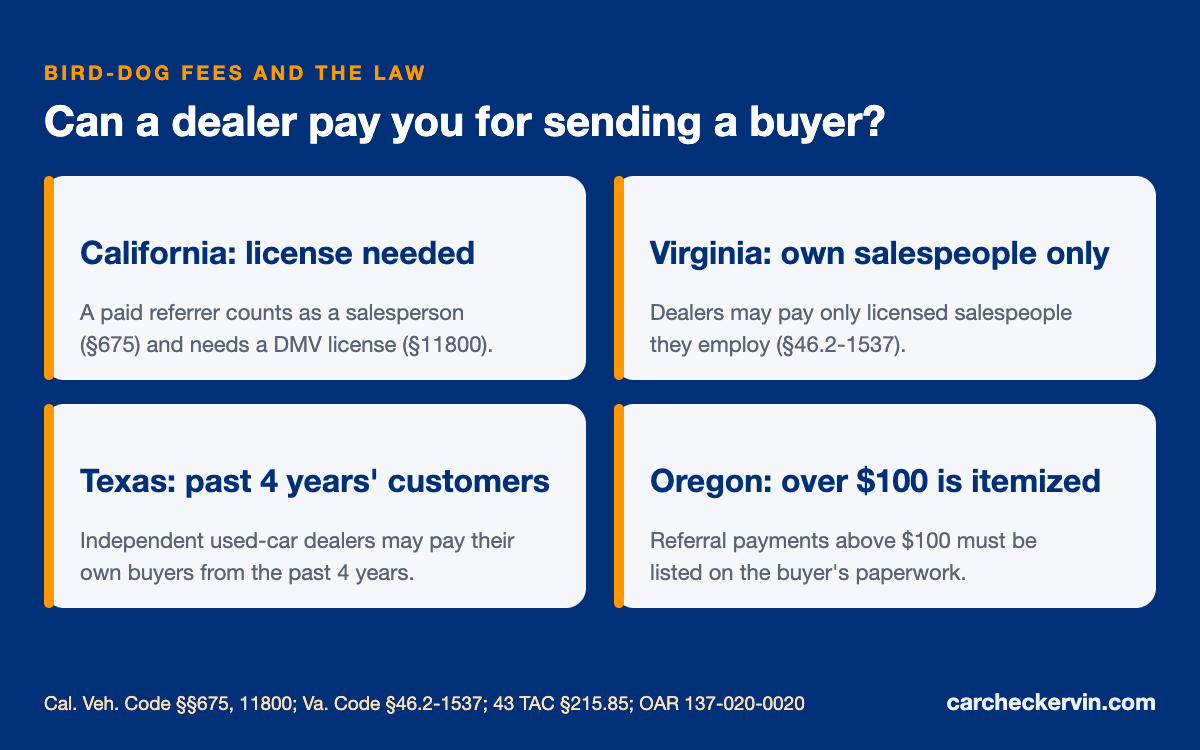
- It depends on the state. California treats anyone paid to steer a buyer to a car as a salesperson who needs a DMV license. Virginia lets dealers pay sale-related compensation only to their own licensed salespeople. Texas lets independent used-car dealers pay referral fees only to people who bought from them in the past 4 years.
Five checks before you accept a bird-dog fee
A referral fee is easy money only if the dealer is allowed to pay it and the buyer is not misled. These checks take a few minutes.
- 1Ask whether the dealer can pay youSome states only allow payments to licensed salespeople. A dealer that cannot pay you legally may simply never pay.
- 2Get the terms in writingThe amount, what counts as a sale, and when the money arrives. A text or email from the sales manager is better than a handshake.
- 3Tell the buyer you are paidThey should know your tip is not neutral. In Oregon, referral payments over $100 go on their paperwork anyway.
- 4Send them with a VIN checkYour fee depends on a sale, so let the car's history speak for it. A clean report protects your name.
- 5Record it as incomeA referral fee is taxable income. Keep the dealer's payment record with your tax papers.
What a Bird Dog Does in Car Sales
In car sales, a bird dog is anyone who finds buyers for a salesperson without selling the car themselves. They mention a dealer to a friend who is shopping, send the salesperson a name and number, and collect a fee if the friend drives home in a car from that lot. Dealers call it a referral program, a friends-and-family reward or a bird-dog program; it is the same arrangement.
The usual bird dogs are past customers, the salesperson's own circle, and people who meet car buyers every day: mechanics, detailers, tow drivers and car-club organizers. The word is borrowed from hunting, where a bird dog locates the birds so the hunter can take the shot. Outside cars, the term also shows up in real estate, where it means someone who finds properties for investors — a different job with different rules.
How Much Is a Bird Dog Fee?
Most bird-dog fees are flat amounts paid per car. AutoRaptor, which sells customer-management software to dealers, says the usual range is $50–$250, paid when the person you referred buys. Some dealers pay more to stand out: Cole Chevrolet GMC in Bluefield, West Virginia, advertises up to $300 for every referral who buys or sells a vehicle.
Oregon's consumer rules give a useful benchmark. A dealer there must list any payment it makes to an outside party in connection with a sale on the buyer's purchase order and finance contract, except a referral fee of $100 or less, which the rule itself calls a “bird-dog” payment. In other words, Oregon treats $100 as an ordinary referral and anything bigger as something the buyer should see.
What decides the fee
- Per car, not a percentage: the fee is usually flat, whatever the car's price.
- Only on a completed sale: a referral who looks and leaves earns nothing.
- State law: in some states the dealer cannot pay an unlicensed person at all.
Where Bird-Dog Fees Are Legal: Four State Rules
California's Vehicle Code defines a vehicle salesperson to include anyone who “induces or attempts to induce” a person to buy a vehicle and expects a commission, fee or anything of value for it (§675), and makes acting as a salesperson without a DMV license unlawful (§11800). The DMV's dealer guide spells out what that means under the heading “Use of Bird Dogs”: it includes paying a referral or finder's fee to anyone who directs a customer to a dealer. Virginia is just as direct: §46.2-1537 bars dealers and salespeople from paying compensation in any form to anyone in connection with a sale unless that person is a licensed salesperson employed by the dealer.
Texas takes a narrower path. Arranging a used-car sale for a fee counts as dealing and needs a dealer license, but the rule makes one exception: an independent used-car dealer may pay a referral fee to someone who bought a vehicle from that dealer in the past 4 years (43 Tex. Admin. Code §215.85). The Texas DMV's notice on the rule says franchised dealers are not included. Oregon does not ban the payment; it requires dealers to itemize third-party payments on the buyer's paperwork unless the referral fee is $100 or less.
Why States Restrict Bird-Dog Fees
States license the people who sell cars so that someone accountable stands behind every pitch a buyer hears. A paid referrer does part of that job — persuading someone to buy — without the license, the background check or the rules that come with it. That is why California writes the bird dog into its definition of a salesperson rather than treating the fee as a simple thank-you.
The other concern is the buyer. A friend's recommendation carries weight because it sounds disinterested. Oregon's answer is disclosure: payments above the referral threshold appear on the purchase documents. Where the law is silent, the safest habit is the same one: tell the person you referred that the dealer pays you.
Bird-Dog Fee vs Affiliate Commission
Both pay you for sending a buyer. They differ in who pays, when, and how many of your contacts can earn you something.
Bird-dog fee from a dealer
- Paid by one dealership, only when a car sells
- Usually $50–$250 per car
- Restricted or banned for unlicensed people in some states
- Only buyers who choose that dealer count
Affiliate commission on a VIN report
- Paid when someone buys a vehicle history report
- $2.00 per report, up to $7.00 per pack
- No car sale and no dealer involved
- Any used-car buyer counts, from any seller
The amounts are smaller, but every used-car buyer should run a report, not only the few who buy from one lot.
Refer Car Buyers Without Going Through a Dealer
Our car affiliate program pays $2.00 for every report and up to $7.00 for every report pack bought through your link. Share it with anyone shopping for a used car, wherever they buy.
See the car affiliate programWere You Sent to a Dealer by a Friend?
If a friend or a mechanic sent you to a particular lot, they may be earning a referral fee. That does not make the advice bad, but it is fair to ask. A recommended dealer is still selling you a specific car, and that car has its own history.
Before you sign, run the VIN. A report shows title brands, salvage and junk records, odometer readings and ownership history, so the recommendation stands or falls on the car rather than on who sent you. Ours costs $14.99, with a free preview of which records exist first.
Taxes on Bird-Dog Fees
A referral fee is income, whether it arrives as cash, a check or a gift card. Record each payment with the date and the dealer's name, and include the total when you file. If you earn referral fees regularly, keep the dealer's confirmations with your records: they are the evidence if a figure is ever questioned.
Related Checks and Guides
Related guides for referrers and for the buyers they send.
Where These Facts Come From
The rules and fees on this page come from the statutes, rules and dealer pages themselves, read on 29 September 2026.
Dealer licensing rules change and differ by state. Check your state's DMV or dealer board before you accept a referral fee.
Vérifiez toujours le VIN avant d’acheter
L’aperçu gratuit affiche les mentions au titre, le statut de vol et les rappels ouverts en quelques secondes, et signale s’il existe des dossiers d’accident et d’odomètre. L’historique complet est à 21,99 $ CAD — paiement unique, sans abonnement.
Bird Dogs in Car Sales — Frequently Asked Questions
Fees, the law and taxes.
What does bird dog mean in sales?+
A bird dog is someone who finds prospects for a salesperson and is paid when one of them buys. In car sales it means sending a buyer to a dealer for a referral fee. In real estate the term usually means someone who finds properties for investors.
How much do dealerships pay for referrals?+
Commonly $50–$250 per car sold, paid only when the referred person buys. Some dealers advertise more, such as up to $300 per referral at Cole Chevrolet GMC in West Virginia.
Can a car dealer pay a referral fee in California?+
Not to an unlicensed person. California's Vehicle Code treats anyone paid to induce a vehicle sale as a salesperson who needs a DMV license, and the DMV's dealer guide says this includes paying a referral or finder's fee to someone who directs a customer to a dealer.
Can a car salesman pay a bird dog out of their own commission?+
Not in Virginia: §46.2-1537 bars both dealers and salespeople from paying compensation, directly or indirectly, to anyone who is not a licensed salesperson employed by the dealer. Other states write their rules differently, so check yours.
Do I have to pay taxes on a bird-dog fee?+
Yes. A referral fee is income, whether it is paid in cash, by check or as a gift card. Keep a record of each payment.
Is an affiliate link the same as bird-dogging?+
Both pay you for a referral, but an affiliate link earns a commission on a product rather than on a car sale. Our program pays $2.00 to $7.00 when someone buys a vehicle history report through your link, with no dealer involved.
Sending Someone to Buy a Car? Send a VIN Check With It
A referral is only as good as the car at the end of it. Enter the VIN for a free preview of title brands, salvage records and odometer readings before anyone signs.
This guide is general information, not legal or tax advice. Dealer licensing rules differ by state and change over time; confirm with your state's DMV or dealer board. CarCheckerVIN is not affiliated with any dealership or software company named on this page.
Vérifications VIN connexes
Plus d'outils pour vérifier l'historique de tout véhicule