Bonded Title Texas — the $15 application, the 1.5× bond and the three-year clock.
A Texas bonded title is how you title a vehicle you own but can't prove you own: the seller vanished, the title was signed wrong, or there never was one in your hands. You file Form VTR-130-SOF with a TxDMV Regional Service Center and pay $15. TxDMV values the vehicle, then you buy a surety bond for 1.5 times that value, and the county tax office issues the title. Section 501.053 of the Transportation Code ends the bond on its 3rd anniversary. Here is every step, the forms in order, and the rules that disqualify a vehicle.
Run the VIN Before You Pay for It
TxDMV checks NMVTIS for title brands before it sets the bond. Check the same VIN first: a junk or salvage record can end the bonded route before it starts.
Free preview · No sign-up · No owner or personal data
Quick Answer
- How do you get a bonded title in Texas?
- Take or mail Form VTR-130-SOF, your evidence of ownership, any lien releases and photo ID to the TxDMV Regional Service Center for your county with the $15 fee. If approved, TxDMV issues a Notice of Determination (VTR-130-ND) naming the bond amount. Buy a surety bond for that amount within 1 year, then within 30 days take the notice, the bond and Form 130-U to your county tax office.
- How much does a bonded title cost in Texas?
- TxDMV charges $15. The bond itself is 1.5 times the value TxDMV sets, so a vehicle valued at $6,000 needs a $9,000 bond; you pay the surety a premium for it, which the surety sets. The county then charges its usual title fee and the motor vehicle sales tax figured on Form 130-U, and a vehicle never titled in Texas needs a law-enforcement VIN inspection.
- How long does a Texas bonded title last?
- The bond lasts 3 years: § 501.053(d) says it expires on the third anniversary of the date it took effect. During that time anyone who loses money because the title was issued (a prior owner, a lienholder, a later buyer) can sue on the bond, up to its amount. The statute does not say the title itself carries a "bonded" remark, and neither does TxDMV.
Five steps from no title to a Texas title
Two offices are involved. TxDMV's Regional Service Center decides eligibility and the bond amount; the county tax assessor-collector issues the title.
- 1Check eligibilityTexas resident or military stationed in Texas, the vehicle in your possession, complete, not junked or nonrepairable, and no lien under 10 years without a release.
- 2File VTR-130-SOFBoth pages, $15, evidence of ownership and photo ID, at the Regional Service Center that serves your county. Add VTR-68-A if the vehicle has no Texas record.
- 3Get the Notice of DeterminationForm VTR-130-ND states the bond amount: 1.5 times the value TxDMV set from the SPV, a national guide or an appraisal.
- 4Buy the surety bondFrom an agency licensed to sell vehicle surety bonds in Texas, within 1 year of the notice, or the notice has to be redone.
- 5Title it at the countyWithin 30 days of buying the bond: Form 130-U, the notice, the original bond (VTR-130-SB) and your documents at the county tax office.
What a Texas Bonded Title Is
Texas will not title a vehicle without evidence that you own it. When that evidence is missing or defective, the Transportation Code offers two ways around it. Section 501.052 lets you ask the county tax assessor-collector for a hearing. Section 501.053, the bonded-title route, lets you file a bond instead, "as an alternative to the procedure provided by Section 501.052", if the vehicle is in your possession and there is no security interest on it, any lien is at least 10 years old, or you produce releases of every lien.
The bond is the state's insurance policy against being wrong. Under § 501.053(b) it must be issued by a company authorized to do surety business in Texas, equal 1.5 times the vehicle's value as TxDMV determines it, and indemnify every prior owner and lienholder and every later buyer or lender against loss, "including reasonable attorney's fees", caused by issuing you the title or by a defect or undisclosed lien in your claim. Anyone harmed has a right of action on the bond; the surety's total liability to all of them is capped at the bond amount. And § 501.053(d) ends it: "A bond under this section expires on the third anniversary of the date the bond became effective."
Who Qualifies, and What Disqualifies a Vehicle
TxDMV's page and the eleven questions on VTR-130-SOF sort applicants before any bond is priced.
A Texas resident or Texas-stationed military
TxDMV limits the bonded route to Texas residents and military personnel stationed in Texas. The form asks both questions, plus whether the vehicle was ever titled in Texas.
The vehicle is in your possession
Section 501.053(a) requires possession, and the form asks separately about legal possession and legal control. If either answer is no, you give the vehicle's location and explain.
A complete vehicle
Running isn't required, but a car or pickup needs a motor, body and frame; a motorcycle a motor and frame; a trailer a bed, frame and axle assembly. An incomplete vehicle will not be titled.
No lien under 10 years without a release
A recorded lienholder from the last 10 years must sign a release or a letter of no interest. Without one you are not eligible, and TxDMV points you to a court order instead.
Not salvage, nonrepairable or junked
Section 501.053(f) bars a bonded title for a salvage or nonrepairable motor vehicle. TxDMV adds junked vehicles. A repaired salvage vehicle needs a Rebuilt Vehicle Statement (VTR-61) on the form.
Assembled and imported vehicles
A newly assembled vehicle or kit needs VTR-61 and an ASE inspection on VTR-64 or VTR-852. A vehicle not built for sale in the United States needs proof it meets U.S. DOT safety rules, or evidence that it is an assembled vehicle.
Step One: The Regional Service Center
The application goes to the TxDMV Regional Service Center that serves your county, in person (appointments can be booked online for the same or next day) or by mail. Bring both pages of VTR-130-SOF, the $15 processing fee (check or money order by mail, cash in person, non-refundable), whatever evidence of ownership you have (a bill of sale, invoice, canceled check, a defective title), any lien releases, and photo ID. An ID that expired no more than 12 months ago counts as current. The form's last line is a warning: falsifying it is a third degree felony.
If the vehicle has never been titled or registered in Texas, add a VIN inspection by an auto theft investigator on Form VTR-68-A. TxDMV doesn't perform these; local law enforcement or a Motor Vehicle Crime Prevention Authority grantee does. Before it issues a Notice of Determination, TxDMV runs its own checks. Its department-use block on the form records whether it searched the state record, whether it checked the stolen file and ISO ClaimSearch (VIN decoding) when there is no Texas record, and whether NMVTIS returned any brand: Salvage, Junk, Flood Damage, Replica, Rebuilt Salvage, Reconstructed, Manufacturer's Buyback, Not Actual Mileage.
Take to the Regional Service Center
- VTR-130-SOF: both pages, every question answered.
- $15: check or money order; cash in person only.
- Ownership evidence: bill of sale, invoice, canceled check.
- Lien releases: for any lien under 10 years.
- VTR-68-A: if the vehicle has no Texas record.
The Bond Amount and the Forms at a Glance
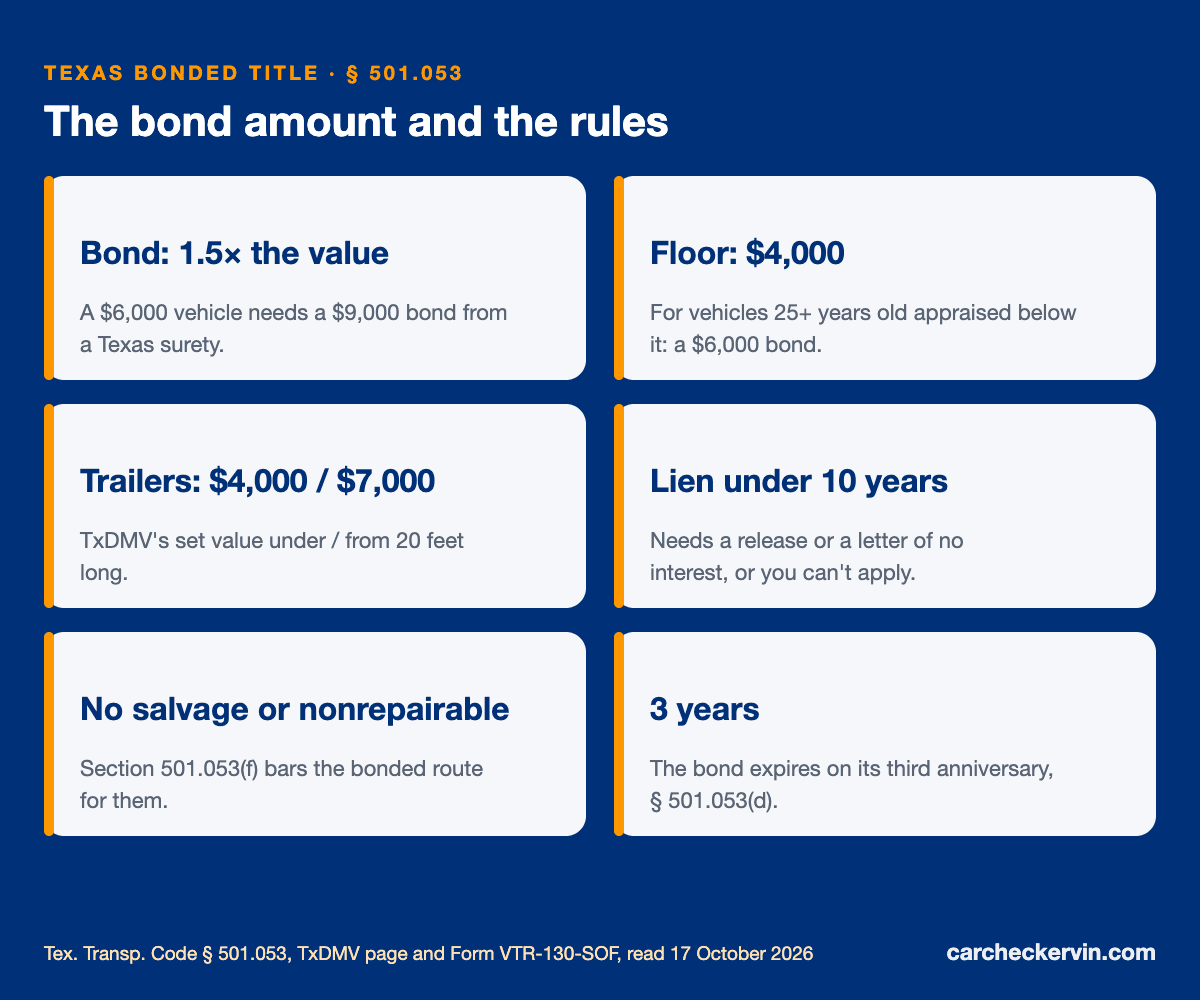
The money and the paperwork on one card: the fee, the multiplier, the value floor for older vehicles, the trailer values and the two deadlines that follow the notice.
Every figure comes from § 501.053 and TxDMV's own page and form, read on the date shown.
How TxDMV Sets the Bond Amount
TxDMV values the vehicle with its Standard Presumptive Value (SPV) calculator first, a national reference guide if the SPV returns nothing, and an appraisal on Form VTR-125 by a licensed dealer or insurance adjuster as the last resort (dated, and submitted within 30 days). The bond is 1.5 times that value. Worked amounts, computed the same way:
| Vehicle and value used | Bond amount |
|---|---|
| Trailer under 20 feet (TxDMV's set value): $4,000 | $6,000 |
| Car 25+ years old appraised below the floor: $4,000 | $6,000 |
| Car with a $6,000 value: $6,000 | $9,000 |
| Trailer 20 feet or longer (TxDMV's set value): $7,000 | $10,500 |
| Pickup with a $12,000 value: $12,000 | $18,000 |
| SUV with a $25,000 value: $25,000 | $37,500 |
Two shortcuts set the value for you. A vehicle 25 or more years old appraised under $4,000 is valued at $4,000, and its owner may choose an appraisal over the guide value. A trailer or semitrailer can take TxDMV's set value: $4,000 under 20 feet, $7,000 at 20 feet or longer. What you pay the surety for the bond is a premium the surety sets, not the bond amount.
Steps Two and Three: The Notice, the Bond, the County
An approved application comes back as a Notice of Determination for a Bonded Title or Tax Assessor-Collector Hearing (Form VTR-130-ND) with the bond amount on it. Take it, and the documents the Regional Service Center returns, to an auto insurance agency or any agency licensed to sell vehicle surety bonds in Texas. You have 1 year from the notice date to buy the bond; after that TxDMV requires a new notice and a new bond amount.
Within 30 days of buying the bond, file at your county tax assessor-collector's office: Form 130-U, both pages of VTR-130-SOF, the original VTR-130-ND with its enclosures, the original bond on Form VTR-130-SB (with the surety's power of attorney if it came with one), any lien releases, your ownership evidence and photo ID. To register as well as title, add a Texas vehicle inspection report (or a VIN certification on VTR-270 where one of its options applies) and proof of liability insurance in your name. Out-of-state commercial vehicles, or any vehicle whose weight can't be determined, need a certified weight certificate. Form 130-U also computes the motor vehicle sales and use tax due on the purchase.
Every Form in the Texas Bonded Title File
In the order you meet them. Form numbers are TxDMV's, read on 17 October 2026.
| Form | What it is | When you need it |
|---|---|---|
| VTR-130-SOF | Bonded Title Application or Tax Collector Hearing Statement of Fact | Always; filed with the Regional Service Center |
| VTR-68-A | Law Enforcement Identification Number Inspection | The vehicle has no Texas title or registration record |
| VTR-125 | Motor Vehicle Appraisal for Tax Collector Hearing / Bonded Title | TxDMV can't value the vehicle, or a 25+ year-old vehicle's owner opts to appraise |
| VTR-61 | Rebuilt Vehicle Statement | A repaired salvage vehicle, or a newly assembled vehicle |
| VTR-64 / VTR-852 | ASE inspection | A newly assembled vehicle or kit |
| VTR-130-ND | Notice of Determination | Issued by TxDMV; states the bond amount |
| VTR-130-SB | The surety bond | Bought from the surety; the original goes to the county |
| 130-U | Application for Texas Title and/or Registration | Always; filed at the county tax office |
| VTR-270 | Vehicle Identification Number Certification | Registering, where its certification options apply instead of an inspection report |
Check the Title Brands Before You Apply
Enter the VIN for a free preview of the NMVTIS title brands, junk and salvage records and odometer readings on file for it, the same kind of record TxDMV checks before it sets your bond.
The Hearing Instead of a Bond
The same form, VTR-130-SOF, starts a tax assessor-collector hearing. Section 501.052 gives anyone aggrieved by TxDMV's refusal to issue a title the right to apply for a hearing to the assessor-collector of the county where they live. The assessor-collector must hold it no earlier than the 11th day and no later than the 15th day after receiving the application, the applicant and TxDMV may both submit evidence, and the decision binds both of them. An applicant who loses can appeal only to the county or district court of their county of residence, and must do it no later than the 5th day after receiving the decision.
Some vehicles can't get a hearing at all. Section 501.052(f) excludes titles for salvage or nonrepairable vehicles and any vehicle that is the subject of pending litigation, that a court has awarded to someone else, or that is held as evidence in a criminal investigation; an assessor-collector who receives such an application must deny it. The bond route has its own bar on salvage and nonrepairable vehicles in § 501.053(f). And when a recent lienholder won't sign a release, TxDMV's advice is a court order awarding ownership free of the lien, with TxDMV itself not named as a party.
Hearing deadlines, § 501.052
- Day 11–15: the assessor-collector holds the hearing.
- Binding: on you and on TxDMV.
- 5 days: to appeal to county or district court.
- Excluded: salvage, nonrepairable, litigated or evidence vehicles.
Bonded Title, Hearing or Court Order
Three ways to a Texas title without good ownership papers, from the statute and TxDMV's page.
Bonded title, § 501.053
- $15 to TxDMV plus the surety's premium on a 1.5× bond.
- Lien under 10 years needs a release.
- No hearing, no court; the county issues the title.
- The bond runs 3 years, then expires.
Hearing (§ 501.052) or a court order
- Hearing: the county decides between day 11 and day 15; 5 days to appeal.
- Hearing: no bond is bought; the decision binds TxDMV.
- Court order: TxDMV's route when a recent lienholder won't release.
- The hearing is closed to salvage and nonrepairable titles (§ 501.052(f)).
Which is faster depends on your county; the statute fixes only the hearing's 11-to-15-day window.
Before You Buy a Vehicle That Has No Title
TxDMV puts its bonded-title instructions on a page called "Bought a Vehicle Without a Title?", and that is who needs them: someone who paid for a truck, got a bill of sale, and never got a title signed over. The bonded route can fix the paperwork, but not every vehicle survives the checks. TxDMV looks up the state record, the stolen file and ISO ClaimSearch when there is no Texas record, and NMVTIS for brands such as Junk, Salvage, Flood Damage and Not Actual Mileage. A junk or nonrepairable record ends the bonded route under § 501.053(f), and a lien from the last 10 years ends it unless the lender signs off.
So run the checks a buyer can run before money changes hands. Read the VIN on the vehicle itself, not only on the paperwork, and make sure the two match. Check the NMVTIS title history for brands and junk or salvage reports, and the odometer readings on file. Ask the seller for the lienholder's name if there was a loan. And price the bond in: on a $12,000 pickup the bond amount is $18,000, and the premium for it is yours to pay.
Related Checks and Guides
The national bonded-title explainer, the other Texas title pages, and what to read if the vehicle turns out to be salvage.
Where These Facts Come From
From the Texas Transportation Code as published by the Texas Legislature, and TxDMV's page and forms, read on 17 October 2026. TxDMV updates its forms; use the current version from its site.
CarCheckerVIN is not affiliated with the Texas Department of Motor Vehicles, any county tax office or any surety company. This page is general information, not legal advice. Bond premiums and county fees are not quoted because neither the statute nor TxDMV sets them.
Texas Bonded Title — Frequently Asked Questions
What Texas applicants ask most.
What is VTR-130-SOF?+
It is TxDMV's Bonded Title Application or Tax Collector Hearing Statement of Fact: page one describes the vehicle, the applicants and how you got the vehicle, and asks 11 yes-or-no questions about residency, possession, salvage status and completeness; page two lists what to file. You submit both pages with $15 to a TxDMV Regional Service Center.
Can I get a Texas bonded title for a vehicle from another state?+
Yes, if you are a Texas resident or military stationed in Texas and the vehicle is in your possession. If it has never been titled or registered in Texas, you also need a VIN inspection by an auto theft investigator on Form VTR-68-A, which TxDMV does not perform.
Can I get a bonded title if the car has a lien?+
Only if the lien is at least 10 years old, or you provide a release or letter of no interest from every lienholder on a lien younger than that. Otherwise TxDMV says you are not eligible and suggests a court order awarding you ownership free of the lien.
Can I get a bonded title on a salvage car in Texas?+
Section 501.053(f) says a person may not obtain a title under the bond procedure for a salvage or nonrepairable motor vehicle, and TxDMV excludes junked vehicles too. A salvage vehicle that has been repaired is handled with a Rebuilt Vehicle Statement (VTR-61); see our Texas rebuilt title page.
How is the Texas bond amount calculated?+
It is 1.5 times the value TxDMV assigns, from its SPV calculator, then a national guide, then a VTR-125 appraisal. A vehicle 25 years or older appraised under $4,000 is valued at $4,000, so its bond is $6,000.
What happens when the Texas title bond expires?+
Section 501.053(d) ends the bond on the third anniversary of its effective date; until then, anyone harmed by the title's issue can recover on it, up to the bond amount. Neither the statute nor TxDMV's page says the title carries a "bonded" notation, so ask your county tax office before relying on a surety's claim that it does.
Run the VIN Before You Apply
Enter any 17-character VIN for a free preview. The full report lists title brands, NMVTIS junk and salvage records, insurance total-loss records, odometer readings, and auction records with the damage the auction recorded and its photos.
CarCheckerVIN is an independent vehicle-history service and is not affiliated with the Texas Department of Motor Vehicles or any county tax assessor-collector. Requirements are summarized from the Texas Transportation Code and TxDMV's published page and forms and are not legal advice. Records in our reports reflect what was reported to our data providers. Our reports do not include police or repair-shop accident entries.
Vérifications VIN connexes
Plus d'outils pour vérifier l'historique de tout véhicule