Car appraisal by VIN: what the number includes — and misses
The big appraisal tools all start from your VIN, because it pins the exact car. Every appraisal also assumes the history behind that VIN is clean. Preview the records behind it free, before the offer is on the desk.
Run the history half of the appraisal now
Free preview: auction records, damage notes, open recalls and photos on file against the VIN.
256-bit encrypted · No sign-up · Instant
At the car? Scan the VIN with the app
Free · no account · iOS 17+

Quick Answer
- How do I get a car appraisal by VIN?
- The major valuation tools start from the VIN because it removes the guesswork about what the car is: KBB, NADA, Carfax, Edmunds, CarGurus, Carvana and JD Power — the whole first page of results — all take a VIN or plate. The VIN pins the exact year, make, model, trim, engine and assembly plant — the difference between pricing a 2019 pickup and pricing your 2019 pickup.
- Why do two appraisals of the same car differ?
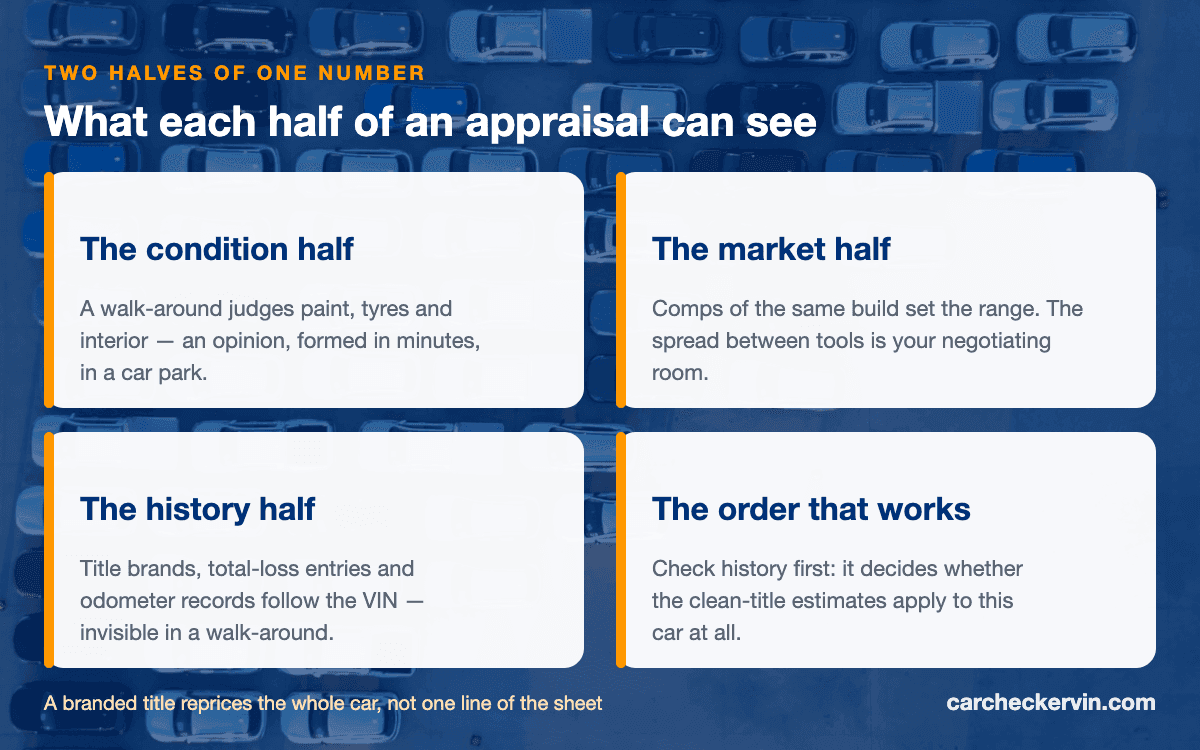
- Because an appraisal is two judgements stacked: the car's condition (which is an opinion formed in a walk-around) and the market (which comps the appraiser trusts and how fast they need to resell). A dealer pricing for auction risk, an instant-cash site pricing for volume and an insurer pricing a total loss are answering different questions — off the same VIN.
- What does the appraisal number quietly assume?
- That the history file is clean. The tools price trim and mileage, but a salvage or rebuilt brand, an insurer total-loss entry, a junkyard record or an odometer that reads lower than a past title event each reprice the car — sometimes by more than any option package. The free preview here shows the first warning signs — auction and damage records against the VIN — and the full report opens the title and odometer file itself.
What an appraisal actually reads off the VIN
The seventeen characters do four jobs in a valuation, and only the first two are the ones people think of:
The exact build
Year, make, model, trim, engine and assembly plant come straight out of the seventeen characters. An appraisal keyed to the wrong trim prices the wrong car — the quietest error on the sheet.
The right comps
Valuation tools match your VIN's build against recent sales of the same configuration. A rare engine or package changes which sales count as comparable — and therefore the number.
A mileage cross-check
Odometer readings are recorded at title events. An appraisal takes the dash at its word; the title history is where a rollback shows, and it is the cheaper of the two to check first.
The history file
Title brands, insurer total-loss declarations and junk or salvage entries follow the VIN through the federal system. None of them appear in a walk-around, and every one of them moves the price.
Where to get the estimate itself
We do not sell appraisals, so this is simple to say plainly: for the market-value half, use the established tools — KBB, NADA, Edmunds, CarGurus and Carvana all return a VIN-based estimate, and Carfax publishes a history-adjusted one. Collect two or three; the spread between them is itself information about how negotiable the number is.
What none of the instant tools show you is the federal history file behind the VIN. That is the half this site covers — free at preview depth, $14.99 for the full report — and it is the half that decides whether the estimates above even apply.
Four steps to a defensible appraisal
The order matters: the cheap checks come first, and the negotiation comes last, after you know what the file says.
- 1Decode the buildFree. Know the exact trim and engine before anyone prices the wrong car.
- 2Preview, then verifyFree counts flag trouble; the full report opens the brands, total-loss and odometer file.
- 3Collect estimatesTwo or three VIN-based numbers from the big tools. The spread is the negotiating room.
- 4Then sit downWalk in with the build sheet, the history and the comps. The desk has fewer surprises left.
Verify the clean-history assumption first
Free preview of the warning signs behind the VIN — then $14.99 for the full title and odometer file if the counts earn it.
The rest of the value question
Vérifiez toujours le VIN avant d’acheter
L’aperçu gratuit affiche les mentions au titre, le statut de vol et les rappels ouverts en quelques secondes, et signale s’il existe des dossiers d’accident et d’odomètre. L’historique complet est à 21,99 $ CAD — paiement unique, sans abonnement.
Car appraisal by VIN — frequently asked
Is a car appraisal by VIN free?
Getting the estimate itself usually costs you nothing — Edmunds describes its own appraisal tool as free, and its peers behave the same way. What no instant estimate does is verify the car's past. The history half is a separate lookup: our preview of the warning signs is free, and the full title and odometer file is a one-off report, so you can weigh both sides before taking any offer seriously.
Which appraisal site is most accurate?
The honest answer is that none of them is 'the' number — they are estimates built for different buyers. KBB leans on its own market data, Carfax adjusts for history it holds, dealer desks price in their auction risk, and instant-cash offers price in certainty. Getting two or three and understanding why they differ tells you more than hunting the single accurate one. Where they all converge is the input: the VIN.
Can an appraisal be wrong about my trim or options?
Yes, and it is worth catching before you accept a number. Tools that decode the VIN get the factory build right almost by definition, but a hurried human appraisal keyed from year-make-model can price a base trim when you own the top one. Decode your own VIN first — it is free — and walk in knowing what the seventeen characters say the car is.
How much does a salvage or rebuilt title change an appraisal?
Enough that it is usually the largest single adjustment on the sheet — a branded title reprices the whole car rather than one line of it. The honest ranges depend on the damage type and the buyer, and our salvage value calculator walks through them; the point for an appraisal is simpler: if a brand exists, every clean-title estimate you have collected is the wrong starting number.
Do I need the history if the appraiser will check it anyway?
Run it yourself first, for the same reason you check your own credit before a mortgage meeting. If the file is clean, you walk in knowing the clean-title estimates apply. If it is not, you find out privately — a free preview of the warning signs, then the full file for the price of a lookup — rather than across a desk mid-negotiation, and you decide what to disclose, dispute or reprice before someone else frames it for you.
What does this site add to an appraisal?
The half the valuation tools assume: the history. The free preview shows the auction records, damage notes, open recalls and photos on file against the VIN, and the $14.99 full report opens the title brands, total-loss entries and odometer readings themselves. It does not replace an appraisal — it tells you whether the appraisal's clean-history assumption holds.
The appraisal prices the car. The history prices the appraisal.
Know both halves before the number is agreed — the first look at the second one is free.
No sign-up · Preview first · Instant
Vérifications VIN connexes
Plus d'outils pour vérifier l'historique de tout véhicule