Carfax report for my car — see it before buyers do.
Every serious buyer will run your VIN. Running it first — free to preview, $14.99 in full — means you find the surprises, fix the errors, and price the car with proof instead of hope.
Preview your own VIN free — what buyers will see
17-character VIN → records on file, brands and flags, before any payment.
Free preview · no card, no account
Quick Answer
- How do I get a Carfax report for my own car?
- The same way a stranger would — which is exactly the point. Reports are keyed to the VIN, not the owner: type your 17 characters at carfax.com and pay $39.99–$44.99, or preview the records free here and unlock the full NMVTIS-backed report for $14.99. Owning the car earns you no discount anywhere — just easier access to the VIN.
- Is there a free Carfax report for my own car?
- No — ownership doesn't unlock a free full report. Carfax's owner-side product is its maintenance app and the report library of things you already bought. What is free, for any owner: the preview here — record counts, title brands and odometer flags for your VIN before you pay anyone.
- Why check a car I already know the history of?
- Because buyers won't read your memory — they'll read the file. The record can hold surprises you never caused: a mis-keyed odometer entry, a brand attached in error, an accident you thought went unreported. Finding them before a buyer's report does is the difference between fixing a problem and losing a sale.
What a buyer's report says about your car — and your price
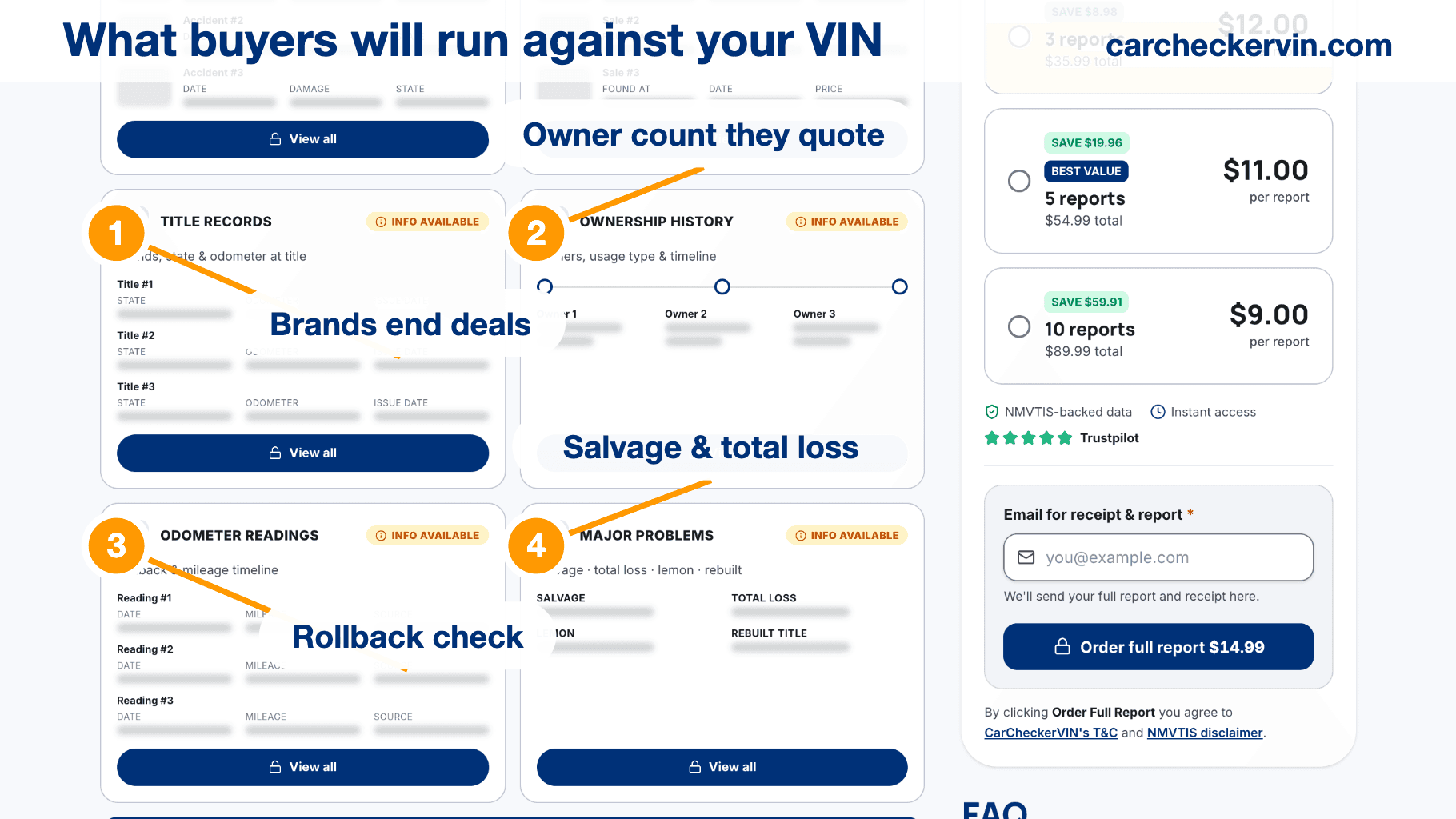
Whoever the buyer pays, their report reads the same federal file. Each section lands on your asking price in a specific way:
| Report section | What the buyer sees | What it does to your sale |
|---|---|---|
| Title brands | Salvage, rebuilt, flood or lemon brands from any state, ever | A surprise brand doesn't lower your price — it stops the conversation |
| Odometer trail | Every recorded reading, in sequence, across transfers | One mis-keyed entry reads as rollback until you can explain it |
| Accident & damage records | Reported entries with severity where recorded | "Minor, repaired, documented" beats a buyer discovering it alone |
| Total-loss & salvage filings | Insurer write-offs and salvage-yard reports | If one exists, your listing needs to lead with the story, not hide it |
| Auction history & photos | Wholesale lane appearances, with photos where available | An auction past isn't fatal — an undisclosed one is |
The pattern: nothing in the file is as damaging as the buyer finding it before you did. The report is $14.99; the mid-negotiation surprise costs the deal.
Three jobs the report does for a seller
Sellers don't buy history reports out of curiosity — they buy leverage:
Find the file's surprises first
Records are filed by states, insurers and yards — and clerks mis-key things. A wrong odometer digit or a brand on the wrong VIN sits quietly until a buyer's report surfaces it at the worst moment. Your own run finds it while there's still time to act.
Price with proof attached
A clean report next to your asking price ends the "how do I know?" conversation before it starts. Buyers negotiate hardest against uncertainty; a documented history removes the discount they'd charge you for it.
Keep the negotiation on your terms
When you already know what the file says, no buyer can ambush you with it. The seller who says "yes, that entry — here's the repair invoice" keeps the price; the seller who looks surprised doesn't.
The “free Carfax for my car” answer, honestly
Half this search hopes ownership unlocks a free report. What actually exists on the owner's side:
Carfax's owner tools are an app
What Carfax offers owners is its maintenance app — service alerts and recall notices for cars you register — plus access to reports you've already purchased. Neither is a free full history report on demand.
Listing perks belong to listings
The free reports you see attached to cars for sale are bought by platforms and dealers as marketing for those specific listings. Your driveway sale doesn't come with one until you buy it.
The owner's real free option
The preview here is free for any VIN, including yours: record counts, title brands, odometer flags. Plenty of owners learn what they need from that alone — the $14.99 unlock is for when you want the full file buyers will read.
Your VIN is on the title in your drawer. Run it.
The free preview shows what's on file for your car right now — before a buyer's report turns it into a negotiation.
When your car's file is wrong
Sometimes the pre-listing check finds an entry that isn't true — a reading transposed at a title transfer, a brand that belongs to a different VIN, damage severity that doesn't match what happened. That's precisely why you run the report early: records are corrected at the source, through whoever filed them — the state that keyed the transfer, the insurer that reported the loss — and that process takes correspondence and documentation, not minutes. A seller who discovers an error two weeks before listing fixes it or gathers the paperwork that explains it. A seller who discovers it during a buyer's test-drive phone call watches the deal walk. Run the file, read every line against your own records, and start any dispute while the car is still in the driveway.
Selling with the report in hand
Once the file is clean — or explained — put it to work:
Date it close to the listing
History files gain records, not lose them. A report run the week you list carries more weight than one from last spring — and at $14.99, re-running it near the sale date is cheap insurance.
Share the PDF, expect a re-run
Attach the report to your listing or hand it over on request. Serious buyers will still run their own — that's healthy. Two independent reports agreeing is the strongest trust signal a used-car sale gets.
Pair it with your paper trail
The report shows what was filed; your invoices show what was fixed. Together they answer the two questions every buyer is silently asking: what happened to this car, and was it handled?
Selling one now, another later?
Households turn over cars in waves — and flippers run VINs constantly. Report credits don't expire with a listing: check the car you're selling now for $29.98 less than one retail Carfax covers two runs here, or hold pack credits for the next title that lands in the drawer:
Credits sit on the account until a VIN needs them — this month's sale, next year's trade-in, or the shortlist when you become the buyer again.
Both sides of the report question
Selling this month, buying the next — the same file, read from either chair.
Vérifiez toujours le VIN avant d’acheter
L’aperçu gratuit affiche les mentions au titre, le statut de vol et les rappels ouverts en quelques secondes, et signale s’il existe des dossiers d’accident et d’odomètre. L’historique complet est à 21,99 $ CAD — paiement unique, sans abonnement.
Reports on your own car — what owners ask
Including the questions sellers wish they'd asked earlier.
Can I run a Carfax or history report on a car I own?+
Yes — reports are keyed to the 17-character VIN, and nothing about them is restricted to buyers. Owners run them for exactly one reason buyers can't: to see the file before it's used against their asking price. Your VIN is on the title, the registration, the windshield base and the door jamb.
Do I get a free report because it's my car?+
No. Ownership gives you the VIN, not the report — Carfax's owner offering is its maintenance app and access to reports you've previously bought, at retail. The genuinely free layer for any owner is the preview here: record counts, title brands and odometer flags at no charge, with the full file at $14.99 if you want what buyers will read.
Does running a report on my own car get recorded anywhere?+
Reading the file leaves no mark on it. Reports are passive reads of existing records — running one on your own VIN doesn't add an entry, flag the car, or signal anything to future buyers. The file only grows when states, insurers, yards and auctions file events.
I found an error in my car's report. What now?+
Corrections run through whoever filed the record — the state DMV that keyed a transfer, the insurer that reported a loss — and they take documentation and time, which is the strongest argument for running the report well before you list. Gather your paperwork, dispute at the source, and keep the correspondence; even an open dispute with evidence in hand reads far better to a buyer than a surprise.
Should I attach my report to the listing or make buyers get their own?+
Attach it — and expect serious buyers to run their own anyway. Two reports agreeing is the best trust signal available in a private sale. What you're buying with the attached report is the first impression: a listing that leads with documentation attracts buyers who negotiate less.
How fresh should the report be when I list the car?+
Run or re-run it the week the listing goes live. Files only accumulate records, so an old clean report proves less than a recent one — and at $14.99, even checking before listing and re-running near the sale costs $29.98 total, still less than a single retail Carfax.
We're selling two cars this year — cheapest way to check both?+
A pack: three reports for $35.99 ($12.00 each), five for $54.99 ($11.00), ten for $89.99 ($9.00). Credits don't expire with a listing — spend two on this year's sales and keep the rest for the replacement-car shortlist, where you'll be the one running VINs on strangers' cars.
Buyers will read your car's file. Read it first.
Preview your VIN free right now — and if the file needs the full read, the NMVTIS-backed report is $14.99, delivered in under a minute.
Vérifications VIN connexes
Plus d'outils pour vérifier l'historique de tout véhicule