Indiana DMV Lien Check — Free VIN Lien Lookup
Check any Indiana vehicle for an open loan or a lienholder on record before you pay for it. A lien is filed against the VIN, not against the piece of paper the seller hands you — so the only reliable way to find one is to search the number stamped on the car.
Run a Free Indiana Lien Check
Enter any 17-character VIN — we'll surface any active or historical lien and the lienholder on record
Free · No sign-up · Instant result
How an Indiana DMV Lien Check Works
Three steps turn scattered Indiana Bureau of Motor Vehicles and lender records into a straight answer on whether the car is actually free to sell.
Enter the 17-character VIN
Find the VIN on the dashboard by the windscreen, on the driver-side door jamb, or on the Indiana title itself. Check that all three match before you go further — a mismatch is a bigger problem than a lien.
We search the title and lending records
We cross-reference NMVTIS, Indiana Bureau of Motor Vehicles title-brand feeds, and UCC-1 filings. Those are separate systems that record separate things, which is why a seller can be truthful about one and silent about another.
Read the lienholder and the status
The report names the lienholder, the filing date, and whether the interest is active or released. An open lien is not automatically a reason to walk away — it is a reason to change how you pay.
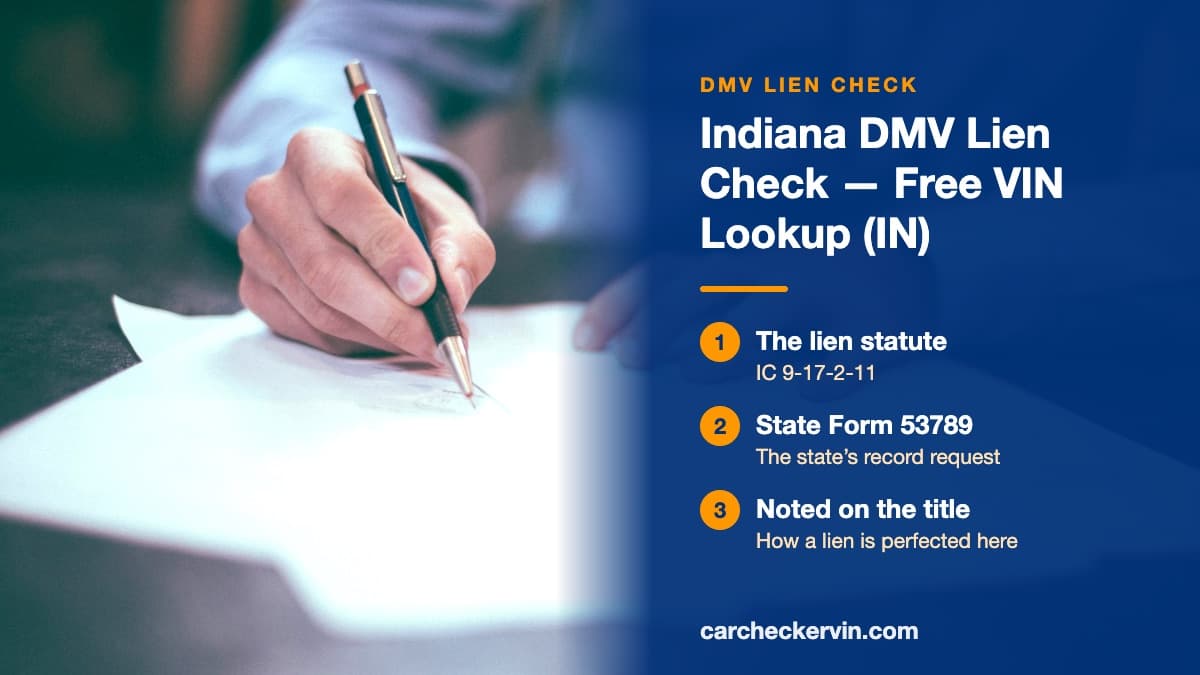
How Indiana Records a Vehicle Lien
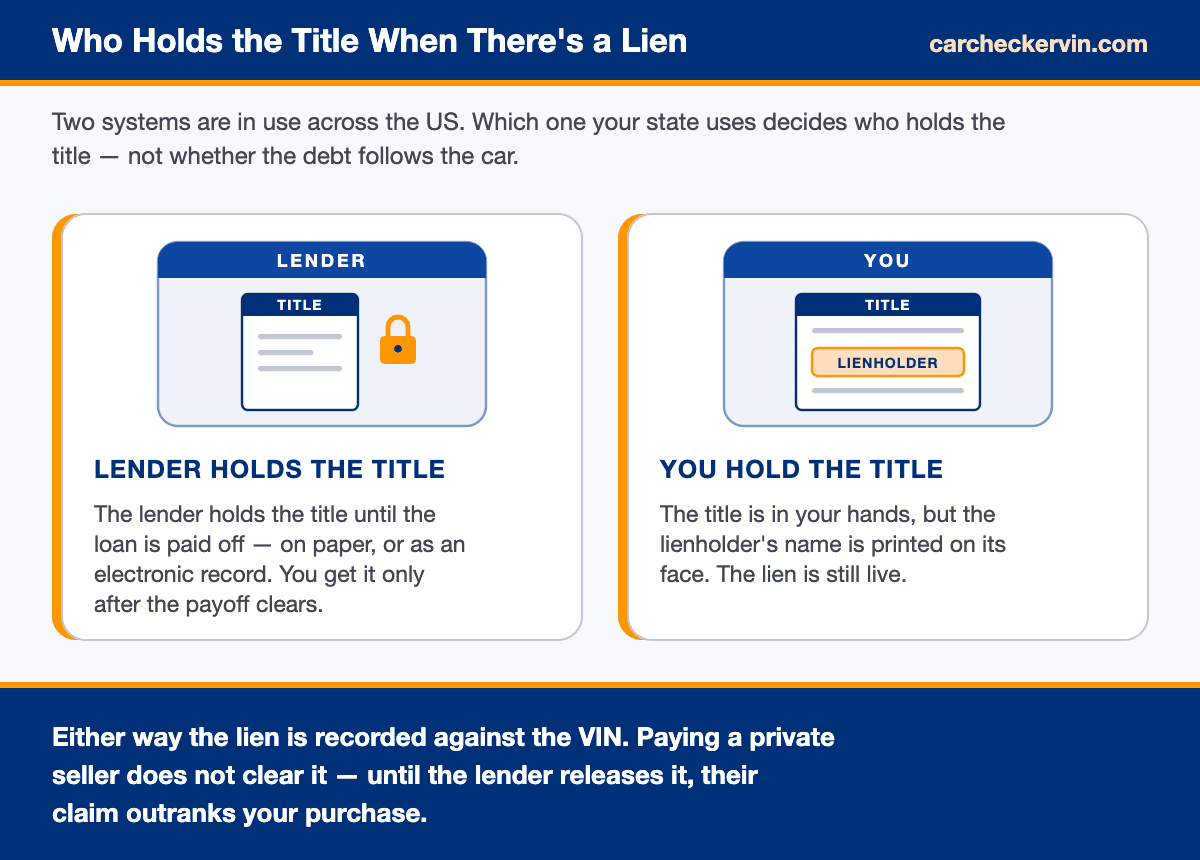
Indiana has largely stopped printing titles on cars that carry bank debt. Participation in the Bureau of Motor Vehicles electronic lien system was voluntary until 30 June 2023 and is now mandatory for any lienholder handling at least 12 lien transactions a year in Indiana, so when a participating lender is the primary lienholder the title exists only as an electronic record and nobody has a piece of paper. The BMV notes the exception that matters to private buyers: titles naming an individual as lienholder are still issued on paper. So a seller who financed through a bank has nothing to show you and that is normal, while a seller who owes money to a person should be able to produce a paper certificate with that person's name printed on it. Where paper does exist the lender keeps it — under IC 9-17-2-11 the bureau delivers the certificate to the owner only if no lien appears, and to the lienholder if one does. A UCC-1 search will not help you either: IC 26-1-9.1-311 makes filing a financing statement neither necessary nor effective against a vehicle covered by the Indiana certificate-of-title statute, leaving dealer inventory as the only carve-out.
The practical consequence is the same wherever the car is titled: the seller's document may read clean, or say nothing at all, while the state record still shows the encumbrance. Searching the VIN beats reading the title, because the seller controls the title and does not control the record.
Indiana lien records at a glance
- Titling agency: Indiana Bureau of Motor Vehicles
- How a lien attaches: Noted on the certificate of title
- Governing statute: IC 9-17-2-11; IC 9-17-5-1; IC 26-1-9.1-311
What an Open Lien Actually Does to Your Purchase
“There's still a bit owing on it” sounds like the seller's problem. Once money has changed hands it is yours. Three things follow from an unreleased lien, and they compound.
The title will not transfer
The Indiana Bureau of Motor Vehicles will not issue you a clean certificate of title while another party's interest is on record. You can hold a signed bill of sale, the keys, and the car, and still not be the legal owner of it.
The lender can repossess
The security interest attaches to the vehicle, not to the borrower. If the seller stops paying, the lender's claim is against the car — sitting on your driveway — and your recourse is to sue the seller, who has already spent your money.
You cannot resell or borrow against it
An encumbered vehicle cannot be cleanly sold on, and no lender will accept it as collateral. The problem does not stay quiet until you try to leave — it surfaces at exactly the moment you need the car to be an asset.
Does This Indiana Car Carry a Hidden Lien?
Don't rely on the paper title — it can look clean over an active loan. Run the VIN to see the lienholder and status, free, in seconds.
How a Lien Gets Released in Indiana
Indiana's deadline is set in business days rather than days, so it is recorded as null above: a person holding a certificate of title because of a lien must deliver the satisfaction or discharge to the owner not more than 10 business days after receiving payment, and the Secretary of State's dealer division restates the same 10 business day rule for a third-party lienholder delivering a title to a dealer. On an electronic lien nothing is signed at all — the lender transmits an electronic release, the bureau removes the lien automatically, and the title is then printed and mailed to you or left electronic depending on the format preference on file. On paper, the lienholder signs the lien release section of the certificate or supplies a release letter on its own letterhead carrying the owner's name, the release date and the vehicle year, make and vehicle identification number. If you bought from a dealer and the title has not arrived, the Secretary of State says state law gives the dealer 31 days from purchase, after which a written demand starts a 10-day clock and then entitles you to return the vehicle and be refunded the purchase price plus tax, finance and insurance expenses and any other fees paid to the dealer.
Whatever the mechanism, the thing to insist on is evidence rather than assurance. A release that has been filedis a record you can verify by VIN. A release the seller says is “coming in the post” is not a fact about the car — it is a fact about the seller.
Buying safely when the loan is still open
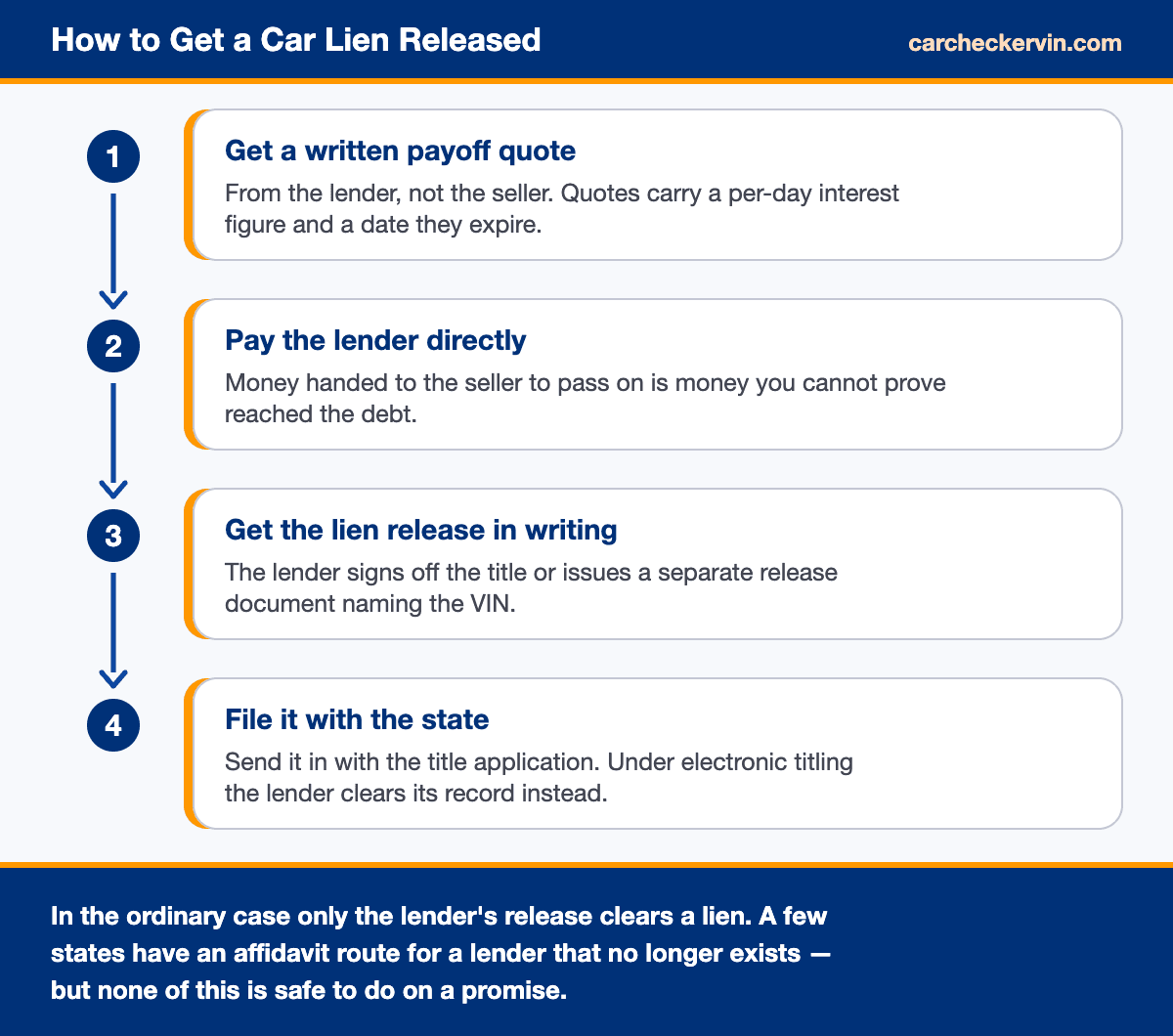
Most private sales of financed cars are honest — the seller owes less than you are paying and simply needs your money to clear the loan. That is a solvable problem, and the solution is to never let the payoff pass through the seller's hands.
- 1Ask the seller for a written payoff quote from the lender, showing the exact amount and a good-through date. Verbal figures drift.
- 2Pay the lender directly for the payoff amount, and pay the seller only the balance. Two payments, not one.
- 3Complete the transaction at the lender's branch where possible, so the release is generated while you are standing there.
- 4Get the lien release document, then re-run the VIN before you register the car to confirm the record actually cleared.
- 5Only then file the transfer with the Indiana Bureau of Motor Vehicles and put the car in your name.
Red Flags of a Hidden Lien in Indiana
- Seller cannot produce a physical title, or produces only a photocopy
- Title names a lienholder with no recorded satisfaction or release
- Cash only; refuses cashier's cheques, escrow, or any traceable payment
- Only a duplicate title or a certified copy is available
- Asking price well below market with no verifiable explanation
- Pressure to complete quickly and skip the paperwork
- Seller's name does not match the name on the title
- Seller wants to meet somewhere other than their home address
How to Read the Lienholder Line on an Indiana Title
Buyers are handed a title, glance at it, and hand over money. Three fields on that document decide whether you are about to own the car, and they are worth reading slowly.
The lienholder name and date
If a bank, credit union or finance company is printed there, a loan was recorded against this VIN. That alone does not mean money is still owed — it means a security interest was filed and something must show it was discharged. An empty lienholder field on an older IN title means no lien was recorded when the title was printed, which is not the same as no lien existing today.
The release or satisfaction block
A discharged lien usually leaves a mark: a signed and dated release section, a stamp, or a reissued title printed after the payoff with the lienholder field blank. A title that still names a lender and carries no release is an open lien until the state record says otherwise.
Whether it is a duplicate
Duplicates are usually innocent — people lose titles. But a duplicate is also how a seller produces a clean-looking document while the original sits with a lender, and how the same car gets sold twice. If the title is marked duplicate, treat the paper as unverified and go to the record.
None of this is a substitute for the record, and that is the honest summary of the whole section: the title is a printout of what the state knew on the day it was issued. The VIN search is what the state knows now. The same document carries two other things worth reading before you pay — any damage brand Indiana has printed on it and the mileage certified at the last transfer. A lien can be paid off; neither of those can.
Four Places a Lien Hides Behind a Clean Title
The awkward cases are not the ones where the title names a lender. They are the ones where it does not, and money is still owed on the car.
The lien was recorded in another state
Titles move. A car financed elsewhere and retitled in Indiana can carry a security interest that the newer INrecord does not restate, particularly if the retitling happened quickly or across a state line where the paperwork is thinner. This is why a VIN check that reads national NMVTIS data matters more than a single state's screen: it sees the title history, not just the current title. The same gap is what lets a branded Indiana title come back unbranded.
The debt is against a business, not the vehicle
Fleet, work and ex-lease vehicles are often financed on a blanket UCC-1 filing covering a company's equipment. Nothing appears on the car's title, because the lender's interest is in the business's assets rather than in that specific VIN. If you are buying from a contractor, a small fleet, or a company winding down, this is the failure mode to look for.
A repair shop or storage yard has a lien
Mechanic's and storage liens arise from unpaid work or unpaid fees, not from a loan, and they attach after the title was printed. They can be enforced against the car regardless of who owns it. A car that has sat at a shop for months and is now being sold in a hurry deserves a direct question about what is owed on it.
The payoff happened but nobody filed the release
The most common case, and the least sinister. The loan is genuinely paid; the lender was slow, or the release went to an old address. It still blocks registering the car in Indiana, because the Indiana Bureau of Motor Vehicles works from what is filed, not from what is true. Sorting it out before the sale takes a phone call. Sorting it out after takes weeks, with your money already gone.
You Already Bought the Car and There Is a Lien
This page mostly exists to stop that happening, but people arrive here after the fact, so: the situation is bad, not always hopeless, and moving quickly matters more than anything else you do.
- 1Find out what is actually owed. Call the lienholder named on the title with the VIN. They will not discuss another person's account, but they will normally confirm whether the lien is still open, which is the only fact you need first.
- 2Contact the seller in writing. Text and email are evidence; a phone call is not. Ask for the payoff to be completed by a specific date. Many sellers in this position intended to pay the loan off and did not, and a written deadline is often enough.
- 3Work out whether paying it off yourself is cheaper than the alternative. If the remaining balance is small against what you paid, clearing it and pursuing the seller for that amount can beat losing the car to repossession while you argue.
- 4Report a dealer to the state. Indiana regulates licensed dealers, and selling a vehicle with an undisclosed lien is squarely the kind of complaint the regulator exists for. This route does not exist for private sales.
- 5Get a lawyer involved before the lender does. Repossession does not require the lender to care that you were not the borrower — their interest is in the car. A small-claims or fraud action against the seller is a separate matter from keeping the vehicle, and the two run on different clocks.
General information, not legal advice. Lien enforcement and buyer remedies vary by state and by the terms of the loan.
Checking the Official Indiana Record
A free VIN check tells you whether there is something to worry about. The state's own record is what you use to confirm it before a large payment — the two are complements, not substitutes.
One thing to know before you click. The federal Driver's Privacy Protection Act limits who may be given a motor vehicle record, and being a prospective buyer is not on its list of permitted uses. Expect to need the seller's written consent — or, simpler, ask the seller to request the record themselves and send it to you.
Request for Certified Records (State Form 53789)
Fee: $4.00 per certified title inquiry
Open the official IN record searchWhat a Lien Check Does Not Tell You
A lien is a fact about the car's finances. It says nothing about the car's history, and the two failure modes are independent — a vehicle with no lien at all can still have been written off, rolled back, or reported stolen. These are separate records and separate searches.
More Indiana Vehicle Guides
Everything else worth knowing before you put an Indiana car in your name.
DMV Lien Check in Other States
View the full DMV lien check hubIndiana DMV Lien Check — Frequently Asked Questions
How do I run an Indiana DMV lien check?+
Enter the vehicle's 17-character VIN in the search box on this page. The lien is recorded against the VIN rather than against whatever paperwork the seller is holding, so a VIN search reaches it even when the document in front of you looks clean. We cross-reference NMVTIS title records, Indiana Bureau of Motor Vehicles title-brand feeds, and UCC-1 filings to show whether the car carries an active lien and who the lienholder is.
What happens if I buy an Indiana car with an active lien?+
You do not get clear ownership. The lienholder keeps a security interest in the vehicle until the debt is paid, and the Indiana Bureau of Motor Vehicles will not transfer a clean title into your name while that interest is on record. If the seller stops paying after you have handed over the money, the lender can repossess the car from you — you would be left suing the seller for the purchase price rather than keeping the vehicle.
Can I check an Indiana lien on the official state record?+
Indiana publishes one — the Request for Certified Records (State Form 53789), at $4.00 per certified title inquiry — though whether you can personally pull it is a separate question from whether it exists. The federal Driver's Privacy Protection Act limits who may be given a motor vehicle record, and wanting to buy the car is not one of the permitted uses. Some states answer a plain lien or title status query for anyone holding the VIN; most release the full record to the registered owner, or to you with the owner's written consent. The move that works is to ask the seller to pull it, or to have them sign the consent line on the request — a seller who refuses has told you something useful. A free VIN check needs nobody's permission, so run that first: it tells you whether there is anything worth chasing before you pay a fee.
Is a lien the same as a salvage or rebuilt title brand?+
No, and confusing them is a common and expensive mistake. A lien is a debt secured against the car and it can be cleared by paying the loan off. A title brand is a permanent statement about the car's history — that it was written off, flooded, or had its mileage rolled back — and no payment removes it. A car can carry both, one, or neither, and you need to check for them separately.
Can an Indiana seller hide a lien from me?+
They can hide the paperwork, but not the record. A private seller can hand you a photocopied title, a duplicate, or nothing at all, and none of that changes what the state has filed against the VIN. This is the whole reason to search by VIN rather than to read the document you are shown: the document is produced by the person with an incentive, the record is not.
Indiana sources
The Indiana-specific statements above come from these official pages. Fees, forms and deadlines do change — check the source before relying on a figure for a transaction.
Vérifications VIN connexes
Plus d'outils pour vérifier l'historique de tout véhicule
Run Your Free Indiana Lien Check Now
Two minutes now, against a debt that would otherwise follow the car into your name. Enter the VIN and see every recorded lien and lienholder on file.