DMV vehicle history report — what you actually get.
Your state DMV sells vehicle records — your own car, a form, a $5–$25 fee, weeks of waiting. The document that checks a car you're buying is built on federal NMVTIS data: previewed free, $14.99 in full.
Run the federal-data check on any VIN — free
17-character VIN → records on file, brands and flags, before any payment.
Free preview · no card, no account
Quick Answer
- Does the DMV sell vehicle history reports?
- No. State DMVs sell vehicle records — a different document.A DMV record is your own car's title and registration abstract, ordered by the owner on a paper form with a $5–$25 fee and a wait measured in weeks. A vehicle history report — the thing used-car shoppers need — comes from the federal NMVTIS system through approved providers.
- What's the official government way to check a used car?
- NMVTIS — the National Motor Vehicle Title Information System, which aggregates title and brand data contributed by all 50 state DMVsand is accessed through approved data providers. That's the route this site uses: the same DMV-sourced records, previewed free and unlocked for $14.99 in under a minute.
- Can I pull a DMV record on a car I want to buy?
- Generally not with the seller's details attached — vehicle records fall under the federal Driver's Privacy Protection Act, so releases require a permissible use and never include the owner's identity for casual due diligence. The shopping-safe version of the same title data is the NMVTIS report, keyed to the 17-character VIN alone.
DMV vehicle record vs vehicle history report, line by line
Two documents get called the same thing in this search. They answer different questions, for different cars, on very different clocks:
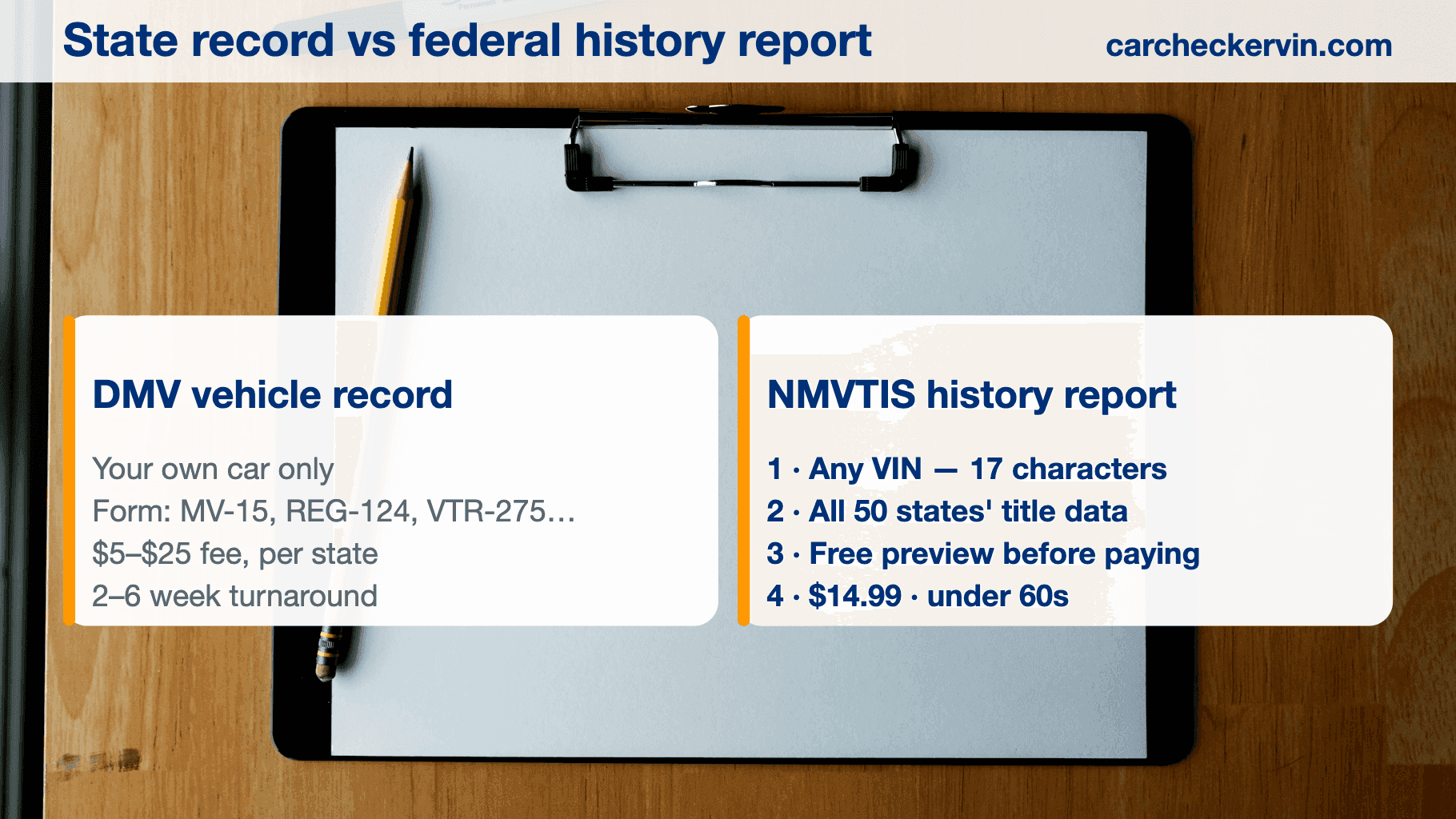
| DMV vehicle record | Vehicle history report | |
|---|---|---|
| Whose car | Your own — releases on other people's cars are privacy-restricted | Any car you're considering, keyed to its 17-character VIN |
| How you order | State form (MV-15, REG-124, VTR-275 and kin), often by mail | Type the VIN — the free preview runs before any payment |
| Cost and wait | $5–$25 and typically 2–6 weeks | $14.99, delivered in under 60 seconds |
| What it shows | One state's title and registration trail for that vehicle | Titles and brands across states, odometer trail, total-loss and auction records |
| Built for | Owner paperwork — title corrections, sale records, disputes | Buying decisions — is this car what the listing says it is? |
Neither document names the current owner — that's protected either way. The difference is scope and speed: one state's paper trail on your own car, versus every reporting state's records on any car, while the seller is still answering your first text.
When the DMV's own document is the right one
This page isn't here to talk you out of a records request — three jobs genuinely call for the state's paper:
Fixing or proving ownership
A lost title, a lien that should have been released, a name that changed — the DMV record is the authoritative account of your own car's paperwork, and the request fee is money well spent.
Courts, insurers and claims
When a legal or insurance matter needs the state's certified version of events for a vehicle you own or are party over, only the official record carries that weight.
Documenting a handover
Some states let sellers pull their own record to show a buyer in good faith. It covers one state's history — pair it with a multi-state report so the buyer isn't left guessing about the years before.
Why the DMV can't run your shopping check
The wall you hit isn't bureaucracy — it's federal privacy law, and it applies in every state:
The DPPA sets the rules
The Driver's Privacy Protection Act (18 U.S.C. § 2721) restricts what states may release from motor-vehicle records. "I'm thinking of buying this car" is not one of the permissible uses that unlocks a stranger's record.
Owner identity stays sealed
Even where a record can be released, the owner's name and address don't come with it for casual due diligence. Any service promising otherwise is promising something the law forbids.
The VIN route is the legal route
NMVTIS exists precisely for this: title, brand and total-loss data contributed by the states, keyed to the VIN with no personal information attached. Buyers get the history; owners keep their privacy.
Skip the form. Keep the government data.
The records behind a state request, previewed free for any 17-character VIN — no fee, no wait, no paperwork.
Fifty counters, one federal shortcut
Search this term and page one is a tour of state records desks — California's record request, Virginia's "Obtain Vehicle History," Wisconsin's "request your own vehicle record," New York's records portal. Each speaks for one state, on that state's forms and timeline. A car that has lived in three states leaves paper in three separate systems — and no state's desk can see the other two. That's the problem NMVTIS was built to solve: every state DMV contributes its title and brand data to one federal system, so a single VIN query reads the whole trail at once. The report built on it costs $14.99 against the $5–$25 a single state charges for a slice — and it arrives while the listing is still open in your other tab.
What the federal file shows that state paper can't
Six sections of the $14.99 report, and why a single state's record can't replicate them:
Titles across every reporting state
The full chain of state titles in one view — including the state a seller hoped you wouldn't think to ask about.
Brands that followed the car
Salvage, flood, rebuilt and lemon brands stay attached federally even when a re-title in a new state produced cleaner-looking paper.
Odometer trail across transfers
Readings recorded at every title transfer, whichever state took them — the sequence that makes a rollback arithmetic, not argument.
Total-loss and salvage filings
Insurer write-offs and junk-yard reports feed NMVTIS directly — records that never appear on a registration abstract.
Auction lanes and photos
Wholesale auction appearances with photos where available — commercial history no DMV counter tracks at all.
Recalls and factory specs
Open manufacturer recalls plus the build sheet for the exact VIN — the mechanical half of a buying decision, alongside the paper half.
Several candidates, zero forms
A records request per candidate would cost weeks per car. Report packs run the math the other way — every VIN previewed free, credits spent only where records exist:
At $9.00 a report on the 10-pack, checking an entire shortlist costs less than two single states' record fees at the top of their range — with every reporting state included.
The rest of the official-records question
How the government systems fit together, page by page.
Vérifiez toujours le VIN avant d’acheter
L’aperçu gratuit affiche les mentions au titre, le statut de vol et les rappels ouverts en quelques secondes, et signale s’il existe des dossiers d’accident et d’odomètre. L’historique complet est à 21,99 $ CAD — paiement unique, sans abonnement.
DMV records and history reports — what people ask
Including the answers that send you to the DMV after all.
Can I get a vehicle history report from the DMV?+
No state DMV sells one. What DMVs sell is the vehicle record — a title and registration abstract for a car you own, ordered on a state form for $5–$25 with a wait that typically runs 2–6 weeks. The multi-state shopping document called a vehicle history report comes from NMVTIS, the federal title system, through approved providers like this one.
Is a DMV vehicle record the same as a Carfax or NMVTIS report?+
No. The DMV record covers one state's paper trail for one vehicle, and it's meant for that car's owner. A history report reads title, brand, odometer and total-loss data across every reporting state for any VIN. They overlap on the state's own title entries — the report simply sees all the states at once, plus the records no registration abstract carries.
Why won't the DMV tell me about a car I'm about to buy?+
Federal privacy law. The Driver's Privacy Protection Act (18 U.S.C. § 2721) limits motor-vehicle record releases to enumerated permissible uses, and window-shopping a stranger's car isn't one of them. The VIN-keyed NMVTIS report is the route the system intends buyers to use — full vehicle history, no personal information attached.
What does a DMV vehicle record cost, and how long does it take?+
Typically $5–$25 depending on the state, ordered with a form such as an MV-15, REG-124 or VTR-275, with turnaround commonly in the 2–6 week range. It's the right purchase for owner paperwork — title corrections, disputes, documenting a sale. For checking a car you don't own yet, the $14.99 report answers in under a minute.
Is NMVTIS really government data?+
Yes — it's the National Motor Vehicle Title Information System, the federal title database that all 50 state DMVs contribute title and brand data to, alongside insurer total-loss and salvage reporting. Consumers access it through approved data providers; that's the data this site's reports stand on.
Do state-specific searches — California, Texas, Virginia — change the answer?+
Only the form names and fees change. Every state runs the same two-track system: records requests for owners under DPPA rules, and NMVTIS contribution for the federal file. Whichever state the car sits in, the shopping check is the same VIN-keyed report, and the free preview works identically.
What if the report comes back empty for my VIN?+
Then you get a 100% refund — that's standing policy, not a favor. The free preview makes the situation rare, because it shows the record count before you pay. And an empty federal file on a car whose seller claims a rich multi-state past is itself worth knowing before money moves.
The same state-fed data, without the state wait.
Preview any 17-character VIN free — title brands, odometer flags and record counts — and unlock the full NMVTIS-backed report for $14.99 when it matters.
Vérifications VIN connexes
Plus d'outils pour vérifier l'historique de tout véhicule