Ford Edge Years to Avoid — the 2011–2013 and the 2016–2020.
The 2013 Edge drew 2,447 NHTSA complaints, the most of any year, 1,004 about a door-ajar warning that will not go out. On the 2017, 766 of 1,387 complaints mention coolant, and on the 2019 351 mention the transmission.
Found an Edge You Like?
Enter its VIN for a free preview of title brands, salvage and total-loss records and odometer readings, then ask what was done to the engine and transmission.
Free preview · No sign-up · No owner or personal data
Quick Answer
- What Ford Edge years should you avoid?
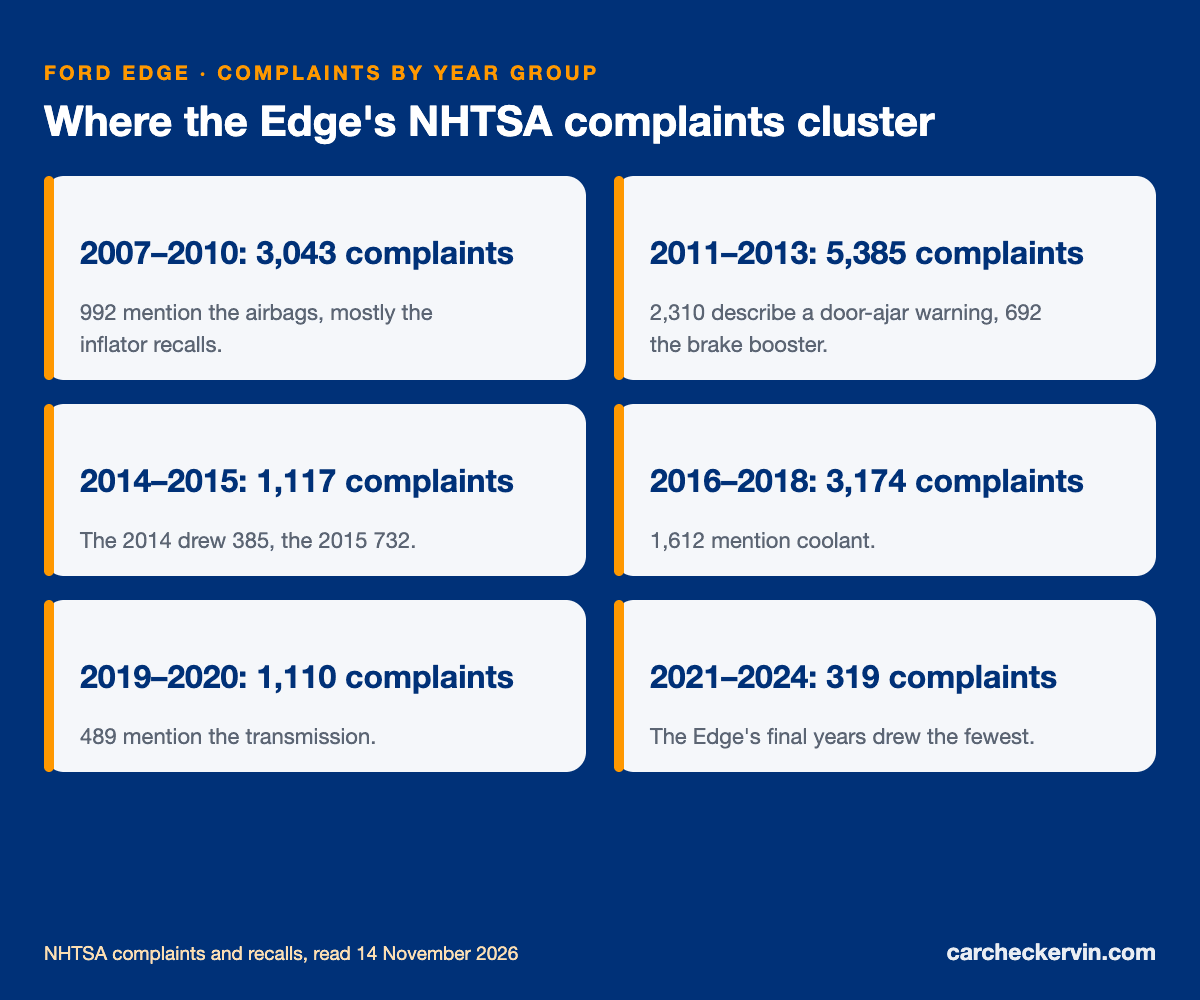
- The 2011–2013 and the 2016–2020. The 2011–2013 drew 5,385 complaints, 2,310 about a door-ajar warning and 692 about the brake booster. The 2016–2018 drew 1,612 that mention coolant, and the 2019–2020 489 that mention the transmission.
- What is the best year for a used Edge?
- Only three Edge years from 2007 to 2021 have no single fault making up a quarter of their complaints: the 2021 (116), 2014 (385), 2015 (732). The 2023 and 2024 drew fewer still (23 and 44) but have had less time for complaints.
- Is there a recall for the Edge coolant leak?
- Not on NHTSA's list as of 14 November 2026. 1,115 2016–2018 complaints describe coolant getting into the cylinders or a failed head gasket, and owners describe misfires, white smoke and replacement engines.
Five checks for a used Edge, by year
Each Edge generation has its own weak spot, so read the year first and check the fault that goes with it.
- 1Read the year from the VINCharacter 10 is the model year; every Edge VIN our visitors checked starts 2FM, the Canadian code.
- 22011–2013: every doorClose each door and watch the cluster; a door-ajar light or a dome light that stays on is the fault.
- 32010–2013: brake pedalA hiss when braking, or a pedal that goes hard or sinks, points to the booster; ask whether it was replaced.
- 42016–2018: coolant levelA low reservoir with no visible leak, a misfire code or white exhaust smoke can mean coolant in the cylinders.
- 5Check title and mileage recordsA salvage brand or a mileage gap shows up by VIN; coolant in a cylinder does not.
Avoid: the 2011–2013 Edge
The 2011–2013 Edge drew 5,385 complaints, and the electrical system is the component owners name most on all three. 2,310 describe a door-ajar warning that stays on with the door shut; 587 of those also mention the battery, because the dome light stays on and drains it.
The brakes come next. 818 complaints on the 2010–2013 name the brake booster, 380 on the 2013 alone, describing a hiss, or a pedal that goes hard, spongy or to the floor. 187 cite Ford customer-satisfaction program 13N02, which owners describe as a booster replacement.
Neither fault is covered by a recall on NHTSA's list. Recall 14V393000 covers a halfshaft that can disengage on 2012–2014 Edges.
The 2011–2013 by the numbers
- 1,803 · 1,135 · 2,447 complaints on the 2011, 2012 and 2013.
- 2,310 about a door-ajar warning.
- 692 name the brake booster.
- No recall on NHTSA's list covers either fault.
Avoid: the 2016–2018 for coolant, the 2019–2020 for the transmission
On the second-generation Edge the engine takes over. 766 of the 2017's 1,387 complaints mention coolant, and 1,115 across the 2016–2018 describe coolant reaching the cylinders or a head gasket failing. Owners describe a low coolant warning, a misfire, white smoke and a dealer recommending a new engine.
The 2019 and 2020 move the trouble to the transmission: 351 of the 2019's 779 complaints and 138 of the 2020's 331 mention it, describing rough shifts, jerking and replacements.
The only transmission recall NHTSA lists for the 2019–2020 is 20V550000, for loose bolts on the start/stop accumulator endcap that can leak fluid. Recall 18V390000 covers torque-converter welds on 2017–2018 Edges with the 2.0-litre engine and six-speed automatic.
The 2016–2020 by the numbers
- 932 · 1,387 · 855 complaints on the 2016, 2017 and 2018.
- 1,612 2016–2018 complaints mention coolant.
- 489 2019–2020 complaints mention the transmission.
- No recall on NHTSA's list covers the coolant fault.
Every Ford Edge Model Year Compared
NHTSA complaints and recall campaigns for every Edge from 2007 to 2024, read on 14 November 2026.
| Year | Generation | Complaints | Crash · fire reports | Recalls | Most-cited component |
|---|---|---|---|---|---|
| 2007 | 1st | 989 | 16 · 22 | 6 | Air Bags |
| 2008 | 1st | 1,120 | 39 · 15 | 7 | Air Bags |
| 2009 | 1st | 261 | 6 · 5 | 7 | Air Bags |
| 2010 | 1st | 673 | 28 · 3 | 7 | Air Bags |
| 2011 | 1st | 1,803 | 23 · 4 | 3 | Electrical System |
| 2012 | 1st | 1,135 | 26 · 5 | 3 | Electrical System |
| 2013 | 1st | 2,447 | 33 · 7 | 2 | Electrical System |
| 2014 | 1st | 385 | 14 · 0 | 3 | Service Brakes |
| 2015 | 2nd | 732 | 18 · 3 | 7 | Engine |
| 2016 | 2nd | 932 | 17 · 3 | 7 | Engine |
| 2017 | 2nd | 1,387 | 26 · 1 | 8 | Engine |
| 2018 | 2nd | 855 | 17 · 3 | 7 | Engine |
| 2019 | 2nd | 779 | 7 · 1 | 3 | Power Train |
| 2020 | 2nd | 331 | 12 · 1 | 4 | Power Train |
| 2021 | 2nd | 116 | 4 · 1 | 7 | Power Train |
| 2022 | 2nd | 136 | 10 · 0 | 5 | Power Train |
| 2023 | 2nd | 23 | 1 · 0 | 4 | Electrical System |
| 2024 | 2nd | 44 | 5 · 0 | 2 | Electrical System |
Complaints are unverified owner reports and are not divided by sales.
Other Edge Years With a Known Weak Spot
Smaller clusters in NHTSA's records, and the recalls behind them.
2007–2010: airbag inflators
Recalls 21V158000 (driver) and 16V384000 (passenger): the inflator may explode. The airbags are the component owners name most on all four years, 992 complaints, most of them about the recall and waiting for parts.
2007–2008: rear drive
43 2007 and 11 2008 complaints name the power transfer unit on all-wheel-drive models.
2015–2018: brake hoses
Recalls 20V469000 and 25V544000: the front brake hoses and a rear brake hose may rupture and leak fluid.
2015–2018: shifter cable
Recall 22V413000: the bushing that holds the shifter cable may detach, so the Edge may roll after Park is selected.
2020–2021: rear axle
Recall 21V011000: too little lubricant in the rear drive unit may let the axle seize.
2021–2022: EcoBoost valves
Recall 24V635000: on the 2.7-litre Nano EcoBoost, the intake valves may break while driving.
What Edge Owners Say on YouTube
First-generation owners name a part NHTSA's records barely show: the V6 water pump. Only 96 complaints on the 2007–2014 mention it, but on YouTube owners rank it first because it sits inside the engine.
In owners' words (paraphrased)
- V6 owners: the water pump is inside the engine, so a failure is about a $3,000 repair and can send coolant into the oil.
- 2011: the brake booster, all four door locks, the power steering pump, a $1,800 water pump and the rear toe-in, and the owner still loves it.
- Another owner: the brake booster replaced twice within about 50,000 miles.
- 2013 bought new: nine years with only the door-ajar warning.
- 2007 bought at 43,000 miles: now about 176,000 miles on fluids, brakes and suspension work.
- An AWD owner: the power transfer unit is a top-five first-generation problem.
Checking an Edge for Sale?
Enter the VIN for a free preview: title brands, junk and salvage records, total-loss records and odometer readings.
Fewest vs. Most Edge Complaints
Fewest is limited to 2007–2021 and leaves out years where one fault is a quarter or more of complaints (2007–2013 and 2016–2020).
Fewest complaints
- 2021: 116 complaints, 7 recalls
- 2014: 385 complaints, 3 recalls
- 2015: 732 complaints, 7 recalls
Most complaints
- 2013: 2,447 complaints, 2 recalls
- 2011: 1,803 complaints, 3 recalls
- 2017: 1,387 complaints, 8 recalls
- 2012: 1,135 complaints, 3 recalls
- 2008: 1,120 complaints, 7 recalls
Recall counts include multi-model campaigns.
The Edges Our Visitors Check
Between 14 June 2026 and 13 November 2026, visitors ran 653 different Ford Edge VINs through our free preview, all with the Canadian 2FM code. 177 (27%) were first-generation 2007–2014 models and 476 (73%) were 2015 or newer.
99 (15%) were 2011–2013s, the door-ajar years, 167 (26%) were 2016–2018s and 145 (22%) 2019–2020s. The single most-checked year was the 2020, at 76 VINs.
Edge Complaints by Generation
The first generation (2007–2014) drew 8,813 complaints over eight model years, the second (2015–2024) 5,335 over ten.
What to Check on a Used Edge
By year, the faults to look for.
2007–2010: airbag recalls
Confirm 21V158000 and 16V384000 were done.
2007–2014 V6: water pump
Ask for records; milky oil or a falling coolant level are warning signs.
2011–2013: door latches
Open and close every door; watch for a warning light or a dome light that stays on.
2010–2013: brake booster
Listen for a hiss when braking; ask whether the booster was replaced.
2016–2018: coolant
Check the reservoir level and ask about misfires or a replaced engine.
2019–2020: transmission
Test for rough or delayed shifts from a stop; ask for transmission work orders.
Reading Edge Complaint Numbers
NHTSA complaints are owner reports, not verified and not divided by sales. On the 2007–2010, 1,002 complaints mention the inflator recalls or Takata, so most airbag complaints are about the recall, not an airbag that failed.
The fault counts come from searching the words owners used, so they are a minimum. The 2023 has 23 complaints and the 2024 44, too few to read a pattern from.
Related Checks and Guides
Recalls, history checks and related Ford pages.
Where These Facts Come From
Complaint and recall figures are NHTSA's own records; owner experiences are linked so you can read them in full.
NHTSA records read 14 November 2026. Written by the CarCheckerVIN editorial team with AI assistance, from NHTSA's complaint and recall records, our own preview logs and the owner posts linked above; figures checked November 2026. CarCheckerVIN is not affiliated with Ford Motor Company.
Ford Edge Years to Avoid — Frequently Asked Questions
Doors, brakes, coolant and the transmission.
What is the worst year for the Ford Edge?+
By NHTSA complaint count, the 2013 (2,447), then the 2011 (1,803) and the 2017 (1,387).
Why does my Edge say a door is ajar when it is closed?+
It is the most-reported fault on the 2011–2013: 2,310 complaints describe it, many owners trace it to the door latch or its switch, and NHTSA lists no recall for it. One 2013 owner says it was the only problem in nine years.
Which Edge years have coolant problems?+
The 2016–2018 above all: 1,612 complaints mention coolant, 766 on the 2017. Where owners name the engine, it is almost always the 2.0-litre.
Does the Edge have brake booster problems?+
On the 2010–2013, yes: 818 complaints name the booster. Ask whether it was replaced, and listen for a hiss when you press the pedal.
What about the 2021–2024 Edge?+
They drew far fewer complaints: 116 on the 2021, 136 on the 2022, 23 on the 2023 and 44 on the 2024. Check recall 24V635000 on a 2021–2022 with the 2.7-litre engine.
Will your report show these problems?+
No history report can tell you coolant is reaching a cylinder. Ours lists title brands, NMVTIS junk and salvage records, insurance total-loss records, odometer readings, and auction records with the damage the auction recorded and its photos for the VIN. Recalls are free to check on NHTSA's site.
Test the Doors and Brakes, Check the Coolant, Then the Title
On a 2011–2013 Edge, close every door and press the brake hard; on a 2016–2018, look at the coolant level and ask about misfires. Free preview first; the full report is $14.99 and lists title brands, NMVTIS junk and salvage records, insurance total-loss records, odometer readings, and auction records with the damage the auction recorded and its photos.
Complaint and recall figures are NHTSA's public records as read on 14 November 2026; complaints are unverified owner reports. Owner comments are paraphrased from the linked video. CarCheckerVIN is not affiliated with Ford Motor Company. Records in our reports reflect what was reported to our data providers. Our reports do not include police or repair-shop accident entries.
Vérifications VIN connexes
Plus d'outils pour vérifier l'historique de tout véhicule