How to Get a Dealer License — the bond, the lot and the paperwork, state by state.
Every state licenses car dealers itself, so there is no national dealer license. The pieces repeat, though: a surety bond, a qualifying place of business, an application with background checks, and in many states a course. Texas and California both demand a $50,000 bond. Here is what their statutes and DMVs require, when you need a license at all, and what changes once you have one.
Check Every Car You Buy for Resale
California requires dealers to pull an NMVTIS report on every used car they display. Enter a VIN for a free preview of title brands and odometer records.
Free preview · No sign-up · No owner or personal data
Quick Answer
- How do you get a car dealer license?
- Apply to your state's licensing agency (the DMV in California and Texas) with proof of a qualifying place of business, a surety bond, and in many states a pre-licensing course. Texas and California both require a $50,000 bond. California adds a DMV written test; Texas requires a 6-hour course for independent used-car dealers.
- How many cars can you sell without a dealer license?
- It depends on the state. Texas exempts anyone selling fewer than 5 vehicles of the same type in a calendar year, if they are registered in the seller's name. California sets no number: anyone in the business of selling cars for profit is a dealer. Federally, the FTC's Used Car Rule applies once you have sold 5 or more used cars in twelve months.
- How much does a dealer license cost?
- State fees are the small part. Texas charges $500 for the first year of a license and $200 a year after that; California's application fee is $175. The $50,000 bond is bought from a surety company, which sets its own premium, and the place of business is usually the biggest cost.
Five steps every state asks for
The order and the forms differ by state. These five pieces come from the Texas and California rules.
- 1Set up the businessCalifornia asks for a resale permit and, for companies, a Statement of Information.
- 2Secure the locationOwned or leased for the license term, with an office; most retail lots need display space.
- 3Buy the bond$50,000 in Texas and California, from a surety company.
- 4Take the courseRequired for used-car dealers in both states; California adds a written test.
- 5Apply and pay the feesCalifornia adds Live Scan fingerprints and a site inspection.
When You Need a Dealer License
The line is set by each state, and it is drawn in different places. Texas law says you need a dealer number to "engage in business as a dealer", including on consignment, but exempts people who sell fewer than 5 vehicles of the same type in a calendar year that are owned and registered in their own name. It also exempts lenders selling repossessions, insurers selling total losses, and sales of antique cars 25 years or older.
California has no count. Its Vehicle Code defines a dealer as anyone engaged, wholly or in part, in the business of selling vehicles or buying them for resale, whether or not they own the vehicles. The exemption is for people selling cars they used for personal or business purposes, not to avoid the law.
The federal government adds its own line. The FTC's Used Car Rule treats as a dealer anyone who sells a used car after selling or offering 5 or more in the previous twelve months, and requires a Buyers Guide on every used car that dealer offers to consumers.
Texas and California Side by Side
From each state's statute and DMV pages, read on 16 October 2026.
| Texas | California | |
|---|---|---|
| License name | General distinguishing number (GDN) | Vehicle dealer license |
| Surety bond | $50,000 | $50,000 ($10,000 motorcycle or ATV only) |
| State fees | $500 first year, $200 each later year | $175 application, $125 renewal |
| Course | 6 hours online, independent dealers, once | 4 hours, then 4 every 2 years |
| Test | None | DMV written test, 3 attempts |
| Place of business | Office, 6-inch sign letters, room for 5 cars | Permanent office, display area and signs |
| Wholesale-only relief | No display space needed | No display area or sign inspection |
| Sell without a license | Fewer than 5 of a type a year, in your name | No set number |
The bond premium you pay a surety company is not set by either state.
What the Application Asks For
The common parts, with the state that requires each one named.
A real place of business
Texas: owned, or leased for at least the license term, with a furnished office. California: an office that is not temporary or mobile.
A surety bond
Texas conditions it on paying your bank drafts and passing good title. California's covers fraud that costs a buyer, seller or lender money.
Education
Texas: a 6-hour course capped at $150. California: a 4-hour course and a DMV test.
Background checks
California requires Live Scan fingerprints for every owner listed on the application.
Tax registration
California asks for a resale permit from the CDTFA, which lets you collect sales tax.
A site inspection
California inspects the office, the records, the display area and the signs before licensing.
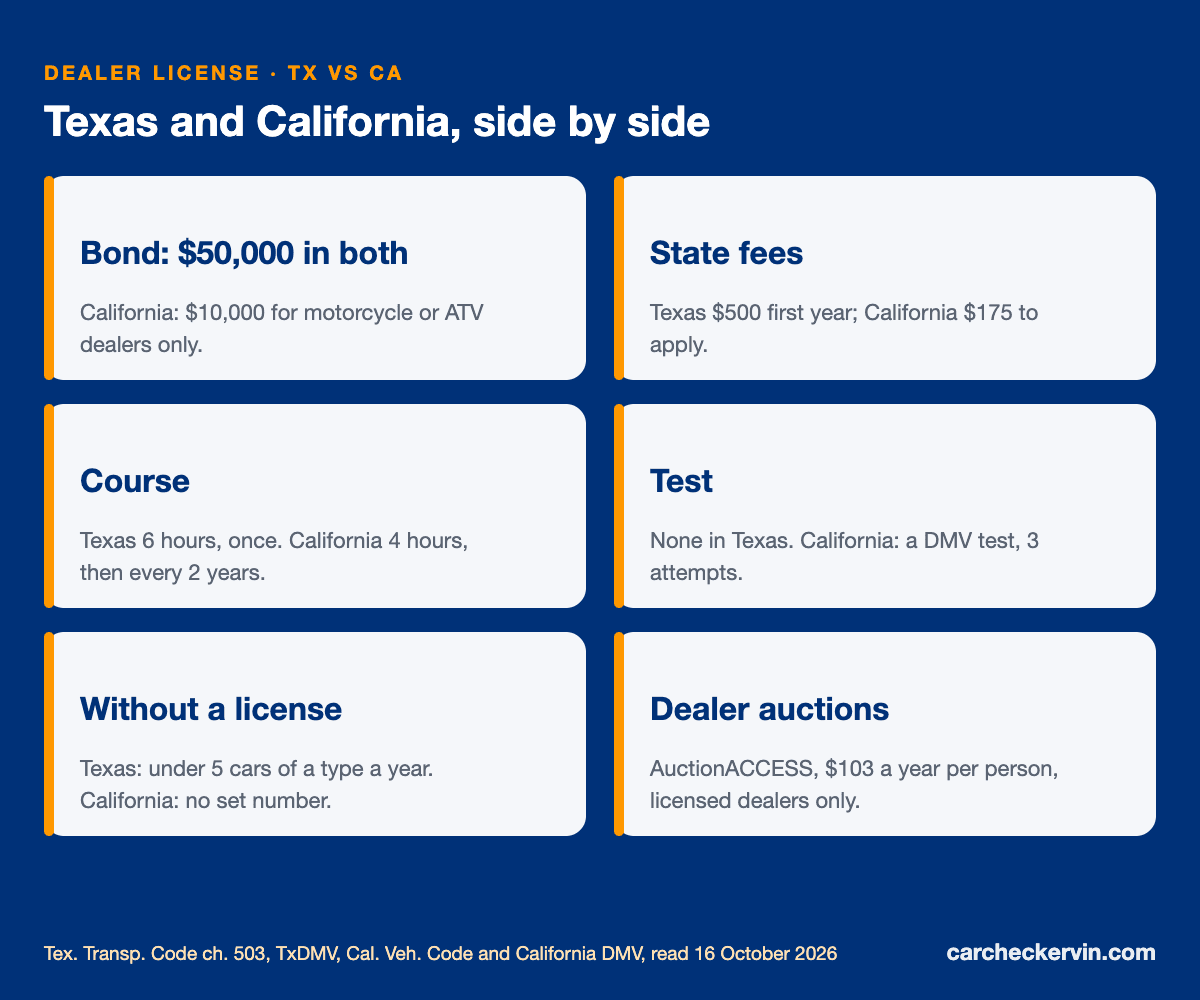
The Two States at a Glance
The table above, drawn as a one-page comparison: the bond, fees, course and lot rules for each state.
Your own state may differ on every line except the principle: a bond, a location and an application.
A Wholesale License and Dealer Auctions
A wholesale license lets you buy and sell only to other dealers, and it drops some of the retail requirements. Texas exempts wholesale dealers from the display-space rule. California does not inspect a wholesale-only dealer's display area or signs, and waives the renewal course for wholesale dealers handling fewer than 50 vehicles a year.
A license is what opens dealer-only auctions. AuctionACCESS, a credentialing service, says it is accepted at over 400 auction marketplaces in the U.S. and Canada, and its membership is restricted to licensed dealers and their employees or contractors. It costs $103 a year per person, and each auction still registers you separately.
Without a license
- Copart: public Members can buy "No License Required" lots.
- Brokers: bid on licensed-only lots on your behalf, for a fee.
- Public auctions: police, government and online enthusiast sales.
- Private sales: in Texas, fewer than 5 of a type a year in your name.
What Changes Once You Are Licensed
A license brings duties. Texas expects you to stay regularly and actively in business: TxDMV says a dealer must sell or assign at least 5 vehicles in a calendar year or the license may be revoked. You file title work for each sale within 20 business days (45 calendar days for in-house financing) and report sales every month to the county.
California requires dealers to obtain an NMVTIS report on every used vehicle they offer or display, and to post a warning on the car when the report shows a state title brand. Federally, every used car offered to consumers needs an FTC Buyers Guide on the window.
Checking a Trade-In or an Auction Buy?
Enter the VIN for a free preview of its title brands, odometer readings and earlier auctions.
Licensed Dealer vs Private Seller
The same car, sold by each. The rules that follow it are not the same.
Private seller (under the state limit)
- No bond, no license
- No FTC Buyers Guide
- Sells cars titled in their own name
- No dealer-only auctions
Licensed dealer
- $50,000 bond in Texas and California
- Buyers Guide on every used car offered
- Can sell on consignment and buy for resale
- Dealer auctions through AuctionACCESS, $103 a year per person
Related Checks and Guides
State guides and the auctions a license opens.
Where These Facts Come From
From statutes, DMV pages and AuctionACCESS, read on 16 October 2026. State requirements change; check your licensing agency before you apply.
CarCheckerVIN is not a licensing agency, surety, school or law firm. This page is general information, not legal advice.
Vérifiez toujours le VIN avant d’acheter
L’aperçu gratuit affiche les mentions au titre, le statut de vol et les rappels ouverts en quelques secondes, et signale s’il existe des dossiers d’accident et d’odomètre. L’historique complet est à 21,99 $ CAD — paiement unique, sans abonnement.
Dealer License — Frequently Asked Questions
What people ask before they apply.
Can I get a dealer license without a lot?+
In Texas, a wholesale dealer does not need display space, but every dealer needs an established place of business with an office and a sign. California does not inspect a wholesale-only dealer's display area or signs, but the office still has to be permanent.
How much is a dealer bond?+
$50,000 in both Texas and California. California's is $10,000 for dealers who sell only motorcycles or ATVs. The surety company sets the premium you pay.
Do I need a dealer license to buy at auction?+
For dealer-only auctions, yes. AuctionACCESS, accepted at over 400 marketplaces, admits only licensed dealers and their representatives, at $103 a year per person. Public auctions, Copart's "No License Required" lots and brokers are the alternatives.
How long does it take to get a dealer license?+
California's Vehicle Code gives the DMV 120 days to investigate an application. Texas does not set a number in the statute; the time depends on the application and the site.
Is there a test for a dealer license?+
California, yes: a DMV written test for used and wholesale dealers, with 3 attempts. Texas has no test but requires a 6-hour course for independent used-car dealers.
Do dealers have to check vehicle history?+
California requires an NMVTIS report on every used vehicle a dealer offers or displays. Our report lists title brands, NMVTIS junk and salvage records, insurance total-loss records, odometer readings, and auction records with the damage the auction recorded and its photos.
Run the VIN on Your Next Buy
Enter any 17-character VIN for a free preview. The full report lists title brands, NMVTIS junk and salvage records, insurance total-loss records, odometer readings, and auction records with the damage the auction recorded and its photos.
CarCheckerVIN is an independent vehicle-history service and is not affiliated with any state agency, AuctionACCESS or surety company. Requirements are summarized from public sources and are not legal advice. Records in our reports reflect what was reported to our data providers. Our reports do not include police or repair-shop accident entries.
Vérifications VIN connexes
Plus d'outils pour vérifier l'historique de tout véhicule