Is there an emissions warranty on a used car?
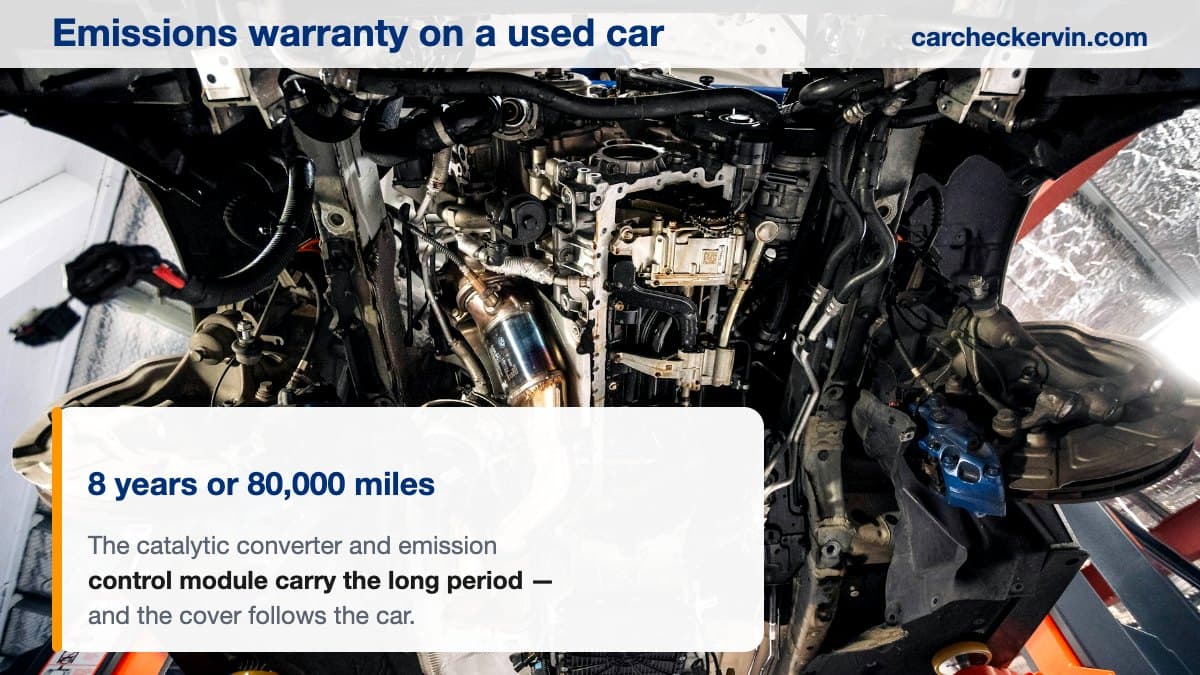
Often, yes — and long after the manufacturer's own warranty has gone. Federal rules put 8 years or 80,000 miles on the catalytic converter and other major emission parts, and define the protected owner to include anyone who buys the car later.
Been quoted for a catalytic converter?
Check the car's record before you accept the repair — or the price.
No account · Nothing stored · $14.99 only for the full report
Quick Answer
- Does a used car have an emissions warranty?
- It can. Federal rules set emissions warranty periods that run from when the vehicle was first placed in service — and they define the protected party as the original purchaser or any subsequent purchaser. Buying second-hand does not end the coverage.
- How long does it last?
- For a light-duty vehicle, 8 years or 80,000 miles on the 5 specified major emission control components — the catalytic converter among them — and a shorter period for everything else.
- Why does this matter when buying?
- Because a failed emissions test on a car still inside that window may be a warranty claim rather than a bill. It is worth establishing before you accept a price reduction that is smaller than the repair the seller says you will need.
The sentence that decides it
The obvious objection to all of this is that warranties belong to the first buyer. The regulation answers it directly, in its own definitions:
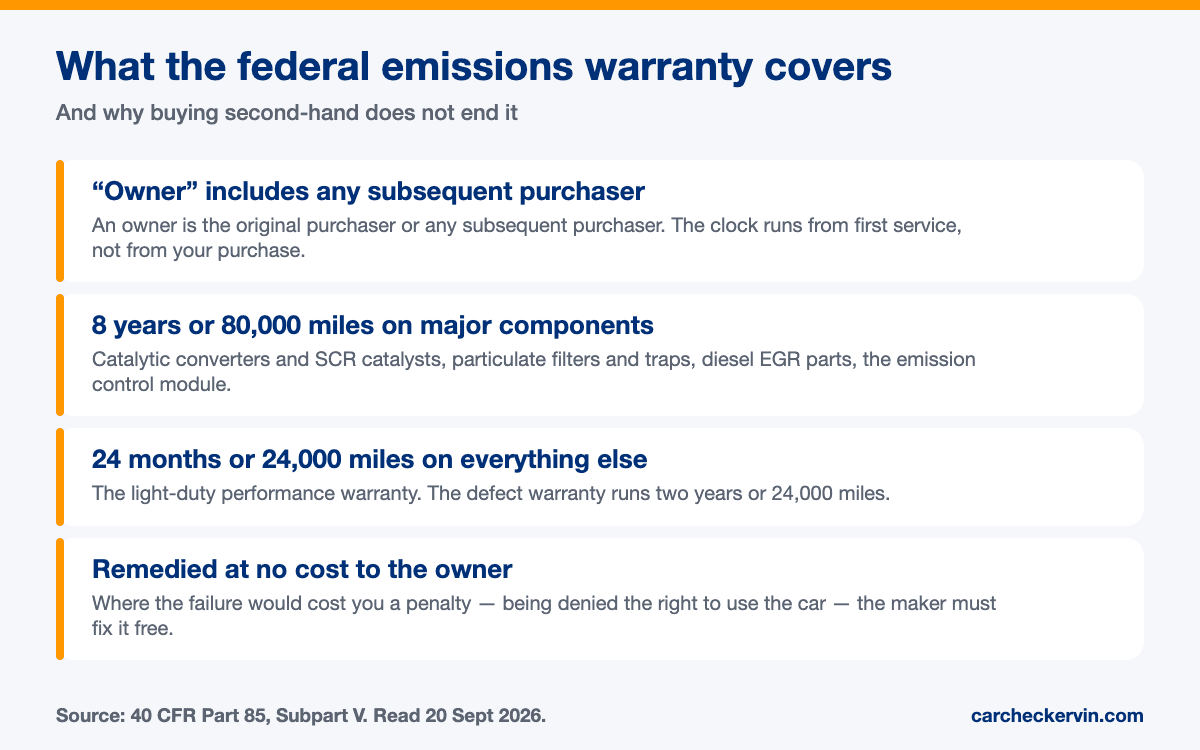
“Owner means the original purchaser or any subsequent purchaser of a vehicle.”
The clock runs from when the vehicle was first placed in service and is capped by mileage, so what matters is the car's age and odometer — not how many times it has changed hands.
Two warranties, not one
This is where most explanations go wrong. The rule creates two separate protections with different triggers, and you can be entitled to either.
Performance warranty
Triggered when the car fails an EPA-approved emission test and that failure costs you something — most obviously the ability to register it.
Defect warranty
Triggered when an emission-related part is defective, whether or not you have been anywhere near a test lane.
“Under the emission performance warranty, in the case of a vehicle failing to conform at any time during its useful life to the applicable emission standards or family emission limits as determined by an EPA-approved emission test, the manufacturer must remedy that nonconformity at no cost to the owner if such nonconformity results or will result in the vehicle owner having to bear any penalty or other sanction (including the denial of the right to use the vehicle) under local, State, or Federal law.”
Read the remedy carefully: at no cost to the owner. Not discounted, not pro-rated.
How long each one lasts
| Vehicle | Performance | Defect | Major components |
|---|---|---|---|
| Light-duty vehicles, light-duty trucks, and medium-duty passenger vehicles | 24 months or 24,000 miles | two years or 24,000 miles | 8 years or 80,000 miles |
| Medium-duty vehicles | 5 years or 50,000 miles | five years or 50,000 miles | 8 years or 80,000 miles |
The long column is the one that matters to a used-car buyer. A car at five years and sixty thousand miles is well past its bumper-to-bumper cover and still comfortably inside 8 years and 80,000 miles.
Know the car before you pay for its exhaust
Title brands, reported mileage, flood and salvage records and open recalls — $14.99, no account.
The 5 components with the long warranty
These are named individually in the rule. Everything else on a light-duty vehicle falls under the shorter period.
1Catalytic converters and SCR catalysts
“Catalytic converters and SCR catalysts, and related components.”
The expensive one, and the part most often quoted to a used-car buyer after a failed emissions test.
2Particulate filters and traps
“Particulate filters and particulate traps, used with both spark-ignition and compression-ignition engines.”
Covers petrol and diesel alike — a clogged DPF on a diesel falls here.
3Exhaust gas recirculation components
“Components related to exhaust gas recirculation with compression-ignition engines.”
Diesel EGR specifically.
4Emission control module
“Emission control module.”
The computer that manages the whole system.
5EV and plug-in hybrid traction batteries
“Batteries serving as a Renewable Energy Storage System for electric vehicles and plug-in hybrid electric vehicles, along with all components needed to charge the system, store energy, and transmit power to move the vehicle.”
Phased in — see the caveat below, which matters for every used EV on the road today.
The battery entry is phased in, and the phase-in matters. Treating the traction battery as a covered major component is OPTIONAL for manufacturers before model year 2027 on ordinary light-duty vehicles. So a used EV bought today is very unlikely to carry this particular coverage — check the manufacturer's own battery warranty instead.
What a manufacturer can ask you to prove
The coverage is conditional, and it is fair to say so plainly: “An emission warranty claim may be denied on the basis of noncompliance by a vehicle owner with the written instructions for proper maintenance and use.”
But the rule also limits how far that can be pushed, which is the part worth knowing if you bought the car without a folder of receipts:
“A vehicle manufacturer may require an owner to submit evidence of compliance only with those written maintenance instructions for which the manufacturer has an objective reason for believing were not performed, and if not performed could be the cause of the particular vehicle's exceeding applicable emission standards.”
So a manufacturer cannot simply demand a complete service history. It has to point at a specific instruction, have an objective reason to think it was skipped, and connect that omission to the emissions failure. Three forms of evidence are accepted:
- 1
A maintenance log book validated at the approximate time or mileage intervals specified for service, by someone who regularly engages in the business of servicing automobiles.
- 2
A showing that the vehicle was submitted for scheduled maintenance servicing at the approximate intervals specified, to someone who regularly engages in the business of servicing automobiles.
- 3
A statement by the vehicle owner that he or she performed the maintenance at the approximate time or mileage interval specified, including a showing that the owner purchased and used proper parts.
The third is worth noticing: work you did yourself counts, if you can show you used proper parts at roughly the right intervals.
How to use this before you buy
- 1
Find the in-service date, not the model year
Both periods run from when the vehicle was first placed in service. A car registered late in its model year has more coverage left than its badge suggests.
- 2
Check the odometer against the mileage cap
Whichever limit arrives first ends the cover. At 80,000 miles the age is irrelevant.
- 3
Ask the franchise dealer to check the VIN
The dealer for that make can see open emissions-warranty coverage. That is a free phone call and it can be worth a great deal.
- 4
Do not accept a small discount for a big repair
If a seller reduces the price because the car 'needs a cat', establish whether the manufacturer owes that repair before you agree the number.
- 5
Keep whatever service records exist
They are what answers a maintenance challenge later. A car sold with its history is worth more for exactly this reason.
Sources
- 40 CFR Part 85, Subpart V — Emission Control System Performance Warranty
The performance and defect warranties, the 8-year/80,000-mile period for the 5 specified major emission control components, and the definition of "owner" that carries the coverage to a subsequent purchaser. 89 FR 28152, Apr. 18, 2024, as amended at 89 FR 50234, June 13, 2024; 91 FR 7759, Feb. 18, 2026. Read 2026-09-20.
- NHTSA Recalls by VIN
The federal safety-recall lookup: free, by VIN, covering unrepaired recalls.
Vérifiez toujours le VIN avant d’acheter
L’aperçu gratuit affiche les mentions au titre, le statut de vol et les rappels ouverts en quelques secondes, et signale s’il existe des dossiers d’accident et d’odomètre. L’historique complet est à 21,99 $ CAD — paiement unique, sans abonnement.
Keep reading
Frequently asked questions
Does the emissions warranty transfer to me as a used buyer?+
Yes — the regulation settles it in its definitions rather than leaving it to argument: "Owner means the original purchaser or any subsequent purchaser of a vehicle." The clock runs from when the vehicle was first placed in service, not from when you bought it.
What actually triggers the performance warranty?+
Failing a test in a way that costs you something. "Under the emission performance warranty, in the case of a vehicle failing to conform at any time during its useful life to the applicable emission standards or family emission limits as determined by an EPA-approved emission test, the manufacturer must remedy that nonconformity at no cost to the owner if such nonconformity results or will result in the vehicle owner having to bear any penalty or other sanction (including the denial of the right to use the vehicle) under local, State, or Federal law." The phrase to notice is "denial of the right to use the vehicle" — being unable to register the car is exactly the sanction the rule has in mind.
How is that different from the defect warranty?+
Different trigger. The performance warranty responds to the car FAILING an EPA-approved emission test; the defect warranty responds to an emission-related part being DEFECTIVE, whether or not you have been tested. Both are in the same rule and both carry the long period for the major components.
Which parts get the long coverage?+
5 specified major emission control components: catalytic converters and scr catalysts, particulate filters and traps, exhaust gas recirculation components, emission control module, and traction batteries in electric and plug-in hybrid vehicles. Everything else on a light-duty vehicle carries the shorter period.
How long is the shorter period?+
For light-duty vehicles, light-duty trucks and medium-duty passenger vehicles the performance warranty runs 24 months or 24,000 miles, and the defect warranty two years or 24,000 miles. Medium-duty vehicles get 5 years or 50,000 miles.
Does this cover the battery in a used EV?+
Not in practice yet, and this is the trap. The traction battery is on the list, but the provision is phased in: Treating the traction battery as a covered major component is OPTIONAL for manufacturers before model year 2027 on ordinary light-duty vehicles. So a used EV bought today is very unlikely to carry this particular coverage — check the manufacturer's own battery warranty instead. Treat a used EV's battery as covered by the manufacturer's own warranty, not by this rule.
Can the manufacturer refuse because I have no service history?+
They can try, but the rule limits what they may demand. A claim "an emission warranty claim may be denied on the basis of noncompliance by a vehicle owner with the written instructions for proper maintenance and use." — however, "A vehicle manufacturer may require an owner to submit evidence of compliance only with those written maintenance instructions for which the manufacturer has an objective reason for believing were not performed, and if not performed could be the cause of the particular vehicle's exceeding applicable emission standards." So the demand has to be specific and causally plausible, not a blanket request for every receipt.
What counts as proof I maintained the car?+
Three things, and one of them is your own word. A validated maintenance log book; a showing that the car was submitted for scheduled servicing at roughly the right intervals; or "A statement by the vehicle owner that he or she performed the maintenance at the approximate time or mileage interval specified, including a showing that the owner purchased and used proper parts." Do-it-yourself maintenance is explicitly contemplated.
How do I find out what a specific used car is entitled to?+
Start with the in-service date and the odometer, because both periods run from the first and are capped by the second. Then ask the franchise dealer for that make to check the VIN against open emissions-warranty coverage. The car's wider record — title brands, reported mileage, open recalls — is the $14.99 history check.
Check the car's history
Title brands, flood records and open recalls — $14.99.
Vérifications VIN connexes
Plus d'outils pour vérifier l'historique de tout véhicule