Idaho Odometer Check by VIN — Is the Mileage Real?
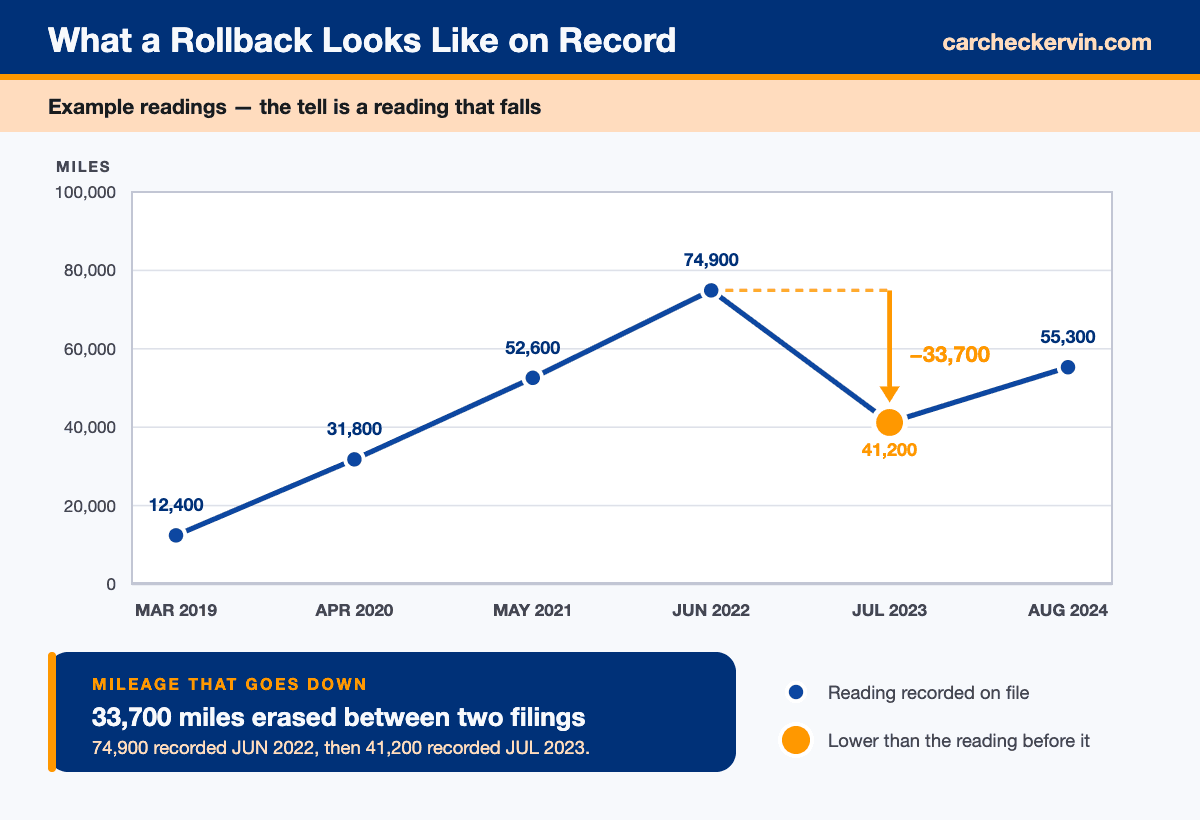
A rolled-back odometer is the cheapest lie in the used-car trade and the most expensive one to believe. Run the VIN to see every mileage figure anyone has ever reported for this car, in date order. You are not checking whether the number is high — you are checking whether it has ever gone down.
Run a Free Idaho Odometer Check
Enter any 17-character VIN — cars, trucks, SUVs, motorcycles
Free · No sign-up · Instant result
How an Idaho Odometer Check Works
Three steps, and the useful output is not a number — it is a shape. A mileage history that rises steadily tells you one thing; a history with a step down in it tells you something else entirely, and no amount of paperwork from the seller explains it away.
Enter the 17-character VIN
Take it off the car, not the advert — dashboard by the windscreen, driver-side door jamb, or the Idaho title. Check all three agree before you go further. A VIN that does not match across the car is a far larger problem than the mileage.
We pull every reported reading
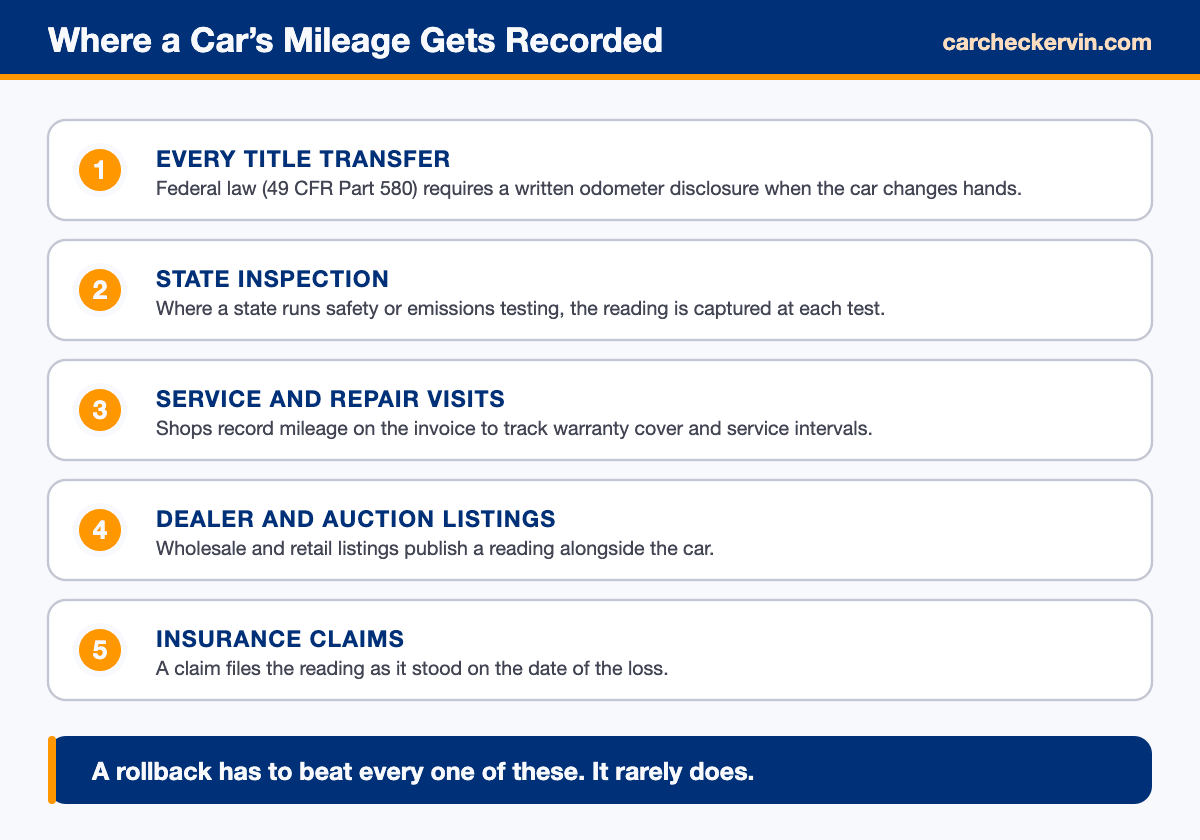
Odometer readings are captured at title transfer and fed into NMVTIS by the Idaho Transportation Department and by every other state the car has lived in, alongside auction, inspection and service records. Separate systems, one VIN, one timeline.
Look for the number that falls
Read the timeline in date order. A later reading lower than an earlier one is rollback with almost no innocent explanation. Long gaps and a mileage brand on the title are the two next things worth your attention.
What Federal Law Requires — and the Rule That Changed
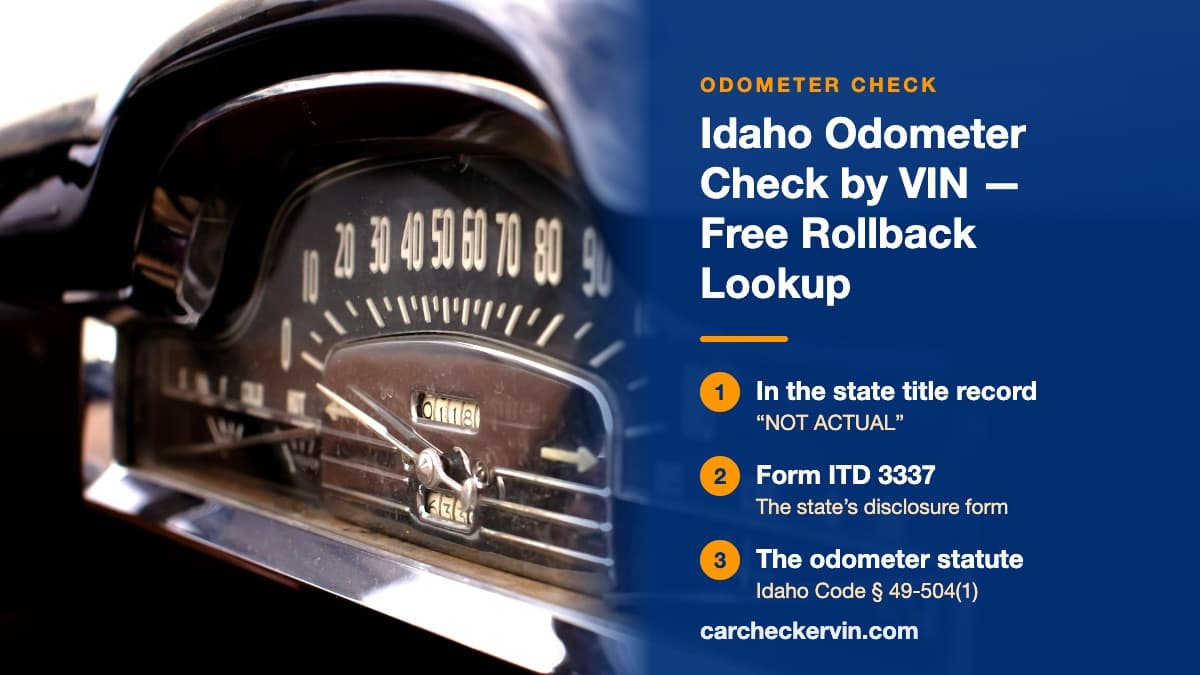
Odometer disclosure is federal, not state: 49 CFR Part 580 sets the rule and Idaho administers it through the Idaho Transportation Departmentrather than replacing it. The seller writes the mileage down, dates it, signs it, and — the part people skim — ticks which of three things the number is: the actual mileage, mileage that exceeds the odometer's mechanical limits, or a reading that is not actual and should not be relied on.
The 10-year rule is now two rules
For decades a vehicle stopped needing a disclosure once it was 10 model years old. NHTSA amended that in 2021, because cars had started outlasting the exemption and a fifteen-year-old car with 120,000 miles on it is now an ordinary purchase rather than a scrap prospect. The exemption split in two, on the model-year 2011 line:
Model year 2011 and newer
Disclosure required for 20 years from the model year. A 2011 model is covered until 2031; a 2016 model until 2036. In practice this means the entire modern used market.
Model year 2010 and older
Kept the old 10-year exemption, which every one of them passed years ago. No federal disclosure is required on any of them today.
Worked through for 2026: nothing from model year 2011 onward is exempt — not one car, because the earliest of them does not reach 20 years old until 2031. Everything 2010 and older is exempt. The line is that simple, and it is the opposite of what a page still quoting the flat 10-year rule will tell you: under the old wording a 2016 model would be exempt today, and it is not.
Exempt does not mean unrecorded. An exempt vehicle still generates readings at auction, at inspection and in service records, and they still land against the VIN. The exemption removes an obligation on the seller; it does not empty the database.
One more federal rule worth knowing as a buyer, because it turns a suspicious cluster into a checkable fact: under 49 U.S.C. §32704, if an odometer is repaired or replaced and cannot be set to the true prior reading, it must be set to zero and a written notice fixed to the left door frame stating the mileage before the repair and the date it happened. If a car reads 40,000 miles and wears like 200,000, open the driver's door and look at the frame before you accept the explanation.
How Idaho Records the Odometer Disclosure
Idaho carries the mileage on the title paperwork rather than on a standalone odometer affidavit. In a private-party sale the seller signs the assignment on the existing Idaho certificate of title to release interest, and the reading is entered in Section 2 of the Application for Certificate of Title, form ITD 3337: a box marked "Odometer Reading --- (no tenths)", a Mi/Km tick, a Date of Reading, and an Odometer Status line offering Actual, In Excess, Not Actual, No Device or Exempt. Read that status line before you pay. "In Excess" means a five-digit odometer that has already rolled past 100,000, "Not Actual" means the odometer is or has been broken and the number on the dash is worthless as history, and ITD's own instructions bar anyone from ticking "Actual" if the previous odometer status was anything other than Actual — so once a vehicle has been recorded as Not Actual, that flag cannot be scrubbed back to clean on a later Idaho title. The buyer files the released title, the disclosure, and a VIN inspection if the car is coming from out of state, with a county assessor's motor vehicle office within 30 days of transfer, or pays a $20 late-filing penalty.
Where Idaho differs from the federal rule: Idaho writes no exemption list of its own; its administrative rule adopts the federal one wholesale. IDAPA 39.02.05.201.01 provides that "In compliance with 49 CFR Part 580, when ownership of a motor vehicle is transferred ... The transferor will disclose mileage to the transferee," and the same rule pushes dealer, distributor, lessor and auction record-retention onto 49 CFR Part 580 as well. The statute behind it, Idaho Code 49-504(1), states the duty flatly — the title application must contain "the odometer reading at the time of sale or transfer" — and then hands the exception-writing power to the agency: "The department may promulgate rules to provide for exceptions to the odometer requirement." ITD's public guidance renders the cut-off as "Odometer Disclosure for vehicles newer than 2010, weighing under 16,000 lbs." Where Idaho does go beyond the federal scheme is on the seller's side: Idaho Code 49-526 makes the seller file a separate Release of Liability with the department within five days of delivery, that statement must itself include the odometer reading, and knowingly filing one with false information is independently unlawful — a state-side paper trail of the mileage that federal law has no analogue for.
The paperwork is Application for Certificate of Title (ITD 3337). View the form
The state provision is Idaho Code § 49-504(1), which sits on top of the federal requirement rather than replacing it.
Idaho odometer rules at a glance
- Titling agency: Idaho Transportation Department
- Where the disclosure lives: Printed on the certificate of title
- Disclosure form: Application for Certificate of Title (ITD 3337)
- ID statute: Idaho Code § 49-504(1)
- Mileage title brands: NOT ACTUAL · IN EXCESS · NO DEVICE
- Reports go to: Idaho Transportation Department, DMV Dealer Operations
Whatever medium the disclosure takes, the same thing happens next: the figure the seller signed becomes part of the Idaho title record, the Idaho Transportation Department reports it into NMVTIS, and from that moment it is attached to the VIN in a place the next seller cannot reach. That is the mechanism the whole check rests on. A dashboard can be rewritten by anyone with a laptop; a filed disclosure from four owners ago cannot.
It also means the disclosure is worth reading rather than signing past. A seller who ticks “not actual mileage” has told you, in writing and under federal law, that the number on the dash is fiction — and buyers routinely sign that form without noticing which box is filled. Copy the reading onto your Idaho bill of sale as well: that is the document that dates the handover, and it is what fixes the mileage to a day if the two of you later disagree about it.
Checking the Official Idaho Record
The disclosure described above ends up with the Idaho Transportation Department, which makes the state file the primary copy and a VIN check the derived one. Before you click, though: the federal Driver's Privacy Protection Act limits who may be given a motor vehicle record, and being a prospective buyer is not a permitted use. Ask the seller to request their own record and send it to you. A seller who will not is telling you something.
Idaho Motor Vehicle Record Request (Form ITD 3374)
Fee: $7.00 per current title record
Open the official ID record requestAsk for the title history specifically if the form lets you choose — that is the response that carries the mileage recorded at each transfer, rather than current status only.
How to Read a Mileage Timeline
The timeline is a list of dates and numbers, and it answers three questions in order. Take them in that order — people who start with question three talk themselves into cars.
Does any reading fall?
An odometer counts up. If a 2019 record says 96,400 and a 2022 record says 71,000, one of them is false, and it is almost always the later one — because the point of a rollback is to make the car look younger at the moment of sale. This single test catches most fraud, and it needs no expertise: read down the list and check the numbers only ever get bigger.
Is the rate believable?
American cars average roughly 12,000 to 14,000 miles a year. A car showing 8,000 miles across five years is not automatically fake, but it needs a story — a second car, a long deployment, a garage in a city with good transit — and the story should match the wear. Be equally suspicious of the reverse: 40,000 miles in one year is a rideshare or delivery vehicle, which changes what “60,000 miles” means about the state of the car.
What happens across the gaps?
Gaps are normal. A car serviced by an independent garage, in a state with no annual safety inspection, kept by one owner for six years, will generate no readings at all in that time. The gap itself is not the finding. What matters is the pair of readings on either side of it: if the mileage rises sensibly across a four-year silence, nothing happened. If it falls, or barely moves, the gap is where to look.
The cluster-replacement excuse, and how to test it
When a mileage drop is pointed out, the standard answer is that the instrument cluster was replaced. Sometimes that is true — clusters fail, and a used one from a breaker's yard arrives with somebody else's miles on it. The difference is that a genuine swap leaves a trail: a repair invoice naming the part, a mileage figure recorded at the time, and, where the new unit could not be set to the true reading, the door-frame notice federal law requires. Ask for the invoice. “The dash was changed at some point before I bought it” is not a record; it is the absence of one, offered as though it were an explanation.
The arithmetic tells you too. A replacement makes one discontinuity, at one date, after which the numbers resume climbing normally; a rollback makes a drop and then a suspiciously slow climb, because the story has to stay consistent with a car that is being driven. Before you accept either version, check the VIN on the dash still matches the door jamb and the paperwork — a cluster swap moves the plate that carries it, and a mismatch stops being a mileage question and becomes a theft-and-cloning question instead.
Check This IdahoCar's Mileage Before You Pay
Every reported reading, in date order, in about five seconds. Free, and you do not need the seller's permission to run it.
Idaho Title Brands for Mileage
Idaho does not use the federal phrasing, so a buyer searching an Idaho record for "exceeds mechanical limits" or "odometer discrepancy" will find neither — the rollover status is called IN EXCESS, and the full set is ACTUAL, IN EXCESS, NOT ACTUAL, NO DEVICE and EXEMPT. Two Idaho traps. ITD's own instruction is that "ACTUAL cannot be checked, if the previous odometer status was noted as anything other than ACTUAL", so an Idaho NOT ACTUAL never washes off, even after the cluster has been repaired. And ITD defines NOT ACTUAL purely as a broken odometer rather than as suspected tampering, so the status carries less accusation than it sounds like.
A mileage notation is stickier than most other bad news about a car. A lien is cleared by paying the loan, and an accident recedes as it is repaired, but nothing about owning a car for another year turns an unknown number into a known one. A few states do publish a correction route, and in more than one of them a failed attempt leaves the car marked worse than before it was tried. Others close the door outright — Idaho's own instruction to its clerks is that actual mileage may not be claimed again once any other status has been recorded. What does not vary by state is the record underneath: the reading and its notation go into NMVTIS against the VIN, follow the car into every state it is later titled in, and surface in a VIN check twenty years later.
What it costs is straightforward: a branded car is worth substantially less than the same car with a clean title, it is harder to sell on, and some lenders will not finance it. None of that is a reason to avoid one outright — a branded car at a branded price can be a sound purchase. It is a reason to know before you agree the price rather than after. The same is true of the damage brands Idaho prints, which sit on the same certificate and are read the same way.
What Idaho's title record calls it
- NOT ACTUAL
- IN EXCESS
- NO DEVICE
Wording varies between states for the same underlying fact, and so does precision. A car branded elsewhere and re-titled in Idaho keeps the brand, but some states collapse several distinct conditions into a single phrase on the way in, so the national record can hold a distinction the new title has dropped.
Checking the Car Against the Number
The database tells you what was reported. The car tells you what actually happened. Wear is the one record a seller cannot edit remotely, and it is remarkably consistent: parts your hands and feet touch every day wear on a schedule, and that schedule is measured in miles.
Pedal rubbers and the footwell
A brake pedal pad at 30,000 miles still has its moulded pattern. At 150,000 it is polished smooth on the side your foot lands. A brand-new pedal rubber on a car with an old, worn carpet underneath is the wrong way round — nobody replaces a pedal pad and leaves the carpet.
Seat bolster, belt and wheel
The outer bolster of the driver's seat takes the abrasion of every entry and exit, and the leather on the wheel thins where the hands rest. Collapsed foam, a shiny edge or a rim worn through to its backing on a car claiming 45,000 miles does not fit — which is why an aftermarket wheel cover on an otherwise tidy interior is worth lifting. Check the belt webbing too: it frays and fades at a predictable rate and is almost never replaced.
Tyres and what they imply
Most tyres last 40,000 to 60,000 miles. A car showing 28,000 miles on its third set is telling you the odometer is wrong or the mileage was reset. Read the DOT date code on each tyre: four digits for week and year. Tyres dated years apart on a low-mileage car is a car that has done real distance.
Digital cluster tells
A rewritten digital cluster leaves nothing to see on the screen, but the surrounding trim is often disturbed: scratched screw heads, clips that no longer sit flush, a gap along one edge. On many cars the mileage is also stored in a second module, so a scan tool at a workshop can compare the two and find a mismatch the dashboard hides.
Six places to cross-check the mileage
- The dashboard reading, photographed with the VIN in shot
- The odometer disclosure on the Idaho title
- Any state inspection or emissions certificate
- Oil-change and tyre-fitting stickers
- Repair and maintenance invoices
- Old listing photos of the same VIN, still online
Reporting Suspected Odometer Fraud in Idaho
If you have not bought the car yet, the useful action is to stop and keep the evidence: screenshot the listing, photograph the dashboard with the VIN visible in the same frame, and save the report. Sellers delete adverts quickly once they have been challenged.
If you have already bought it, odometer fraud is a federal offence and you are not limited to arguing with the seller. Under 49 U.S.C. §32710, a buyer defrauded by someone acting with intent can recover three times the actual damages or $10,000, whichever is greater, plus legal costs. The signed odometer disclosure from the transfer is the central piece of evidence, which is one more reason to keep your copy rather than leaving it with the paperwork.
Report it even if your own case goes nowhere. Rollback is rarely a one-car event, and it is the pattern across several complaints that turns a grievance into a prosecution.
Idaho — where to report
Idaho Transportation Department, DMV Dealer Operations
208-584-4343
Open the ID complaint pageNHTSA — the federal route
Office of Odometer Fraud Investigation, which enforces 49 CFR Part 580 nationally and takes complaints on vehicles bought in any state.
NHTSA odometer fraudWhat an Odometer Check Does Not Tell You
Mileage is one fact about a car, filed in one set of records. It is independent of everything else that can be wrong: a vehicle with a spotless, rising, well-documented mileage history can still have been written off by an insurer, still carry an unpaid loan, and still be on a theft list. Those live in different systems and need different searches.
More Idaho Vehicle Guides
The rest of what is worth knowing before you put an Idaho car in your name.
Odometer Check in Other States
The federal disclosure rule is identical everywhere. What changes is the form it is captured on, the wording each state prints when the mileage cannot be certified, and who takes the complaint.
View the full odometer check hubIdaho Odometer Check — Frequently Asked Questions
How do I check a car's mileage history in Idaho?+
Enter the 17-character VIN. Every reported reading is filed against that number rather than against the dashboard, so the lookup can assemble title transfers reported by the Idaho Transportation Department, inspections, auction entries and service records into one date-stamped timeline. You are looking for a single thing: a reading lower than an earlier one. Odometers count up, so a fall is never innocent.
Which cars still need an odometer disclosure in 2026?+
Every vehicle from model year 2011 onward — no exceptions on age yet. NHTSA's 2021 amendment gave those cars a 20-year disclosure requirement, so the earliest any of them ages out is 2031. Model year 2010 and older kept the old 10-year rule and are all exempt today. A great many used-car pages still describe the old flat rule and get this backwards.
What form is the Idaho odometer disclosure on?+
Application for Certificate of Title (ITD 3337). In Idaho the disclosure is recorded on the certificate of title itself, so check that the reading and the mileage brand are filled in and signed on the title before you hand over money — not afterwards. A blank one signed "for convenience" is a federal violation on both your parts.
What does "NOT ACTUAL" mean on Idaho odometer paperwork?+
It is Idaho's own wording for mileage the state will not certify as the true total, and it is one of 3 Idaho uses. They are not interchangeable — the weakest of them is not an accusation — and the section above sets out what separates them. Whether Idaho will ever clear a brand depends on which one it is: some states lift the milder ones at the next sale and make the serious ones permanent. What does not change is the record behind it. The brand is reported against the VIN into NMVTIS, so re-titling the car in another state alters the phrase printed on the paper, not the history underneath it.
Can a VIN check catch a digital odometer rollback?+
It catches the evidence, not the act. A digital cluster can be rewritten in minutes with a tool that costs less than a set of tyres and leaves no scratched screws behind — there is nothing to find on the dashboard. But the readings already filed against the VIN are not on the car and cannot be reached. The rollback shows up as a contradiction between the dash and the record, which is why the record is the thing to check.
Who investigates odometer fraud in Idaho?+
Idaho Transportation Department, DMV Dealer Operations, on 208-584-4343. Go to them rather than NHTSA when the seller, the dealer or the title is in Idaho, because a state investigator can act on the Idaho title record and on a licensed Idaho dealer directly. NHTSA's Office of Odometer Fraud Investigation is the right route when the car crossed state lines or the same seller appears to have done this before, and there is no reason to choose — a rollback is rarely a one-car event, and it is the pattern across complaints that gets one prosecuted.
Is a rolled-back odometer worth walking away from, or just negotiating on?+
Walk. The mileage is not the real problem — the seller is. Someone who has rewritten the one number a buyer uses to price the car has told you what else they are willing to leave out, and a rollback usually travels with a service history that has been curated to match. There is no discount that makes the rest of the story reliable.
Does a clean mileage timeline mean the car is fine?+
It means nobody reported a contradictory reading. Mileage records and damage records are separate systems: a car with a flawless odometer history can still have been written off, flooded, financed and never paid off, or reported stolen. Run the Idaho title and lien checks alongside this one — they answer different questions and a clean answer to one says nothing about the others.
Idaho sources
The Idaho-specific statements above come from these official pages. Forms and statute numbers do change — check the source before relying on one for a transaction.
Vérifications VIN connexes
Plus d'outils pour vérifier l'historique de tout véhicule
Run the Idaho Mileage Timeline Before You Hand Over Money
One VIN, every reported reading, in date order. It takes less time than the test drive and it is the only part of the inspection the seller cannot prepare for.
Or get the full VIN history report