REG 156 — replacing lost or stolen California plates, stickers and cards.
One California DMV form covers 13 things, from license plates and the year sticker to the registration card and a disabled person placard. You tick what you need, tick why (lost, stolen, mutilated, never arrived, never handed over by the last owner), sign under penalty of perjury, and mail it to Sacramento or take it to any DMV office. Lost or stolen plates don't come back with the same number: the DMV issues substitute plates with a new configuration. Here is what each section asks, what it costs, and when the DMV wants a CHP officer to see the car first.
Plates Missing on a Car You're Buying?
A missing plate or a sticker that doesn't match is worth a closer look. Enter the VIN for a free preview of the title brands, salvage records and odometer readings on file.
Free preview · No sign-up · No owner or personal data
Quick Answer
- What is REG 156?
- The California DMV's Application for Replacement Plates, Stickers, Documents, currently Rev 11/2024. The DMV's procedures manual says it replaces lost, stolen, mutilated or illegible license plates, stickers, registration cards, disabled person placards and ID cards, CVRA weight decals and year stickers, and vessel certificates of number and stickers. It doesn't replace a title; that's the REG 227.
- How much does it cost to replace California license plates?
- $28 for plates, $28 for a registration card and $28 for a year sticker, on the DMV's registration fee page and its procedures manual's fee table. A month sticker and a permanent disabled person placard are free, and items the DMV mailed that never arrived are replaced at no charge. The DMV's online plate page still shows $27 and says the fee changes every year, so check the fee page before you pay.
- Where do I send REG 156?
- To any DMV office, or by mail to DMV, P.O. Box 942869, Sacramento, CA 94269-0001. Mail works only if you're the registered owner at the address the DMV has on file; a different address means going in person. Standard plates, year stickers and registration cards can also be replaced online for most vehicles.
Four steps to replace California plates or stickers
Try the online service first if your vehicle qualifies. REG 156 is the route for everything it turns away.
- 1Check the online routeStandard plates, year stickers and registration cards can be replaced online for most vehicles.
- 2Report stolen platesBring a police report; if both plates are gone, notify law enforcement right away.
- 3Fill in the five sectionsOwner, items, reason, plate details if your address changed, and a signed certification.
- 4Mail it or go inSend the form, fee and any remaining plate to Sacramento, or take them to a DMV office.
What REG 156 Replaces
REG 156 (Rev 11/2024) is a one-page application with a privacy notice on the back. Its Section 2 lists 13 things you can ask for: license plates, registration card, year/month sticker, vessel year sticker, vessel certificate of number, vessel mussel fee sticker, disabled person placard, disabled person ID card, planned non-operation (PNO) card, PFR sticker, CVRA weight decal, CVRA year sticker and trailer or OHV ID card. Tick every box that applies, so one form can cover plates and a registration card together.
Some things need a different form. A lost title is the REG 227. Special interest plates go on the REG 17, special recognition plates on the REG 17A, special equipment ID plates on the REG 88 and moped plates on the REG 230. A lost month sticker needs no form at all: the DMV's manual says month stickers are replaced for no fee and without a REG 156.
One more limit: the DMV won't issue replacement plates or stickers to a vehicle that isn't currently registered. Owners in that position get new plates when they renew.
The Five Sections, in Order
From REG 156 (Rev 11/2024), read on 28 October 2026.
| Section | What it asks | Who completes it |
|---|---|---|
| Top of the form | Plate or CF number, make, VIN or hull ID; disabled placard number and birth date for a placard; engine number for a motorcycle | Owner |
| 1 — Registered owner of record | True full name or business name and DL/ID number for the owner and any co-owner, physical address, county, mailing address | Owner |
| 2 — Plates, stickers, documents | The items you want, from 13 boxes | Owner |
| 3 — The item requested was | 10 reasons, from lost and stolen to "not received from prior owner" | Owner |
| 4 — License plate | Only if your address differs from DMV records: one plate missing (surrender the other) or both | Owner, in person |
| 5 — Certification | Printed name, title if signing for a company, phone, signature under penalty of perjury, date, email | Registered owner |
"All information on this form is mandatory," the form says, and missing information can get the application rejected. It has no notary section.
REG 156 at a Glance
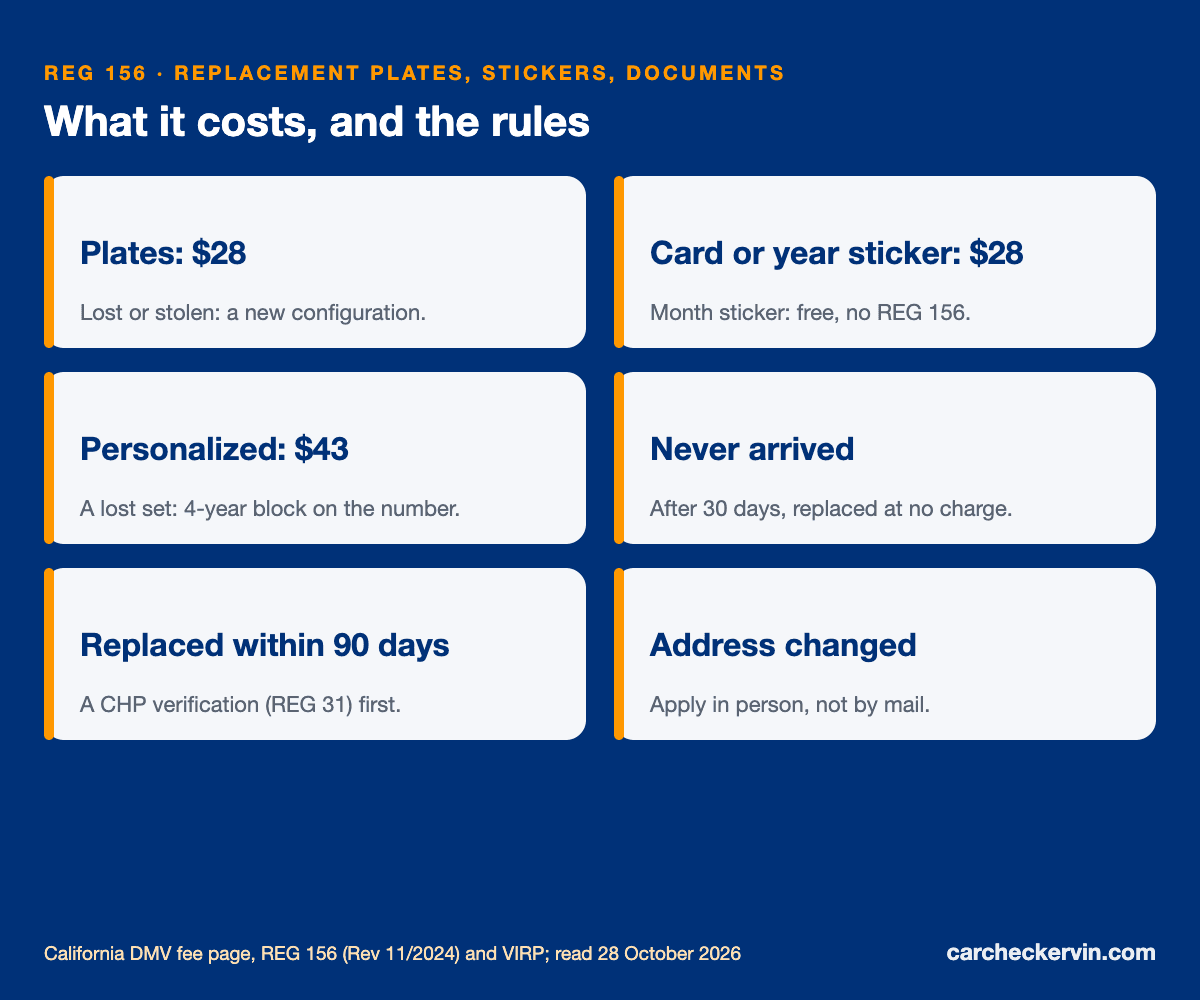
What each replacement costs and the rules that change your route, on one card.
From the California DMV's fee schedule, REG 156 (Rev 11/2024) and its procedures manual, read on 28 October 2026.
Lost or Stolen Plates Come Back With a New Number
The DMV doesn't reissue a lost or stolen plate number. Its replacement page says lost or stolen plates are replaced with substitute plates "with a new configuration"; only special plates can be reordered. If one plate of a pair is missing, the other one is surrendered, and any plates still in your hands go back to the DMV. A plate or sticker reported missing that later turns up is no longer valid: the form says to destroy it or return it.
Two rules slow things down. Stolen plates need a police report. And if replacement plates were already issued for the car within the last 90 days, the DMV wants a Verification of Vehicle (REG 31) completed by the California Highway Patrol first. Personalized special interest plates carry one more catch: if both are lost or stolen, the DMV's manual says that configuration can't be issued again for 4 years.
Before you file
- Stolen: bring a police report.
- Both plates gone: notify law enforcement right away.
- Replaced in the last 90 days: a CHP REG 31 first.
- The old plate turns up: destroy it or return it.
Buying a Car With Missing Plates?
A seller who can't hand over the plates or a current sticker may have a reason. Enter the VIN for a free preview of the title brands and junk and salvage records on file.
Online, Kiosk, Mail or Counter
Which route works depends on the item and on whether your address has changed.
Online: standard plates
Plate number and the last 3 digits of the VIN. Not for personalized plates or two stolen plates.
Online: sticker or card
The last 5 VIN digits; mailed within 14 days, with a new card in a sticker order.
DMV Now kiosk
289 kiosks print a replacement card or sticker; cards add 1.95%.
By mail
Same address as DMV records only. Send the form, fee and any remaining plate.
At a DMV office
A California DL/ID, or an out-of-state one plus a second photo ID.
Never arrived
Wait 30 days, then tick "Not Received from DMV": no charge.
REG 156 or REG 227
Both replace something the DMV issued. They cover different paper.
REG 156
- Plates, stickers, the registration card and placards.
- Signed by the registered owner under penalty of perjury.
- $28 for plates, a card or a year sticker.
- Mail to P.O. Box 942869 or take it to any DMV office.
REG 227
- The certificate of title.
- For a title that's lost, stolen, damaged or illegible.
- $28 replacement title fee.
- A lienholder's release on it must be notarized.
Buying a car? The DMV's manual says a replacement registration card needs no separate application or fee when it comes with another application, such as a transfer.
Related Checks and Guides
The other DMV form guides, and the California pages they connect to.
Where These Facts Come From
From the California DMV's REG 156, its replacement and fee pages and its procedures manual, read on 28 October 2026. Download the current form from dmv.ca.gov before you file.
The DMV's online plate page listed $27 on 28 October 2026, while its fee page and procedures manual listed $28; the page itself says fees change annually. CarCheckerVIN is not affiliated with the California DMV.
REG 156 — Frequently Asked Questions
What California owners and buyers ask most.
Can I replace California license plates online?+
For standard plates, usually yes: you need the plate number and the last 3 digits of the VIN, and you must be the registered owner on record. The online service can't be used for personalized plates, for two stolen plates (or a motorcycle's stolen plate), or to change your address, and card payments carry a 2.3% service fee.
Do I get the same plate number back?+
Not if the plates were lost or stolen: the DMV issues substitute plates with a new configuration. Special plates can be reordered, but if both plates of a personalized special interest set are lost or stolen, the DMV's manual says that configuration can't be issued again for 4 years.
Do I need a police report to replace stolen plates?+
Yes. The DMV lists a police report among the documents for stolen plates. If both plates are missing, or the only plate on a motorcycle, truck tractor or trailer, the form says the owner must notify a law enforcement agency immediately.
The seller didn't give me the registration card or sticker. What now?+
REG 156 has a "Not Received from Prior Owner" box, but the DMV's manual says the registered owner completes the form. If you're the buyer, transfer the car first: buyers have 10 days, and the DMV's manual says a replacement registration card needs no separate application or fee alongside a transfer.
How long do replacement plates take?+
Online sticker and card orders are mailed within 14 days. If plates, stickers or a card haven't arrived within 8 weeks of applying, the DMV says to call 1-800-777-0133. You may legally drive while you wait for new stickers and registration (CVC § 4606).
Does REG 156 need to be notarized?+
No: the form has no notary section, and the registered owner signs under penalty of perjury. A licensed registration service needs a notarized REG 5065 when the owner's name or address doesn't match DMV records.
Check the VIN Behind the Plates
Plates change; the VIN doesn't. Enter any 17-character VIN for a free preview. The full report lists title brands, NMVTIS junk and salvage records, insurance total-loss records, odometer readings, and auction records with the damage the auction recorded and its photos.
CarCheckerVIN is an independent vehicle-history service and is not affiliated with the California Department of Motor Vehicles. This guide summarizes the DMV's published REG 156, fee schedule, replacement pages and procedures manual and is not legal advice. Records in our reports reflect what was reported to our data providers. Our reports do not include police or repair-shop accident entries.
Vérifications VIN connexes
Plus d'outils pour vérifier l'historique de tout véhicule