Florida Salvage Title Check by VIN — Is the Title Clean?
A salvage brand is recorded against the VIN, not against the document the seller hands you. Run the number and you see every brand the car has collected in Florida and in every other state it has passed through — including the ones a re-issued title no longer prints.
Run a Free Florida Salvage Title Check
Enter any 17-character VIN — cars, trucks, SUVs, motorcycles
Free · No sign-up · Instant result
How a Florida Salvage Title Check Works
Three steps turn scattered insurer, auction and Florida Department of Highway Safety and Motor Vehicles records into a straight answer on whether this car has ever been written off.
Enter the 17-character VIN
Read it off the plate at the base of the windscreen, the driver-side door jamb, and the Florida title, and check all three agree before you go any further. A VIN that does not match across the car is a bigger problem than any brand.
We search the national brand record
The lookup queries NMVTIS, which the Florida Department of Highway Safety and Motor Vehicles and all other state titling agencies report into, plus insurance total-loss feeds and salvage-auction listings. Those are separate systems, and a car can appear in one before it appears in the others.
Read every brand, in every state
The result shows each brand ever applied to the VIN and the state that applied it — not just what Florida currently prints. A brand from a previous state is the single clearest sign the paper title in front of you has been washed.
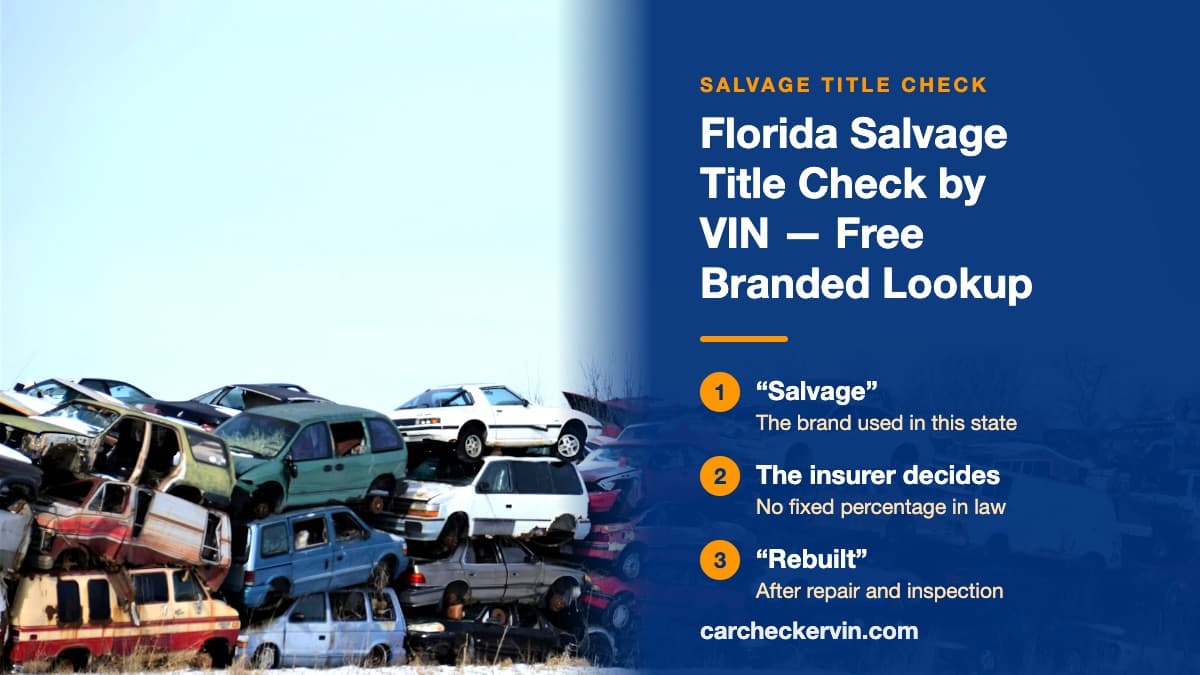
What Counts as a Total Loss in Florida
A total loss is an accounting decision, not a verdict on whether the car can be fixed. Almost any vehicle can be repaired given enough money. The insurer stops when repairing costs more than the car is worth, writes the owner a cheque for its value, takes the wreck, and notifies the state — and it is that notification, not the crash, that produces the brand.
Florida sets no statutory threshold. The insurer decides when a vehicle is uneconomic to repair, which means two carriers can look at identical damage and reach opposite conclusions. The practical effect for a buyer is that the absence of a brand tells you less here than it would under a fixed rule.
Florida splits the test by who was carrying the risk, and only one half of it contains a number. Section 319.30(3)(a)1 defines a total loss two ways. The first is insurer conduct: "when an insurance company pays the vehicle owner to replace the wrecked or damaged vehicle with one of like kind and quality or when an insurance company pays the owner upon the theft of the motor vehicle". No percentage, no estimate, no threshold — the payment is the trigger.
The second is arithmetic, and it applies only to the uninsured. A vehicle is a total loss "when an uninsured motor vehicle or mobile home is wrecked or damaged and the cost, at the time of loss, of repairing or rebuilding the vehicle is 80 percent or more of the cost to the owner of replacing the wrecked or damaged motor vehicle or mobile home with one of like kind and quality".
Florida salvage rules at a glance
- Titling agency: Florida Department of Highway Safety and Motor Vehicles
- Total-loss test: Insurer's judgement — no statutory trigger
- Governing statute: Fla. Stat. §§ 319.30, 319.14, 319.141, 319.23, 319.32; Fla. Admin. Code r. 15C-22.002
- Salvage brand wording: Salvage Rebuildable
- Rebuilt brand wording: Rebuilt
- Never-road-legal brand: Certificate of Destruction
- Out-of-state brand carried forward: Yes
Check this FL VIN for a brand:
Read the denominator carefully, because it is not the usual one. Florida measures against replacement cost to the owner, not against the car's actual cash value. The comparison is to what a like-for-like car costs to buy, which on a well-kept older vehicle is often a larger number than the wreck itself was worth — so the same repair bill clears 80 percent of ACV long before it clears 80 percent of replacement cost. The clock is fixed too: the cost is measured "at the time of loss", not when the estimate is finally written.
The gap between the two rules is where badly damaged Florida cars keep ordinary titles. Section 319.30(3)(a)2 says a vehicle "shall not be considered a 'total loss' if the insurance company and owner ... agree to repair, rather than to replace" it. That is a complete exemption, not a discount: a heavily wrecked car can be rebuilt on the insurer's money and stay on a clean title, with no brand and no inspection, because the parties agreed to repair it.
The backstop is narrow and self-reported. Only if "the actual cost to repair the motor vehicle ... to the insurance company exceeds 100 percent of the cost of replacing" it must a brand be applied — and even then the statute puts the duty on "the owner", who must forward a request to brand the title "Total Loss Vehicle" within 72 hours after the agreement. The owner is not the party holding the repair invoices. The insurer is. A rule that asks the person without the numbers to report the numbers is a rule that will be under-reported, and the resulting brand "shall become a part of the vehicle's title history" only if somebody files it.
Where a total loss is admitted, the paperwork moves fast. Under 319.30(3)(b) the owner — "including persons who are self-insured" — must forward the title to the department within 72 hours of the vehicle becoming salvage. An insurer that pays compensation must obtain the certificate of title, "make the required notification to the National Motor Vehicle Title Information System", and forward the title to the department within 72 hours of receiving it. And neither party "may ... dispose of a motor vehicle or mobile home that is a total loss before it obtains a salvage certificate of title or certificate of destruction from the department".
One sentence in that paragraph is worth more to an owner than anything else in the section. Where the owner keeps the car in a total loss settlement, "the department must issue a salvage certificate of title or certificate of destruction directly to the motor vehicle or mobile home owner rather than to the insurance company or its agent". The document goes to the person holding the car, which is what stops a retained wreck from disappearing into an insurer's paperwork.
There is a route for the insurer that cannot get the title at all. Thirty days after paying the claim, 319.30(3)(b)1 lets it receive the salvage certificate or certificate of destruction anyway, provided it has released or paid out every lien, has attested that the total loss payment was distributed, and has attested on a departmental form to the attempts made to obtain the title — attempts that may be made "by written request delivered in person or by first-class mail with a certificate of mailing" to the last known address. An in-person request needs its own affidavit. The department "is not liable and may not be held liable" for issuing on that basis.
The worst damage gets no title at all, and here a second percentage appears. A late model vehicle — defined at 319.30(1)(i) as one "that has a manufacturer's model year of 7 years or newer" — with a current retail cost of at least $7,500 just before the damage, and estimated repair costs "equal to 90 percent or more of the current retail cost", is declared unrebuildable. The department prints a certificate of destruction authorising dismantling, and the statute then says flatly: "The department may not issue a certificate of title for that vehicle."
Do not compare the 90 to the 80. They run against different denominators — the 90 percent test measures against current retail cost from an official used car guide, while the 80 percent test measures against replacement cost to the owner. A car can fail one and pass the other. Both gates also have to be cleared before the destruction rule bites: seven model years or newer and $7,500 or more of retail value.
The destruction rule has three named exits. The certificate "shall be reassignable a maximum of two times before dismantling or destruction of the vehicle is required". A van "equipped with custom-lowered floors for wheelchair access or a wheelchair lift" escapes it, the insurer instead having a salvage rebuildable title issued with a brand of "insurance-declared total loss", provided it determines the vehicle is repairable to a condition safe for the road. And the subsection does not apply at all "when a stolen motor vehicle or mobile home is recovered in substantially intact condition and is readily resalable without extensive repairs to or replacement of the frame or engine" — nor to a mobile home worth less than $1,500 retail.
Below the $7,500 and late-model gates a certificate of destruction is still mandatory in two situations, and this is the paragraph that stops washed foreign junk paper at the state line. Where the car "is damaged, wrecked, or burned to the extent that the only residual value ... is as a source of parts or scrap metal", or where it "comes into this state under a title or other ownership document that indicates that the motor vehicle is not repairable, is junked, or is for parts or dismantling only", the owner or insurer must obtain a certificate of destruction. Knowingly violating that paragraph, or falsifying documentation to avoid it, "commits a misdemeanor of the first degree".
One warning about second-hand accounts of the 80 percent figure, including the state's own. The frequently asked questions at the back of FLHSMV procedure TL-36 answer a question about self-insured vehicles by saying that "Section 319.30, Florida Statutes, states that when a self-insured motor vehicle is wrecked or damaged and the cost of repairing or rebuilding the motor vehicle is 90% or more of the cost to replace the motor vehicle with one of like kind and quality, it is a total loss." The section says 80 percent. The 90 percent figure belongs to the separate certificate-of-destruction test in subsection (3)(c), which uses a different denominator again, and the department's manual has borrowed it into the wrong provision. Read the statute, not the summary.
The rule sits in Fla. Stat. §§ 319.30, 319.14, 319.141, 319.23, 319.32; Fla. Admin. Code r. 15C-22.002.
What follows from that: the brand records an economicevent. A ten-year-old car with a book value of a few thousand dollars can be totalled by a shunt that would barely register on a new one, and it is the cheap car that gets branded. Read a salvage brand as “the repair bill was large relative to this car”, then go and find out what the damage actually was.
The Three Total-Loss Regimes, and Why They Matter to You
There is no national rule for when a damaged car becomes a salvage car. Each state picks one of three tests, and the choice decides whether an identical wreck leaves the body shop with a brand or without one.
Percentage of value
The most common test. The state fixes a percentage of the car's pre-loss actual cash value, and an insurer whose repair estimate reaches it must report a salvage. Thresholds run from about half the value to the whole of it, so the same $6,000 estimate on a $10,000 car is a mandatory brand in one state and a routine repair in another.
Total loss formula (TLF)
Repair cost plus salvage value, measured against actual cash value. TLF is sensitive to the parts market — a truck with hungry demand for its doors and tailgate totals on less damage than a car whose panels nobody wants.
Insurer discretion
No statutory trigger. The carrier decides when repair stops making commercial sense, on internal thresholds that are neither published nor binding. Two insurers can look at the same photographs and reach different answers, and neither is breaking a rule.
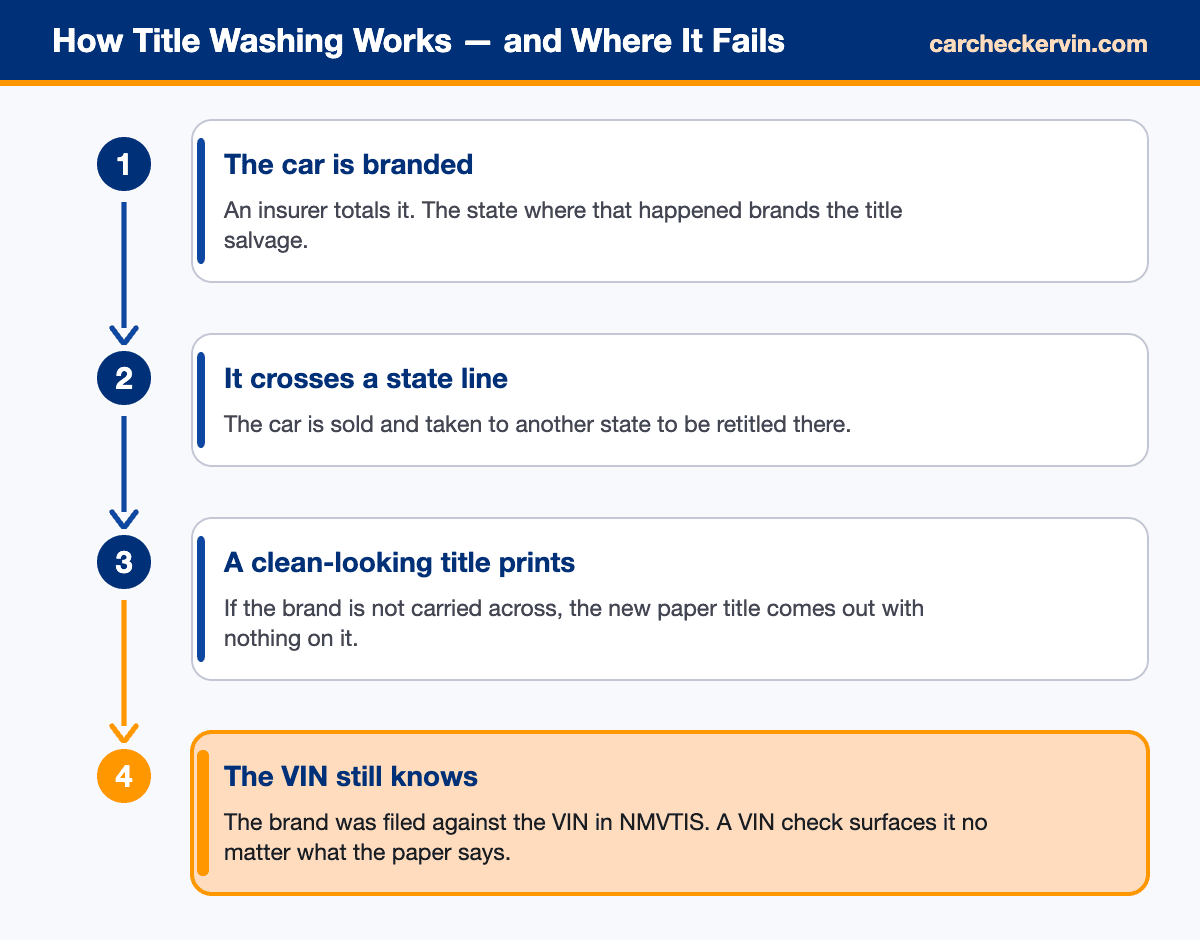
The consequence cuts both ways, and it is the reason to check the record rather than the paperwork. A cheap salvage car from a low-threshold state is not necessarily badly wrecked — it may have been branded on arithmetic another state would never have applied. An unbranded car from a high-threshold or discretionary state is not necessarily undamaged. It also makes moving damaged cars between states a business: a rebuilder who buys a wreck, repairs it and re-titles it where the brand does not carry across ends up holding a clean-looking certificate on a written-off car, without forging anything. That is title washing, and it is the same route by which a mileage brand gets left behind — which is why the two are worth checking together.
NMVTIS is the answer to that gap. Every state titling agency, insurer, salvage yard and recycler reports into it, and it is keyed to the VIN rather than to any document. A second state can print a fresh certificate; it cannot delete the record of the first one. The title is produced by the person selling you the car. The record is not.
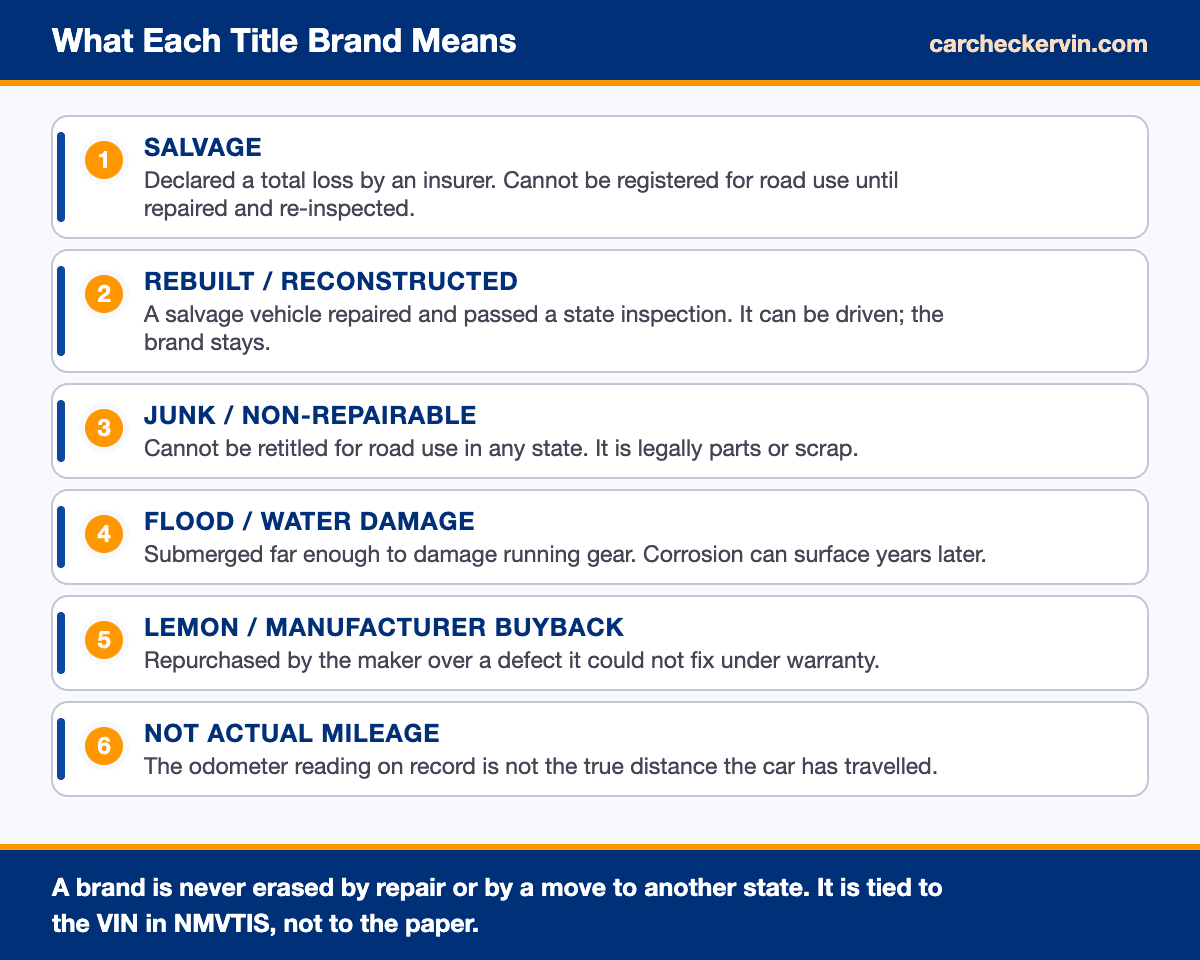
Florida Title Brand Vocabulary
States do not use the same words for the same thing, and the words are not decoration — they decide what you are allowed to do with the car. These are the brands the Florida Department of Highway Safety and Motor Vehicles applies. Each one surfaces in a VIN check no matter which state later issues the title.
A salvage vehicle that has been repaired and passed a state inspection to legally return to the road. The prior total-loss damage permanently lowers its value and can complicate insurance and resale.
A salvage vehicle that has been repaired and passed a state inspection to legally return to the road. The prior total-loss damage permanently lowers its value and can complicate insurance and resale.
The strongest non-repairable designation: the vehicle must be dismantled or crushed and can never be re-titled for road use. A clear warning sign on any history report.
Issued when an insurer declares a vehicle a total loss — usually when repair costs reach roughly 65–100% of its value, depending on the state. A salvage vehicle cannot legally be driven until it is repaired, inspected, and re-titled.
Marks a vehicle damaged by water submersion. Flood cars frequently develop hidden electrical faults, corrosion, and mold months or years later — often after cosmetic cleanup hides the evidence.
Flags vehicles damaged by named tropical storms or hurricanes. Like other flood-damaged cars, they carry hidden corrosion and electrical risk and are frequently transported to other states to be resold.
A Florida salvage title is never branded with the bare word "Salvage". The department brands it "Rebuildable" or "Rebuildable Flood" where the car was wrecked, and "Salvage Theft" where an insurer paid out on a theft that was never recovered at the time of the claim.
That last one matters when you are reading a history report. A Salvage Theft car may have come back intact and be mechanically untouched — the brand records an insurance event, not damage. Florida's own statute recognises the distinction elsewhere: 319.30(3)(c) disapplies the destruction rules entirely where a stolen vehicle "is recovered in substantially intact condition and is readily resalable". A Salvage Theft brand is a reason to ask what happened, not a finding that anything was broken.
Nor does a Rebuildable brand prove the car ever reached 80 percent. Form HSMV 82363 lets an uninsured or self-insured owner request a Salvage Rebuildable or Salvage Rebuildable Flood title "even if the cost of repairing or rebuilding the vehicle is less than 80 percent". Some Florida salvage brands are therefore voluntary, applied by an owner who wanted the paperwork settled rather than by a test the car failed.
The rebuilt brand is not a word but a sentence. Section 319.23(2) has the department stamp, in a conspicuous place on the title, "words stating ... that the vehicle has been rebuilt and may have previously been declared a total loss vehicle due to damage". Note the hedge the legislature wrote into its own brand — "may have" — which is there because the rebuilt stamp covers cars assembled from parts and kit cars as well as former total losses.
Section 319.14(1)(b) sets out what has to happen first: nobody may knowingly offer for sale, sell or exchange a rebuilt vehicle until the department has stamped the title and "has conducted the physical examination of the vehicle to assure the identity of the vehicle and all major component parts". Only then does the department "affix a decal to the vehicle, in the manner prescribed by the department, showing the vehicle to be rebuilt".
Section 319.14(4) is the strongest carry-forward language of any state, and it does three jobs in a single sentence: "If a certificate of title, including a foreign certificate, is branded to reflect a condition or prior use of the titled vehicle, the brand must be noted on the registration certificate of the vehicle and such brand shall be carried forward on all subsequent certificates of title and registration certificates issued for the life of the vehicle." It settles Florida-to-Florida carry-forward, it honours another state's brand expressly, and it puts the brand on the registration as well as the title.
The brands it reaches are wider than damage. Section 319.14 covers vehicles previously used as taxicabs, police vehicles or short-term-lease vehicles, manufacturer buybacks stamped "Manufacturer's Buy Back", and vehicles that are rebuilt, assembled from parts, kit cars, glider kits, replicas, flood vehicles, custom vehicles or street rods. A Florida title can carry a mark for a reason that has nothing to do with a crash — which is exactly why the words on the paper are worth reading rather than pattern-matching.
Florida's flood brand has a precondition most people miss. A "flood vehicle" is defined at 319.14(1)(c)8 as one "that has been declared to be a total loss pursuant to s. 319.30(3)(a) resulting from damage caused by water". No total loss declaration, no flood brand. A car that sat in salt water and was dried out privately, with no claim paid and no 80 percent finding, is not a flood vehicle in Florida law however much corrosion it is carrying.
There is an asymmetry in the statute that shows how seriously Florida treats damage brands compared with use brands. Section 319.14(10) lets a lease-vehicle notation and a nonconforming-vehicle notation be removed: once a car has ceased to be used as a lease vehicle and has passed to a private owner, or a manufacturer buyback has 36,000 miles or 34 months behind it, that owner "may request the department to issue a corrected certificate of title that does not contain the statement of the previous use". Rebuilt and flood are not on that list. Those brands do not come off.
An out-of-state title showing "Water Damage" or "Flood Damage" becomes a Florida "Flood Damaged" brand on arrival, under the same carry-forward rule. Two things, though, travel less well than the title language suggests.
The first is the decal. Florida's red-and-white rebuilt decal is placed under TL-37 in the driver's door jamb, where it may not be affixed to a removable part, and it is the one Florida brand you can check on the car itself. But it is not assigned at all when the rebuilt brand came in from another state — so a door-jamb check on an out-of-state rebuild finds nothing, and its absence proves nothing. Removing one is treated seriously: under 319.14(7), a person who removes a rebuilt decal "with the intent to conceal the rebuilt status of the vehicle commits a felony of the third degree".
The second is California. TL-36 treats a California title branded salvage as already rebuilt there, converting it straight to a Florida rebuilt title with an inspection "not required". Only a California salvage certificate issued in lieu of a title sends the car through the Florida rebuild process. A Californian rebuild therefore reaches a Florida title without any Florida examination of the repair.
Disclosure duties are real and they reach private sellers, not just dealers. Section 319.14(2) makes it an offence for "a person" to knowingly sell, exchange or transfer such a vehicle "without, before consummating the sale ... disclosing in writing" that it is rebuilt, assembled from parts, a kit car, glider kit, replica or flood vehicle, or was a taxi, police or short-term-lease vehicle. The statute prescribes no form; it requires only that the disclosure be in writing and come before the deal closes. Section 319.14(3) separately requires any advertisement to "clearly and precisely state" the same facts, and makes a breach a second-degree misdemeanour; 319.14(6) makes a knowing sale in breach of the section a second-degree misdemeanour too, reaching not only the seller but "any officer, agent, or employee" who authorises, directs, aids in or consents to it.
Set against all that, 319.14(9) shields a seller from civil liability where the brand was missing from the title and registration certificate that they themselves received — "unless the person has actively concealed the prior use or condition of the vehicle from the purchaser". That is the provision that decides who carries the loss when a washed title surfaces later, and it decides it against the buyer. The paperwork trail, not the seller's word, is what protects you in Florida.
One last definition worth carrying into a rebuilder's paperwork. Section 319.30(1)(j) defines major component parts far more broadly than most states: for an ordinary car, "any fender, hood, bumper, cowl assembly, rear quarter panel, trunk lid, door, decklid, floor pan, engine, frame, transmission, catalytic converter, or airbag"; for trucks, any bed mounted to a truck frame; and for electric, hybrid and plug-in hybrid vehicles, additionally "any electric traction motor, electronic transmission, charge port, DC power converter, onboard charger, power electronics controller, thermal system, traction battery pack, or airbag". Airbags and catalytic converters are on the list, and so is a traction battery pack — so a rebuilt EV's inspection paperwork should include receipts for the high-voltage components, and their absence is a question worth asking.
The one to memorise is Certificate of Destruction. That brand is not a discount — it is a permanent bar on the vehicle ever being titled for road use again in Florida. A car carrying it is a parts source and nothing else, and anyone offering to sell you one as a driveable project is either mistaken or lying.
Florida carries a brand applied by another state forward onto its own title, so a washed document from a neighbouring state does not survive a transfer into FL.
Has This Florida Car Ever Been Written Off?
A re-issued title can look clean over a total loss recorded in another state. Run the VIN and see every brand on the record, free, in seconds.
Salvage to Rebuilt: The Florida Inspection
A salvage title is not a licence to drive. It is closer to a receipt for a wreck: the car is legally off the road until somebody repairs it, submits it for inspection, and gets a new certificate issued in the rebuilt category. Buying a salvage-titled car and driving it home is not a grey area — it is an unregistered, uninsurable vehicle on a public road, and Florida will not put plates on it until the rebuilt certificate exists.
In Florida the inspection is carried out by the Florida Department of Highway Safety and Motor Vehicles, at a Bureau of Dealer Services regional office or a private PRVIP inspection facility. The examination is an identity check, not a safety check, and both statutes that describe it say so in the same terms. Section 319.14(1)(b) has the department examine the vehicle "to assure the identity of the vehicle and all major component parts, as defined in s. 319.30(1), which have been repaired or replaced", and 319.32(1) describes the physical examination as including "verification of the vehicle identification number and verification of the bill of sale or title for major components". Nothing in either provision certifies that the repair was done competently or that the car is safe to drive.
What you get on a pass is the decal. TL-37 is explicit that it may not be affixed until the vehicle has passed, and rule 15C-22.002(9) confines the whole exercise — "a rebuilt documentation review, motor vehicle physical inspection, and rebuilt decal placement" — to inspectors authorised by the department under rule 15C-22.004.
Since 2022 there have been two places to have it done. Section 319.141(2) required the department to implement a private-sector program by 1 October 2022 in twelve named counties: Bay, Broward, Duval, Escambia, Hillsborough, Leon, Manatee, Marion, Miami-Dade, Orange, Palm Beach and Volusia. Outside those counties the examination is still a Bureau of Dealer Services regional office appointment.
The statute defines what the inspection actually consists of, and the list is the most useful part of this whole section for anyone assessing a rebuilt Florida car. Under 319.141(1)(b), "rebuilt inspection services" means an examination of the vehicle together with a properly endorsed certificate of title, salvage certificate of title or manufacturer's statement of origin; an application for a rebuilt certificate of title; a rebuilder's affidavit; a photograph of the junk or salvage vehicle taken before repairs began, if available; a photograph of the interior driver and passenger sides of the vehicle if airbags were previously deployed and replaced; receipts or invoices for all major component parts and repairs which were changed; and proof that notice of the rebuilding has been reported to the National Motor Vehicle Title Information System.
Two items on that list deserve emphasis. The NMVTIS reporting requirement means a properly processed Florida rebuild is supposed to appear in the national record at the moment of inspection, which is why a VIN check on a Florida rebuild that shows nothing is worth a second look. And the airbag photograph is a specific, checkable artefact: if the restraints were deployed and replaced, photographs of both front interior sides exist somewhere in the file.
One item is softer than it looks. The pre-repair photograph is required only "if available", which means a car that arrived at the rebuilder without any documentation of its wrecked condition can still be inspected. Where a seller can produce those photographs, they are worth asking for; where they cannot, the statute does not treat that as a failure.
The private facilities are held to real conditions. Section 319.141(4) requires a $100,000 surety bond or irrevocable letter of credit in the department's favour, garage liability cover with a minimum $100,000 single limit including bodily injury and property damage, and criminal background checks showing that owners, partners, corporate officers and inspectors have not been convicted of, pled to, or been incarcerated for a felony in the previous ten years.
The physical requirements are unusually specific, and they exist to stop the customer influencing the outcome. The facility must be a permanent fixed structure at a postal address "where the only services provided on such property are rebuilt inspection services", with permanent signage, posted business hours, a designated office and customer waiting area, surveillance cameras with recording capability covering the inspection areas, sufficient onsite parking, room for every vehicle being inspected, and a covered area for at least two vehicles in bad weather. The inspection area itself must be "separate and visually obstructed from any area accessible to the customer".
Independence is attested annually and the list of disqualifying relationships is long. A participant must confirm no direct or indirect interest in any vehicle the facility has inspected or proposes to inspect, and no employment by, ownership interest in or financial arrangement with a motor vehicle repair shop, a motor vehicle dealer, a towing company, a vehicle storage company, a vehicle auction, an insurance company, a salvage yard, a metal retailer or a metal rebuilder from which referrals are received. Only a selected and approved participant "may charge or receive a fee for providing or facilitating such services".
Oversight continues after approval. The department "shall conduct an onsite facility inspection at least once per quarter" and must immediately terminate a participant that falls below the minimum requirements; results are entered through a departmental electronic filing system; records of each inspection are kept at least five years; and forty-five days' written notice is required before a change of facility ownership. A participant may not inspect a vehicle bought in complete rebuilt condition without the department's prior approval.
The consequence of failing is narrower than most states allow. Under 319.141(7), "a vehicle owner who fails an initial rebuilt inspection may only have that vehicle reinspected by the department or the facility that conducted the original inspection". There is no shopping for a friendlier inspector.
Getting the car there legally has its own procedure. Rule 15C-22.002(5) and (6) let an applicant obtain a temporary tag under s. 320.131 at a tax collector, tag agency or regional office to transport the vehicle to an authorised facility, on proof of a valid driver's licence and insurance, and only against an authorisation notice "that is stamped by the authorized facility confirming that a scheduled appointment has been made". The facility may fax that notice to the issuing office. A private participant may hand out the Application for Temporary License Plate (HSMV 83091) only where an appointment is actually booked and no permanent or dealer plate can lawfully be issued.
On cost, the statutory fees are small and the private ones are not capped. Section 319.32(1) sets $40 for the initial examination and $20 for each subsequent one, with the initial fee going to General Revenue and later fees to the Highway Safety Operating Trust Fund. What a PRVIP participant may charge for its own service on top is not fixed anywhere; rule 15C-22.002(8) requires only that "the participant shall provide a receipt to the applicant itemizing any services fees as separate from the statutorily required fee". Ask for that itemisation before booking, because the separation is the only protection the rule gives you.
The Florida Department of Highway Safety and Motor Vehicles, at a Bureau of Dealer Services regional office or a private PRVIP inspection facility
Inspection fee: $40 for the initial physical examination and $20 for each subsequent examination, set by § 319.32(1) and repeated in the Private Rebuilt Motor Vehicle Inspection Program rules — the first fee is deposited into the General Revenue Fund and later ones into the Highway Safety Operating Trust Fund. Budget more than that at a private facility: neither the statute nor rule 15C-22.002 caps what a PRVIP participant may charge for its own service on top, and subsection (8) requires only that the receipt itemise "any services fees as separate from the statutorily required fee". Around it sit the ordinary title charges — $70 for the original certificate of title, only $2 for the salvage certificate of title itself, $10 more where the vehicle was previously registered outside Florida, a $4.25 service charge on the application, $2.50 for shipping a paper title and $1 for security materials
Official FL rebuilt-title inspection pageUnderstand what these inspections are usually for, because buyers routinely misread them. The primary purpose in most states is anti-theft verification — confirming the VIN plates are original and untampered, and that the parts bolted onto the car were bought rather than stolen, which is why receipts for major components are demanded. A rebuilt inspection is not a structural engineering assessment, and passing it is not a statement that the repair was done well.
So the certificate on the wall tells you the car is legal. It does not tell you the frame was pulled straight, the airbag module was replaced rather than reset, or the welds are where a factory would have put them. That is what your own independent pre-purchase inspection is for, and on a rebuilt car it is not optional.
What to ask for before you agree a price
- 1Photographs of the car before repair. A rebuilder who did honest work kept them; one who did not will find a reason they are unavailable.
- 2The parts invoices, especially for airbags, structural components and safety restraints. Salvaged airbags are a known and dangerous shortcut.
- 3The Florida inspection paperwork in the seller's name, matching this VIN, not a photocopy of somebody else's.
- 4The insurance total-loss settlement, if the seller has it — it names the damage the carrier actually paid out on.
- 5An independent inspection from a shop that does collision work, on a lift, before money changes hands. Budget for it as part of the purchase.
Then put the sale itself on paper. Write the brand into your Florida bill of sale in the seller's own words — a rebuilder who will not describe the car in writing as what its title says it is has told you something. And before the money moves, check whether anyone still holds a security interest in it. Rebuilt cars are bought at auction and repaired on credit far more often than clean ones are, and a lender's claim survives the repair, the inspection and the new certificate.
What a Rebuilt Title Actually Costs You
The sticker discount is real. What people underestimate is that the brand keeps charging you — every year you own the car, and again on the day you sell it.
Insurance is narrower and sometimes unavailable
Liability cover is normally fine. Physical damage is where the problem lives: several large insurers decline comprehensive and collision on a rebuilt vehicle outright, and those that write it settle any future claim against the reduced branded value. Get a quote against the actual VIN before you agree a price.
Most lenders will not finance it
Branded collateral is hard to value and hard to move on repossession, so banks and captive finance arms generally decline. Some credit unions lend at a shorter term and a higher rate. In practice it is a cash purchase — which also removes the lender's appraisal, one of the few independent checks in a normal transaction.
The resale discount does not fade
A branded car trades well below a comparable clean one, commonly quoted around 20% to 40% depending on the vehicle and the documentation. The gap does not close with age, because every future buyer runs the same VIN you are running now. Most dealers will not take one in part-exchange at all.
Repair quality is the real variable
A car repaired with new OEM panels on a jig can be entirely sound. One straightened by eye with junkyard parts and a reset airbag light shows up later as pulling under braking, doors that stop sealing, or restraints that do not fire. Nothing on the title separates the two — only the documentation and a lift.
Should You Ever Buy a Salvage or Rebuilt Car?
Sometimes, yes. The honest answer is that it depends on what the car was hit by and what you need the car to do — and it is a judgement most buyers can make for themselves once they know what to separate. Two lists, and they are not close calls.
Cases where the discount is genuinely worth it
- Hail damage on an otherwise untouched car. It is cosmetic, it totals cars on paint cost alone, and the mechanical vehicle underneath is exactly what it was.
- A recovered theft with no collision damage, where the write-off happened because the insurer had already paid the claim before the car turned up.
- An older, low-value car totalled by modest damage. On a $4,000 car it takes very little to cross a threshold, and the repair may be one panel.
- A car you intend to keep for a decade and run into the ground. The resale penalty only bites if you plan to sell.
- A repair you can fully document — pre-repair photographs, parts invoices, and a shop you can phone.
Cases where the discount is a warning, not a bargain
- Any flood history. Water gets into loom connectors, control modules and seat-belt pretensioners, and the failures arrive months later in an order nobody can predict.
- Deployed airbags with no invoice for the replacement modules. A reset light over a spent or salvaged restraint system is the most dangerous shortcut in the trade.
- Structural or unibody repair without documented frame measurements. If the shell is out of alignment the car will never track, brake or crash correctly.
- A rebuilder who cannot produce pre-repair photographs, or who bought and re-titled the car in the last few weeks.
- Anything you need to finance, insure comprehensively, or resell within a couple of years — the brand blocks all three.
The flood exception is not a preference. Every other category on these lists is a matter of price and documentation. Flood is the one where a well-presented car and a ruined car look identical for the first year, and where the damage is distributed through the electrical system rather than concentrated somewhere a mechanic can look. Flood cars also travel: they are bought cheaply after a storm, cleaned, and sold hundreds of miles away, which is why the state on the current title tells you very little about where the water was.
What a Salvage Check Does Not Tell You
A title brand is a fact about the car's damage history as reported by an insurer. It is silent on who owns the car, what the odometer has done, and whether anyone is looking for it. Those live in different systems and are different searches — a car with a spotless brand record can still be encumbered, clocked, or stolen.
More Florida Vehicle Guides
Everything else worth checking before you put a Florida car in your name.
Salvage Title Check in Other States
Worth comparing if the car you are looking at was titled somewhere else before it reached Florida— the threshold that branded it, or failed to, was that state's rather than this one's.
View the full salvage title check hubFlorida Salvage Title Check — Frequently Asked Questions
How do I check for a salvage title in Florida?+
Enter the 17-character VIN in the search box on this page. Title brands are recorded against the VIN, not against the paper title the seller is holding, so a VIN search reaches a brand the document does not show. We cross-reference NMVTIS — which aggregates title-brand records from the Florida Department of Highway Safety and Motor Vehicles and every other state titling agency — along with insurance total-loss feeds and salvage-auction records.
What counts as a total loss in Florida?+
Florida sets no statutory threshold. The insurer decides when a vehicle is uneconomic to repair, so the same damage can be totalled by one carrier and repaired by another. The rule is set by Fla. Stat. §§ 319.30, 319.14, 319.141, 319.23, 319.32; Fla. Admin. Code r. 15C-22.002. Whichever test applies, what triggers the brand is the insurer's decision, not the severity of the damage as a mechanic would judge it — which is why a lightly damaged older car and a badly damaged newer one can end up carrying the same title.
What title brands does Florida use?+
Florida records these brands through the Florida Department of Highway Safety and Motor Vehicles: Salvage Rebuildable, Rebuilt, Certificate of Destruction, Salvage, Flood, Hurricane. The wording matters more than it looks — the word for a repaired total loss differs between states, and a seller describing the car in a neighbouring state's vocabulary is either careless or moving cars across a state line.
How does a salvage car get a rebuilt title in Florida?+
It has to be repaired and then cleared by the Florida Department of Highway Safety and Motor Vehicles, at a Bureau of Dealer Services regional office or a private PRVIP inspection facility before it can be re-titled and driven; the section on the Florida inspection above covers what that involves, and whether a physical inspection is guaranteed or only happens on the cars the state picks. The inspection fee is $40 for the initial physical examination and $20 for each subsequent examination, set by § 319.32(1) and repeated in the Private Rebuilt Motor Vehicle Inspection Program rules — the first fee is deposited into the General Revenue Fund and later ones into the Highway Safety Operating Trust Fund. Budget more than that at a private facility: neither the statute nor rule 15C-22.002 caps what a PRVIP participant may charge for its own service on top, and subsection (8) requires only that the receipt itemise "any services fees as separate from the statutorily required fee". Around it sit the ordinary title charges — $70 for the original certificate of title, only $2 for the salvage certificate of title itself, $10 more where the vehicle was previously registered outside Florida, a $4.25 service charge on the application, $2.50 for shipping a paper title and $1 for security materials. Passing it is not a statement that the repair was done well — in most states the inspection is an ownership and anti-theft check, which is why it wants receipts for major parts rather than frame measurements.
Does a salvage brand disappear if the car is re-titled in another state?+
No. The brand is attached to the VIN in NMVTIS, and NMVTIS is fed by every state titling agency, by insurers, and by salvage yards. A paper title issued in a second state can come out looking clean — that is what title washing is — but the VIN record does not reset when the car crosses a state line. Florida also carries a brand applied elsewhere forward onto its own title.
Can you insure and finance a rebuilt-title car in Florida?+
Liability cover is usually available. Comprehensive and collision often are not, and most banks will not lend against branded collateral, so rebuilt cars tend to be cash purchases. Get a written quote from your own insurer against the VIN before you agree a price, not after.
Is it safe to buy a rebuilt car in Florida?+
It depends on what the damage was and who repaired it. Hail, a recovered theft or a rear-end hit on an older car can total a vehicle on economics alone and leave nothing structurally wrong. A flood car, deployed airbags with no documented replacement, or a repaired unibody is a different proposition. Ask for the pre-repair photographs, the parts invoices and the Florida inspection paperwork, then pay an independent shop to put it on a lift. If the seller cannot produce the repair record, you are buying the repair blind.
Does a clean salvage check mean the car was never damaged?+
No, and this is the limit worth understanding. A brand only exists if an insurer wrote the car off and reported it. Damage repaired privately, out of pocket, or by a driver who never made a claim leaves no brand at all — and on an older car, where repair costs easily exceed a low book value, owners often avoid claiming for exactly that reason. A clean brand record is good news about the paperwork, not a report on the bodywork.
Florida sources
The Florida-specific statements above come from these official pages. Thresholds, fees and brand wording do get amended — check the source before relying on a figure in a transaction.
Vérifications VIN connexes
Plus d'outils pour vérifier l'historique de tout véhicule
Run Your Free Florida Salvage Title Check
One VIN, every brand ever recorded against it, in any state. Two minutes now against a write-off that would otherwise follow the car into your name.
Or get the full VIN history report