South Dakota Salvage Title Check by VIN — Is the Title Clean?
A salvage brand is recorded against the VIN, not against the document the seller hands you. Run the number and you see every brand the car has collected in South Dakota and in every other state it has passed through — including the ones a re-issued title no longer prints.
Run a Free South Dakota Salvage Title Check
Enter any 17-character VIN — cars, trucks, SUVs, motorcycles
Free · No sign-up · Instant result
How a South Dakota Salvage Title Check Works
Three steps turn scattered insurer, auction and South Dakota Motor Vehicle Division records into a straight answer on whether this car has ever been written off.
Enter the 17-character VIN
Read it off the plate at the base of the windscreen, the driver-side door jamb, and the South Dakota title, and check all three agree before you go any further. A VIN that does not match across the car is a bigger problem than any brand.
We search the national brand record
The lookup queries NMVTIS, which the South Dakota Motor Vehicle Division and all other state titling agencies report into, plus insurance total-loss feeds and salvage-auction listings. Those are separate systems, and a car can appear in one before it appears in the others.
Read every brand, in every state
The result shows each brand ever applied to the VIN and the state that applied it — not just what South Dakota currently prints. A brand from a previous state is the single clearest sign the paper title in front of you has been washed.
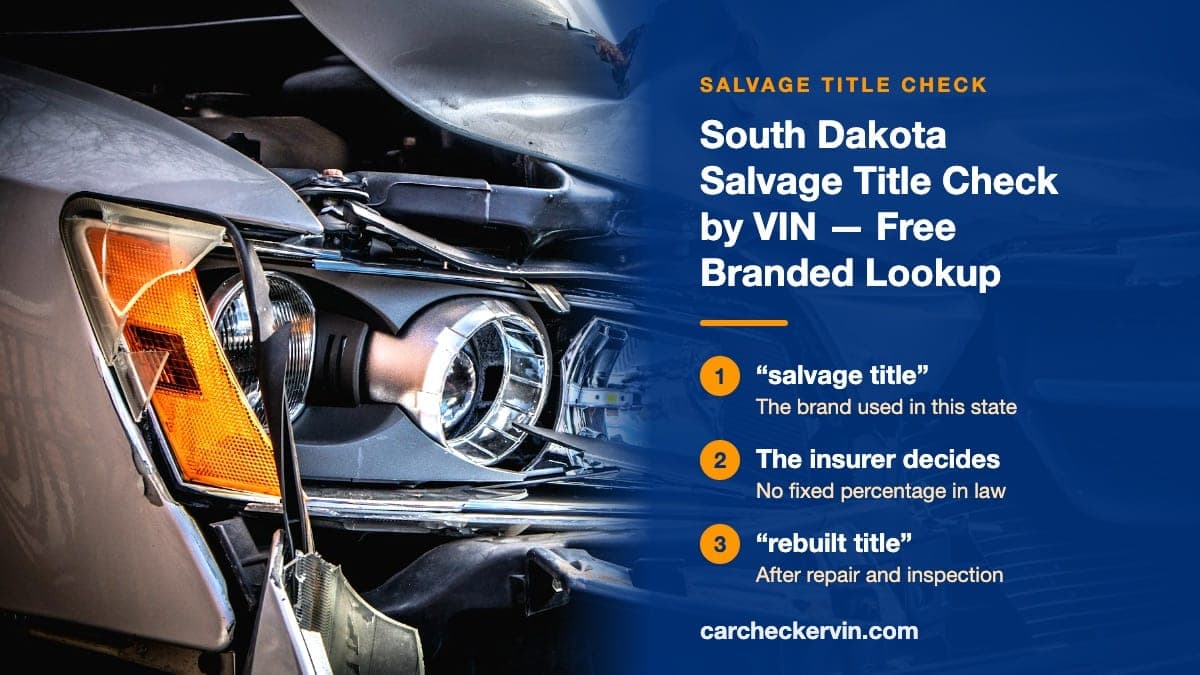
What Counts as a Total Loss in South Dakota
A total loss is an accounting decision, not a verdict on whether the car can be fixed. Almost any vehicle can be repaired given enough money. The insurer stops when repairing costs more than the car is worth, writes the owner a cheque for its value, takes the wreck, and notifies the state — and it is that notification, not the crash, that produces the brand.
South Dakota sets no statutory threshold. The insurer decides when a vehicle is uneconomic to repair, which means two carriers can look at identical damage and reach opposite conclusions. The practical effect for a buyer is that the absence of a brand tells you less here than it would under a fixed rule.
South Dakota puts no percentage in its law at all. Section 32-3-51.19 defines a salvage vehicle as "any motor vehicle that an insurer or self insurer determines a total loss due to theft or to damage caused by fire, vandalism, collision, weather, submersion in water, or flood". There is no ratio, no dollar figure and no estimate anywhere in it — the insurer's own determination is the entire test.
What the statute does instead is list the causes, and the list is wide. Fire, vandalism, collision, weather, submersion in water and flood all reach the same single brand, which means a South Dakota salvage title tells you an insurer wrote the car off but not what happened to it. Two cars carrying identical paper may have been through completely different events.
South Dakota salvage rules at a glance
- Titling agency: South Dakota Motor Vehicle Division
- Total-loss test: Insurer's judgement — no statutory trigger
- Governing statute: SDCL §§ 32-3-1, 32-3-18, 32-3-22.1, 32-3-30.2, 32-3-51.5, 32-3-51.6, 32-3-51.11, 32-3-51.12, 32-3-51.13, 32-3-51.17, 32-3-51.18, 32-3-51.19, 32-3-51.20, 32-3-51.21, 32-3-51.22, 32-3-52, 32-3-53, 32-3-53.2, 32-3-53.4, 32-3-77
- Salvage brand wording: salvage title
- Rebuilt brand wording: rebuilt title
- Never-road-legal brand: junking certificate
- Out-of-state brand carried forward: Yes
Check this SD VIN for a brand:
The determination binds in both directions. Under 32-3-51.20, an insurer or self-insurer that acquires ownership of a salvage vehicle which does not already have a salvage title must, "within forty-five days following acquisition of the certificate of title of that vehicle, surrender the certificate of title for the vehicle to the department", and the department then "shall promptly issue a title indicating it is a salvage vehicle". Note the clock runs from acquiring the title, not from acquiring the car — a gap that matters when an insurer takes possession long before the paperwork arrives.
The more useful half is 32-3-51.21, because it covers the case that leaves most states with unbranded wrecks. "If an insurer or self insurer declares a vehicle to be a total loss but does not acquire ownership of the vehicle, the owner shall obtain a salvage title for the vehicle." The insurer must, "in writing, notify the owner of the obligation to obtain a salvage title before the owner sells or transfers the title", and an owner who sells or transfers without first obtaining one "is guilty of a Class 1 misdemeanor". South Dakota closes the owner-retention gap and puts a criminal penalty behind it.
Two exclusions then do a great deal of work, and they appear twice over — once in the definition itself and again in the owner's duty. Neither 32-3-51.19 nor 32-3-51.21 "appl[ies] to any motor vehicle more than ten model years old or with a gross vehicle weight rating of more than sixteen thousand pounds".
Read that plainly: an eleven-year-old car can be declared a total loss by an insurer in South Dakota, paid out in full, and keep an ordinary title, because the definition that produces the brand does not reach it. The same is true of any truck rated above 16,000 pounds at any age. On an older vehicle the absence of a South Dakota salvage brand is close to meaningless, and the history record behind the VIN is the only thing that will show the loss.
The scope line at the top of the definition is worth reading too, because it limits the reach of everything above. Section 32-3-51.19 begins "For purposes of §§ 32-3-51.5, 32-3-51.20, and 32-3-51.21" and nowhere else. It governs the treatment of out-of-state marked titles, the insurer's surrender duty and the owner's duty — and it does not govern the separate question of when a car counts as rebuilt, which runs off an entirely different test.
Since 2018 there has been a route for the insurer that cannot get the title at all. Section 32-3-77 provides that where an insurer "is unable to obtain a certificate of title ... from the owner or lienholder within forty-five days of payment of a total loss claim", and so cannot surrender it as 32-3-51.20 requires, "the department shall issue a salvage title or certificate of title for the motor vehicle to the insurer" on two proofs: payment to the registered owner, and payment in satisfaction of any previously perfected lien. An uncooperative owner delays the brand; it does not prevent it.
The same yardstick returns for stolen cars, and produces a genuinely separate brand. Under 32-3-51.22 an insurer that recovers a stolen vehicle has forty-five days to inspect it and apply for a title. "If the vehicle has no damage or the damage is less than that defined in § 32-3-51.19", the salvage title is surrendered and the department "shall promptly issue a title marked as a recovered theft with no salvage notation".
And if the damage does reach the line, nothing happens: "the salvage title is retained and the insurer or self insurer is not required to apply for a title pursuant to this section". So a South Dakota recovered-theft brand is a real and distinct thing, and its presence is mildly reassuring — it means the car came back in good enough condition that the insurer did not treat it as a write-off after all.
On the way in from another state the rule is short and firm. Section 32-3-51.5 provides that any vehicle "whose title has been marked by another state or jurisdiction, shall receive a title, which shall contain similar damage disclosure information", and that where the foreign title "has been branded as salvage or with any other similar brand", the applicant "shall receive a salvage title or, at the option of the owner, a junking certificate". There is no route to a clean South Dakota title for a foreign salvage car, and the owner's only choice is whether to end it there.
A foreign rebuilt brand travels just as completely. Section 32-3-51.6 provides that a vehicle "whose title has been marked by this state or another state or jurisdiction as rebuilt or with any other similar brand approved for highway use shall only receive a rebuilt title". Note the phrase "any other similar brand approved for highway use" — it is drafted to catch other states' vocabulary rather than to match particular words, which is why a Minnesota or Iowa rebuilt car does not arrive in South Dakota looking clean.
So the practical answer is that there is no arithmetic to check here, and on anything over ten model years old there may be no brand to check either. What decides whether the car in front of you was written off is the insurer's decision, and the only durable record of that decision is the one attached to the VIN.
The rule sits in SDCL §§ 32-3-1, 32-3-18, 32-3-22.1, 32-3-30.2, 32-3-51.5, 32-3-51.6, 32-3-51.11, 32-3-51.12, 32-3-51.13, 32-3-51.17, 32-3-51.18, 32-3-51.19, 32-3-51.20, 32-3-51.21, 32-3-51.22, 32-3-52, 32-3-53, 32-3-53.2, 32-3-53.4, 32-3-77.
What follows from that: the brand records an economicevent. A ten-year-old car with a book value of a few thousand dollars can be totalled by a shunt that would barely register on a new one, and it is the cheap car that gets branded. Read a salvage brand as “the repair bill was large relative to this car”, then go and find out what the damage actually was.
The Three Total-Loss Regimes, and Why They Matter to You
There is no national rule for when a damaged car becomes a salvage car. Each state picks one of three tests, and the choice decides whether an identical wreck leaves the body shop with a brand or without one.
Percentage of value
The most common test. The state fixes a percentage of the car's pre-loss actual cash value, and an insurer whose repair estimate reaches it must report a salvage. Thresholds run from about half the value to the whole of it, so the same $6,000 estimate on a $10,000 car is a mandatory brand in one state and a routine repair in another.
Total loss formula (TLF)
Repair cost plus salvage value, measured against actual cash value. TLF is sensitive to the parts market — a truck with hungry demand for its doors and tailgate totals on less damage than a car whose panels nobody wants.
Insurer discretion
No statutory trigger. The carrier decides when repair stops making commercial sense, on internal thresholds that are neither published nor binding. Two insurers can look at the same photographs and reach different answers, and neither is breaking a rule.
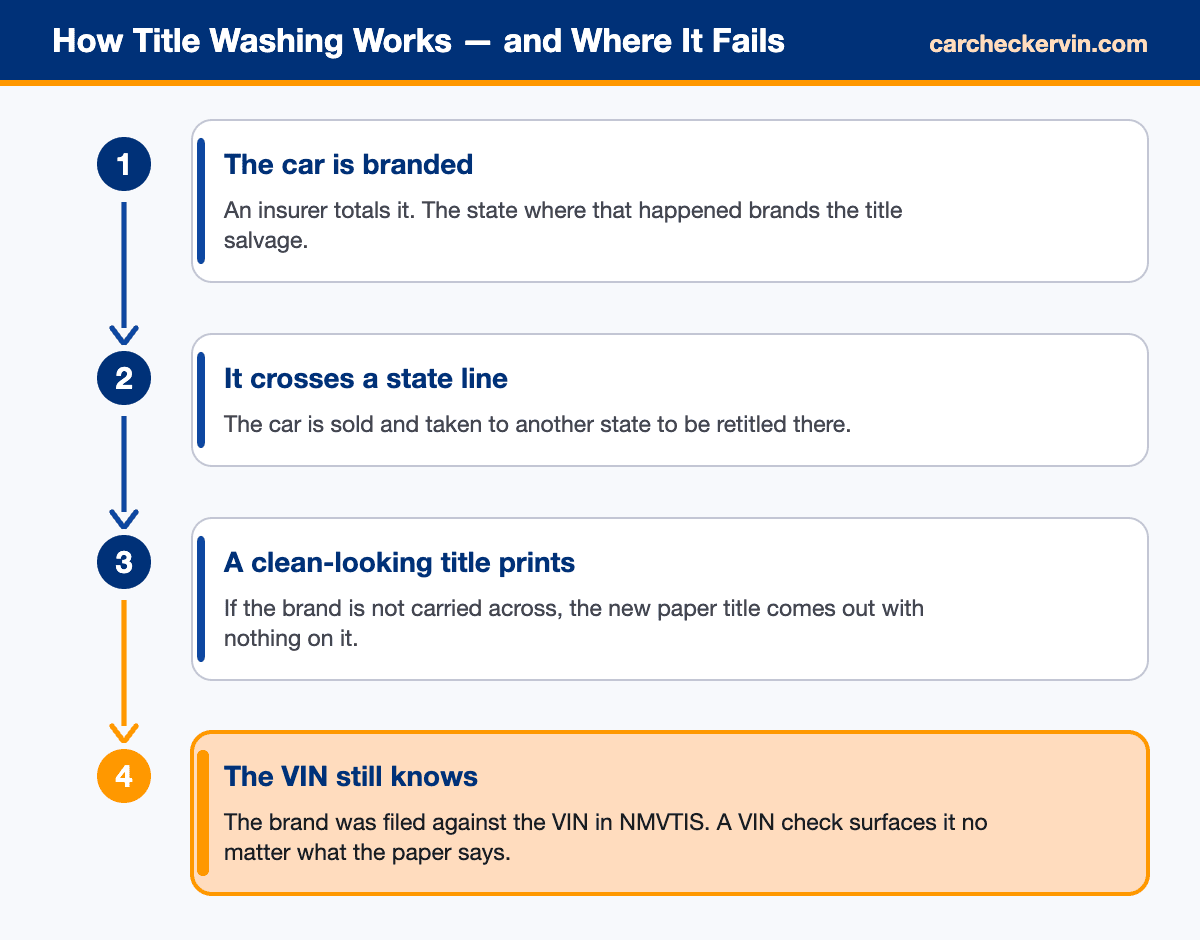
The consequence cuts both ways, and it is the reason to check the record rather than the paperwork. A cheap salvage car from a low-threshold state is not necessarily badly wrecked — it may have been branded on arithmetic another state would never have applied. An unbranded car from a high-threshold or discretionary state is not necessarily undamaged. It also makes moving damaged cars between states a business: a rebuilder who buys a wreck, repairs it and re-titles it where the brand does not carry across ends up holding a clean-looking certificate on a written-off car, without forging anything. That is title washing, and it is the same route by which a mileage brand gets left behind — which is why the two are worth checking together.
NMVTIS is the answer to that gap. Every state titling agency, insurer, salvage yard and recycler reports into it, and it is keyed to the VIN rather than to any document. A second state can print a fresh certificate; it cannot delete the record of the first one. The title is produced by the person selling you the car. The record is not.
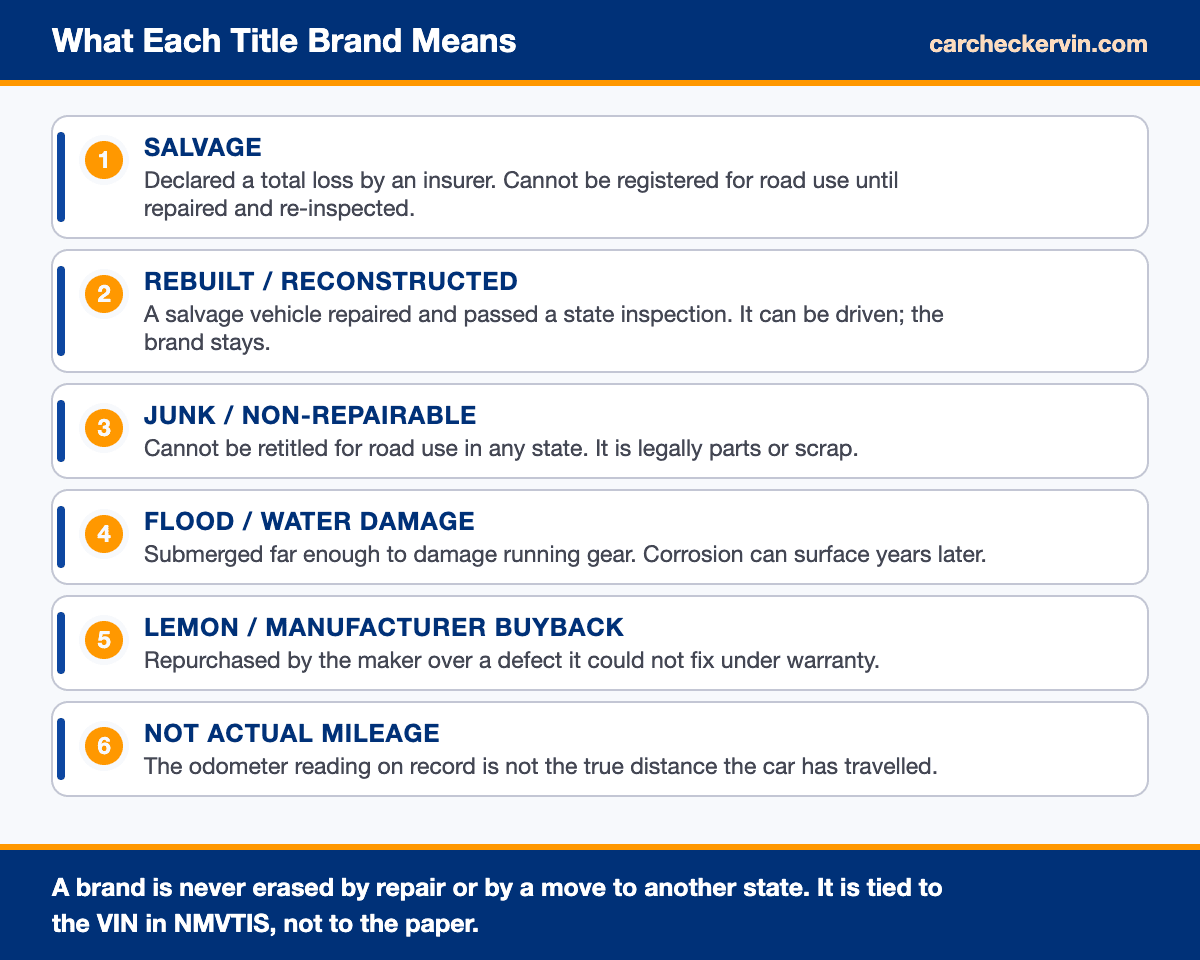
South Dakota Title Brand Vocabulary
States do not use the same words for the same thing, and the words are not decoration — they decide what you are allowed to do with the car. These are the brands the South Dakota Motor Vehicle Division applies. Each one surfaces in a VIN check no matter which state later issues the title.
Issued when an insurer declares a vehicle a total loss — usually when repair costs reach roughly 65–100% of its value, depending on the state. A salvage vehicle cannot legally be driven until it is repaired, inspected, and re-titled.
A salvage vehicle that has been repaired and passed a state inspection to legally return to the road. The prior total-loss damage permanently lowers its value and can complicate insurance and resale.
A certificate showing the vehicle has been retired as junk or scrap. It permanently bars the vehicle from being re-titled for road use.
Marks a vehicle damaged by water submersion. Flood cars frequently develop hidden electrical faults, corrosion, and mold months or years later — often after cosmetic cleanup hides the evidence.
South Dakota's terminal document is a "junking certificate", and the definition at § 32-3-1(10) is admirably blunt: "a certificate of ownership, which may not be restored to a title document that allows highway use, issued by the department to the owner of a vehicle that is going to be dismantled and sold for parts". No inspection, no bond and no discretionary route reopens it.
It is mandatory rather than optional. Section 32-3-51.17 provides that any vehicle "whose title has been marked as nonrebuildable, parts only, or whose owner has designated that the vehicle should not be placed upon the roads and highways, shall receive a junking certificate". Two of those three triggers are about paper — a brand applied elsewhere — and the third is a decision the owner makes and cannot take back.
A second route to the same document runs through dismantling. Under § 32-3-51.12 any owner "of a motor vehicle that is being dismantled for the purpose of selling its parts shall apply for a junking certificate", surrendering the plates, registration card and certificate of title with the application; where the title shows a lien, "the lien holder's consent to the issuance of the junking certificate shall be endorsed on the certificate of title". The department then cancels both the registration and the title on its records. The same section carries a serious offence: the owner "may not remove the vehicle's identification number or other identification numbers", and doing so "is a Class 6 felony".
The department can look before it issues. Section 32-3-51.13 lets any vehicle "whose title has been marked as rebuilt or salvage by this state or any other state or jurisdiction", or any vehicle whose owner is applying for a junking certificate, "be inspected by an employee of the department, or a person designated by the department" — a discretionary power that sits alongside the mandatory rebuilt inspection and is easy to overlook.
The rebuilt brand is unusually wide, and it turns on a test that has nothing to do with crash damage. Section 32-3-1(24) defines a rebuilt vehicle as one "that has been rebuilt by the addition or deletion of assemblies, subassemblies, parts, or component parts so that upon gross visual examination it does not appear to be the vehicle described in the certificate of title last issued for the vehicle, or whose title has been marked as rebuilt by this state or another state or jurisdiction".
Read the first limb again. It is an identity test — does the car still look like the one the last title described? — and it says nothing about a collision, an insurer or a write-off. A heavily modified South Dakota car that was never wrecked can carry a rebuilt title on that limb alone. That is one more reason to read a South Dakota rebuilt brand alongside the vehicle's history rather than as a verdict on its own, and it cuts the other way too: a rebuilt title here is weaker evidence of past damage than the same word in most states.
The second limb is the carry-forward one, and § 32-3-51.6 makes it operative: such a vehicle "shall only receive a rebuilt title". Between them, 32-3-51.5 and 32-3-51.6 mean South Dakota honours both a foreign salvage brand and a foreign rebuilt brand, and 32-3-51.5 additionally requires the new title to contain "similar damage disclosure information" to whatever the other state recorded.
What South Dakota does not have is a flood brand of its own. Flood and "submersion in water" appear in § 32-3-51.19 as two of the six causes that can produce a total loss determination, but the document that results is a plain salvage title. Nothing on the finished paper distinguishes a car that burned from one that sat in a river, and after a rebuild both read simply "rebuilt".
Before relying on anything in this chapter, know that a large part of it was repealed and the repealed sections still resolve. Sections 32-3-51.7 to 32-3-51.10 were repealed by SL 2015, ch 157, §§ 2 to 5, and 32-3-51.14 to 32-3-51.16 by the same act, §§ 6 and 7; § 32-3-51.4 went in SL 1990, ch 231, § 5. Each of those URLs returns a page rather than an error, with the repeal line as its entire body, so a link check cannot tell them from live law. Only reading them can.
The part a buyer can actually use is the disclosure machinery, and South Dakota's is unusually open. Section 32-3-51.11 requires the department to retain each damage disclosure statement it receives, and provides that the statement "shall become part of the title history available to the public pursuant to § 32-3-30.2".
That history is not gated behind an eligibility test. Section 32-3-30.2 lets the department, "upon written request and payment of a five dollar fee, furnish a person an abstract of the title history of any motor vehicle and semitrailer registered pursuant to this title including any damage disclosure statement", and adds that the abstract "may include all documents filed with the department to establish the title history of the vehicle". Five dollars, any person, any vehicle, with the fee going to the state motor vehicle fund and governmental entities exempt.
That is a materially better position than a buyer has in most states, where the equivalent record sits behind a notarised statement of permissible purpose under the federal Driver's Privacy Protection Act. In South Dakota the state's own file on a car — including the damage disclosure statements filed by previous owners — is available to a prospective buyer before they decide, for the price of a written request.
There is a dealer duty on top of it, and its remedy has teeth most disclosure rules lack. Section 32-3-51.18 requires any vehicle sold or offered for sale "by a vehicle dealer or a used vehicle dealer as defined in § 32-6B-1" to "display a sticker, decal, or notice that discloses damage to the vehicle for which the current title denotes a salvage brand or similar brand", in a format the department prescribes by rule. And then: "If the dealer fails to comply with this section, the purchaser of the motor vehicle may return the motor vehicle to the dealer within ten days after receiving the title, and the dealer shall make a full refund to the purchaser."
Read that remedy carefully, because the clock is unusual. The ten days run from receiving the title, not from the sale — which in practice is often weeks after the car was driven away, since South Dakota titles issue through the county treasurer. A buyer who spots a salvage brand on a title that arrives a month after the purchase still has a statutory right to hand the car back and be repaid in full, provided the dealer never displayed the required notice.
Enforcement against the trade is backed by a quiet inspection power. Section 32-3-52 requires departmental employees authorised by the secretary to "require the surrender of the plates and documents for such vehicles from dealers, salvage yards, and other similar establishments, when it is determined that the plates and documents have not been forwarded to the department as required". It is the provision that keeps salvage paperwork moving out of yards and into the state record, which is ultimately what makes a VIN check on a South Dakota car worth running.
The one to memorise is junking certificate. That brand is not a discount — it is a permanent bar on the vehicle ever being titled for road use again in South Dakota. A car carrying it is a parts source and nothing else, and anyone offering to sell you one as a driveable project is either mistaken or lying.
South Dakota carries a brand applied by another state forward onto its own title, so a washed document from a neighbouring state does not survive a transfer into SD.
Has This South Dakota Car Ever Been Written Off?
A re-issued title can look clean over a total loss recorded in another state. Run the VIN and see every brand on the record, free, in seconds.
Salvage to Rebuilt: The South Dakota Inspection
A salvage title is not a licence to drive. It is closer to a receipt for a wreck: the car is legally off the road until somebody repairs it, submits it for inspection, and gets a new certificate issued in the rebuilt category. Buying a salvage-titled car and driving it home is not a grey area — it is an unregistered, uninsurable vehicle on a public road, and South Dakota will not put plates on it until the rebuilt certificate exists.
In South Dakota the inspection is carried out by the Motor Vehicle Division of the South Dakota Department of Revenue, or a Highway Patrol officer. The inspection is documentary as much as physical, and the statute makes the documents a precondition rather than a formality. Section 32-3-53 provides that a rebuilt vehicle "may not be licensed or titled until there is submitted to the department proper affidavits, photo copies of receipts, bills of sale establishing ownership, or titles and the source of all parts and component parts used to rebuild the vehicle". No parts trail, no title — regardless of how the car looks.
The department says the same thing in plainer language and earlier in the process: during the rebuild, all titles, manufacturer's statements or certificates of origin, bills of sale, invoices, receipts "or any other ownership information for vehicles and parts used in the construction of the vehicle must be saved". This is a rule you comply with while buying parts, not while filling in a form.
Two applications start it: an Application for Motor Vehicle Title & Registration and an Application for Inspection of Rebuilt Motor Vehicle, both filed in the county of the applicant's residence and signed by the record owner or by an authorised agent — with a power of attorney attached where an agent signs.
The capacity is genuinely small. The department runs three inspection locations, each holding a single session a month: Sioux Falls on the first Wednesday, Pierre on the second, Rapid City on the third, with the applicant booking the slot. A rebuild finished in the wrong week waits.
Who may look is set out in § 32-3-53.2, not in § 32-3-53 as the summaries usually have it: "The motor vehicles, trailers, or semitrailers referred to in § 32-3-53 may be inspected by an employee of the Department of Revenue or a highway patrolman." The certificate of inspection "shall be of a form prescribed and furnished by the department", so it is a controlled document rather than a letter.
The same section carries a broad catch-all that reaches cars nobody would call rebuilt. Vehicles "of any age which have body and chassis from different vehicles combined to make one vehicle, which have component parts changed, or which lack supporting documents with the application for title may also be inspected". Missing paperwork is, by itself, a ground for inspection.
One definitional limit is easy to miss: under § 32-3-53.4, for the purposes of §§ 32-3-53 and 32-3-53.2 a trailer means one "which has an actual weight of three thousand pounds or greater". Lighter trailers fall outside the rebuilt inspection regime altogether.
The order of operations matters, because the title comes last and the county treasurer sits in the middle of it. After the inspection the owner takes a copy of the certificate of inspection — along with any original titles, statements of origin, bills of sale, invoices and receipts — to the local county treasurer's office, buys plates and pays any tax due.
There is a real concession on that tax. The department gives reciprocity for sales tax already paid on parts used in the construction, so a rebuilder who kept the receipts is not taxed twice on the same components. That is another reason the paperwork discipline pays for itself.
Only then does the title issue. Section 32-3-53 provides that "once the department is notified that the inspection is complete and has verified that the correct amount of tax has been paid, it shall issue a rebuilt title", and the brand is not discretionary at the end of it: "Each new certificate of title shall have noted thereon that the vehicle has been rebuilt."
Note what the statute does not say. Nowhere in § 32-3-53 or § 32-3-53.2 is the inspector required to certify that the repair was competently done, that the structure is sound, or that the vehicle is safe to drive. What the sections demand is affidavits, receipts, bills of sale and titles establishing where the parts came from. This is a provenance and identity check, like most states', and it is not a workmanship guarantee — a distinction worth holding on to when a seller describes a car as "state inspected".
The money has a quirk worth knowing. What the department's own page calls the $25 inspection fee is, in the statute, something else: § 32-3-22.1 makes it "the fee for assignment of a vehicle identification number", payable to the county treasurer at the time of application for a rebuilt title, forwarded to the Division of Motor Vehicles with the application and the affidavit of rebuilt motor vehicle. "The rebuilt application may not be processed if the fee is not paid" — and, if no identification number is actually assigned as a result of the inspection, "the Division of Motor Vehicles shall refund the fee to the applicant".
Around it sits the ordinary title charge. Section 32-3-18 sets the certificate of title application fee at ten dollars, split evenly between the state motor vehicle fund and the county general fund, and requires the application to list every owner, the full vehicle description with identification numbers, the applicant's claim of title, and every lien, title reservation and encumbrance with the holders' names and addresses. Licence fees are then charged under the ordinary non-commercial schedule.
Section 32-3-53 was last amended by SL 2025, ch 44, § 7, so this is current law rather than a settled backwater — worth re-reading rather than assuming, if you are working from an older account of South Dakota practice.
The Motor Vehicle Division of the South Dakota Department of Revenue, or a Highway Patrol officer
Inspection fee: $25.00 under SDCL 32-3-22.1, which is statutorily a fee for assignment of a vehicle identification number rather than an inspection fee, even though the Department of Revenue's own rebuilt vehicles page calls it "the inspection fee". It is payable to the county treasurer at the time of application for a rebuilt title, forwarded to the Division of Motor Vehicles with the application and the affidavit of rebuilt motor vehicle, and the rebuilt application "may not be processed if the fee is not paid" — but if no identification number is assigned as a result of the inspection, the Division "shall refund the fee to the applicant". Add the $10.00 certificate of title application fee under SDCL 32-3-18, split evenly between the state motor vehicle fund and the county general fund, plus licence plate fees on the ordinary non-commercial schedule and any sales tax not already covered by the reciprocity the department gives for tax paid on parts
Official SD rebuilt-title inspection pageUnderstand what these inspections are usually for, because buyers routinely misread them. The primary purpose in most states is anti-theft verification — confirming the VIN plates are original and untampered, and that the parts bolted onto the car were bought rather than stolen, which is why receipts for major components are demanded. A rebuilt inspection is not a structural engineering assessment, and passing it is not a statement that the repair was done well.
So the certificate on the wall tells you the car is legal. It does not tell you the frame was pulled straight, the airbag module was replaced rather than reset, or the welds are where a factory would have put them. That is what your own independent pre-purchase inspection is for, and on a rebuilt car it is not optional.
What to ask for before you agree a price
- 1Photographs of the car before repair. A rebuilder who did honest work kept them; one who did not will find a reason they are unavailable.
- 2The parts invoices, especially for airbags, structural components and safety restraints. Salvaged airbags are a known and dangerous shortcut.
- 3The South Dakota inspection paperwork in the seller's name, matching this VIN, not a photocopy of somebody else's.
- 4The insurance total-loss settlement, if the seller has it — it names the damage the carrier actually paid out on.
- 5An independent inspection from a shop that does collision work, on a lift, before money changes hands. Budget for it as part of the purchase.
Then put the sale itself on paper. Write the brand into your South Dakota bill of sale in the seller's own words — a rebuilder who will not describe the car in writing as what its title says it is has told you something. And before the money moves, check whether anyone still holds a security interest in it. Rebuilt cars are bought at auction and repaired on credit far more often than clean ones are, and a lender's claim survives the repair, the inspection and the new certificate.
What a Rebuilt Title Actually Costs You
The sticker discount is real. What people underestimate is that the brand keeps charging you — every year you own the car, and again on the day you sell it.
Insurance is narrower and sometimes unavailable
Liability cover is normally fine. Physical damage is where the problem lives: several large insurers decline comprehensive and collision on a rebuilt vehicle outright, and those that write it settle any future claim against the reduced branded value. Get a quote against the actual VIN before you agree a price.
Most lenders will not finance it
Branded collateral is hard to value and hard to move on repossession, so banks and captive finance arms generally decline. Some credit unions lend at a shorter term and a higher rate. In practice it is a cash purchase — which also removes the lender's appraisal, one of the few independent checks in a normal transaction.
The resale discount does not fade
A branded car trades well below a comparable clean one, commonly quoted around 20% to 40% depending on the vehicle and the documentation. The gap does not close with age, because every future buyer runs the same VIN you are running now. Most dealers will not take one in part-exchange at all.
Repair quality is the real variable
A car repaired with new OEM panels on a jig can be entirely sound. One straightened by eye with junkyard parts and a reset airbag light shows up later as pulling under braking, doors that stop sealing, or restraints that do not fire. Nothing on the title separates the two — only the documentation and a lift.
Should You Ever Buy a Salvage or Rebuilt Car?
Sometimes, yes. The honest answer is that it depends on what the car was hit by and what you need the car to do — and it is a judgement most buyers can make for themselves once they know what to separate. Two lists, and they are not close calls.
Cases where the discount is genuinely worth it
- Hail damage on an otherwise untouched car. It is cosmetic, it totals cars on paint cost alone, and the mechanical vehicle underneath is exactly what it was.
- A recovered theft with no collision damage, where the write-off happened because the insurer had already paid the claim before the car turned up.
- An older, low-value car totalled by modest damage. On a $4,000 car it takes very little to cross a threshold, and the repair may be one panel.
- A car you intend to keep for a decade and run into the ground. The resale penalty only bites if you plan to sell.
- A repair you can fully document — pre-repair photographs, parts invoices, and a shop you can phone.
Cases where the discount is a warning, not a bargain
- Any flood history. Water gets into loom connectors, control modules and seat-belt pretensioners, and the failures arrive months later in an order nobody can predict.
- Deployed airbags with no invoice for the replacement modules. A reset light over a spent or salvaged restraint system is the most dangerous shortcut in the trade.
- Structural or unibody repair without documented frame measurements. If the shell is out of alignment the car will never track, brake or crash correctly.
- A rebuilder who cannot produce pre-repair photographs, or who bought and re-titled the car in the last few weeks.
- Anything you need to finance, insure comprehensively, or resell within a couple of years — the brand blocks all three.
The flood exception is not a preference. Every other category on these lists is a matter of price and documentation. Flood is the one where a well-presented car and a ruined car look identical for the first year, and where the damage is distributed through the electrical system rather than concentrated somewhere a mechanic can look. Flood cars also travel: they are bought cheaply after a storm, cleaned, and sold hundreds of miles away, which is why the state on the current title tells you very little about where the water was.
What a Salvage Check Does Not Tell You
A title brand is a fact about the car's damage history as reported by an insurer. It is silent on who owns the car, what the odometer has done, and whether anyone is looking for it. Those live in different systems and are different searches — a car with a spotless brand record can still be encumbered, clocked, or stolen.
More South Dakota Vehicle Guides
Everything else worth checking before you put a South Dakota car in your name.
Salvage Title Check in Other States
Worth comparing if the car you are looking at was titled somewhere else before it reached South Dakota— the threshold that branded it, or failed to, was that state's rather than this one's.
View the full salvage title check hubSouth Dakota Salvage Title Check — Frequently Asked Questions
How do I check for a salvage title in South Dakota?+
Enter the 17-character VIN in the search box on this page. Title brands are recorded against the VIN, not against the paper title the seller is holding, so a VIN search reaches a brand the document does not show. We cross-reference NMVTIS — which aggregates title-brand records from the South Dakota Motor Vehicle Division and every other state titling agency — along with insurance total-loss feeds and salvage-auction records.
What counts as a total loss in South Dakota?+
South Dakota sets no statutory threshold. The insurer decides when a vehicle is uneconomic to repair, so the same damage can be totalled by one carrier and repaired by another. The rule is set by SDCL §§ 32-3-1, 32-3-18, 32-3-22.1, 32-3-30.2, 32-3-51.5, 32-3-51.6, 32-3-51.11, 32-3-51.12, 32-3-51.13, 32-3-51.17, 32-3-51.18, 32-3-51.19, 32-3-51.20, 32-3-51.21, 32-3-51.22, 32-3-52, 32-3-53, 32-3-53.2, 32-3-53.4, 32-3-77. Whichever test applies, what triggers the brand is the insurer's decision, not the severity of the damage as a mechanic would judge it — which is why a lightly damaged older car and a badly damaged newer one can end up carrying the same title.
What title brands does South Dakota use?+
South Dakota records these brands through the South Dakota Motor Vehicle Division: salvage title, rebuilt title, junking certificate, Flood. The wording matters more than it looks — the word for a repaired total loss differs between states, and a seller describing the car in a neighbouring state's vocabulary is either careless or moving cars across a state line.
How does a salvage car get a rebuilt title in South Dakota?+
It has to be repaired and then cleared by the Motor Vehicle Division of the South Dakota Department of Revenue, or a Highway Patrol officer before it can be re-titled and driven; the section on the South Dakota inspection above covers what that involves, and whether a physical inspection is guaranteed or only happens on the cars the state picks. The inspection fee is $25.00 under SDCL 32-3-22.1, which is statutorily a fee for assignment of a vehicle identification number rather than an inspection fee, even though the Department of Revenue's own rebuilt vehicles page calls it "the inspection fee". It is payable to the county treasurer at the time of application for a rebuilt title, forwarded to the Division of Motor Vehicles with the application and the affidavit of rebuilt motor vehicle, and the rebuilt application "may not be processed if the fee is not paid" — but if no identification number is assigned as a result of the inspection, the Division "shall refund the fee to the applicant". Add the $10.00 certificate of title application fee under SDCL 32-3-18, split evenly between the state motor vehicle fund and the county general fund, plus licence plate fees on the ordinary non-commercial schedule and any sales tax not already covered by the reciprocity the department gives for tax paid on parts. Passing it is not a statement that the repair was done well — in most states the inspection is an ownership and anti-theft check, which is why it wants receipts for major parts rather than frame measurements.
Does a salvage brand disappear if the car is re-titled in another state?+
No. The brand is attached to the VIN in NMVTIS, and NMVTIS is fed by every state titling agency, by insurers, and by salvage yards. A paper title issued in a second state can come out looking clean — that is what title washing is — but the VIN record does not reset when the car crosses a state line. South Dakota also carries a brand applied elsewhere forward onto its own title.
Can you insure and finance a rebuilt-title car in South Dakota?+
Liability cover is usually available. Comprehensive and collision often are not, and most banks will not lend against branded collateral, so rebuilt cars tend to be cash purchases. Get a written quote from your own insurer against the VIN before you agree a price, not after.
Is it safe to buy a rebuilt car in South Dakota?+
It depends on what the damage was and who repaired it. Hail, a recovered theft or a rear-end hit on an older car can total a vehicle on economics alone and leave nothing structurally wrong. A flood car, deployed airbags with no documented replacement, or a repaired unibody is a different proposition. Ask for the pre-repair photographs, the parts invoices and the South Dakota inspection paperwork, then pay an independent shop to put it on a lift. If the seller cannot produce the repair record, you are buying the repair blind.
Does a clean salvage check mean the car was never damaged?+
No, and this is the limit worth understanding. A brand only exists if an insurer wrote the car off and reported it. Damage repaired privately, out of pocket, or by a driver who never made a claim leaves no brand at all — and on an older car, where repair costs easily exceed a low book value, owners often avoid claiming for exactly that reason. A clean brand record is good news about the paperwork, not a report on the bodywork.
South Dakota sources
The South Dakota-specific statements above come from these official pages. Thresholds, fees and brand wording do get amended — check the source before relying on a figure in a transaction.
- sdlegislature.gov
- sdlegislature.gov
- sdlegislature.gov
- sdlegislature.gov
- sdlegislature.gov
- sdlegislature.gov
- sdlegislature.gov
- sdlegislature.gov
- sdlegislature.gov
- sdlegislature.gov
- sdlegislature.gov
- sdlegislature.gov
- sdlegislature.gov
- sdlegislature.gov
- sdlegislature.gov
- sdlegislature.gov
- sdlegislature.gov
- sdlegislature.gov
- sdlegislature.gov
- dor.sd.gov
Vérifications VIN connexes
Plus d'outils pour vérifier l'historique de tout véhicule
Run Your Free South Dakota Salvage Title Check
One VIN, every brand ever recorded against it, in any state. Two minutes now against a write-off that would otherwise follow the car into your name.
Or get the full VIN history report