Virginia Salvage Title Check by VIN — Is the Title Clean?
A salvage brand is recorded against the VIN, not against the document the seller hands you. Run the number and you see every brand the car has collected in Virginia and in every other state it has passed through — including the ones a re-issued title no longer prints.
Run a Free Virginia Salvage Title Check
Enter any 17-character VIN — cars, trucks, SUVs, motorcycles
Free · No sign-up · Instant result
How a Virginia Salvage Title Check Works
Three steps turn scattered insurer, auction and Virginia Department of Motor Vehicles records into a straight answer on whether this car has ever been written off.
Enter the 17-character VIN
Read it off the plate at the base of the windscreen, the driver-side door jamb, and the Virginia title, and check all three agree before you go any further. A VIN that does not match across the car is a bigger problem than any brand.
We search the national brand record
The lookup queries NMVTIS, which the Virginia Department of Motor Vehicles and all other state titling agencies report into, plus insurance total-loss feeds and salvage-auction listings. Those are separate systems, and a car can appear in one before it appears in the others.
Read every brand, in every state
The result shows each brand ever applied to the VIN and the state that applied it — not just what Virginia currently prints. A brand from a previous state is the single clearest sign the paper title in front of you has been washed.
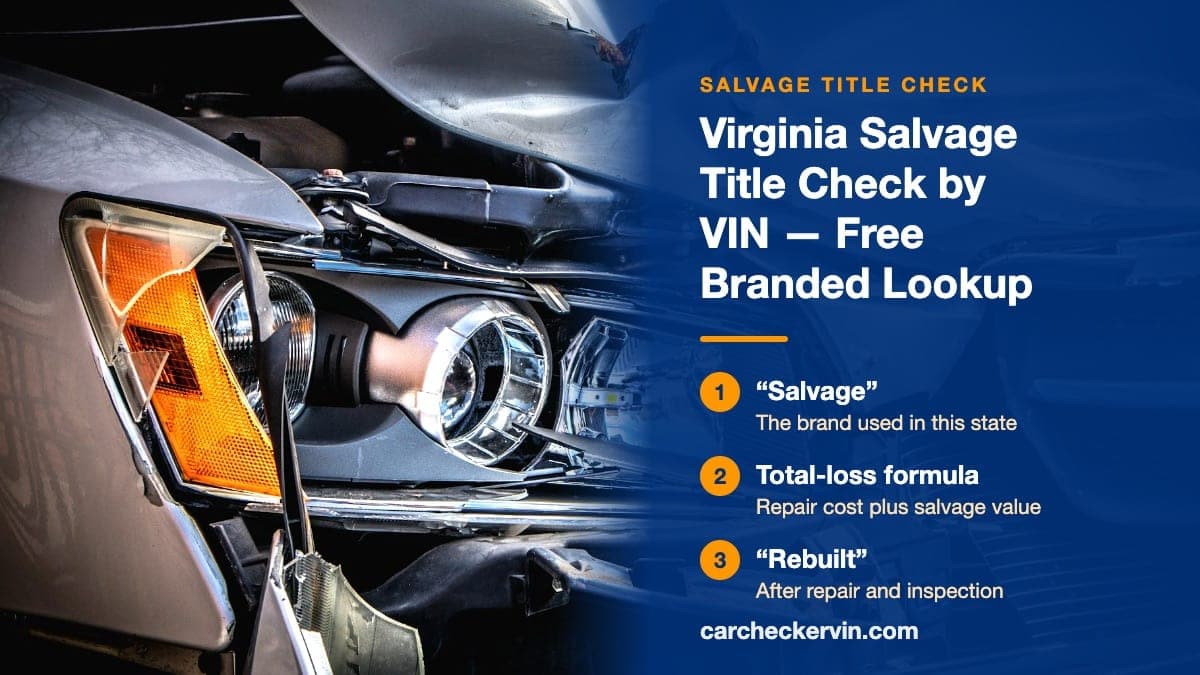
What Counts as a Total Loss in Virginia
A total loss is an accounting decision, not a verdict on whether the car can be fixed. Almost any vehicle can be repaired given enough money. The insurer stops when repairing costs more than the car is worth, writes the owner a cheque for its value, takes the wreck, and notifies the state — and it is that notification, not the crash, that produces the brand.
Virginia applies the total loss formula: the car is a total loss when the cost to repair it plus what the wreck would fetch as salvage equals or exceeds its actual cash value. Because the salvage side of that sum counts, a model with strong parts demand crosses the line on less damage than an equivalent car nobody wants for parts.
The formula gets all the attention, but it is only one of three ways a Virginia car becomes salvage, and it is not the one that catches most of them. Section 46.2-1600 makes a late model vehicle salvage if it has been "acquired by an insurance company as a part of the claims process other than a stolen vehicle" — full stop, with no damage threshold at all. If the insurer takes the car, it is salvage regardless of how lightly it was hurt.
The formula in the second limb governs only cars the insurer did not acquire. Such a vehicle is salvage when it has been "damaged as a result of collision, fire, flood, accident, trespass, or any other occurrence to such an extent that its estimated cost of repair, excluding charges for towing, storage, and temporary replacement/rental vehicle or payment for diminished value compensation, would exceed its actual cash value less its current salvage value".
Virginia salvage rules at a glance
- Titling agency: Virginia Department of Motor Vehicles
- Total-loss test: Total loss formula (repair + salvage vs. actual cash value)
- Governing statute: Va. Code §§ 46.2-624, 46.2-1157, 46.2-1600, 46.2-1602, 46.2-1602.1, 46.2-1602.2, 46.2-1602.3, 46.2-1603, 46.2-1603.1, 46.2-1603.2, 46.2-1604, 46.2-1605, 46.2-1606, 46.2-1607, 46.2-1608, 46.2-1609, 46.2-1610
- Salvage brand wording: Salvage certificate
- Rebuilt brand wording: REBUILT
- Never-road-legal brand: Nonrepairable certificate
- Out-of-state brand carried forward: Yes
Check this VA VIN for a brand:
Both halves of that fraction are defined, which is unusual and useful. "Actual cash value" means "the retail cash value of the vehicle prior to damage as determined, using recognized evaluation sources", either by the insurer responsible for paying the claim or, if none is, by the Department. So the denominator is retail, and where there is no insurer the state itself sets it.
"Current salvage value" is defined too, and its default is the number that matters most. It means the salvage value as determined by the insurer responsible for paying the claim, or — "if no insurance company is responsible therefor, 25 percent of the actual cash value". For an uninsured owner the formula therefore collapses to repair cost above 75 percent of value, which is the same figure the other triggers use.
A recovered stolen vehicle runs on a straight percentage instead. Where such a vehicle is acquired by an insurance company as part of the claims process and its "estimated cost of repair exceeds 75 percent of its actual cash value", it is salvage. Note the two conditions are cumulative: the insurer must have acquired it and the damage must clear 75 percent.
The third limb is the quiet one. Any vehicle becomes salvage where it "is determined to be a salvage vehicle by its owner or an insurance company by applying for a salvage certificate for the vehicle", provided it is not a nonrepairable vehicle. Applying is the determination. An owner can convert a perfectly repairable car into a salvage vehicle by filling in a form, which means not every Virginia salvage certificate reflects a car that failed any test.
Who is covered turns on "late model vehicle", and the definition is disjunctive in a way most summaries flatten. It means "the current-year model of a vehicle and the five preceding model years, or any vehicle whose actual cash value is determined to have been at least $10,000 prior to being damaged".
Read the second limb: it carries no age ceiling at all. A fifty-year-old car worth $40,000 is a late model vehicle in Virginia and is fully inside the salvage regime, while a six-year-old economy car worth $8,000 is outside it. Anyone valuing a classic or a well-kept enthusiast car in Virginia is inside this chapter whether they expect to be or not.
The insurer's duty is set out separately at § 46.2-1602.1: every insurance company that acquires, through the claims process, any late model vehicle titled in Virginia, or any recovered stolen vehicle over the 75 percent line, "shall apply to and obtain from the Department either (i) a salvage certificate or certificate of title ... or (ii) a nonrepairable certificate". It may also do so voluntarily for any other vehicle it determines to be salvage or nonrepairable.
The deadlines are fifteen days, and they attach to different events. Under § 46.2-1603(C) an application for the certificate of title on an unrecovered stolen vehicle must be made "within 15 days after payment has been made to the owner, lienholder, or both", and an application for the salvage certificate on a recovered stolen vehicle "within 15 days after the stolen vehicle is recovered". Section 46.2-1603.2(B) applies the same fifteen days to a nonrepairable certificate, running from payment.
There is one gap in that scheme. The uninsured and self-insured owner's duty at § 46.2-1603(E) says only that such an owner "shall similarly apply for and obtain a salvage certificate" — and carries no deadline at all. The same subsection does give that owner a route to a number: "If no estimated cost of repairs is available from an insurance company, the owner of the vehicle may provide an estimate from an independent appraisal firm", verified by the Department. An independent appraisal firm is itself defined, and pointedly excludes insurance companies and anyone who is a rebuilder or affiliated with one.
One whole class of damaged car is written out of the chapter. Section 46.2-1602.2 exempts a "repairable vehicle" — a late model vehicle that is not rebuilt but "is repaired to its pre-loss condition by an insurance company and is not accepted by the owner ... immediately prior to its acquisition by said insurance company" — from everything that follows, provided the insurer notifies the Department of each one. The safeguard is that "upon discovery by the Department that such vehicle was incorrectly designated as a repairable vehicle, the Department may require that vehicle's certificate status be corrected", which is worth knowing exists but is a discovery-based backstop rather than a check.
And since 2023 an insurer can skip a step at the terminal end. Section 46.2-1602.3 lets an insurance company or its authorised agent obtain a nonrepairable certificate for a Virginia-titled vehicle acquired through the claims process "without first obtaining a certificate of title or a salvage certificate", on an electronic filing carrying the company's details, the claim number and payment date, the vehicle's year, make, model and identification number, and a certification. A car can therefore go from insured to permanently untitleable without an intermediate document ever existing.
The rule sits in Va. Code §§ 46.2-624, 46.2-1157, 46.2-1600, 46.2-1602, 46.2-1602.1, 46.2-1602.2, 46.2-1602.3, 46.2-1603, 46.2-1603.1, 46.2-1603.2, 46.2-1604, 46.2-1605, 46.2-1606, 46.2-1607, 46.2-1608, 46.2-1609, 46.2-1610.
What follows from that: the brand records an economicevent. A ten-year-old car with a book value of a few thousand dollars can be totalled by a shunt that would barely register on a new one, and it is the cheap car that gets branded. Read a salvage brand as “the repair bill was large relative to this car”, then go and find out what the damage actually was.
The Three Total-Loss Regimes, and Why They Matter to You
There is no national rule for when a damaged car becomes a salvage car. Each state picks one of three tests, and the choice decides whether an identical wreck leaves the body shop with a brand or without one.
Percentage of value
The most common test. The state fixes a percentage of the car's pre-loss actual cash value, and an insurer whose repair estimate reaches it must report a salvage. Thresholds run from about half the value to the whole of it, so the same $6,000 estimate on a $10,000 car is a mandatory brand in one state and a routine repair in another.
Total loss formula (TLF)
Repair cost plus salvage value, measured against actual cash value. TLF is sensitive to the parts market — a truck with hungry demand for its doors and tailgate totals on less damage than a car whose panels nobody wants.
Insurer discretion
No statutory trigger. The carrier decides when repair stops making commercial sense, on internal thresholds that are neither published nor binding. Two insurers can look at the same photographs and reach different answers, and neither is breaking a rule.
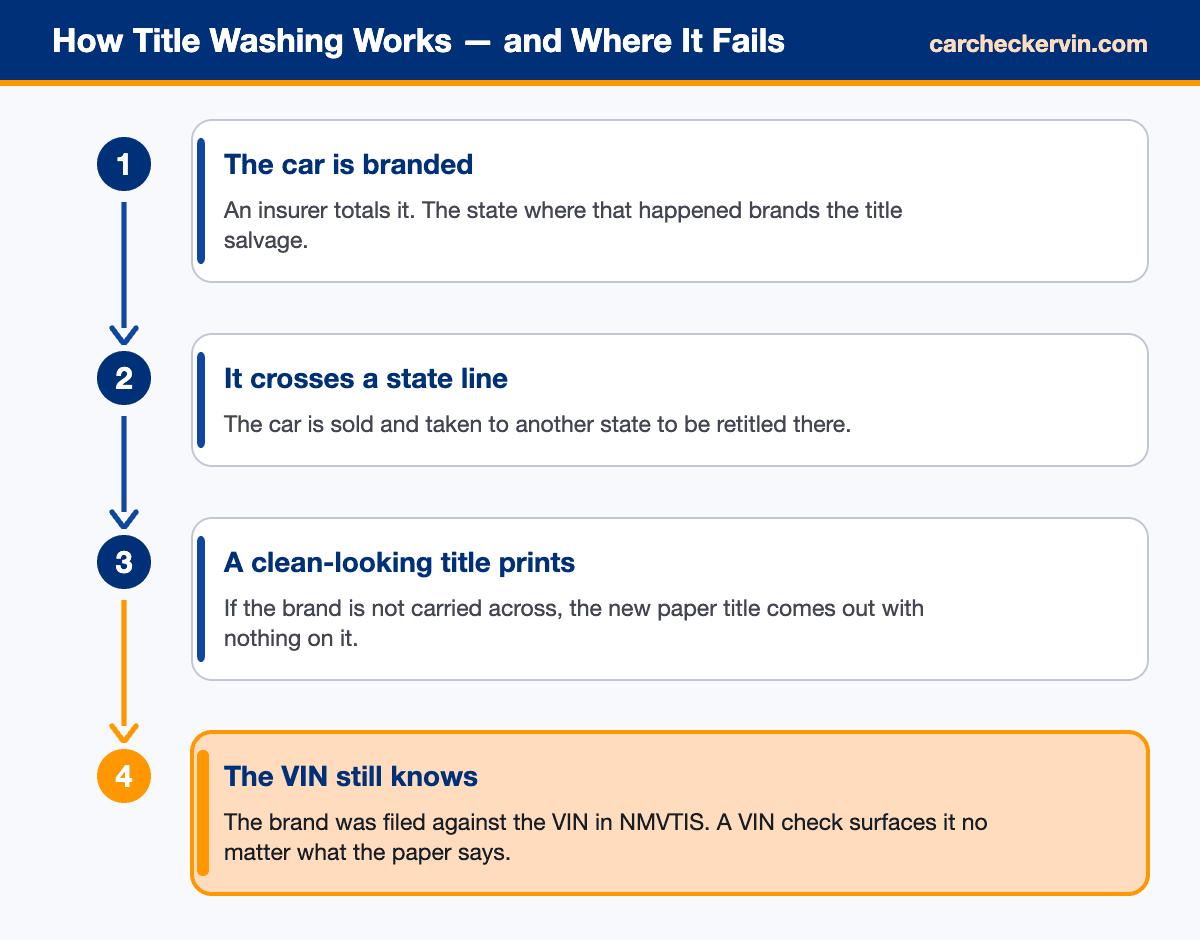
The consequence cuts both ways, and it is the reason to check the record rather than the paperwork. A cheap salvage car from a low-threshold state is not necessarily badly wrecked — it may have been branded on arithmetic another state would never have applied. An unbranded car from a high-threshold or discretionary state is not necessarily undamaged. It also makes moving damaged cars between states a business: a rebuilder who buys a wreck, repairs it and re-titles it where the brand does not carry across ends up holding a clean-looking certificate on a written-off car, without forging anything. That is title washing, and it is the same route by which a mileage brand gets left behind — which is why the two are worth checking together.
NMVTIS is the answer to that gap. Every state titling agency, insurer, salvage yard and recycler reports into it, and it is keyed to the VIN rather than to any document. A second state can print a fresh certificate; it cannot delete the record of the first one. The title is produced by the person selling you the car. The record is not.
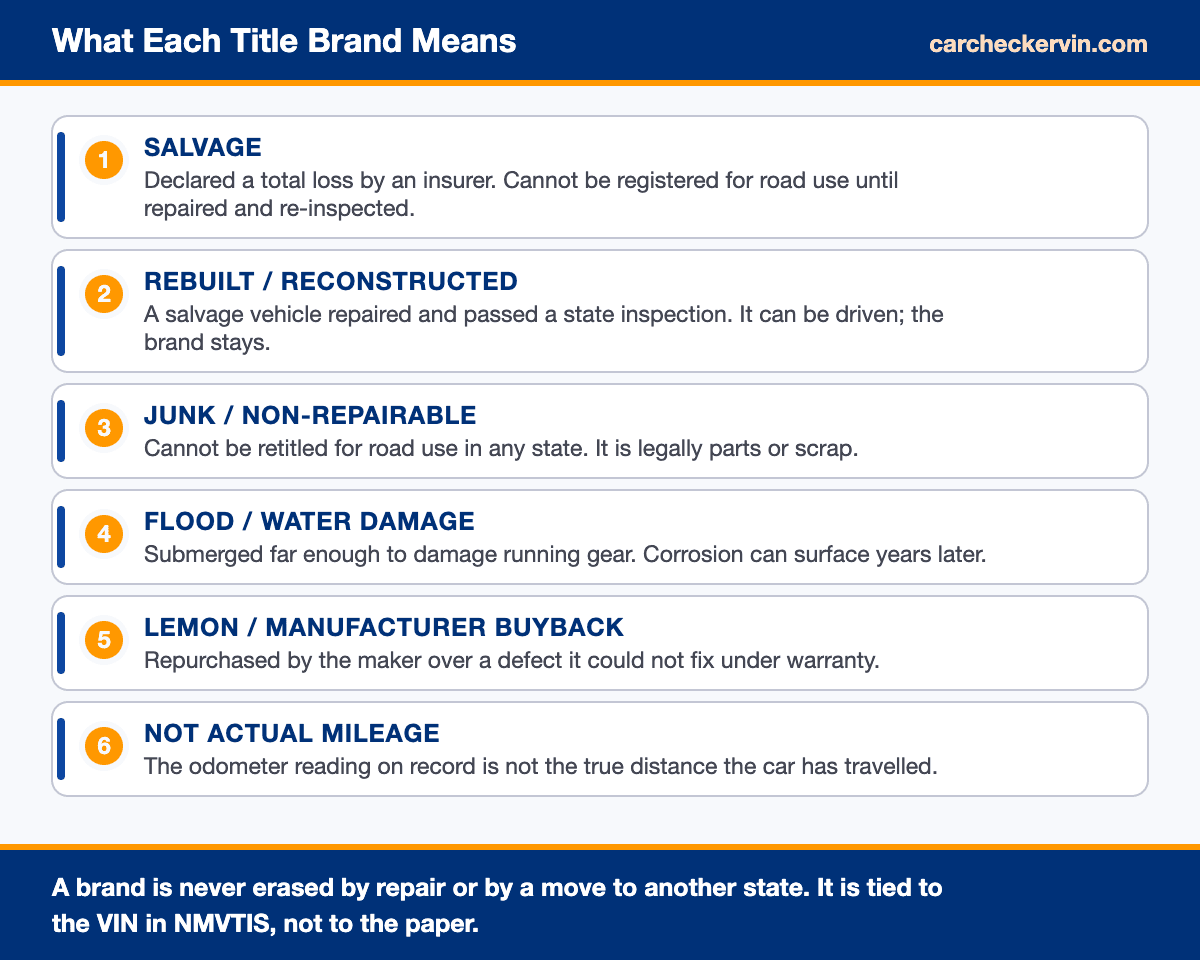
Virginia Title Brand Vocabulary
States do not use the same words for the same thing, and the words are not decoration — they decide what you are allowed to do with the car. These are the brands the Virginia Department of Motor Vehicles applies. Each one surfaces in a VIN check no matter which state later issues the title.
Issued when an insurer declares a vehicle a total loss — usually when repair costs reach roughly 65–100% of its value, depending on the state. A salvage vehicle cannot legally be driven until it is repaired, inspected, and re-titled.
A salvage vehicle that has been repaired and passed a state inspection to legally return to the road. The prior total-loss damage permanently lowers its value and can complicate insurance and resale.
Means the vehicle is too damaged to ever be legally returned to the road. It can be sold only for parts or scrap — never re-titled for driving.
Marks a vehicle damaged by water submersion. Flood cars frequently develop hidden electrical faults, corrosion, and mold months or years later — often after cosmetic cleanup hides the evidence.
Virginia's rebuilt brand has a second trigger that catches cars which were never salvage, and it is the single most useful thing to know about the state. Under § 46.2-1600 a "rebuilt vehicle" means "(i) any salvage vehicle that has been repaired for use on the public highways or (ii) any late model vehicle that has been repaired and the estimated cost of repair exceeded 75 percent of its actual cash value, excluding the cost to repair damage to the engine, transmission, or drive axle assembly".
Nothing in that second limb requires the car ever to have been salvage, ever to have had a certificate, or ever to have been surrendered. What makes it operate is § 46.2-1603(D), which requires an insurer to notify the Department of each late model Virginia car on which it has paid a damage claim where "the estimated cost of repair exceeds 75 percent of actual cash value" and "the vehicle is to be retained by its owner". The owner keeps the car, the insurer pays, the Department brands. A Virginia car with an entirely clean-looking ownership history and a REBUILT title is normal.
The same subsection carries an escape hatch worth understanding: "No such notification shall be required for a vehicle when a supplemental claim has been paid for the cost of repairs to the engine, transmission, or drive axle assembly if such components are replaced by components of like kind and quality." A car can absorb an arbitrarily expensive drivetrain replacement and never brand — a $14,000 engine claim on a $16,000 car is invisible to the title. The same three components are also excluded from the repair figure in the rebuilt definition itself, so the exclusion works twice.
Note the asymmetry by insurance status, because it is stark. An insured owner who keeps a 75-percent car is merely reported under subsection (D) and holds a title throughout. An uninsured or self-insured owner in the identical position must, under § 46.2-1603(E), surrender the title and take a salvage certificate — which means no registration and no plates until the car is rebuilt and examined. The identical damage produces a driveable car for one owner and an undriveable one for the other.
Virginia does not brand a salvage title, because there is no salvage title. Section 46.2-1603(G) has the Department "cause the title of such vehicle to be cancelled and the appropriate certificate issued" — on an application, or on a subsection (D) notification from an insurer. What the owner then holds is a salvage certificate, and § 46.2-1603(H) provides that all provisions applicable to a certificate of title apply to it "except that no registration or license plates shall be issued for the vehicle described in the salvage certificate".
Flood lives in a different chapter altogether. Search the whole of Chapter 16 for "flood" and you get exactly one hit, inside the list of damage causes in the salvage definition. The water brand comes from § 46.2-624, which is triggered not by a percentage or a water line but by an insurance payout: "When a vehicle has been damaged by water to such an extent that the insurance company insuring it has paid a claim of $3,500 or more because of this water damage, the insurance company shall report the payment of such claim to the Department." The Commissioner then issues a new title with "an appropriate indicator".
Read who that duty falls on. It is the insurance company, alone. An uninsured flooded car, a car whose owner never claimed, or a claim that came to $3,400 generates no report and no indicator. After Virginia's tidal and hurricane flooding this is the gap that matters most, and it is not one a title check can close — only the VIN history behind it can.
Carry-forward is express and mandatory in both directions. Section 46.2-1605(D) provides that the title issued after a successful examination "and any subsequent title thereafter issued for the rebuilt vehicle shall be permanently branded to indicate that it is a rebuilt vehicle". Section 46.2-1606(A) then says the Commissioner "may accept certificates of titles for salvage vehicles or other documents deemed appropriate ... issued by other states indicating a vehicle has been declared salvage, and shall carry forward all appropriate brands or indicators". May accept, but shall carry forward — the discretion is over the document, never over the brand.
Nonrepairable is the hardest dead end of the four, and Virginia states it three separate ways. Section 46.2-1603.2(D) provides that "no vehicle for which a nonrepairable certificate has been issued shall ever be titled or registered for use on the highways"; § 46.2-1605(D) independently refuses a title to any vehicle "for which a nonrepairable certificate has ever been issued"; and § 46.2-1600 goes furthest of all, providing that a vehicle demolished or declared nonrepairable "shall no longer be considered a vehicle". There is no fee to issue one, and no route back.
The owner-retained case is covered here too: § 46.2-1603.2(C) requires an insurer to notify the Department of each late model Virginia vehicle on which a claim has been paid that "is a nonrepairable vehicle that is retained by its owner", and the Department then cancels the title and issues the certificate.
A foreign junk-class brand produces a curious hybrid. Under § 46.2-1606(B) the Department issues a nonnegotiable title where NMVTIS or the incoming out-of-state document shows a brand such as "junk", "for destruction" or "for parts", and the car has been rebuilt, titled and registered in that other state. Such a vehicle "may be registered for use on the highways in the Commonwealth" — but the title is nonnegotiable, so it can be driven and never lawfully sold on. Where it will not be registered by the transferee, the transferee must declare it nonrepairable instead.
Selling is restricted in ways that surprise private buyers. Section 46.2-1602(A)(2) makes it unlawful for a salvage pool to sell a salvage vehicle stored in Virginia "either in person or through any Internet auction" to anyone not licensed here as an auto recycler, motor vehicle dealer or vehicle removal operator, or regulated as a similar business elsewhere. Paragraph (A)(3) closes nonrepairable vehicles to everyone but auto recyclers and vehicle removal operators. The carve-out at (B)(2) is narrow: an individual may dispose of a salvage vehicle "acquired or retained for his own use when it has been acquired or retained and used in good faith and not for the purpose of avoiding the provisions of this chapter".
Finally, disclosure. Search all of Chapter 16 for "disclos" and there is one hit: § 46.2-1602(A)(4) makes it unlawful for "any person to sell a rebuilt vehicle without first having disclosed the fact that the vehicle is a rebuilt vehicle to the buyer in writing on a form prescribed by the Commissioner". That form is VSA 59.
Because the prohibition says "any person" and § 46.2-1609(A) makes a first violation of any provision of the chapter a Class 1 misdemeanour — with "second and subsequent violations" a Class 5 felony — a private seller who hands over no VSA 59 is committing a crime, not a civil wrong. There is no equivalent duty for water damage, and none for a car that once carried a salvage certificate but is being sold on that certificate rather than as rebuilt.
Behind all of it sits a record-keeping regime that is why a Virginia VIN check has something to find. Section 46.2-1608 requires every licensee to record each vehicle received and sold with its make, model, year, title number and state, vehicle identification number, price, the names and addresses of both parties, the date and hour, photocopies of both parties' photo identification, "digital photographs of the seller, the buyer, and the vehicle", and the signatures of all three. Section 46.2-1607 lets the Commissioner, anyone authorised by the Commissioner, or any law-enforcement officer examine those records and inspect any vehicle or component part in a licensee's yard during business hours.
The one to memorise is Nonrepairable certificate. That brand is not a discount — it is a permanent bar on the vehicle ever being titled for road use again in Virginia. A car carrying it is a parts source and nothing else, and anyone offering to sell you one as a driveable project is either mistaken or lying.
Virginia carries a brand applied by another state forward onto its own title, so a washed document from a neighbouring state does not survive a transfer into VA.
Has This Virginia Car Ever Been Written Off?
A re-issued title can look clean over a total loss recorded in another state. Run the VIN and see every brand on the record, free, in seconds.
Salvage to Rebuilt: The Virginia Inspection
A salvage title is not a licence to drive. It is closer to a receipt for a wreck: the car is legally off the road until somebody repairs it, submits it for inspection, and gets a new certificate issued in the rebuilt category. Buying a salvage-titled car and driving it home is not a grey area — it is an unregistered, uninsurable vehicle on a public road, and Virginia will not put plates on it until the rebuilt certificate exists.
In Virginia the inspection is carried out by the Virginia DMV, through an official safety inspection station and then a DMV Special Agent. Most write-ups describe this as one inspection. It is two, done by different bodies for different purposes, and only the first is about safety.
Section 46.2-1605(A) sends the rebuilt car for an ordinary state safety inspection under § 46.2-1157 — the same annual inspection every Virginia car gets — with one unusual safeguard: "the inspection shall be conducted by an inspector wholly unaffiliated with the person requesting the inspection of the vehicle." A rebuilder cannot pass his own work, and a body shop cannot inspect a car it repaired.
Only then does the Department look at it. Section 46.2-1605(B)(1) requires the examination to include "a review of video or photographic images of the vehicle prior to being rebuilt, if available; all documentation for the parts and labor used for the repair of the salvage vehicle; and verification of the vehicle's identification number, confidential number, odometer reading, and engine, transmission, or electronic modules, if applicable".
And then the statute says, in terms, what that examination is not: "This inspection shall serve as an antitheft and antifraud measure and shall not certify the safety or roadworthiness of the vehicle." Nothing in Virginia law puts a structural engineer under the car. The safety inspection at stage one is the ordinary annual test every car on the road takes — it is not a rebuild audit, and passing it says nothing about whether the repair restored the structure.
One provision in that subsection is a genuine consumer protection and is worth quoting because it is rare. "The Commissioner shall ensure that, in scheduling and performing examinations of salvage vehicles under this section, single vehicles owned by private owner-operators are afforded no lower priority than examinations of vehicles owned by motor vehicle dealers, salvage pools, licensed auto recyclers, or vehicle removal operators." A private rebuilder is not to be queued behind commercial volume.
What you bring is proof of the passed safety inspection, receipts for original parts, a photograph of the vehicle before repairs, and any old component parts carrying a vehicle identification number. Form LES 022A adds a grid of twenty named parts to be ticked repaired or replaced. Keep in mind what the chapter counts as a major component under § 46.2-1600: the front clip assembly, the engine, the transmission, the rear clip assembly, the frame, the air bags, and "any door that displays a vehicle identification number" — air bags are on that list, so their documentation is not optional.
Getting the car to either appointment has its own rule. Under § 46.2-1605(F) a licensed salvage dealer or rebuilder who also holds a motor vehicle dealer licence may use dealer plates "for the sole purpose of transporting a rebuilt salvage vehicle to and from an official safety inspection station", on vehicles it owns. Everyone else applies to the Department for a temporary trip permit under § 46.2-651.
Failing is recoverable and the Department has to tell you why. Section 46.2-1605(E) provides that where the examination "reveals irregularities in the required documentation or obvious defects, the Department shall identify to the owner the irregularities and defects that must be corrected before the Department's examination can be completed".
A number problem is not. Section 46.2-1605(C) lets the Department impound any salvage vehicle "whose vehicle identification number or confidential number has been altered, is missing, or appears to have been tampered with" until it completes an investigation, during which the vehicle "may not be moved, sold, or tampered with". A new number may then be issued; if the car turns out to be stolen and the owner can be found it goes back to them; and if the owner cannot be found and the applicant has a conviction under § 46.2-1074 or § 46.2-1075, the vehicle "shall be deemed forfeited to the Commonwealth".
There is also a waiver a buyer should know about. Under § 46.2-1605(B)(2) no Departmental examination is required at all where (i) the rebuilder "has been licensed under this chapter for at least 10 years and has not incurred any penalties", (ii) the vehicle "is at least 10 years old but does not qualify as an antique motor vehicle", and (iii) "the resale value of the rebuilt vehicle is less than $10,000".
A cheap older Virginia rebuild can therefore carry a REBUILT title with no Departmental examination behind it at all. The only residual safeguard is a paperwork one: a rebuilder using that waiver "shall be required to maintain all required records for rebuilt vehicles described in subdivision 1 for inspection upon request of the Department or any law-enforcement official". If you are looking at a sub-$10,000 rebuilt car ten years old or older, ask which route it took, and ask to see those records.
The title that follows is branded whichever route was taken, and § 46.2-1605(D) adds a line easy to skip: "All rebuilt vehicles shall be subject to all safety equipment requirements provided by law." The same subsection bars a title for any vehicle that has not first passed a safety inspection, and for any vehicle "for which a nonrepairable certificate has ever been issued".
On money, the Commissioner "may charge a fee of $125 per vehicle" for the examination under § 46.2-1605(B)(1). Section 46.2-1610 sends every fee collected under the chapter into "a special fund to be used to meet the expenses of the vehicle identification number and salvage vehicle inspection programs", so the programme is funded by the people using it. A separate $25 processing fee applies under § 46.2-1603(B) where an insurer applies for a salvage certificate on an affidavit because it cannot produce the title.
One further point on sourcing, because it is the kind of thing that gets invented. There is no Virginia Administrative Code chapter on salvage or rebuilt vehicles — DMV's live regulatory chapters cover public participation, older-driver courses, hauling permits and driver training schools, and the rest are repealed. The procedure above is statute plus published departmental practice, and any citation of the form "24VAC20-..." for salvage rules is fabricated.
The Virginia DMV, through an official safety inspection station and then a DMV Special Agent
Inspection fee: $125 for the Departmental examination, which § 46.2-1605(B)(1) frames as a discretion — the Commissioner "may charge a fee of $125 per vehicle" — plus a $15 title fee. The salvage certificate itself is $10 by statute at § 46.2-1603(F), though DMV's own page and Form VSA 58 both ask for $15, and a nonrepairable certificate is free under § 46.2-1603.2(D). Where an insurer applies for a salvage certificate on an affidavit because it cannot produce the title, § 46.2-1603(B) adds a $25 processing fee on top of everything else. Under § 46.2-1610 all of it goes into a special fund "to be used to meet the expenses of the vehicle identification number and salvage vehicle inspection programs", and the stage-one safety inspection is charged separately at the ordinary § 46.2-1157 rate
Official VA rebuilt-title inspection pageUnderstand what these inspections are usually for, because buyers routinely misread them. The primary purpose in most states is anti-theft verification — confirming the VIN plates are original and untampered, and that the parts bolted onto the car were bought rather than stolen, which is why receipts for major components are demanded. A rebuilt inspection is not a structural engineering assessment, and passing it is not a statement that the repair was done well.
So the certificate on the wall tells you the car is legal. It does not tell you the frame was pulled straight, the airbag module was replaced rather than reset, or the welds are where a factory would have put them. That is what your own independent pre-purchase inspection is for, and on a rebuilt car it is not optional.
What to ask for before you agree a price
- 1Photographs of the car before repair. A rebuilder who did honest work kept them; one who did not will find a reason they are unavailable.
- 2The parts invoices, especially for airbags, structural components and safety restraints. Salvaged airbags are a known and dangerous shortcut.
- 3The Virginia inspection paperwork in the seller's name, matching this VIN, not a photocopy of somebody else's.
- 4The insurance total-loss settlement, if the seller has it — it names the damage the carrier actually paid out on.
- 5An independent inspection from a shop that does collision work, on a lift, before money changes hands. Budget for it as part of the purchase.
Then put the sale itself on paper. Write the brand into your Virginia bill of sale in the seller's own words — a rebuilder who will not describe the car in writing as what its title says it is has told you something. And before the money moves, check whether anyone still holds a security interest in it. Rebuilt cars are bought at auction and repaired on credit far more often than clean ones are, and a lender's claim survives the repair, the inspection and the new certificate.
What a Rebuilt Title Actually Costs You
The sticker discount is real. What people underestimate is that the brand keeps charging you — every year you own the car, and again on the day you sell it.
Insurance is narrower and sometimes unavailable
Liability cover is normally fine. Physical damage is where the problem lives: several large insurers decline comprehensive and collision on a rebuilt vehicle outright, and those that write it settle any future claim against the reduced branded value. Get a quote against the actual VIN before you agree a price.
Most lenders will not finance it
Branded collateral is hard to value and hard to move on repossession, so banks and captive finance arms generally decline. Some credit unions lend at a shorter term and a higher rate. In practice it is a cash purchase — which also removes the lender's appraisal, one of the few independent checks in a normal transaction.
The resale discount does not fade
A branded car trades well below a comparable clean one, commonly quoted around 20% to 40% depending on the vehicle and the documentation. The gap does not close with age, because every future buyer runs the same VIN you are running now. Most dealers will not take one in part-exchange at all.
Repair quality is the real variable
A car repaired with new OEM panels on a jig can be entirely sound. One straightened by eye with junkyard parts and a reset airbag light shows up later as pulling under braking, doors that stop sealing, or restraints that do not fire. Nothing on the title separates the two — only the documentation and a lift.
Should You Ever Buy a Salvage or Rebuilt Car?
Sometimes, yes. The honest answer is that it depends on what the car was hit by and what you need the car to do — and it is a judgement most buyers can make for themselves once they know what to separate. Two lists, and they are not close calls.
Cases where the discount is genuinely worth it
- Hail damage on an otherwise untouched car. It is cosmetic, it totals cars on paint cost alone, and the mechanical vehicle underneath is exactly what it was.
- A recovered theft with no collision damage, where the write-off happened because the insurer had already paid the claim before the car turned up.
- An older, low-value car totalled by modest damage. On a $4,000 car it takes very little to cross a threshold, and the repair may be one panel.
- A car you intend to keep for a decade and run into the ground. The resale penalty only bites if you plan to sell.
- A repair you can fully document — pre-repair photographs, parts invoices, and a shop you can phone.
Cases where the discount is a warning, not a bargain
- Any flood history. Water gets into loom connectors, control modules and seat-belt pretensioners, and the failures arrive months later in an order nobody can predict.
- Deployed airbags with no invoice for the replacement modules. A reset light over a spent or salvaged restraint system is the most dangerous shortcut in the trade.
- Structural or unibody repair without documented frame measurements. If the shell is out of alignment the car will never track, brake or crash correctly.
- A rebuilder who cannot produce pre-repair photographs, or who bought and re-titled the car in the last few weeks.
- Anything you need to finance, insure comprehensively, or resell within a couple of years — the brand blocks all three.
The flood exception is not a preference. Every other category on these lists is a matter of price and documentation. Flood is the one where a well-presented car and a ruined car look identical for the first year, and where the damage is distributed through the electrical system rather than concentrated somewhere a mechanic can look. Flood cars also travel: they are bought cheaply after a storm, cleaned, and sold hundreds of miles away, which is why the state on the current title tells you very little about where the water was.
What a Salvage Check Does Not Tell You
A title brand is a fact about the car's damage history as reported by an insurer. It is silent on who owns the car, what the odometer has done, and whether anyone is looking for it. Those live in different systems and are different searches — a car with a spotless brand record can still be encumbered, clocked, or stolen.
More Virginia Vehicle Guides
Everything else worth checking before you put a Virginia car in your name.
Salvage Title Check in Other States
Worth comparing if the car you are looking at was titled somewhere else before it reached Virginia— the threshold that branded it, or failed to, was that state's rather than this one's.
View the full salvage title check hubVirginia Salvage Title Check — Frequently Asked Questions
How do I check for a salvage title in Virginia?+
Enter the 17-character VIN in the search box on this page. Title brands are recorded against the VIN, not against the paper title the seller is holding, so a VIN search reaches a brand the document does not show. We cross-reference NMVTIS — which aggregates title-brand records from the Virginia Department of Motor Vehicles and every other state titling agency — along with insurance total-loss feeds and salvage-auction records.
What counts as a total loss in Virginia?+
Virginia uses the total loss formula: the vehicle is a total loss when the cost to repair it plus its salvage value equals or exceeds its actual cash value. The rule is set by Va. Code §§ 46.2-624, 46.2-1157, 46.2-1600, 46.2-1602, 46.2-1602.1, 46.2-1602.2, 46.2-1602.3, 46.2-1603, 46.2-1603.1, 46.2-1603.2, 46.2-1604, 46.2-1605, 46.2-1606, 46.2-1607, 46.2-1608, 46.2-1609, 46.2-1610. Whichever test applies, what triggers the brand is the insurer's decision, not the severity of the damage as a mechanic would judge it — which is why a lightly damaged older car and a badly damaged newer one can end up carrying the same title.
What title brands does Virginia use?+
Virginia records these brands through the Virginia Department of Motor Vehicles: Salvage certificate, REBUILT, Nonrepairable certificate, Flood. The wording matters more than it looks — the word for a repaired total loss differs between states, and a seller describing the car in a neighbouring state's vocabulary is either careless or moving cars across a state line.
How does a salvage car get a rebuilt title in Virginia?+
It has to be repaired and then cleared by the Virginia DMV, through an official safety inspection station and then a DMV Special Agent before it can be re-titled and driven; the section on the Virginia inspection above covers what that involves, and whether a physical inspection is guaranteed or only happens on the cars the state picks. The inspection fee is $125 for the Departmental examination, which § 46.2-1605(B)(1) frames as a discretion — the Commissioner "may charge a fee of $125 per vehicle" — plus a $15 title fee. The salvage certificate itself is $10 by statute at § 46.2-1603(F), though DMV's own page and Form VSA 58 both ask for $15, and a nonrepairable certificate is free under § 46.2-1603.2(D). Where an insurer applies for a salvage certificate on an affidavit because it cannot produce the title, § 46.2-1603(B) adds a $25 processing fee on top of everything else. Under § 46.2-1610 all of it goes into a special fund "to be used to meet the expenses of the vehicle identification number and salvage vehicle inspection programs", and the stage-one safety inspection is charged separately at the ordinary § 46.2-1157 rate. Passing it is not a statement that the repair was done well — in most states the inspection is an ownership and anti-theft check, which is why it wants receipts for major parts rather than frame measurements.
Does a salvage brand disappear if the car is re-titled in another state?+
No. The brand is attached to the VIN in NMVTIS, and NMVTIS is fed by every state titling agency, by insurers, and by salvage yards. A paper title issued in a second state can come out looking clean — that is what title washing is — but the VIN record does not reset when the car crosses a state line. Virginia also carries a brand applied elsewhere forward onto its own title.
Can you insure and finance a rebuilt-title car in Virginia?+
Liability cover is usually available. Comprehensive and collision often are not, and most banks will not lend against branded collateral, so rebuilt cars tend to be cash purchases. Get a written quote from your own insurer against the VIN before you agree a price, not after.
Is it safe to buy a rebuilt car in Virginia?+
It depends on what the damage was and who repaired it. Hail, a recovered theft or a rear-end hit on an older car can total a vehicle on economics alone and leave nothing structurally wrong. A flood car, deployed airbags with no documented replacement, or a repaired unibody is a different proposition. Ask for the pre-repair photographs, the parts invoices and the Virginia inspection paperwork, then pay an independent shop to put it on a lift. If the seller cannot produce the repair record, you are buying the repair blind.
Does a clean salvage check mean the car was never damaged?+
No, and this is the limit worth understanding. A brand only exists if an insurer wrote the car off and reported it. Damage repaired privately, out of pocket, or by a driver who never made a claim leaves no brand at all — and on an older car, where repair costs easily exceed a low book value, owners often avoid claiming for exactly that reason. A clean brand record is good news about the paperwork, not a report on the bodywork.
Virginia sources
The Virginia-specific statements above come from these official pages. Thresholds, fees and brand wording do get amended — check the source before relying on a figure in a transaction.
Vérifications VIN connexes
Plus d'outils pour vérifier l'historique de tout véhicule
Run Your Free Virginia Salvage Title Check
One VIN, every brand ever recorded against it, in any state. Two minutes now against a write-off that would otherwise follow the car into your name.
Or get the full VIN history report