Illinois Stolen Vehicle Check by VIN — Is This Car Stolen?
Run the VIN against the theft and title records a member of the public can actually reach, then check the car itself. No public database is complete — the authoritative stolen-vehicle file is law-enforcement only — so this page covers both halves: what the search can tell you about an Illinois vehicle, and what you have to confirm with your own eyes.
Run a Free Illinois Stolen Vehicle Check
Enter any 17-character VIN — cars, trucks, SUVs, motorcycles
Free · No sign-up · Instant result
How an Illinois Stolen Vehicle Check Works
Three steps, and the third is the one people skip. The first two take seconds and happen on a screen. The third happens in a car park and is the only one that can catch a VIN that has been moved from one vehicle to another.
Enter the 17-character VIN
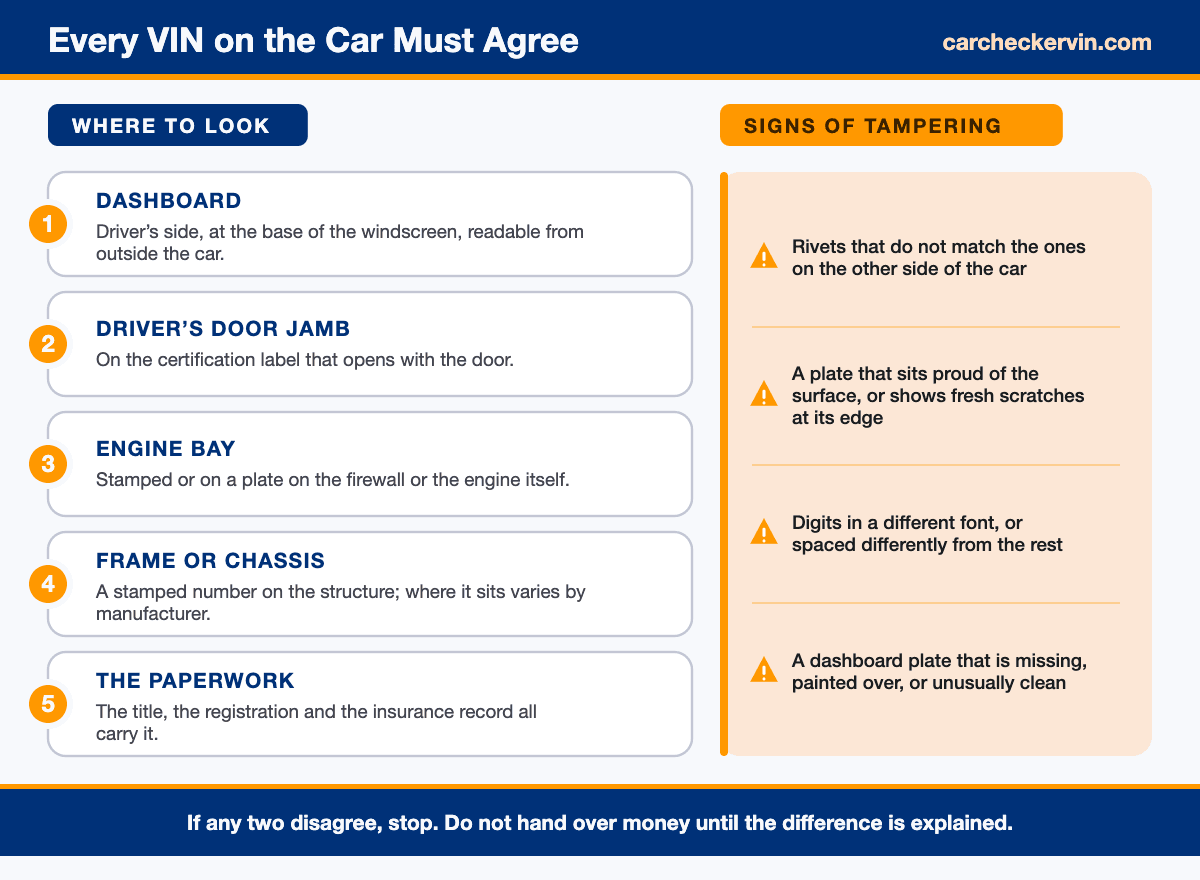
Take it off the plate at the base of the windscreen and off the driver-side door jamb, not off the advert. If the seller will only give you a photograph of the VIN, ask for one showing the plate in place on the car.
We read the theft and title records
The lookup queries NICB theft and total-loss records alongside NMVTIS title brands reported by the Illinois Secretary of State Vehicle Services and every other state titling agency. Those are separate systems recording separate events, which is how a car can be clean in one and flagged in the other.
Then verify the car, not just the number
A clean result tells you no participating insurer or state has filed anything against this VIN. It does not tell you the VIN belongs to the car it is attached to. That part is done standing next to the vehicle, and section by section below.
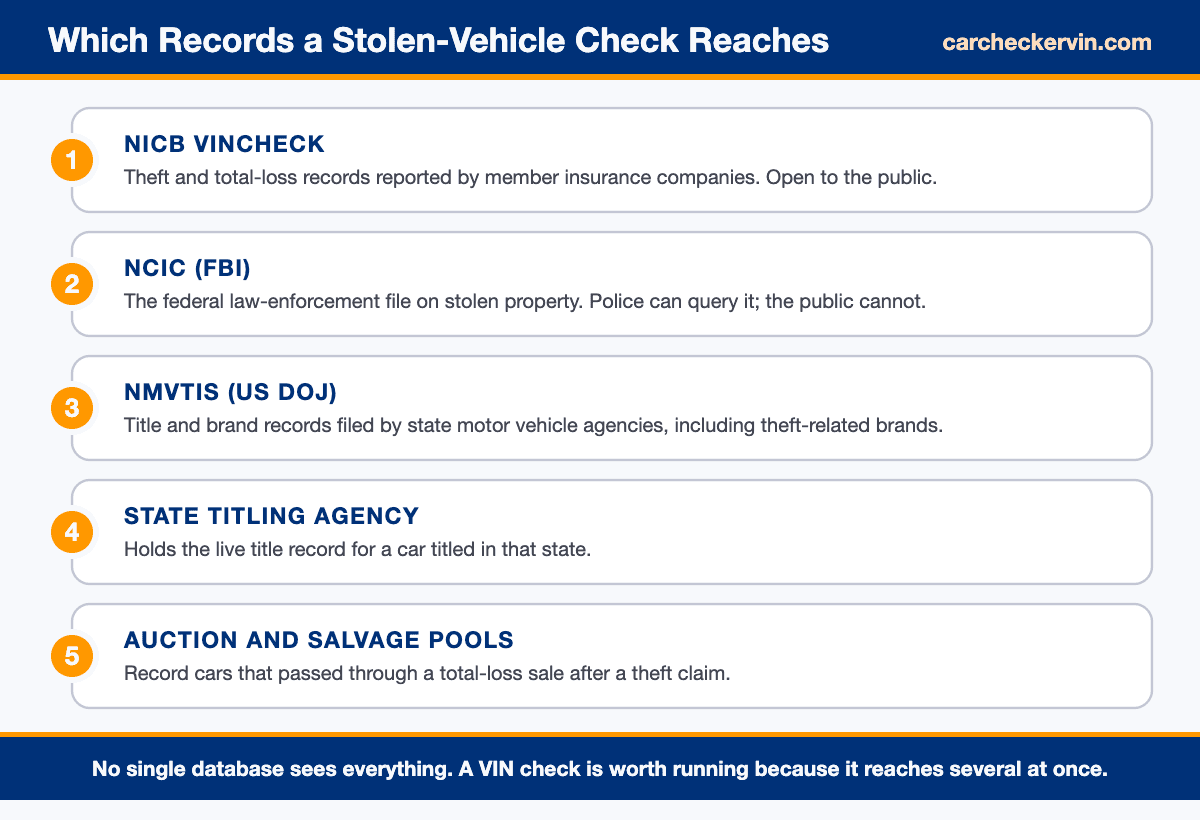
Which Databases a VIN Check Actually Reaches
Sites selling theft checks blur four very different systems into one word, “database”. They are not interchangeable, not equally complete, and the most complete of them is the one you cannot search. Knowing which is which is the difference between reading a clean result correctly and over-trusting it.
NCIC — authoritative, and closed
NCIC's stolen vehicle file is populated and queried by law enforcement. There is no public interface to it. When an officer runs a plate at the roadside and the car lights up as stolen, this is the file that answered. It is populated from police reports, which is why filing one promptly matters so much: a car that is not in NCIC is invisible to every patrol car in the country.
A consumer cannot query it, and no commercial service can query it on your behalf. Anyone who says otherwise is selling you something else under a better-known name.
FBI National Crime Information Center (NCIC)NICB VINCheck — free, public, partial
Free public lookup covering theft and total-loss records reported by participating NICB member insurers, limited to five searches per IP per day. It is the closest thing to a public theft search that exists in the United States, and it is genuinely worth running.
Read the coverage boundary, though: it reflects what member insurers reported, so a car that was uninsured when it was taken, or insured outside the membership, can be stolen and still return nothing. The cap of 5 searches per IP per day also rules out screening a page of listings.
NICB VINCheckNMVTIS — the brand that follows the VIN
A federal system collecting title brands, junk and salvage reports and odometer readings from state titling agencies, insurers and salvage operators. It is not a theft register, but it is where the consequences of a theft surface — a recovered car written off by the insurer picks up a brand here. Its value is that it is national: moving a car to another state and applying for a fresh title used to erase its past, and NMVTIS is the reason that no longer works cleanly.
Illinois title records
The Illinois Secretary of State Vehicle Services holds the title history for vehicles titled in Illinoisand reports its brands into NMVTIS. It answers a different question from a theft file: not “was this car reported stolen” but “what has this car legally been through, and who does the state believe owns it”.
It is also the record that a buyer can compare against the paper in the seller's hand. A title that does not match the state's own file is a stop-the-sale problem, whatever a theft search returns.
What follows from all four being incomplete
None of these systems is a complete register of stolen cars, and the honest conclusion is that a clean VIN check is evidence rather than proof. A theft reported this morning may not have propagated. A theft never reported to an insurer may never appear at all. A cloned VIN returns the clean history of the innocent car whose identity was copied. The defence that actually works is the combination: run the VIN, and then check every VIN location on the vehicle for tampering and disagreement. The database narrows the field; the inspection catches what the database structurally cannot see.
The Illinois title brands a recovered theft can pick up
Most states have no theft-specific brand. What a stolen car usually acquires is a damage brand, applied after it is recovered wrecked or stripped and the insurer writes it off. That is why a theft history and the Illinois title record are so often the same story read from two ends. These are the brands the Illinois Secretary of State Vehicle Services applies, and each one travels with the VIN through NMVTIS:
Why Illinois VIN history reads differently
Illinois law makes it a felony to alter a VIN, and the Secretary of State actively investigates VIN tampering.
How Illinois Handles Vehicle Theft
Public Act 100-0373 moved this Council to the Secretary of State in 2018 and added insurance verification and recyclable metal theft to its remit; Public Act 102-0904 added vehicle hijacking in 2022. It is funded by an assessment on insurers and pays the money back out as grants to law enforcement. Reported vehicle thefts in Illinois fell from 75,214 in 1991 to 28,557 in 2021, and the 2019-2022 grant cycle recovered over 4,700 stolen vehicles worth $92 million.
Illinois runs stolen vehicles through a statewide clearinghouse and then straight into the title file. Under 625 ILCS 5/4-107 the sheriff, superintendent or chief of police who takes the report must, by the fastest means of communication available, immediately report the theft or the recovery to the Illinois State Police in Springfield, with the date of theft, the full vehicle description, the vehicle identification number, the plate and the owner's details. The State Police keep a complete record of every report, and when a vehicle recovered in one jurisdiction turns out to have been stolen in another, they must notify the original agency with the time and place of recovery. The State Police then notify the Secretary of State, who places the theft flag in both the license registration and the title registration files and suspends the registration of the vehicle; the flags come off only when the recovery is reported. The trap this creates for a buyer is spelled out in the same section: if someone applies for a certificate of title or a registration on a vehicle the Secretary of State's records show as stolen or converted, the Secretary must immediately notify the police and hand over the applicant's name and address along with everything else on the application, and the Secretary of State Department of Police must investigate. One quirk worth knowing is that if the car was taken by somebody you had lent it to, § 4-107(b) lets you report it as a theft by conversion, but Illinois will only accept and process that report once a formal complaint is on file and a warrant has been issued. Filing a false report is not a costless option either: 625 ILCS 5/4-103(a)(6) covers knowingly reporting a theft or conversion that did not happen, and § 4-103(b) grades every violation of that section as a Class 2 felony.
Vehicle theft in Illinois is governed by 625 ILCS 5/4-103. Knowing the citation is occasionally useful when you are filing a report or an insurance claim and need to be precise about what you are alleging.
Whatever the state structure, the first call is still local. The police department with jurisdiction over the place the car was taken from is the agency that writes the report and makes the NCIC entry, and no state-level office can substitute for that step.
Illinois vehicle theft at a glance
- State agency: Illinois State Police
- Theft investigation unit: Illinois Vehicle Hijacking and Motor Vehicle Theft Prevention and Insurance Verification Council
- Governing statute: 625 ILCS 5/4-103
If Your Car Was Stolen in Illinois
The first hour matters more than anything you do afterwards, because almost every later step — the insurance claim, the plate cancellation, the recovery itself — depends on a police report existing. Work down this list in order.
- 1Call 911 if the theft is happening now, or if the car was taken within the last few minutes. If it is already hours old, use the local police non-emergency line for the jurisdiction where the vehicle was parked — that is the agency that owns the report.
- 2Rule out a tow or a repossession first.A surprising share of “stolen” cars were removed by a tow operator or a lender. Filing a false stolen report is a criminal offence in every state, so spend the five minutes checking before you make the call.
- 3Have the VIN, plate number, year, make, model and colour ready, plus anything distinctive — a dent, a roof rack, a sticker. The officer enters the vehicle into NCIC from what you give them, and the entry is what turns a random plate reader into a hit.
- 4Get the report number and the officer's name and badge number before you hang up. Your insurer will ask for it, the Illinois Secretary of State Vehicle Services may ask for it, and reconstructing it a week later is far harder than writing it down now.
- 5Check the telematics or tracker app — a factory connected-car service, a Tile, an AirTag, a dashcam with GPS. If you get a location, pass it to the police. Do not go and collect the car yourself.
- 6Notify your insurer the same day. Theft is covered under comprehensive, not liability, and most policies impose a waiting period before a theft claim can settle — ask what yours is rather than assuming. Late notification is one of the few things that can genuinely jeopardise a valid claim.
- 7Tell the lienholder if the car is financed. The loan does not pause because the car is gone, and the lender is a party to the insurance settlement. If you are not certain whose name the security interest is in, the Illinois lien record will tell you before the insurer asks.
- 8Contact Illinois State Police (official page). This is in addition to the local report, not instead of it.
- 9Illinois Vehicle Hijacking and Motor Vehicle Theft Prevention and Insurance Verification Council handles vehicle theft investigation at state level, and the detail on what they do is in the Illinois section above. Ask the officer taking your report whether the case is being referred to them.
- 10Keep watching the VIN. Stolen cars reappear in classified listings, at salvage auctions and in out-of-state title applications. Re-run the VIN periodically; a new title brand or an auction record is a lead worth handing to the investigating officer.
- 11If it is recovered, photograph it before it moves. Document the damage and the odometer — a car driven hard for six weeks by someone who was not you is a mileage question as well as a theft one — and check afterwards whether the title has picked up a brand. A recovered car that was written off while it was missing is legally a different vehicle from the one you reported.
Check the VIN Before You Travel to See the Car
Two minutes at a keyboard beats an hour's drive to a car you would have walked away from. Free, instant, no sign-up.
VIN Inspection in Illinois
A VIN inspection is the one check in the whole system that compares a number on paper against metal. Everything else — the theft search, the title history, the brand file — compares one record against another record, and a well-executed clone defeats all of them at once by wearing the identity of a real, clean vehicle.
That is precisely the gap inspections exist to close. A car that has been stolen, re-tagged with a donor VIN and driven across a state line arrives needing a title in its new state. If that state physically inspects incoming out-of-state vehicles, someone puts their eyes on the dash plate, the door label and the confidential stampings, and the mismatch surfaces. If it does not, the clone gets a clean local title and the laundering is complete.
Requirements differ by state and by circumstance — whether the car is arriving from out of state, being rebuilt from salvage, or simply changing hands. Confirm what applies to your transaction with the Illinois Secretary of State Vehicle Services before you buy, because an inspection you did not know about is the kind of thing that turns a same-day title transfer into a three-week problem.
As a buyer, you do not need to wait for the state to schedule anything. The inspection an official would carry out is largely a comparison you can do yourself in ten minutes with a phone torch, and the next section is that comparison.
Red Flags in an Illinois Private Sale
No single item here proves anything. Two or three together, in the same transaction, is a pattern — and the pattern is what should stop the sale, not any one line.
- The name on the title is not the seller's name, and the explanation involves a relative, a friend, or a business you cannot verify
- No title at all, only a photocopy, or a duplicate title issued in the last few weeks
- A title issued in another state very recently, then the car appears for sale in Illinois
- The asking price is well under comparable listings and the reason offered is vague
- They will only meet in a car park, a petrol station or a lay-by, never at a home or business address
- Cash only, and active resistance to any traceable payment method
- Pressure to decide today, a second buyer who is supposedly on their way, or a deposit demanded before viewing
- No service history, no owner's manual, one key and no spare
- The seller will not let you photograph the VIN plate or the door label
- They decline a pre-purchase inspection at a garage of your choosing
- The plates do not match the registration document, or the registration is expired
- Anything on the car disagrees with anything else on the car
Two of these are worth resolving on the spot rather than filing away. If the plate and the document disagree, know what a current Illinois registration is supposed to look like before you accept an explanation for why this one does not. And if you do go ahead, insist on a written Illinois bill of sale signed in the name that appears on the title. It will not stop a determined thief, but it puts their name, the date and the VIN on one page — which is exactly what a seller with nothing to hide has no reason to refuse.
If you conclude mid-viewing that the car is stolen, do not say so. Finish the conversation normally, leave, and call the police non-emergency line from somewhere else with the VIN, the plate, the listing URL, the address, and the seller's name and number. Confronting someone who is committing a felony over a vehicle they can drive away in achieves nothing except risk.
What a Theft Check Does Not Tell You
A theft record answers one narrow question: has someone reported this VIN taken. Every other way a used car can cost you money lives in a different file, and a car can be entirely clean on theft while being a bad buy for reasons no theft search will ever surface.
More Illinois Vehicle Guides
Everything else worth settling before you put an Illinois car in your name.
Stolen Vehicle Check in Other States
Theft databases are national; the agency you report to, the title brands and the inspection rules are not. A car that moved states carries the records of both.
View the full stolen vehicle check hubIllinois Stolen Vehicle Check — Frequently Asked Questions
How do I check if a car is stolen in Illinois?+
Enter the 17-character VIN in the search box on this page. The check reads NICB VINCheck theft and total-loss records together with the NMVTIS title-brand file, which carries brands reported by the Illinois Secretary of State Vehicle Services and by every other state titling agency. Do it before you travel to see the car, then repeat the physical VIN comparison when you get there — the database answers a question about records, and the car in front of you is a separate question.
Can I search the FBI's stolen vehicle database myself?+
No. FBI National Crime Information Center (NCIC) holds the authoritative stolen-vehicle file, and it is populated and queried by law enforcement. There is no public interface to it, and any site claiming to search it directly for you is describing something that does not exist. A police officer running the plate or the VIN is reading NCIC; a consumer VIN check is reading insurance and title records instead.
Is a free stolen vehicle check enough before buying in Illinois?+
It is the right first step and it is not sufficient on its own. NICB VINCheck is capped at 5 searches per IP address per day and only covers theft and total-loss records reported by participating member insurers — a car that was stolen but never insured, or insured by a company that is not an NICB member, can be missing from it entirely. Pair the VIN check with a physical inspection of every VIN location on the car.
Can a stolen car have a clean Illinois title?+
Yes, and this is the failure mode worth understanding. A car stolen last week has not had time to reach any consumer-facing file. A car with a cloned VIN is carrying the identity of a legitimate vehicle, so the record it returns is a clean record about a different car. And a theft never reported to an insurer may never enter an insurance database at all. A clean result narrows the risk; it does not close it.
What title brands does Illinois use for a recovered or written-off vehicle?+
Illinois records these brands through the Illinois Secretary of State Vehicle Services: Salvage, Rebuilt, Junk, Flood. A vehicle that was stolen, recovered damaged, and written off by the insurer is usually branded Salvage rather than carrying any theft-specific mark. Once a brand is applied it travels with the VIN through NMVTIS, so re-titling the car in another state does not clear it.
Who investigates vehicle theft in Illinois?+
Start with the local police department where the vehicle was taken — that agency writes the report and makes the NCIC entry, and no state-level unit can act until it exists. Illinois also has Illinois Vehicle Hijacking and Motor Vehicle Theft Prevention and Insurance Verification Council, and the section on how Illinois handles vehicle theft above sets out what it does and what the state does with the report once it is filed.
What happens if I buy a stolen car in Illinois?+
You lose the car and you are left chasing the seller for the money. A thief cannot pass good title, so the legal owner — usually the insurer that already paid the original claim — can reclaim the vehicle, and you have no automatic right to compensation from them. Your recourse is a police report and a civil claim against whoever sold it to you, which is only worth something if that person can be found and has assets.
How soon does a theft show up in a VIN check?+
It depends on which record you are hoping to see. A police report reaches NCIC quickly, often within hours, but NCIC is not what a consumer check reads. The insurance-side records that a public lookup does read only appear after the owner files a claim and the insurer reports it, which can take days. Treat any car being sold in a hurry as a car whose records may not have caught up yet.
Illinois sources
The Illinois-specific statements above come from these official pages. Agencies, numbers and procedures change — check the source before you rely on one in an emergency.
Vérifications VIN connexes
Plus d'outils pour vérifier l'historique de tout véhicule
Run the Illinois VIN Before You Pay
A theft search is the cheapest part of buying a used car and the fastest way to rule out the worst outcome. Enter the 17-character VIN and read the theft and title records in seconds.
Free · No sign-up · Instant result