VIN barcode scanner: the stripes beside the seventeen
Most vehicles print the VIN twice on the door-jamb label — once for people, once as a barcode for machines. Read the machine copy and you take your own typing out of the equation.
No scanner handy? Type the VIN instead
Same free decode and record counts, straight from the browser.
256-bit encrypted · No sign-up · Instant
Or point the camera at the barcode
Free · no account · iOS 17+

Quick Answer
- Does the VIN have a barcode?
- On most vehicles sold today, yes — printed right beside the seventeen-character VINon the label in the driver's door jamb. It is the same number in machine-readable form, there so equipment can capture the VIN without anyone retyping it. The stamped metal plate at the base of the windshield carries the same number but no barcode; there is nothing there for a scanner to read.
- What format is a VIN barcode?
- Typically a subset of Code 39, a long-standing industrial symbology that encodes letters and digits alike — which is what a VIN needs. Some manufacturers encode the VIN as 2D formats instead, such as Data Matrix or QR, depending on the scenario. This is why a generic QR reader so often shrugs at a door jamb: it is looking for the wrong kind of stripes.
- How do I scan one for free?
- Our free iPhone app reads the automotive barcode formats with the camera, then decodes the vehicle and shows how many damage, auction, salvage and odometer records exist on that VIN — all before any payment. No barcode in reach? Type the seventeen characters into the form on this page and the identical free check runs in the browser.
The barcode, located and decoded
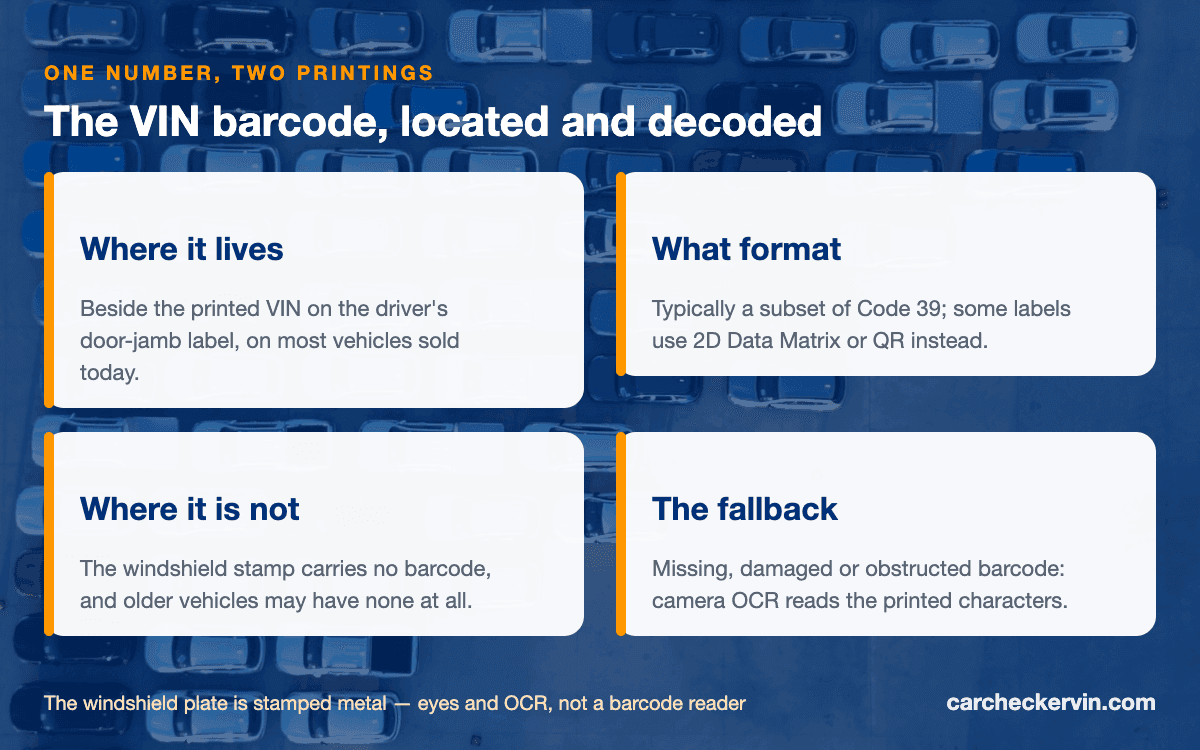
Four facts cover almost every question people bring to a door jamb — where the barcode is, what it is, where it is not, and what to do when it is not there:
Where it lives
The driver's door jamb — the certification label on the edge the door closes against. The barcode is printed next to the human-readable VIN, same seventeen characters, machine shape.
What format it is
Usually a subset of Code 39; some labels carry 2D Data Matrix or QR instead. A VIN-aware scanner tries the automotive formats and checks the result is seventeen legal characters.
Where it is not
The windshield plate is stamped metal with no barcode, and vehicles from before the late-model era may have no barcode anywhere. Older labels also wear, tear and get painted over.
The fallback
When the barcode is missing, damaged or obstructed — common on older vehicles — you are back to reading the characters yourself: photograph the label, zoom in on a bright screen, and type them carefully.
A free reader that knows what a VIN looks like
A generic barcode app hands you whatever the stripes say. A VIN scanner reads the automotive formats, insists the result is seventeen legal characters — never an I, O or Q — and then does something with it: a free decode, and the counts of damage, auction, salvage, title and odometer records on file for that exact vehicle.
Free download, no account, 2.2 MB, iOS 17 or later on iPhone and iPad. The full report is $14.99 one-off, and recall alerts stay free permanently. No Android version — the form above is the type-it-in equivalent.
Four steps from stripes to answer
The barcode is the easy part. The order of what follows is what keeps you from paying for an empty report.
- 1Scan the labelDoor open, camera on the barcode beside the printed VIN. Seconds, in any light the camera can focus in.
- 2Cross-check the metalWindshield stamp, door label and paperwork should all agree. A mismatch outranks anything a report says.
- 3Decode freeYear, make, model, trim, engine, plant — confirm the label matches the car it is stuck to.
- 4Count the recordsZeros: walk away free. Real counts: now a full report has something to show you.
Got the seventeen characters? Run them
Scanned or typed, the check is the same: free decode, free record counts, and the $14.99 report only if the counts earn it.
Around the barcode
Vérifiez toujours le VIN avant d’acheter
L’aperçu gratuit affiche les mentions au titre, le statut de vol et les rappels ouverts en quelques secondes, et signale s’il existe des dossiers d’accident et d’odomètre. L’historique complet est à 21,99 $ CAD — paiement unique, sans abonnement.
VIN barcodes — frequently asked
Where can I find the VIN barcode on my car?
Open the driver's door and look at the jamb — the vertical edge the latch engages. The label there carries the VIN with, on most cars sold today, a barcode printed beside it. Some manufacturers add barcoded VIN labels elsewhere, and motorcycles, trailers and commercial vehicles place theirs differently again — but on a passenger car the jamb is the first place to look.
Why won't my QR code app read it?
Because on most labels it is not a QR code. VIN barcodes are typically a subset of Code 39 — one-dimensional stripes, not a square matrix — and a QR-only reader does not decode that symbology at all. The reverse also happens: some newer labels do use Data Matrix or QR, which a bare Code 39 laser reader cannot see. A VIN scanner reads the automotive formats on both sides of that split, which is the whole reason dedicated ones exist.
Is there a free VIN barcode scanner without ads or sign-up?
Ours is free with no account: a 2.2 MB iPhone app for iOS 17 or later that scans the barcode, decodes the car and shows its record counts at no cost. The only paid thing in it is the full history report — $14.99, the same one-off price as this website, with no subscription. Recall alerts are free permanently. There is no Android version; on other phones, type the VIN into the form above instead.
Is the barcode legally required on a vehicle?
The VIN itself is what federal rules require a vehicle to carry. The barcode beside it is manufacturing practice rather than a legal mandate, which is why most vehicles sold today have one and older vehicles often do not. Practically that means a missing barcode tells you nothing sinister about a car; it usually just tells you the car is older.
Can the barcode disagree with the printed VIN?
They are printed together and encode the same seventeen characters, so on an untouched label they match. Where a mismatch matters is fraud: a re-tagged vehicle can wear a label from a different car entirely. That is why the stamped windshield plate exists as the harder-to-swap reference — if the door label, the windshield stamp and the title paperwork do not all agree, stop and treat the car as suspect regardless of what any scanner says.
What do I get after the scan?
The same free result as typing the VIN by hand, minus the typos: a decode of year, make, model, trim, engine and plant, then the record counts — how many damage records, photos, auction entries, salvage and junk records, title events and odometer readings exist for that exact VIN. If the counts are zeros, you have your answer for free; if they are not, that is what the full report is for.
Read the machine copy, skip the typo
The barcode exists so seventeen characters arrive intact. Use it — and check the car before the money moves.
No sign-up · Preview first · Instant
Vérifications VIN connexes
Plus d'outils pour vérifier l'historique de tout véhicule