What do the numbers on a tire mean?
A sidewall carries a size, a pressure, a load rating, three graded words and a certification symbol. Two federal rules put them there — and the two markings buyers argue about most turn out not to be required by either of them.
Inspecting a used car?
Read the tires yourself — then run the VIN for the history they cannot show you.
No account · Nothing stored · $14.99 only for the full report
Quick Answer
- What are the three graded words on a sidewall?
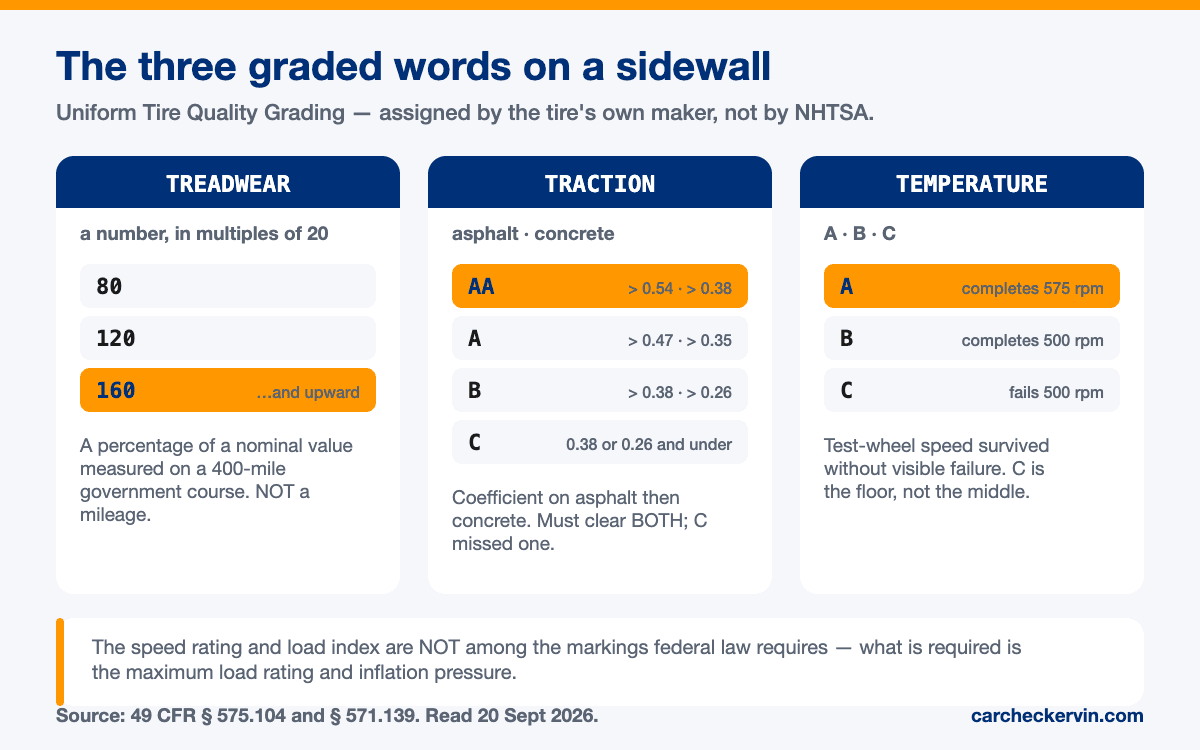
- TREADWEAR, TRACTION and TEMPERATURE. Treadwear is a number in multiples of 20; traction is AA, A, B, or C; temperature is A, B, or C. Together they are the Uniform Tire Quality Grading system.
- Does a higher treadwear number mean more miles?
- Not directly. The regulation defines it as a percentage of a nominal value measured on a government test course — not a distance, and not a promise of mileage. It is also graded by the tire's own maker, which is why comparing numbers across brands is unreliable.
- Is the speed rating required by law?
- No. The federal standard that governs sidewall markings does not list the speed rating or the load index among the things a tire must carry. What it requires is the maximum load rating as a weight, and the maximum permissible inflation pressure.
The 9 markings federal law requires
Start with what must be there. FMVSS No. 139 lists the markings a covered tire has to carry, and this is the whole list:
1DOT
The symbol DOT, which constitutes a certification that the tire conforms to applicable Federal motor vehicle safety standards.
2Tire size designation
The tire size designation as listed in the documents and publications specified in S4.1.1 of this standard.
3Maximum permissible inflation pressure
The highest cold pressure to which the tire may be inflated. Not the pressure your car asks for — that is on the door placard.
4Maximum load rating
The maximum load the tire is rated to carry at its maximum permissible inflation pressure, and for LT tires, the letter designating the tire load range.
5Cord material
The generic name of each cord material used in the plies, both in the sidewall and in the tread area.
6Ply count
The actual number of plies in the sidewall, and the actual number of plies in the tread area, if different.
7Tubeless or tube type
The term “tubeless” or “tube type”, as applicable.
8Radial
The word “radial”, if the tire is a radial ply tire.
9Alpine Symbol
Carried by a tire meeting the standard's definition of a snow tire — the three-peak mountain and snowflake mark.
What is not on that list
Two markings people treat as legally mandated are missing from it, and the omission is not an oversight in our reading:
The speed rating letter and the load index number are not among the markings FMVSS No. 139 requires. The standard requires the maximum load rating as a weight and the maximum permissible inflation pressure. The speed symbol is an industry convention carried on the sidewall, not a federal marking requirement.
We checked rather than assumed. The standard was searched for 5 related terms — speed symbol, speed rating, speed category among them — and none appears. In the same text, 4 control terms were searched for and all four controls were found in the same text, so the absences are a real finding and not a failed search.
This does not make the speed rating meaningless — it is a real engineering figure and your car's handbook may specify a minimum. It means that if a page tells you federal regulations require a speed symbol, or prints a letter-to-speed table and cites the CFR for it, that citation is wrong. We have deliberately not printed such a table here.
TREADWEAR: a percentage, not a mileage
The biggest misreading on a sidewall. The number is defined like this:
“Each tire shall be graded for treadwear performance with the word “TREADWEAR” followed by a number of two or three digits representing the tire's grade for treadwear, expressed as a percentage of the NHTSA nominal treadwear value.”
A percentage of a nominal value, in multiples of 20 — 80, 120, 160 and so on. It is not a number of miles, and nothing in the rule converts it into one. The measurement itself comes from a road course:
“Tire treadwear performance is evaluated on a specific roadway course approximately 400 miles in length, which is established by the NHTSA both for its own compliance testing and for that of regulated persons. The course is designed to produce treadwear rates that are generally representative of those encountered by tires in public use.”
The tires are one check. The record is another.
Title brands, flood and salvage records, reported mileage and open recalls — $14.99, no account.
TRACTION: the numbers behind AA, A, B and C
Most guides tell you AA is best and stop. The grades are actually defined by an adjusted traction coefficient measured on two surfaces, and a tire has to clear both thresholds to earn the grade:
| Grade | Asphalt | Concrete |
|---|---|---|
| AA | more than 0.54 | more than 0.38 |
| A | more than 0.47 | more than 0.35 |
| B | more than 0.38 | more than 0.26 |
| C | 0.38 or less | 0.26 or less |
Note how C works: a tire is graded C if it fails either threshold, while every grade above it requires clearing both. That asymmetry is why C is a genuine warning rather than a middling result.
TEMPERATURE: measured in test-wheel speed
The temperature grade is a survival test. The tire is pressed against a steel test wheel and run at increasing speeds; the grade records the fastest stage it completed without visible failure.
The tire may be graded A only if it successfully completes the 575 rpm test stage.
The tire may be graded B only if it successfully completes the 500 rpm test stage.
The tire shall be graded C if it fails to complete the 500 rpm test stage.
As with traction, C is the floor rather than the middle — a C tire is one that did not complete the 500 rpm stage.
Who actually assigns these grades
This is the fact that should change how you read the numbers. The grades are not issued by the regulator:
“Each manufacturer of tires, or in the case of tires marketed under a brand name, each brand name owner, shall provide grading information for each tire of which he is the manufacturer or brand name owner.”
NHTSA establishes the course and the test surfaces and runs its own compliance testing, but the grade on the sidewall is the manufacturer's own. What the grade promises is narrow: “Each tire shall be able to achieve the level of performance represented by each grade with which it is labeled. An individual tire need not, however, meet further requirements after having been subjected to the test for any one grade.”
The practical consequence: treadwear numbers compare reasonably well within one maker's range and poorly betweenmakers. The stated purpose of the system is still worth having in mind — “The purpose of this section is to aid the consumer in making an informed choice in the purchase of passenger car tires.”
Why your tire might carry no grades
A missing UTQG stamp is often not a defect. The system simply does not cover every tire:
“This section applies to new pneumatic tires for use on passenger cars. However, this section does not apply to deep tread, winter-type snow tires, space-saver or temporary use spare tires, tires with nominal rim diameters of 12 inches or less, or to limited production tires.”
A limited production tire is defined by volume — 15,000 of that design and size a year or fewer. And a brand-new tire line gets a grace period before grading is required, so an ungraded tire can simply be a recent one.
How the markings are physically made
Worth knowing because it tells you where to look and what a genuine marking looks like. The standard specifies both size and position:
“The markings must be in letters and numerals not less than 0.078 inches high and raised above or sunk below the tire surface not less than 0.015 inches.”
“The markings must be placed between the maximum section width and the bead on at least one sidewall.”
Moulded in and raised or sunk, never printed — which is why the markings survive years of kerbing and washing. The standard also names the little bars you have been ignoring in the grooves: “Treadwear indicators (TWI) means the projections within the principal grooves designed to give a visual indication of the degrees of wear of the tread.”
The standard covers radial tires on vehicles rated at 10,000 pounds GVWR or less, manufactured after 1975, so most of what sits on a passenger car or light truck is inside it.
What this is worth when you are buying
- 1
Read the grades on all four
Mixed grades across a car mean the tires were replaced piecemeal. That is not automatically bad, but it tells you how the car was looked after.
- 2
Treat a C traction grade as a flag
C means the tire missed a threshold, not that it landed mid-table. On a car you are about to buy, it is a cheap thing to price in.
- 3
Do not compare treadwear across brands
The maker assigns its own grade. A 500 from one company and a 500 from another were not issued by the same hand.
- 4
Check the wear bars before the tread depth gauge
The indicators are moulded into the grooves for exactly this. If the tread is level with them, the tire is finished regardless of what the seller says.
- 5
Check the age separately
None of these markings tell you how old the tire is — that is the DOT date code, which is a different part of the sidewall and worth reading on any used car.
Reading the age instead? That is the four-digit date code at the end of the DOT number, and it has its own page: how to read a tire date code.
Sources
- 49 CFR § 575.104 — Uniform tire quality grading standards
The grading system behind TREADWEAR, TRACTION and TEMPERATURE: who assigns the grades, the 400-mile government course, the traction coefficients behind AA/A/B/C and the test-wheel speeds behind A/B/C. Read 2026-09-20.
- 49 CFR § 571.139 — FMVSS No. 139 — New pneumatic radial tires for light vehicles
The 9 markings federal law requires on a sidewall, how large they must be, and where they sit. Also the source for what is NOT required. Read 2026-09-20.
- NHTSA Recalls by VIN
The federal safety-recall lookup: free, by VIN, covering unrepaired recalls.
Vérifiez toujours le VIN avant d’acheter
L’aperçu gratuit affiche les mentions au titre, le statut de vol et les rappels ouverts en quelques secondes, et signale s’il existe des dossiers d’accident et d’odomètre. L’historique complet est à 21,99 $ CAD — paiement unique, sans abonnement.
Keep reading
Frequently asked questions
What does the TREADWEAR number actually mean?+
"Each tire shall be graded for treadwear performance with the word “TREADWEAR” followed by a number of two or three digits representing the tire's grade for treadwear, expressed as a percentage of the NHTSA nominal treadwear value." It is a percentage, not a mileage. Grades are expressed in multiples of 20 — for example 80, 120, 160.
Where does the treadwear number come from?+
A government course. "Tire treadwear performance is evaluated on a specific roadway course approximately 400 miles in length, which is established by the NHTSA both for its own compliance testing and for that of regulated persons. The course is designed to produce treadwear rates that are generally representative of those encountered by tires in public use." The candidate tire is run against that course and the result is converted into the grade.
Who assigns the grades — NHTSA or the tire company?+
The tire company. The rule puts the duty on the maker: "Each manufacturer of tires, or in the case of tires marketed under a brand name, each brand name owner, shall provide grading information for each tire of which he is the manufacturer or brand name owner." NHTSA establishes the course and does its own compliance testing, but it does not issue the grade. That is the single most important thing to know before comparing two brands' numbers.
What do the traction letters mean in measurable terms?+
They are thresholds on an adjusted traction coefficient, measured on both asphalt and concrete, and a tire must clear BOTH to earn a grade. AA needs more than 0.54 on asphalt and more than 0.38 on concrete; A needs more than 0.47 and 0.35; B needs more than 0.38 and 0.26; C is 0.38 or less on asphalt or 0.26 or less on concrete.
What does the temperature grade measure?+
How fast a tire can run on a test wheel without coming apart. A tire is graded A only if it completes the 575 rpm stage, B if it completes 500 rpm, and C if it fails 500 rpm. C is therefore the minimum a graded tire can carry, not a middle result.
Why does my tire have no UTQG grades at all?+
Because UTQG does not cover every tire. "This section applies to new pneumatic tires for use on passenger cars. However, this section does not apply to deep tread, winter-type snow tires, space-saver or temporary use spare tires, tires with nominal rim diameters of 12 inches or less, or to limited production tires." A limited production tire is one where annual production or importation of that design and size does not exceed 15,000 tires. There is also a grace period: "Except for a tire of a new tire line, manufactured within the first six months of production of the tire line, each tire shall be graded with the words, letters, symbols, and figures specified in paragraph (d)(2) of this section, permanently molded into or onto the tire sidewall."
So what IS federally required on a sidewall?+
9 things, listed in FMVSS No. 139: DOT, Tire size designation, Maximum permissible inflation pressure, Maximum load rating, cord material, ply count, tubeless or tube type, the word radial, and the Alpine Symbol on a qualifying snow tire.
Is the speed rating or load index required?+
The speed rating letter and the load index number are not among the markings FMVSS No. 139 requires. The standard requires the maximum load rating as a weight and the maximum permissible inflation pressure. The speed symbol is an industry convention carried on the sidewall, not a federal marking requirement. We probed the standard for 5 related terms and found none, while 4 control terms were found in the same text — so all four controls were found in the same text, so the absences are a real finding and not a failed search.
What are the little bars in the tread grooves?+
Treadwear indicators. "Treadwear indicators (TWI) means the projections within the principal grooves designed to give a visual indication of the degrees of wear of the tread." When the tread wears level with them, the tire is telling you it is done — no gauge required.
Check the car's history
Title brands, flood records and open recalls — $14.99.
Vérifications VIN connexes
Plus d'outils pour vérifier l'historique de tout véhicule