Buying a car with no history report
Two free checks still work on any VIN, and the VIN is readable through the windshield from outside the car. So the real question is not whether the seller provides a report — it is whether you are willing to accept the one gap the free checks leave.
Run the VIN yourself
No seller cooperation required. Free decode to start.
No account · Nothing stored · $14.99 only for the full report
Quick Answer
- Should I buy a car without a vehicle history report?
- Only if you have replaced what the report would have told you. Two free checks still work on any VIN: NHTSA for open safety recalls and NICB VINCheck for theft and total-loss records filed by member insurers. Neither reads title brands, which is the gap you are accepting.
- What is the real risk?
- A title brand issued in another state — salvage, junk or flood — that nothing in front of you reveals. That is precisely what the federal record exists to catch, and it is the one thing a physical inspection can miss entirely on a well-repaired car.
- What if the seller refuses to provide one?
- You do not need their permission. A report is bought against the VIN, and the VIN is visible through the windshield from outside the car. A seller who will not let you read it has answered the question for you.
The premise is usually wrong
People ask this question as though a history report is something a seller grants. It is not. A report is bought against the vehicle identification number, and that number is stamped at the base of the windshield on the driver's side, legible from the pavement without touching the car.
So “the seller will not give me a report” is almost never the real situation. Either you have the VIN and can check it yourself, or the seller will not let you read the VIN — and that second one is not a reason to proceed carefully, it is a reason to leave.
What you can still establish for nothing
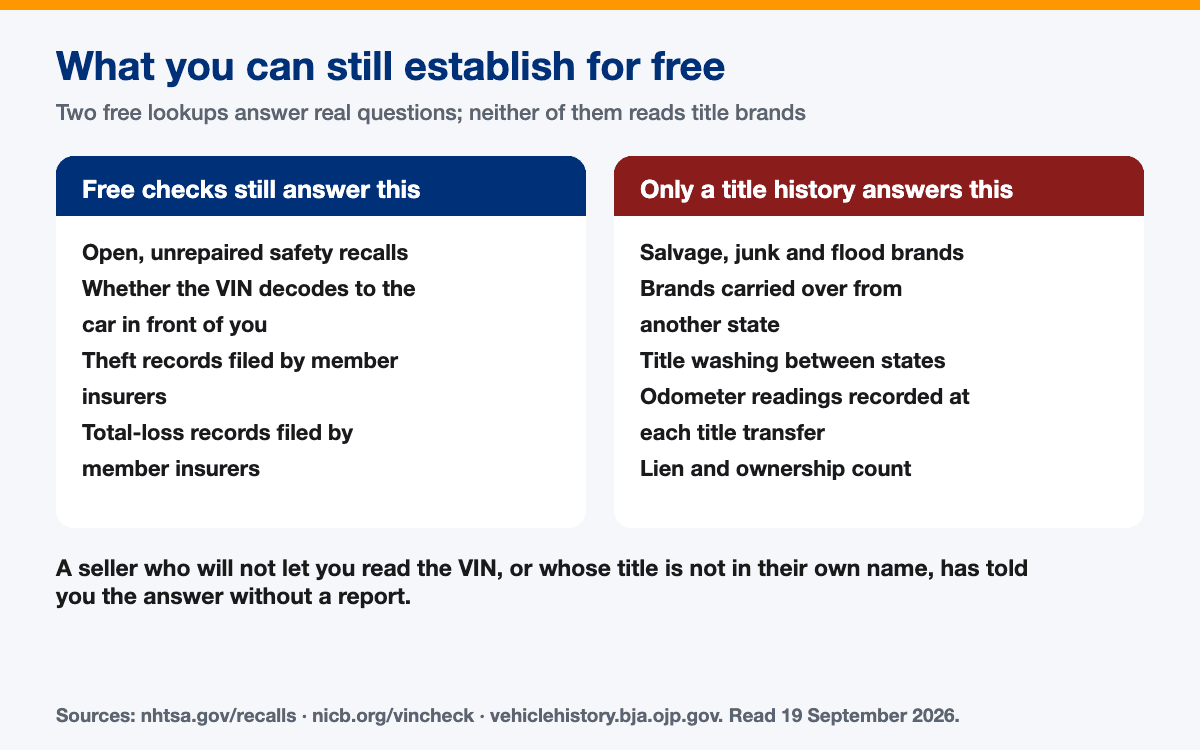
Those free checks are genuinely useful and we would rather you ran them than bought anything. What they cannot do is read the federal title record — and a brand is the failure mode that costs thousands rather than hundreds.
Close the one gap
Title brands across state lines — the thing no free check reads. $14.99, no account.
When buying without a report is defensible
There is a narrow set of situations where it genuinely is, and it is worth being honest about them rather than pretending every car needs every check:
- A car you already know personally — a family member's, or one you have watched being maintained for years.
- A seller whose ownership you can verify directly, with a title in their name and service records to match.
- A sum small enough that you are genuinely prepared to lose all of it, with no financing involved.
- A vehicle you are buying knowingly for parts, where the brand is irrelevant to your purpose.
Outside those, skipping the check is not saving money. It is deferring a cost to the moment you try to insure, finance or sell the car — and by then the discount belongs to somebody else.
The floor, with or without a report
- 1
Read the VIN in three places
Windshield base, driver's door jamb sticker, and the title. Free, takes a minute, and catches the worst cases.
- 2
Confirm the title is in the seller's name
The single most useful non-technical check there is. A title in someone else's name ends it.
- 3
Run the free recall check
NHTSA, by VIN. Open safety recalls are repaired free by a franchise dealer, so this is leverage.
- 4
Run NICB VINCheck
Free theft and total-loss records from participating member insurers.
- 5
Book an independent inspection
On a lift, at a garage you chose. It answers what the car is now; the record answers what it was.
Sources
- NHTSA Recalls by VIN
The federal safety-recall lookup: free, by VIN, covering unrepaired recalls.
- NICB VINCheck
The National Insurance Crime Bureau's free lookup for theft and total-loss records reported by participating member insurers.
- NMVTIS — U.S. Department of Justice
The Justice Department's consumer entry point for the National Motor Vehicle Title Information System. Read 19 September 2026.
- NHTSA vPIC VIN Decoder
The federal decoder that turns a VIN into the manufacturer's declared build.
Vérifiez toujours le VIN avant d’acheter
L’aperçu gratuit affiche les mentions au titre, le statut de vol et les rappels ouverts en quelques secondes, et signale s’il existe des dossiers d’accident et d’odomètre. L’historique complet est à 21,99 $ CAD — paiement unique, sans abonnement.
Keep reading
Frequently asked questions
Can I run a report myself if the seller will not?+
Yes, and this is the most useful thing to know. Reports are bought against the VIN, not against the seller's permission, and the VIN is legible through the windshield from outside the car. There is no scenario where a seller can prevent you checking — only scenarios where they refuse to let you see the number, which tells you everything.
What can I establish for free?+
Open, unrepaired safety recalls from NHTSA; theft and total-loss records filed by participating member insurers from NICB VINCheck; and the manufacturer's declared build from the federal vPIC decoder, which confirms the car matches the advert.
What do those free checks not cover?+
Title brands — salvage, junk, flood — including brands carried in from another state, title washing between states, odometer readings captured at each title transfer, and how many times the car has changed hands.
Is an older cheap car worth a report?+
On a very cheap car the report can be a meaningful share of the price, and that is a fair thing to weigh. But a salvage brand is exactly as expensive to discover late on a cheap car as on an expensive one, and at $14.99 the check is usually smaller than one tank of fuel.
Does a mechanic's inspection replace a report?+
No — they answer different questions and you want both on anything significant. An inspection finds the state of the car today: welds, structure, wear, leaks. A report finds what was recorded about its past. A well-repaired salvage car can pass an inspection while still carrying a permanent brand.
When is buying without a report defensible?+
A narrow set: a car you already know the history of personally, a vehicle bought from someone whose ownership you can verify directly, or a sum small enough that you are genuinely willing to lose it. Outside those, you are not saving money, you are deferring a cost.
What about a report the seller shows me?+
Read it, then check the date. A report run six months ago says nothing about the six months since, and a brand can be filed at any time. If the amount matters to you, run a current check against the VIN yourself.
What is the minimum I should do?+
Read the VIN in three places and confirm they match, confirm the title is in the seller's name, run the two free checks, and book an independent inspection. That is the floor, with or without a report.
Run the VIN yourself
No permission needed. Free decode; $14.99 for the title record the free checks cannot reach.
Vérifications VIN connexes
Plus d'outils pour vérifier l'historique de tout véhicule