Buying Used Cars? Check every VIN free first
Before you test drive or put down a deposit, screen every listing on your shortlist. Pull the VIN, run a free NMVTIS-backed preview to catch branded titles, salvage, and odometer fraud, then buy a $14.99 full report only for the car you're ready to purchase. Start with any VIN below.
Free VIN Preview
Enter a 17-character VIN — screen any used-car listing before you commit
Free preview · No sign-up · Instant result
Quick Answer
- How do I vet a used car before buying?
- Get the 17-character VIN from the listing, then run a free NMVTIS-backed preview to flag title brands, salvage, and odometer problems. It takes seconds and catches deal-breakers before a test drive. A full $14.99 report adds the accident and ownership timeline once you're serious.
- Should I check every used car on my list?
- Yes — screen every serious candidate. Because the preview is free with no sign-up, there's no reason not to filter your whole shortlist and only pay for a full report on the one car you're ready to buy.
- What's the biggest red flag in a used-car listing?
- A seller who won't share the VIN. Reputable listings publish it; a refusal usually hides a branded title, a total-loss record, or an odometer problem. Ask for the VIN, run it, and walk away if it's withheld.
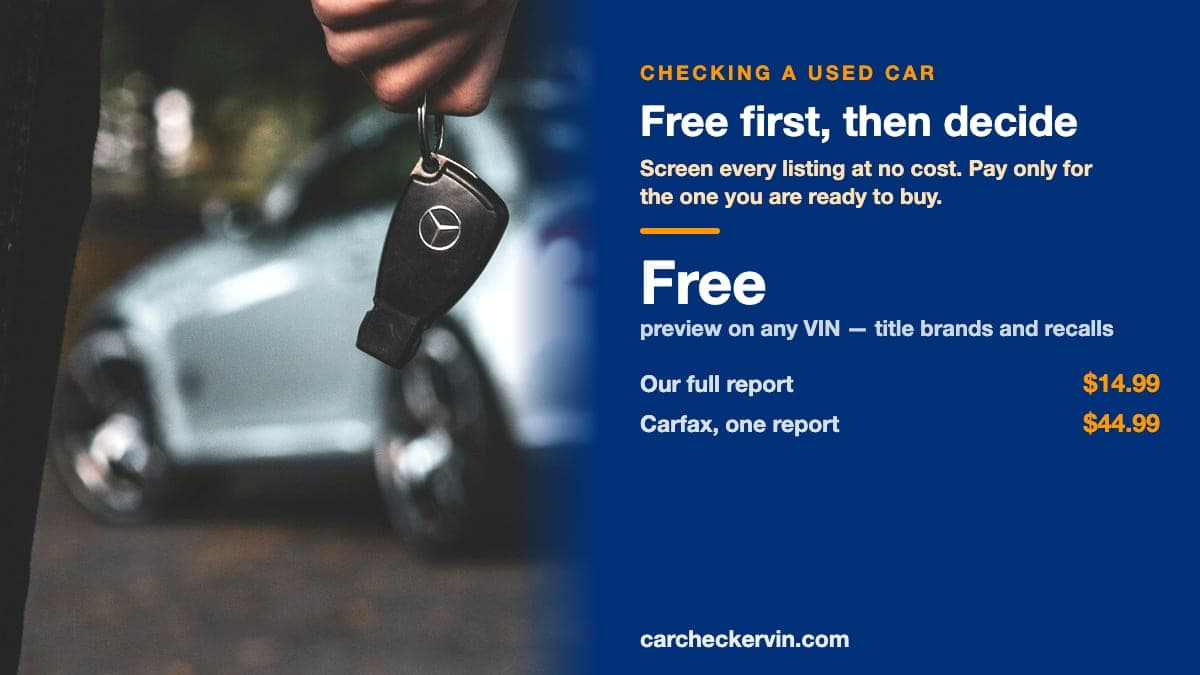
The three-step used-car check
Every used car you consider should clear these three steps in order. The first two are free and take seconds; only pay for depth once a car earns it.
Find and decode the VIN
Get the 17-character VIN from the listing or the car itself, then decode it to confirm the year, make, model, and trim match what the seller claims.
Run a free history preview
Check the VIN against NMVTIS for title brands, salvage, and odometer flags — free, no sign-up. This is the fastest way to eliminate bad listings.
Inspect and test drive
For cars that pass the history check, inspect in person and get a trusted mechanic's opinion on mechanical condition the paperwork can't show.
Is there a free Carfax report for a used car?
Not from Carfax. A single Carfax report is $44.99, and there is no free tier or trial on their own site. What people usually mean by a “free Carfax” is one of two things, and only one of them is reliable.
A dealer paid for it already
Plenty of dealer listings include a Carfax link, because the dealer bought it to help sell the car. It is genuine and it costs you nothing — but it is the seller's copy of the story, it only exists for cars a dealer chose to buy one for, and a private seller will rarely have one at all.
Run the VIN yourself, free
Our preview is free on any VIN, with no card and no trial. It answers the go/no-go question — title brands and open recalls — on every car on your shortlist, including the private-sale ones nobody has paid for.
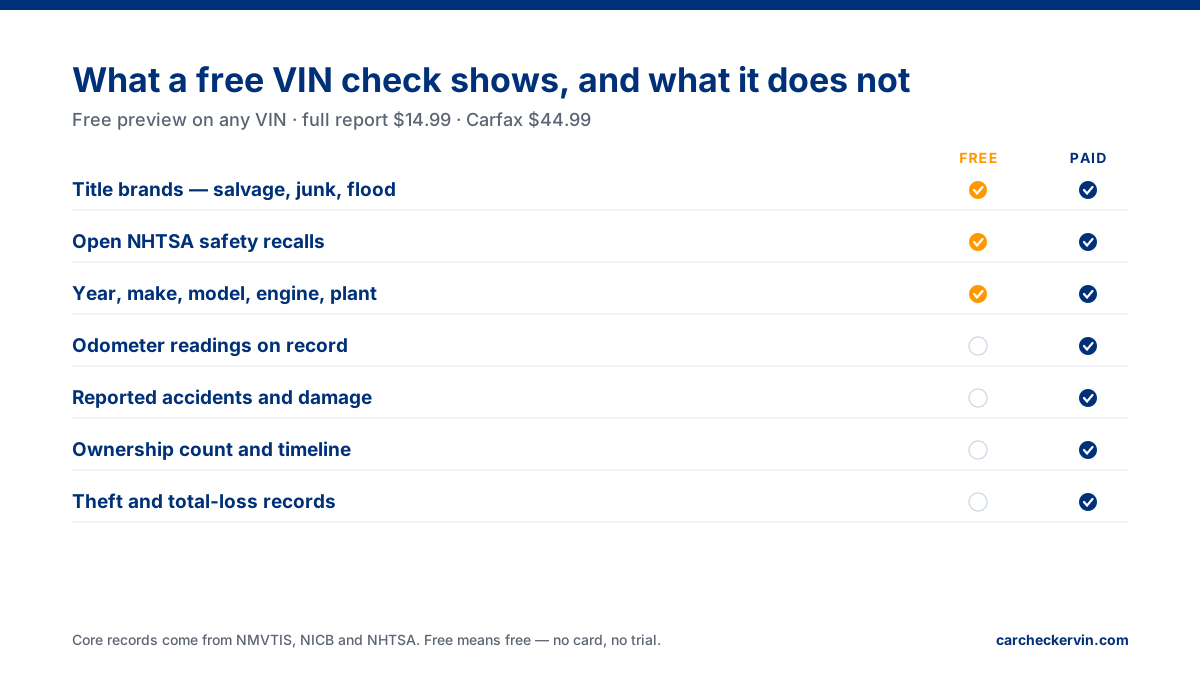
The honest way to use this: screen everything free, and pay once. A free check is enough to drop a car with a salvage brand or an open recall before you drive anywhere. When one car survives the shortlist, the $14.99 report adds the odometer timeline, reported accidents and ownership history — the detail worth having when you are about to hand over money.
Red flags to walk away from
Whether you're browsing cars, trucks, or SUVs, the warning signs are the same. A VIN history check surfaces most of these before you ever meet the seller.
A branded, salvage, rebuilt, or flood title — a major hit to safety and resale value.
Mileage that doesn't match the car's age, wear, or prior records — a sign of odometer rollback.
An open safety recall the seller never had repaired — check NHTSA by VIN for free.
A total-loss or theft record in the history that the listing price doesn't account for.
A seller who won't share the VIN, service history, or let you get an independent inspection.
A price well below market with a vague story — too good to be true usually is.
CarCheckerVIN is an independent vehicle history service and is not affiliated with, endorsed by, or owned by Carfax. Core history is sourced from NMVTIS, NICB, and NHTSA. Listed Carfax prices are for reference and may change.
Screen a listing right now
Paste any VIN for a free NMVTIS-sourced preview. Buy the $14.99 full report only for the car you decide to pursue.
Frequently asked
Is there a free Carfax report for a used car?
Not from Carfax — a single report is $44.99 and there is no free tier or trial on their site. Two things get called a free Carfax: a dealer listing that already includes one, which is genuine but is the seller's copy and only exists where a dealer chose to buy it, and running the VIN yourself. Our preview is free on any VIN with no card, and covers title brands and open recalls on every car including private sales.
What does a free used-car VIN check actually show?
Title brands such as salvage, junk and flood, open NHTSA safety recalls, and the factory decode — year, make, model, engine and plant. That is enough to drop a car before you drive anywhere. Odometer readings, reported accidents, the ownership timeline and theft records sit in the full report, which is $14.99 here against $44.99 for a single Carfax.
Do I need a Carfax for every used car I look at?
No, and paying for one on every listing gets expensive quickly at $44.99 each. Screen the whole shortlist with a free check first, which catches the branded titles and open recalls, then buy one full report for the car you are actually ready to purchase.
How do I check a used car's history before buying?
Grab the 17-character VIN from the listing, the windshield, or the driver-door jamb, then run it through a VIN history check. A free NMVTIS-backed preview flags title brands, salvage, and odometer problems at no cost. If the car passes and you're serious, a full $14.99 report adds the detailed accident and ownership timeline — far less than Carfax's $44.99 for the same core federal data.
Should I check every used car I'm considering?
At least run a free preview on each serious candidate. It takes seconds and catches the deal-breakers — a branded title, a total-loss record, or a rolled-back odometer — before you waste a test drive or a deposit. Because CarCheckerVIN's preview is free with no sign-up, there's no reason not to screen every listing on your shortlist.
Where do I find the VIN on a used-car listing?
Reputable listings on dealer sites and marketplaces publish the full VIN in the vehicle details. If a listing hides the VIN, ask the seller for it directly — a refusal is a red flag. On the car itself, the VIN sits at the base of the windshield on the driver's side and on a sticker inside the driver-door jamb.
What red flags should I look for in a used car?
A branded or salvage title, mileage that doesn't match the car's age or wear, an open safety recall, a total-loss or theft record, and a seller who won't share the VIN or service history. A VIN history check surfaces the title, odometer, theft, and recall flags; an in-person inspection and a mechanic's check cover mechanical condition.
Is a free used-car check as good as a paid report?
For the go/no-go decision, a free NMVTIS-backed preview covers the critical flags — title status, salvage, and obvious odometer issues. A paid report adds depth: the full accident timeline, ownership count, and service history that help you negotiate. Start free to filter your shortlist, then buy a $14.99 report only for the car you're ready to purchase.
Related tools & comparisons
Vérifiez toujours le VIN avant d’acheter
L’aperçu gratuit affiche les mentions au titre, le statut de vol et les rappels ouverts en quelques secondes, et signale s’il existe des dossiers d’accident et d’odomètre. L’historique complet est à 21,99 $ CAD — paiement unique, sans abonnement.
Buy your next used car with confidence
Enter any 17-character VIN for an instant NMVTIS-sourced preview. Screen the listing free, then get the full $14.99 report before you sign.
Vérifications VIN connexes
Plus d'outils pour vérifier l'historique de tout véhicule