Has this car been in an accident?
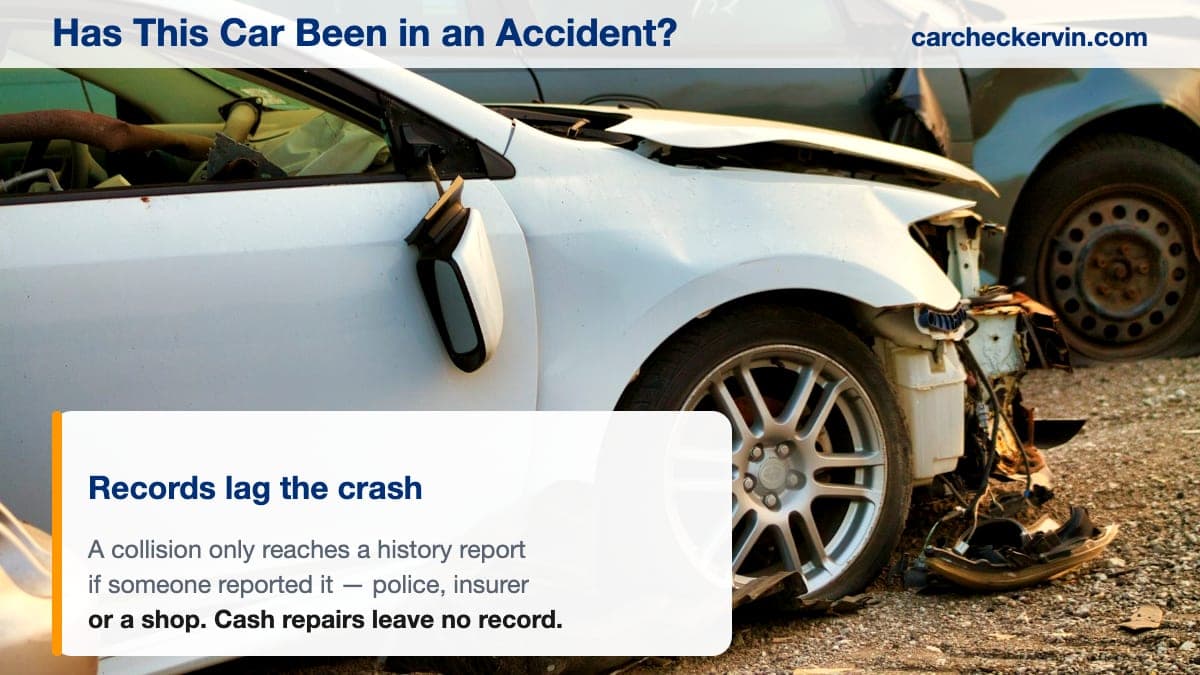
A collision reaches a history report only if somebody filed something — an insurer, the police, a salvage yard. A repair paid for in cash leaves no record anywhere. So you check the databases and you check the car.
Start with the VIN
Free decode. Claim and total-loss records in the full report.
No account · Nothing stored · $14.99 only for the full report
Quick Answer
- How do I check if a used car has been in an accident?
- Run the VIN through a history report to find insurance-claim and total-loss records, then inspect the car for the evidence a report cannot hold: uneven panel gaps, overspray on rubber trim, non-factory welds and a restraint system that does not cycle properly.
- Can an accident be missing from a history report?
- Yes, and this is the single most important thing to understand. A crash repaired privately for cash generates no insurance claim, no police report and no salvage record — so it appears in no database at all.
- What is the strongest single signal?
- A total-loss record. If an insurer wrote the car off, the repair cost exceeded what the car was worth — and that is reportable to the federal NMVTIS database by law.
Why a clean report is not the same as a clean car
Every vehicle history report, from every publisher, is a view of events that somebody reported. Insurers report claims. States report title brands. Salvage yards report what arrives on the truck. What none of them can report is the crash that was settled between two drivers with cash and a phone number.
That is why this page is organised around five trails rather than one lookup. The report is the fastest of them and the only one you can run before you travel to see the car — but it is one of five.
The five trails
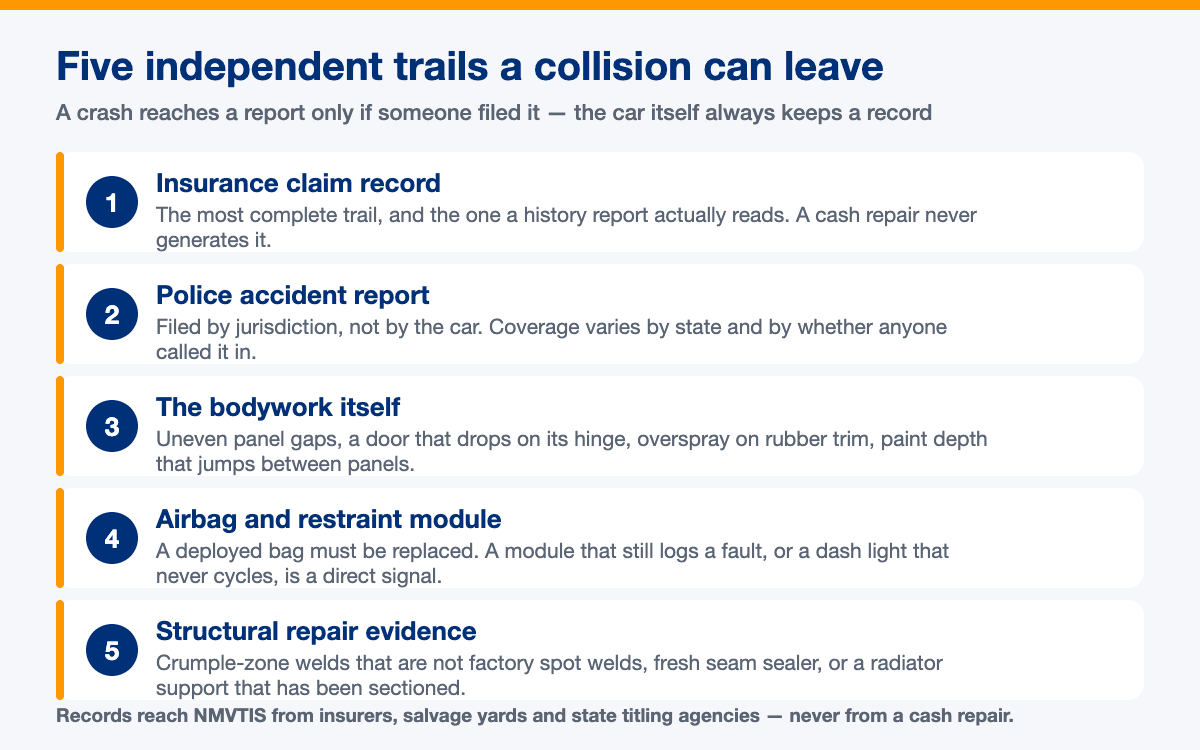
1Insurance claim records
The most complete trail, and the one a history report actually reads. If an insurer paid to repair the car, there is a record with a date and usually a severity indication.
2Police accident reports
Filed by jurisdiction rather than attached to the car. Coverage varies enormously by state and by whether anyone called it in at the time.
3The bodywork itself
Panel gaps that narrow at one end, a door that drops on its hinge as it opens, overspray on rubber seals, and paint depth that jumps between adjacent panels.
4The airbag and restraint module
A deployed bag must be replaced. A warning light that never illuminates at all is a stronger signal than one that stays on — it suggests the bulb was pulled.
5Structural repair evidence
Welds in the crumple zones that are not factory spot welds, a radiator support that has been sectioned, fresh seam sealer, or underbody paint newer than the car.
Run the VIN before you travel
A total-loss record means you never need to make the trip. Free decode; $14.99 for the full title history.
What a total loss means in federal terms
The Justice Department's NMVTIS glossary defines a salvage automobile as one damaged by collision, fire, flood, accident, trespass or other event to the extent that its fair salvage value plus the cost of repairing it for legal road use would exceed its fair market value immediately before the event. Crucially, it also includes any vehicle an insurer designated a total loss under the terms of its policy — whether or not ownership transferred to the insurer.
That last clause matters when you are shopping. A car can carry a total-loss history without ever having been sold at a salvage auction, which is how some sellers end up honestly believing the car was “just repaired”.
A twenty-minute walk-around that finds most of it
- 1
Look down the flanks in daylight
Stand at one corner and sight along the side. Reflections bend where a panel has been filled or replaced. Do both sides; asymmetry is the tell.
- 2
Open and close every door
A door that drops or needs a lift to latch suggests the aperture moved. Check the gaps at the top and bottom of each shut.
- 3
Check the rubber and the trim
Overspray on door seals, window rubber and wheel-arch liners is the most common giveaway of a respray.
- 4
Look at the bolt heads
Fender, hood and door-hinge bolts leave the factory with undisturbed paint. Cracked or tool-marked paint means they came off.
- 5
Cycle the ignition and watch the lights
The airbag telltale should illuminate then extinguish. No light at all is a red flag, not a clean bill of health.
- 6
Pull the trunk mat and look at the spare well
Ripples, fresh sealer or mismatched paint in the spare well point to a rear impact that reached structure.
When an accident record should not stop you
Plenty of good cars have been hit. What separates a bargaining point from a walk-away is severity, whether structure was involved, and the quality of the repair:
- Documented bumper or panel damage, professionally repaired, with the paperwork — negotiate on it.
- Any damage that reached the unibody, the strut towers or the crumple zones — walk unless an independent inspection clears it.
- Airbag deployment with no record of who replaced the modules — treat as a safety issue, not a cosmetic one.
- A total-loss record the seller did not mention — the record is not the problem; the omission is.
Sources
- NMVTIS — U.S. Department of Justice
The Justice Department's consumer entry point for the National Motor Vehicle Title Information System. Read 19 September 2026.
- NMVTIS Glossary (title-brand definitions)
Federal definitions of brand, junk automobile, salvage automobile and total loss. Read 19 September 2026.
- NICB VINCheck
The National Insurance Crime Bureau's free lookup for theft and total-loss records reported by participating member insurers.
- NHTSA Recalls by VIN
The federal safety-recall lookup: free, by VIN, covering unrepaired recalls.
Vérifiez toujours le VIN avant d’acheter
L’aperçu gratuit affiche les mentions au titre, le statut de vol et les rappels ouverts en quelques secondes, et signale s’il existe des dossiers d’accident et d’odomètre. L’historique complet est à 21,99 $ CAD — paiement unique, sans abonnement.
Keep reading
Frequently asked questions
Will a vehicle history report show every accident?+
No report can. A history report shows events somebody filed — an insurance claim, a police report, a salvage or total-loss record. A fender repaired for cash at an independent body shop creates none of those, so it is invisible to every provider equally. This is a limit of the data, not of any one company.
What does a total loss actually mean?+
Under the federal NMVTIS definition, a salvage automobile is one damaged to the extent that its fair salvage value plus the cost of repairing it for legal road use would exceed its fair market value immediately before the damage. It includes any vehicle an insurer designated a total loss under its policy terms.
How can I spot repaired crash damage myself?+
Sight down each flank in daylight: panel gaps should be even and parallel. Look for overspray on rubber seals and window trim, paint that does not match under the door shuts, bolt heads on fenders and hinges with the paint cracked off, and fresh seam sealer that looks different from the factory bead.
What should I check about the airbags?+
Turn the ignition to accessory and watch the airbag warning light: it should illuminate and then go out. A light that never comes on can mean the bulb was removed to hide a fault. A deployed bag must be replaced, and a replacement done badly is a safety problem, not a cosmetic one.
Does frame damage always show up?+
Only if it was reported. On the car, look at the strut towers, the radiator support and the crumple zones for welds that are not factory spot welds, for sectioned metal, and for underbody paint that is newer than the rest of the car.
Is a car with an accident record always a bad buy?+
No. A documented, properly repaired bumper knock is often a reason to negotiate rather than walk. What matters is severity, whether structure was involved, and whether the repair was done to standard. An undocumented repair is worse than a documented one.
What does NICB VINCheck add?+
It is free, and it covers theft records and total-loss records filed by participating member insurers. Because it is a different dataset from a commercial report, it is worth running as a cross-check rather than a substitute.
Should I still pay for an inspection?+
For any car you are serious about, yes. An independent mechanic on a lift sees the underbody, the welds and the suspension geometry — the things neither a report nor a walk-around can reach. It is the cheapest insurance in the process.
Check the VIN now
Claim records, total-loss designations and title brands — $14.99, no account.
Vérifications VIN connexes
Plus d'outils pour vérifier l'historique de tout véhicule