How to spot flood damage
Silt settles where water stood, not where it splashed. That single idea tells you where to look — low, and underneath things that nobody cleans before a sale.
Check the federal flood record
Free decode; the full title history reads flood brands across state lines.
No account · Nothing stored · $14.99 only for the full report
Quick Answer
- How can I tell if a used car has flood damage?
- Look low and look under things. Lift the carpet at its lowest corner for silt or a tide line, run a hand along the bare steel seat rails for rust that stops at a level, draw every seat belt fully out of its reel, and check the spare wheel well — the lowest sealed point in most cars.
- Will a history report always show flood damage?
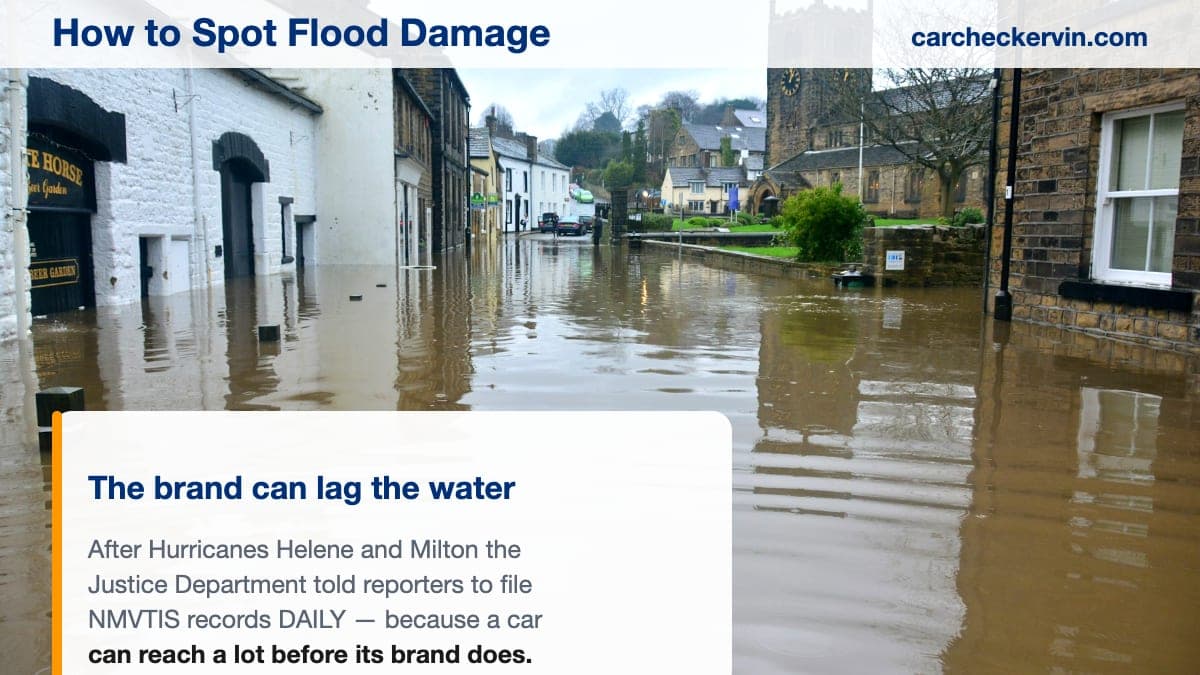
- Not always, and not always yet. A flood brand reaches NMVTIS only once a reporting entity files it. After Hurricanes Helene and Milton the Justice Department wrote to reporting entities asking them to submit NMVTIS reports daily — which tells you the lag is real.
- Is a flood-damaged car ever worth buying?
- Rarely, and never without disclosure and a large discount. Water damage works through wiring looms and control modules over months, so the faults arrive long after the sale.
Why the record can be behind the car
A flood brand only exists once somebody files it. NMVTIS is operated for the Bureau of Justice Assistance by the American Association of Motor Vehicle Administrators, and the entities that report into it are insurers, salvage yards and state titling agencies. A car that went under water but was never claimed on, never sold at salvage and never re-titled can pass through none of them.
On November 5, 2024, after Hurricanes Helene and Milton, BJA wrote to NMVTIS reporting entities about water-damaged vehicles. It encourages entities to submit NMVTIS reports daily, and warns that it will, as appropriate, initiate civil actions that may lead to penalties where reporting obligations go unmet. A regulator asking for daily filing is telling you the lag is real.
So you run the record check and you look at the car. They catch different failures.
The five places to look
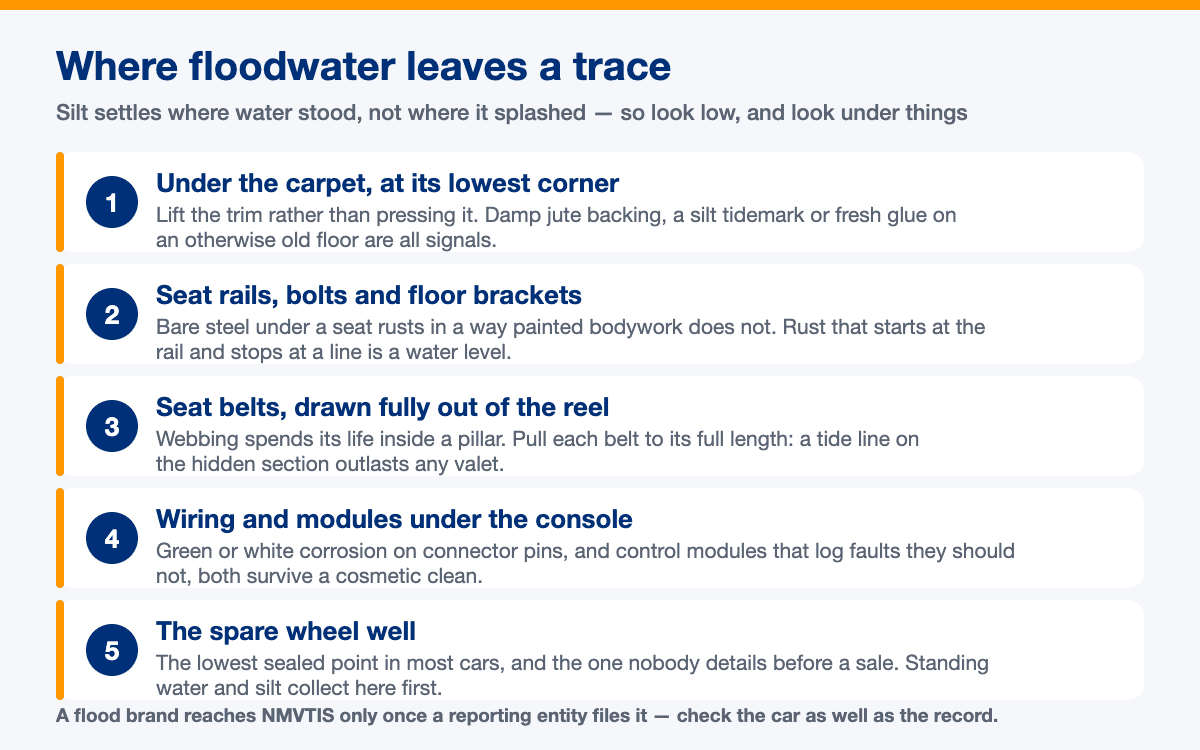
1Under the carpet, at its lowest corner
Lift the trim rather than pressing it. Damp jute backing, a silt tidemark, or fresh adhesive on an otherwise old floor are all signals. Press only tells you about today; lifting tells you about the history.
2Seat rails, bolts and floor brackets
Bare steel under a seat rusts in a way painted bodywork does not. Rust that begins at the rail and stops at a clean horizontal line is a water level, and water levels do not occur naturally inside a car.
3Seat belts, drawn fully out of the reel
Webbing spends its life coiled inside a pillar. Pull each belt to its full length and look at the last two feet — a tide line or staining there outlasts any valet, because nobody cleans what nobody sees.
4Wiring and modules under the console
Green or white corrosion on connector pins is the classic tell. Then exercise every motor in the car: windows, mirrors, seats, sunroof, wipers. Water-damaged looms fail progressively rather than all at once.
5The spare wheel well
The lowest sealed point in most cars and the one least likely to be detailed before a sale. Standing water, silt and rust collect here first and leave last.
Check the flood record by VIN
Flood, salvage and junk brands across state lines — $14.99, no account.
Why water damage keeps arriving after the sale
Flood damage is unlike collision damage in one important respect: it is not finished when you buy the car. Trim and carpet can be stripped and replaced convincingly. Wiring looms cannot — water wicks along the copper inside the insulation, and corrosion carries on in the dark for months.
- Control modules that sat in water fail intermittently first, which reads as a gremlin rather than a cause.
- Connector corrosion raises resistance gradually, so symptoms drift in over a season.
- Airbag and restraint electronics are part of that loom — this is a safety system, not a convenience one.
- Seat-belt pretensioners and their wiring sit low in the car, exactly where water reaches first.
Sources
- 2024 Flood Damage Notification to NMVTIS Reporting Entities (PDF)
BJA's 5 November 2024 letter after Hurricanes Helene and Milton, setting out daily reporting and enforcement. Read 19 September 2026.
- NMVTIS Glossary (title-brand definitions)
Federal definitions of brand, junk automobile, salvage automobile and total loss. Read 19 September 2026.
- NMVTIS — U.S. Department of Justice
The Justice Department's consumer entry point for the National Motor Vehicle Title Information System. Read 19 September 2026.
- NICB VINCheck
The National Insurance Crime Bureau's free lookup for theft and total-loss records reported by participating member insurers.
Vérifiez toujours le VIN avant d’acheter
L’aperçu gratuit affiche les mentions au titre, le statut de vol et les rappels ouverts en quelques secondes, et signale s’il existe des dossiers d’accident et d’odomètre. L’historique complet est à 21,99 $ CAD — paiement unique, sans abonnement.
Keep reading
Frequently asked questions
What does a flood title actually mean?+
The Justice Department defines a brand as a descriptive label regarding the status of a motor vehicle, naming junk, salvage and flood as examples. A flood brand records that water damage was reported against that VIN. Exact thresholds are set by the state issuing the title, so the wording varies while the federal record is shared.
Why might a flooded car have a clean record?+
Because the record depends on somebody filing. NMVTIS is operated for the Bureau of Justice Assistance by the American Association of Motor Vehicle Administrators, and reporting entities file into it — insurers, salvage yards and state titling agencies. A car bought privately from an owner after a storm, cleaned and resold, may never pass through any of them.
What did the 2024 flood notification say?+
On November 5, 2024, in the wake of Hurricanes Helene and Milton, the Bureau of Justice Assistance wrote to NMVTIS reporting entities about water-damaged vehicles. It encourages entities to submit NMVTIS reports daily, and states that BJA will, as appropriate, initiate civil actions that may lead to penalties where reporting obligations are not met.
What is the fastest single check?+
Pull a seat belt all the way out of its reel. The webbing lives inside the pillar, nobody cleans it, and a tide line or staining on the hidden section is hard to fake and easy to see.
Does a musty smell prove flood damage?+
No, and its absence proves nothing either — a heavy deodoriser is itself worth noticing. Smell is a prompt to look harder, not a conclusion. The physical evidence under the carpet and on the seat rails is what settles it.
What about the electrics?+
Look for green or white corrosion on connector pins under the dash and console, and test everything with a motor in it: windows, mirrors, seats, sunroof, wipers. Water-damaged looms fail progressively, so something usually misbehaves even when the car starts fine.
Can flood damage be repaired properly?+
Trim and carpet can be replaced. Wiring looms and control modules that sat in water are a different matter — corrosion continues inside the insulation after the car is dry, which is why faults surface months later.
Should I buy a car from a flood region?+
Region alone is not a verdict; plenty of cars in a flooded county never got wet. Treat a storm date in the car's history as a reason to run both the record check and a careful physical inspection, rather than as an automatic no.
Run the flood check
$14.99 for the NMVTIS-backed title history. Then go and lift the carpet anyway.
Vérifications VIN connexes
Plus d'outils pour vérifier l'historique de tout véhicule