How do I check if a car was in an accident?
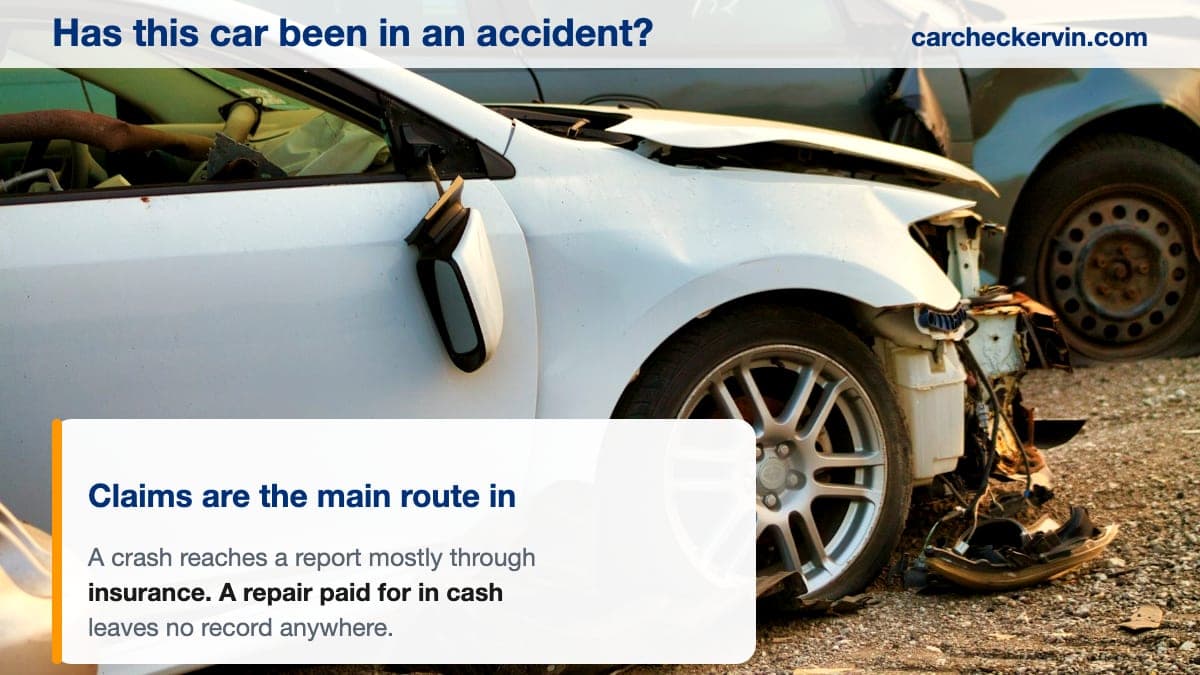
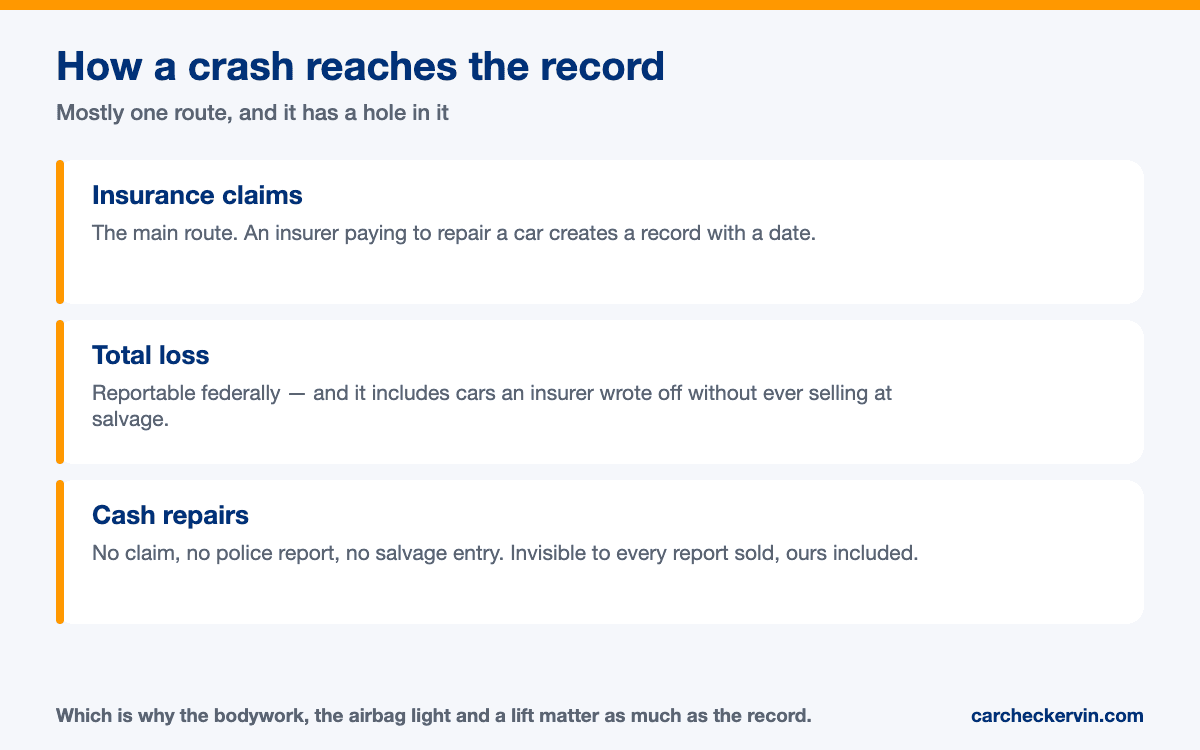
A collision reaches a history report through one route above all others: somebody filed an insurance claim. That single fact explains why a clean report is not the same as an undamaged car, and it tells you exactly where to look instead.
Check this VIN now
Free decode. Full title history when you need it.
No account · Nothing stored · $14.99 only for the full report
The short answer
A collision reaches a history report through one route above all others: somebody filed an insurance claim. That single fact explains why a clean report is not the same as an undamaged car, and it tells you exactly where to look instead.
Looking for the tool rather than the explanation? Accident history check by VIN runs the lookup directly.
The detail that matters
Read the federal record
Title brands across state lines — $14.99, no account.
Where the limits are
No record captures a repair somebody paid for in cash. Reporting duties have carve-outs, and older vehicles have thinner records. Read a clean result as strong evidence rather than proof, and pair it with an independent inspection on a lift.
Step by step
- 1
Run the VIN for claim and total-loss records
This is the route most accidents travel. An insurer that paid to repair the car usually leaves a dated record.
- 2
Cross-check NICB VINCheck
Free, and a different dataset — total-loss records filed by participating member insurers.
- 3
Read the bodywork in daylight
Sight down each flank. Reflections bend where a panel has been filled or replaced, and overspray on rubber trim is the most common giveaway.
- 4
Cycle the restraint system
Turn the ignition to accessory. The airbag light should illuminate and then go out; a light that never appears is worse than one that stays on.
- 5
Put it on a lift
Non-factory welds, sectioned rails and fresh seam sealer are things no report records and no walk-around reveals.
Sources
- NMVTIS — U.S. Department of Justice
The Justice Department's consumer entry point for the National Motor Vehicle Title Information System. Read 19 September 2026.
- NMVTIS Glossary (title-brand definitions)
Federal definitions of brand, junk automobile, salvage automobile and total loss. Read 19 September 2026.
- NHTSA Recalls by VIN
The federal safety-recall lookup: free, by VIN, covering unrepaired recalls.
- NICB VINCheck
The National Insurance Crime Bureau's free lookup for theft and total-loss records reported by participating member insurers.
Vérifiez toujours le VIN avant d’acheter
L’aperçu gratuit affiche les mentions au titre, le statut de vol et les rappels ouverts en quelques secondes, et signale s’il existe des dossiers d’accident et d’odomètre. L’historique complet est à 21,99 $ CAD — paiement unique, sans abonnement.
Keep reading
Frequently asked questions
How do accidents get into a history report?+
Overwhelmingly through insurance. When an insurer pays to repair a car, that creates a record. Police reports contribute too, but coverage varies enormously by jurisdiction and by whether anyone called it in.
What if the damage was repaired privately?+
Then there is usually no record anywhere. A driver who paid cash at an independent body shop generates no claim, no police report and no salvage entry — which is the single biggest limit on every history report sold, ours included.
What counts as a total loss?+
Federally, a vehicle damaged to the extent that its salvage value plus repair cost would exceed its pre-damage market value — and it explicitly includes any vehicle an insurer designated a total loss under its policy, whether or not ownership transferred to the insurer.
So a car can have a total-loss history without going to auction?+
Exactly. That is why a seller can honestly say it was never a salvage car while a total-loss record still exists against the VIN.
What should I look at on the car itself?+
Panel gaps that narrow at one end, overspray on rubber seals and window trim, paint depth that jumps between adjacent panels, cracked paint on fender and hinge bolts, and a boot floor or spare well with ripples or fresh sealer.
How do I check the airbags?+
Turn the ignition to accessory and watch the airbag warning light. It should illuminate and then go out. A light that never appears at all is more worrying than one that stays on.
Does an accident record kill the deal?+
Not by itself. Documented, professionally repaired panel damage is a negotiating point. Structural repair, or a deployment with no record of who replaced the modules, is a different conversation.
What is the most reliable single check?+
A total-loss or salvage record against the VIN. It is reportable by law, which makes it far harder to hide than a body-shop invoice.
Run the VIN
Free decode; $14.99 for the NMVTIS-backed title history.
Vérifications VIN connexes
Plus d'outils pour vérifier l'historique de tout véhicule