Monroney Label — the window sticker the law requires on every new car.
The Monroney label is the price sticker a manufacturer has to fix to a new car's window before the car reaches the dealer. A 1958 law decides what goes on it: the price, the factory options, the destination charge and the total. Later rules added NHTSA's crash-test stars, the EPA fuel economy label and a parts-content label. Used cars don't get one.
Want the Story the Sticker Can't Tell?
The sticker shows how the car left the factory. Enter the VIN for a free preview of what happened after: title brands, salvage records and odometer readings.
Free preview · No sign-up · No owner or personal data
Quick Answer
- What is a Monroney label?
- It's the window sticker federal law requires on every new passenger car sold in the US. Under the Automobile Information Disclosure Act of 1958, the manufacturer must fix it to the windshield or a side window before delivering the car to a dealer. It lists the make, model and VIN, the final assembly point, the receiving dealer, the suggested retail price, each factory option's price, the destination charge and the total. It takes its name from Senator Mike Monroney of Oklahoma, who sponsored the bill.
- Is it illegal to remove a Monroney sticker?
- Before the car is delivered to its first buyer, yes. 15 U.S.C. 1233(c) makes it an offense to willfully remove, alter or make illegible the label before the car reaches the "ultimate purchaser", with a fine of up to $1,000, up to a year in prison, or both, for each car. Once the car is yours, you can take it off.
- Do used cars have a Monroney label?
- No. The law covers new automobiles: cars whose title has never passed to a first retail buyer. A used car on a dealer lot carries the FTC Buyers Guide instead, which states warranty terms, not price or equipment. If the original sticker is lost, the factory details can often be rebuilt from the VIN.
Five sections, top to bottom
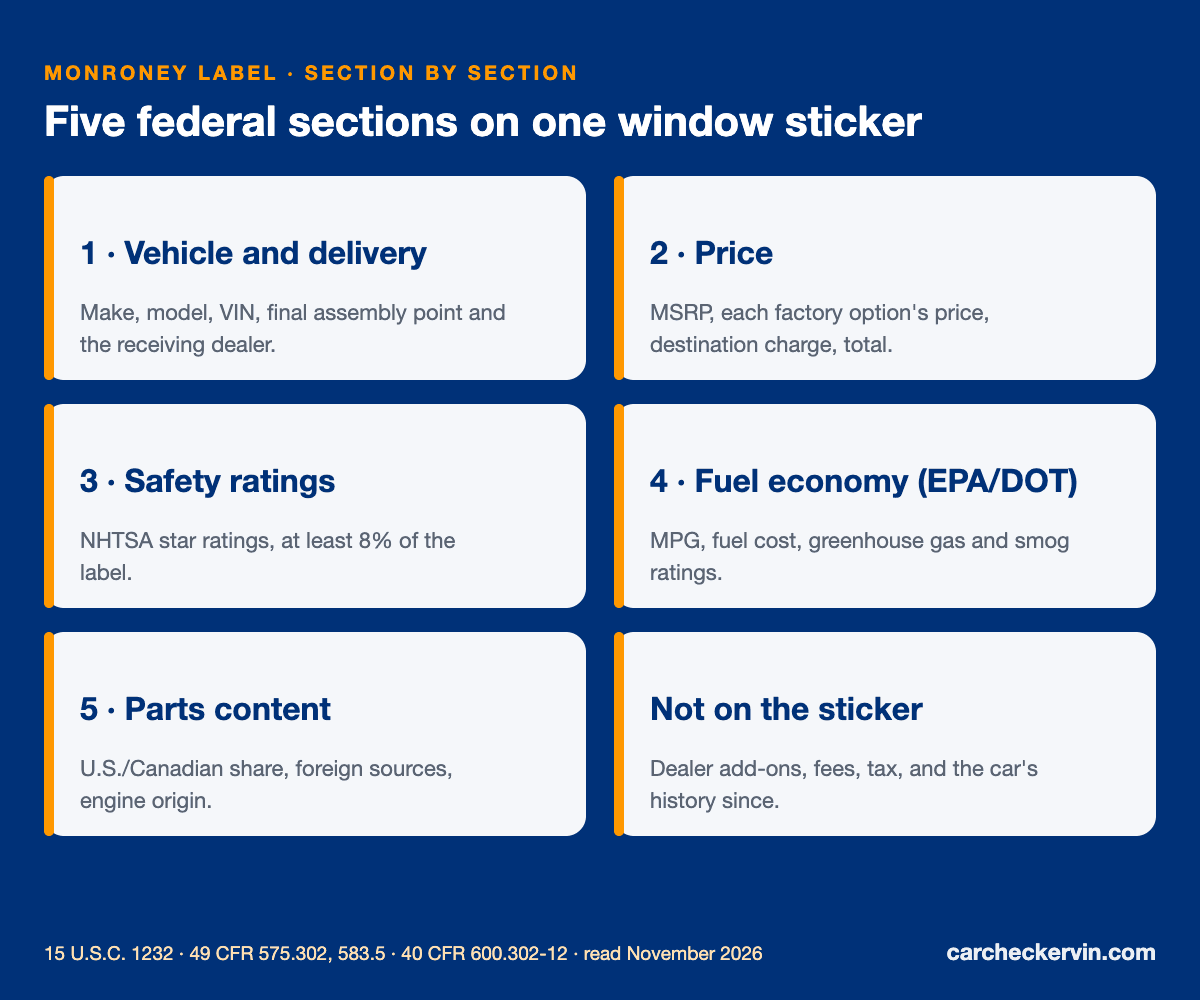
Every manufacturer designs its own layout, but the federal content always falls into the same five parts.
- 1Vehicle and VINMake, model, VIN, final assembly point and the dealer it shipped to.
- 2Price and optionsThe base MSRP, then each factory-installed option with its own price.
- 3Destination and totalThe charge for shipping the car to the dealer, then the sum of all three.
- 4Crash-test starsNHTSA's frontal, side and rollover ratings, or a statement that it wasn't rated.
- 5Fuel economy and partsThe EPA/DOT fuel economy label, and where the parts and the engine came from.
What Federal Law Requires on the Label
The duty sits with the manufacturer. Section 3 of the Automobile Information Disclosure Act, now 15 U.S.C. 1232, says that before a new car goes to a dealer, the maker must "securely affix" a label to the windshield or a side window and fill it in clearly and legibly. The law applies to every manufacturer and importer of new automobiles distributed in the US, and it defines an automobile as any passenger car or station wagon.
Congress passed the bill as S. 3500, and President Eisenhower signed it on July 7, 1958 as Public Law 85-506. It took effect on October 1, 1958, or with the first new model a manufacturer introduced after that, whichever came later. The original list covered the car's identity, its route to the dealer and its price: what the car cost, what each option cost and what the dealer was charged for delivery. A 2005 amendment added the crash-test ratings, and the section was amended again in 2012.
The entries 15 U.S.C. 1232 requires
- Identity: make, model, and serial or identification number.
- Origin: the final assembly point, or the port of entry for an import.
- Delivery: the dealer's name and location, the delivery city, and how the car travelled if driven or towed.
- Price: MSRP, each factory option's price, the destination charge and the total.
- Safety: NHTSA star ratings, or a statement that the car wasn't rated.
The Monroney Label's Federal Sections, Line by Line
The sticker you see on a new car combines several federal labels. This is what each part has to contain and the rule that requires it.
| Section | What it shows | Rule |
|---|---|---|
| Vehicle and delivery | Make, model and VIN, the final assembly point, the dealer it ships to and how it got there | 15 U.S.C. 1232(a)–(e) |
| Price | Base MSRP, each factory-installed option with its price, the destination charge and the total | 15 U.S.C. 1232(f) |
| Safety ratings | NHTSA star ratings for frontal crash, side crash and rollover, or a statement that the car wasn't rated | 15 U.S.C. 1232(g)–(h); 49 CFR 575.302 |
| Fuel economy and environment | MPG, annual fuel cost, five-year cost against the average new vehicle, greenhouse gas and smog ratings | 40 CFR 600.302-12; 49 CFR 575.401 |
| Parts content | U.S./Canadian parts share, the top foreign sources, final assembly point, engine and transmission origin | 49 CFR 583.5 |
Rules read on eCFR, current to November 5, 2026. Manufacturers lay the sticker out themselves; these are the contents the rules require, not a fixed design.
What Each Part of the Sticker Tells You
The price block is the part the 1958 law was written for. It shows the manufacturer's suggested retail price for the car, then every option that was physically on the car when it was delivered to the dealer, each with its own price, then the destination charge and a total. That total is the manufacturer's suggestion, not the price you'll pay.
The crash-test and fuel economy sections came decades later and have their own formats, set by NHTSA and the EPA. They answer different questions: how the car did in federal crash tests, and what it will cost to fuel compared with the average new vehicle.
The Crash-Test Stars and the 8 Percent Rule
NHTSA's star ratings have been part of the Monroney label for vehicles built on or after September 1, 2007. The rule covers vehicles with a gross vehicle weight rating of 10,000 pounds or less that the 1958 Act requires to carry a price sticker. NHTSA's own examples are passenger cars, station wagons, passenger vans and sport utility vehicles. For model-year 2012 and later vehicles built on or after January 31, 2012, the label shows the ratings from NHTSA's revised crash-test program.
The safety section can't be tucked away in small print. It has to cover at least 8 percent of the label's total area or 4½ by 3½ inches, whichever is larger. If NHTSA hasn't rated the car, or hasn't rated it in one of the categories, the label has to say so. A missing star is a statement, not a blank.
The EPA Fuel Economy Label
The fuel economy label is a separate federal requirement, issued jointly by the EPA and the Department of Transportation and required on passenger cars and light trucks from model year 2013. It must be at least 174 by 114 millimetres and carries the heading "Fuel Economy and Environment". It shows the fuel type, the MPG (or MPGe for electric cars), an annual fuel cost, how much more or less you'd spend on fuel over five years than with the average new vehicle, and two sliding scales: a fuel economy and greenhouse gas rating and a smog rating.
NHTSA's rule says it's preferable to build this label into the Monroney label, in its own section. If it isn't, it has to go on a side window as close to the Monroney label as possible, readable from outside the car, and it has to stay there until the car is delivered to its first buyer.
Parts Content: Where the Car Was Built
Since October 1, 1994, new passenger vehicles have also carried a parts-content label under the American Automobile Labeling Act, NHTSA's rule at 49 CFR 583. It can sit on the Monroney label itself, separated from the rest by a solid line at least 3 points wide, or be a label of its own that can be read from outside with the doors closed.
The percentages are calculated for the carline, the model family, not for the individual car on the lot. And the label's own required note says parts content leaves out final assembly, distribution and other non-parts costs, so a high U.S./Canadian figure doesn't mean every dollar of the car was spent in North America.
What the parts label lists
- U.S./Canadian content: the share of parts, by value, from the US and Canada.
- Major foreign sources: any country supplying at least 15% of parts, up to the top two.
- Final assembly: city, state and country.
- Engine and transmission: the country of origin of each.
Looking for a Specific Car's Original Sticker?
A used car won't have its Monroney label on the window any more. For supported makes, our window sticker lookup rebuilds the factory MSRP and options from the VIN.
Look up a window sticker by VINRemoving or Changing the Sticker: What the Law Says
15 U.S.C. 1233 sets three offenses. Each car counts separately.
Not putting it on
A manufacturer that willfully fails to affix the label faces a fine of up to $1,000 per car.
Filling it in wrong
Willfully leaving entries unclear, or making a false entry, carries the same fine of up to $1,000 per car.
Removing or altering it
Anyone who willfully removes, alters or makes it illegible before the first buyer takes delivery faces up to $1,000, a year in prison, or both.
The relabel exception
A manufacturer may relabel a car it reroutes, repurchases or takes back.
After you buy it
The protection ends when the car is delivered to its first buyer. The owner can remove it.
If it's missing on a new car
Ask why before you sign. The label is the manufacturer's record of the car's price and equipment.
Monroney Label vs FTC Buyers Guide
New cars and used cars carry different federal window forms, and they answer different questions.
Monroney label (new cars)
- Required by the Automobile Information Disclosure Act (15 U.S.C. 1232)
- Put on by the manufacturer, before delivery to the dealer
- Price, factory options, destination charge, crash stars, fuel economy
- May not be removed before the first buyer takes delivery
Buyers Guide (used cars)
- Required by the FTC Used Car Rule for dealers who sold 5 or more used vehicles in the past 12 months
- Put on by the dealer before offering the car for sale
- Warranty terms or an "as is" disclosure, not price or equipment
- Printed at least 11 by 7¼ inches; may come off for a test drive
The Buyers Guide applies to vehicles under 8,500 lb GVWR. A dealer's own addendum sticker for add-ons is required by neither rule.
What the Monroney Label Doesn't Tell You
The sticker is a snapshot of the car at the moment it left for the dealer. These are the things it leaves out.
The dealer's price
The MSRP is a suggestion. Discounts, markups and incentives aren't on it.
Dealer-installed add-ons
Only options on the car when it reached the dealer are priced. Later extras usually go on a separate addendum.
Tax, title and fees
Sales tax, registration and dealer documentation fees come on top.
What happened since
Title brands, odometer readings and damage records build up after the sale, and none of it is on the sticker.
This car's exact parts mix
Parts-content figures are carline averages, not a count for this car.
Ratings added later
A sticker shows the stars NHTSA had published when it was printed.
What Our Users' Sticker Lookups Show
Most people who pull a window sticker on CarCheckerVIN want one for a nearly new car. Of the 132 stickers signed-in users downloaded or printed between June 7 and November 6, 2026 (89 accounts), 95 of the 121 with a known model year were 2024 or newer. Ford accounted for 46 of the 132, and Ford and GM's brands together for 75. About a third, 45, were printed rather than saved.
That fits how the sticker gets used after the first sale: to check that a nearly new car advertised with a package or trim really left the factory with it. Guests' lookups aren't logged, so these figures cover signed-in users only.
Related Checks and Guides
Get the sticker for a specific car, or check what happened to it after it left the dealer.
Where These Facts Come From
Everything on this page comes from the statute and the federal regulations, read in their official text.
How we made this page: written by the CarCheckerVIN editorial team with AI assistance, from the statute and regulation text linked above, read in November 2026 (eCFR current to November 5, 2026). The sticker figures are our own count of signed-in users' downloads and prints, June 7–November 6, 2026.
Monroney Label — Frequently Asked Questions
The law, the sticker and what to do with it.
Why is it called a Monroney sticker?+
After Senator Mike Monroney of Oklahoma, who sponsored the Automobile Information Disclosure Act. Congress passed it as S. 3500 and it was signed on July 7, 1958.
Where is the Monroney label on a car?+
The law says the windshield or a side window. The EPA fuel economy label must be on a side window too, either built into the Monroney label or as close to it as possible.
Can a dealer remove the Monroney sticker?+
Not before the car is delivered to its first buyer. Willfully removing, altering or making it illegible before then is an offense under 15 U.S.C. 1233(c), punishable by a fine of up to $1,000, up to a year in prison, or both, per car. The only exception is a manufacturer relabelling a car it reroutes or takes back.
Is the Monroney price what I'll pay?+
No. It's the manufacturer's suggested retail price, plus the price of options fitted before the car reached the dealer and the destination charge. Dealer discounts or markups, dealer-installed add-ons, fees, tax and registration aren't on it.
Do trucks and SUVs have a Monroney label?+
The 1958 Act defines an automobile as a passenger car or station wagon. NHTSA's safety-label rule lists passenger vans and SUVs among the vehicles up to 10,000 lb GVWR that carry one, and the EPA/DOT fuel economy label is required on light trucks as well as passenger cars.
How can I get the Monroney label for my car?+
Check the paperwork from the original sale first, since some owners keep the sticker. For supported makes, a window sticker lookup can rebuild the factory MSRP and options from the VIN.
Is a Monroney label the same as a window sticker?+
Yes. Monroney label, Monroney sticker and new-car window sticker all mean the same federally required label. The Buyers Guide on a used car is a different form.
What happens if a new car has no Monroney label?+
The duty to affix one is the manufacturer's, and a willful failure carries a fine of up to $1,000 per car. As a buyer, ask the dealer why it's missing before you sign anything.
Check the Car Behind the Sticker
The sticker shows how the car left the factory. Enter any 17-character VIN for a free preview of what happened after. The full report is $14.99 once and lists title brands, NMVTIS junk and salvage records, insurance total-loss records, odometer readings, and auction records with the damage the auction recorded and its photos.
This page summarizes federal labeling law for general information and is not legal advice. Rules cited were read on eCFR, current to November 5, 2026. CarCheckerVIN is not affiliated with any vehicle manufacturer or with the agencies cited. Records in our reports reflect what was reported to our data providers. Our reports do not include police or repair-shop accident entries.
Vérifications VIN connexes
Plus d'outils pour vérifier l'historique de tout véhicule