Connecticut Salvage Title Check by VIN — Is the Title Clean?
A salvage brand is recorded against the VIN, not against the document the seller hands you. Run the number and you see every brand the car has collected in Connecticut and in every other state it has passed through — including the ones a re-issued title no longer prints.
Run a Free Connecticut Salvage Title Check
Enter any 17-character VIN — cars, trucks, SUVs, motorcycles
Free · No sign-up · Instant result
How a Connecticut Salvage Title Check Works
Three steps turn scattered insurer, auction and Connecticut Department of Motor Vehicles records into a straight answer on whether this car has ever been written off.
Enter the 17-character VIN
Read it off the plate at the base of the windscreen, the driver-side door jamb, and the Connecticut title, and check all three agree before you go any further. A VIN that does not match across the car is a bigger problem than any brand.
We search the national brand record
The lookup queries NMVTIS, which the Connecticut Department of Motor Vehicles and all other state titling agencies report into, plus insurance total-loss feeds and salvage-auction listings. Those are separate systems, and a car can appear in one before it appears in the others.
Read every brand, in every state
The result shows each brand ever applied to the VIN and the state that applied it — not just what Connecticut currently prints. A brand from a previous state is the single clearest sign the paper title in front of you has been washed.
What Counts as a Total Loss in Connecticut
A total loss is an accounting decision, not a verdict on whether the car can be fixed. Almost any vehicle can be repaired given enough money. The insurer stops when repairing costs more than the car is worth, writes the owner a cheque for its value, takes the wreck, and notifies the state — and it is that notification, not the crash, that produces the brand.
Connecticut sets no statutory threshold. The insurer decides when a vehicle is uneconomic to repair, which means two carriers can look at identical damage and reach opposite conclusions. The practical effect for a buyer is that the absence of a brand tells you less here than it would under a fixed rule.
Connecticut sets no percentage damage threshold, and a whole-chapter sweep confirms it: across Chapter 246 the phrase "per cent" appears twenty-one times and not one instance is a damage ratio. Most of them are about gasoline distillation temperatures, window tint transmission, or how a fee is split between two funds. There is no 70 per cent rule here, no 75 per cent rule, and nothing to compute.
The duty in § 14-16c(a)(1)(A) attaches to four cumulative facts — an insurance company takes possession, the title was issued in this state, the vehicle has been declared a total loss, and it is offered for sale in Connecticut as a result of settling a claim for damage or theft. No arithmetic, and no deadline either; the obligation is triggered by the act of offering the car for sale rather than by a clock. That is a genuinely unusual design. Most states hang the duty on the settlement date and give the insurer a fixed number of days; Connecticut hangs it on the moment the carrier tries to sell the wreck, which means a car sitting unsold in a storage yard is not yet late.
Connecticut salvage rules at a glance
- Titling agency: Connecticut Department of Motor Vehicles
- Total-loss test: Insurer's judgement — no statutory trigger
- Governing statute: Conn. Gen. Stat. §§ 14-16a, 14-16c, 14-52, 14-65, 14-103a, 14-149a, 14-172, 14-174, 14-176, 14-178, 14-179, 14-192, 14-194, 38a-353, 38a-356, 42-110b, 42-179, 42-221, 42-224, 42-225, 42-226, 42-226a, 53a-119, 53a-157b; R.C.S.A. §§ 14-63-4b, 14-174-1 to 14-174-5
- Salvage brand wording: SALVAGE
- Rebuilt brand wording: REBUILT
- Never-road-legal brand: SALVAGE PARTS ONLY
- Out-of-state brand carried forward: Yes
Check this CT VIN for a brand:
The one percentage in the section runs the other way. Subsection (f) exempts a recovered theft from the stamp altogether where the vehicle has no damage to a major component part, or damage not exceeding "fifteen per cent of the retail value of such motor vehicle, as determined in accordance with the provisions of section 38a-353" or "one thousand dollars as evidenced by an insurance adjuster's damage appraisal report." A lightly damaged recovered stolen car can therefore keep a clean Connecticut title by operation of statute. The exemption is not automatic paperwork-wise: the subsection requires that proof of the damage, or of the absence of damage to a major component part, be attached to the certificate. So the clean title travels with an appraisal stapled to it, and a buyer who is handed a clean Connecticut title on a car with a theft-recovery history should ask to see that attachment.
Insurance law supplies its own test in § 38a-353. A constructive total loss is where the cost to repair or salvage the property, or the cost to do both, "equals or exceeds the total value of the property at the time of loss." That is effectively a 100 per cent test, and it is much stricter than the 70 or 75 per cent rules common elsewhere. Read literally it means a Connecticut carrier is not supposed to call a car a constructive total loss until the repair bill has caught up with the whole car, which is a higher bar than most states set and a reason Connecticut totals are often genuinely severe.
Section 38a-353 also fixes how the denominator is built, which is what gives the fifteen per cent figure in § 14-16c(f) any content at all. In calculating the settlement, the insurer must use "at least the average of the retail values" given by (1) the National Automobile Dealers Association used car guide or another publicly available industry source approved by the Insurance Commissioner, and (2) one other approved industry source. Two sources, averaged, retail values — not wholesale, not auction, and not one book the adjuster happens to prefer.
Subsection (b) of the same section is the part most Connecticut claimants have never been told about. Not later than the day the insurer pays, it must give the claimant a detailed copy of its calculation of the constructive total loss value, a copy of any valuation report from an industry source that is not publicly available, and a written notice that the claimant may dispute the amount. The statute even dictates the typography: the final paragraph must appear in not less than twelve-point type and must read "If you do not agree with this valuation, you may contact the Consumer Affairs Division within the Insurance Department", with the division's address, toll-free number and the department's web address. If you were the owner and you never received the arithmetic, you were entitled to it.
Two clocks are worth knowing on the title side. An owner who is insured other than by self-insurance sends the title to the carrier, which stamps it and returns it — the owner never does the stamping. A self-insurer that owns the car stamps its own title. Either way a copy goes to the Department of Motor Vehicles, unless the commissioner has determined under § 14-16c(a) that the same salvage information reaches the department regularly through the National Motor Vehicle Title Information System, in which case the copy requirement can be discontinued.
Where the insurer cannot get the title out of the insured or a lienholder, § 14-16c(c) is the escape hatch, and it is deliberately slow. The carrier applies to the department on a prescribed form, supplies whatever documents the commissioner substitutes for the missing title, and must show that it gave "at least two notices by certified mail, return receipt requested" to the insured and to any lienholder of record announcing its intention to apply for title, and that it paid in full settlement. The commissioner may then issue title in the insurance company's name "not earlier than thirty days after the date of the payment." That subsection was added by P.A. 21-106 and still carries a drafting slip — it refers to "subdivision (3) of this section" where it means the subdivision within subsection (c).
The same 2021 act added subsection (h), which quietly removed a real friction point. Notwithstanding § 1-350b and the requirement in § 1-350d that a power of attorney executed in Connecticut be witnessed by two witnesses and acknowledged by a notary, a power of attorney used to support a title application or transfer by an insurer or its agent "shall only require the signature or electronic signature of the insured." No witnesses, no notary, and an electronic signature counts.
Registration dies immediately, before any of this paperwork is resolved. The DMV's own Salvage Inspection Information Sheets, Form B-256 (rev. 9-2024), put it bluntly: "Technically, the registration on this vehicle has been cancelled," and you should have removed the plates as soon as the vehicle was declared a total loss or the title was stamped. The registration and the plates themselves are not lost — both can be transferred to another vehicle — but they are no longer good on the wreck.
What the absence of a threshold means in practice is that the number that matters is the insurer's, arrived at inside the constructive-total-loss frame in § 38a-353 rather than against a statutory ratio. Two identical cars with identical damage, insured by two different carriers with different labour rates and different parts-sourcing assumptions, can end up on opposite sides of the line. Connecticut does not pretend otherwise, and neither should a buyer reading a history report: the presence or absence of a Connecticut salvage stamp is evidence about one carrier's economics on one day, not a measurement of the damage.
The federal database sits behind all of this in two places. Section 14-16c(a) lets the commissioner drop the copy-to-DMV requirement once NMVTIS data flows regularly, and § 14-172(b) lets the commissioner participate in NMVTIS and rely on what it contains "as prima facie evidence of the facts upon which the commissioner grants or denies" a title application. Connecticut is therefore both a contributor to and a consumer of the national record, which is why an out-of-state brand tends to surface here even when the paper title does not show it.
For a shopper the practical instruction is short. Do not go looking for a Connecticut damage percentage, because there is not one. Look instead for the physical stamp on the certificate, for the appraiser's damage report that is supposed to be attached to it, for the chain of purchasers recorded on the reverse, and — if the title is clean but the history mentions a theft recovery — for the § 14-16c(f) proof that should be travelling with it.
The rule sits in Conn. Gen. Stat. §§ 14-16a, 14-16c, 14-52, 14-65, 14-103a, 14-149a, 14-172, 14-174, 14-176, 14-178, 14-179, 14-192, 14-194, 38a-353, 38a-356, 42-110b, 42-179, 42-221, 42-224, 42-225, 42-226, 42-226a, 53a-119, 53a-157b; R.C.S.A. §§ 14-63-4b, 14-174-1 to 14-174-5.
What follows from that: the brand records an economicevent. A ten-year-old car with a book value of a few thousand dollars can be totalled by a shunt that would barely register on a new one, and it is the cheap car that gets branded. Read a salvage brand as “the repair bill was large relative to this car”, then go and find out what the damage actually was.
The Three Total-Loss Regimes, and Why They Matter to You
There is no national rule for when a damaged car becomes a salvage car. Each state picks one of three tests, and the choice decides whether an identical wreck leaves the body shop with a brand or without one.
Percentage of value
The most common test. The state fixes a percentage of the car's pre-loss actual cash value, and an insurer whose repair estimate reaches it must report a salvage. Thresholds run from about half the value to the whole of it, so the same $6,000 estimate on a $10,000 car is a mandatory brand in one state and a routine repair in another.
Total loss formula (TLF)
Repair cost plus salvage value, measured against actual cash value. TLF is sensitive to the parts market — a truck with hungry demand for its doors and tailgate totals on less damage than a car whose panels nobody wants.
Insurer discretion
No statutory trigger. The carrier decides when repair stops making commercial sense, on internal thresholds that are neither published nor binding. Two insurers can look at the same photographs and reach different answers, and neither is breaking a rule.
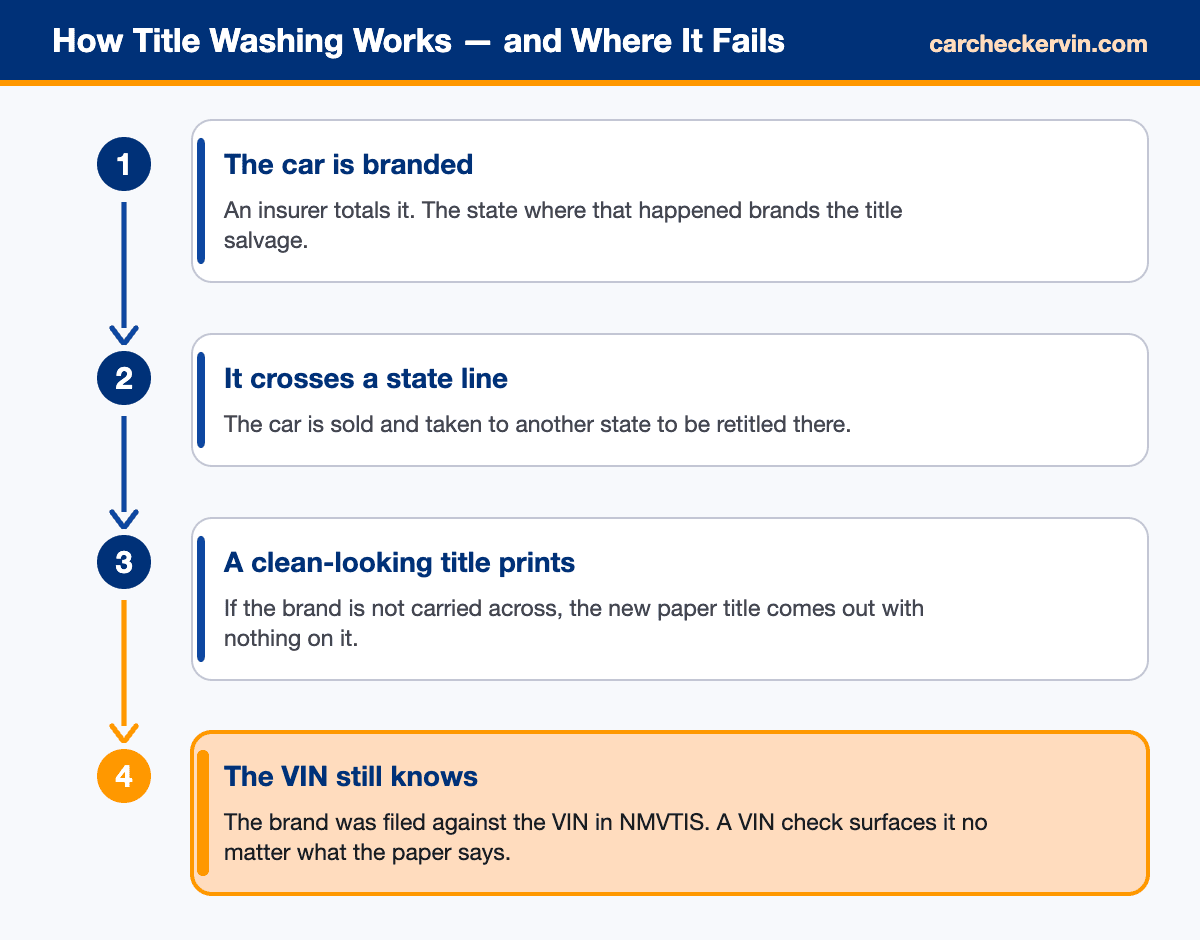
The consequence cuts both ways, and it is the reason to check the record rather than the paperwork. A cheap salvage car from a low-threshold state is not necessarily badly wrecked — it may have been branded on arithmetic another state would never have applied. An unbranded car from a high-threshold or discretionary state is not necessarily undamaged. It also makes moving damaged cars between states a business: a rebuilder who buys a wreck, repairs it and re-titles it where the brand does not carry across ends up holding a clean-looking certificate on a written-off car, without forging anything. That is title washing, and it is the same route by which a mileage brand gets left behind — which is why the two are worth checking together.
NMVTIS is the answer to that gap. Every state titling agency, insurer, salvage yard and recycler reports into it, and it is keyed to the VIN rather than to any document. A second state can print a fresh certificate; it cannot delete the record of the first one. The title is produced by the person selling you the car. The record is not.
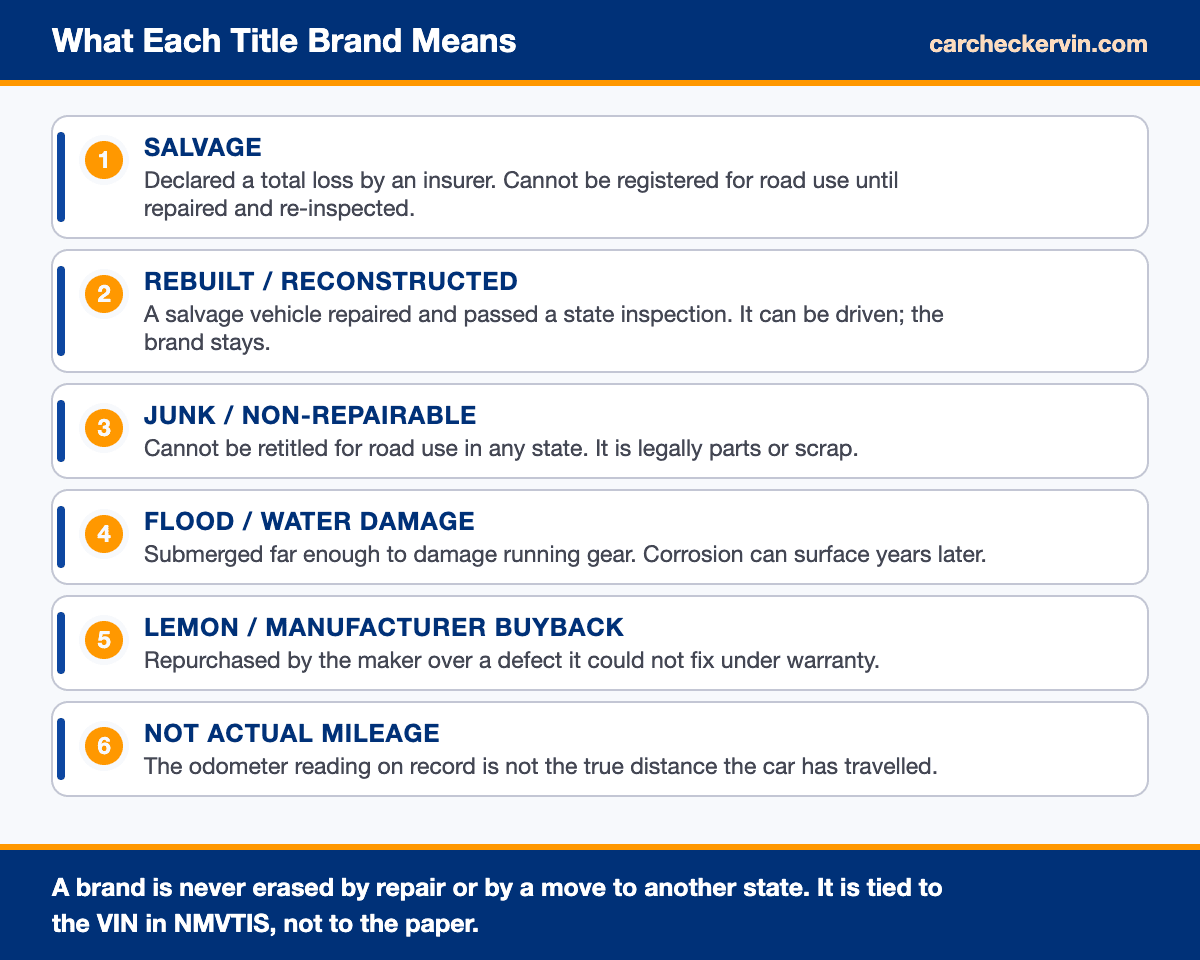
Connecticut Title Brand Vocabulary
States do not use the same words for the same thing, and the words are not decoration — they decide what you are allowed to do with the car. These are the brands the Connecticut Department of Motor Vehicles applies. Each one surfaces in a VIN check no matter which state later issues the title.
Issued when an insurer declares a vehicle a total loss — usually when repair costs reach roughly 65–100% of its value, depending on the state. A salvage vehicle cannot legally be driven until it is repaired, inspected, and re-titled.
A salvage vehicle that has been repaired and passed a state inspection to legally return to the road. The prior total-loss damage permanently lowers its value and can complicate insurance and resale.
Means the vehicle may be used solely as a source of components and cannot be titled for road use under any circumstances.
Marks a vehicle damaged by water submersion. Flood cars frequently develop hidden electrical faults, corrosion, and mold months or years later — often after cosmetic cleanup hides the evidence.
Connecticut splits the job between two actors, and that is what makes it unusual. The insurance company stamps the paper; the Department of Motor Vehicles brands the record afterwards. Neither one does the other's work, and the two marks do not say the same thing.
The stamping duty is precise to the point of being fussy. Section 14-16c(a)(1)(A) requires the insurer to "stamp the word 'SALVAGE' in one-inch-high letters not to exceed three inches in length on the vehicle's certificate of title" and to "attach to such certificate of title a copy of the appraiser's damage report for such totalled motor vehicle." The same obligation falls on a self-insurer that owns the car under subdivision (2)(A), and on the carrier that pays the claim where the owner is insured conventionally.
The DMV brand comes later and under different authority. Under R.C.S.A. § 14-174-3(a) the brand "REBUILT" denotes a vehicle that (i) has an existing certificate of title stamped or branded "SALVAGE" in accordance with § 14-16c, (ii) "has successfully passed anti-theft and salvage inspections conducted by the commissioner," and (iii) is otherwise eligible for registration for highway operation as of the date the new certificate is issued. All three conditions, not any one of them. The new certificate says REBUILT and the SALVAGE stamp does not travel onto it — the DMV states this outright, promising a new title "without the 'Salvage' stamp designation) with the words 'Rebuilt' printed on it."
The branding regulation is candid in a way statutes rarely are. It opens § 14-174-3 with the warning that a title brand "does not indicate the extent to which a vehicle may have been damaged, whether a vehicle has been repaired or to what degree a damaged vehicle has been repaired." That sentence is the state telling you, in its own regulation, that REBUILT is a procedural status and not a quality certificate.
Connecticut's brand catalogue is larger than most write-ups admit. Section 14-174-3 authorises ten: REBUILT, UNREPAIRABLE, FLOOD, GLIDER KIT, MANUFACTURER BUYBACK, BOND POSTED, "WARNING: ODOMETER DISCREPANCY", TRUE MILEAGE UNKNOWN, MILEAGE EXCEEDS MECHANICAL LIMITS, and the catch-all "PREVIOUSLY BRANDED IN (name of appropriate jurisdiction is to be inserted here)". Any one or more of them may appear on a single certificate, and § 14-174-2 lets the commissioner combine brands with the statutory legends listed in § 14-174-4.
FLOOD deserves separate attention because its trigger is wider than an insurance event. Under § 14-174-3(c) the brand denotes a vehicle that has sustained water damage to the extent that an insurance company or self-insurer has declared it salvage or taken possession in settlement of a claim — "or the commissioner becomes aware of facts that warrant the placement of this brand." That final clause means a Connecticut flood brand can attach with no claim, no settlement and no insurer involvement at all, purely on facts that reach the department.
UNREPAIRABLE is the terminal DMV brand and it too is broader than the stamp behind it. Section 14-174-3(b) reaches a vehicle declared a total loss or constructive total loss by an insurance company whose title has been stamped "SALVAGE PARTS ONLY", but also a vehicle "the physical condition of which is such that it has not passed a salvage inspection, or cannot be repaired to the extent necessary to be deemed safe for highway operation." A rebuilder who presents a car and fails can therefore end up with a permanently unregistrable vehicle, which is a risk worth understanding before money changes hands on a Connecticut project car.
The bar for the insurer's terminal stamp is high and countable. It applies where the insurer determines the vehicle has "ten or more major component parts that are damaged beyond repair and must be replaced," out of a statutory list in § 14-149a(a)(2) that runs to only fourteen categories — the engine, the transmission, the right or left front fender, the hood, a door allowing entrance to or egress from the passenger compartment, the front or rear bumper, the right or left rear quarter panel, the deck lid, tailgate or hatchback, the trunk floor pan, the cargo box of a pickup, the frame or the unibody structures serving as the frame, the cab of a truck, the body of a passenger vehicle, and a residual category for anything the commissioner deems comparable. Ten of fourteen is most of the car.
Once that stamp is on, the vehicle is finished, and the DMV says so in three different spellings. Form B-256 warns that if the title is branded "Salvage Parts Only" or "Salvage Unrebuildable," or "Salvage Unrepairable," the motor vehicle "cannot be registered or re-titled under any circumstances," and the inspection standards attached to the same form state flatly that "'Parts Only' vehicles will not be inspected." If you are offered a Connecticut car on any of those three legends, there is no rebuilding path.
Selling such a car outside the licensed trade carries a consumer-protection consequence rather than a mere fine. Under § 14-16c(g) a sale or transfer of a totalled or salvaged vehicle to anyone not licensed as a dealer, repairer, junk yard or junk business "shall constitute an unfair method of competition and an unfair or deceptive act or practice, as defined by section 42-110b" — which is CUTPA, with its own private right of action. Section 14-65(b) requires SALVAGE PARTS ONLY cars to be auctioned "in an area that is separate from any area in which other motor vehicles are being sold at auction," and § 14-65(f) lets the commissioner impose a two thousand dollar civil penalty for breaching that.
Two gaps matter to a buyer. First, a car titled in another state and totalled by a Connecticut insurer gets no stamp at all — § 14-16c(a)(1)(B) requires only that the appraiser's report be attached, so the foreign title leaves the state unmarked. Second, R.C.S.A. § 14-174-2 lets the commissioner honour, translate or simply "decline to carry over the brand or legend" applied by another jurisdiction; where a foreign brand has no Connecticut equivalent the commissioner may apply the one "closest in meaning and purpose", or fall back on the § 14-174-3(j) catch-all reading "PREVIOUSLY BRANDED IN" the naming state. Carry-over is real but discretionary, and the surviving Connecticut word is usually REBUILT rather than SALVAGE.
Nothing in Chapter 246, Chapter 247 or the branding regulation provides any route to remove a brand once applied — a full-text sweep of R.C.S.A. §§ 14-174-1 to -5 returns zero occurrences of "remove" or "delete". The only remedy is the administrative hearing in § 14-174-5, which entitles any person aggrieved by a decision to place a brand or legend to a hearing under chapter 54 and § 14-194. That hearing right is not the regulator's generosity; § 14-174(f) obliges any branding regulation the commissioner adopts to provide for it.
A running chain of custody is printed on the title itself. Section 14-16c(b) requires the insurer, its agent, or the owner to copy the certificate and hand the original — with the appraiser's report attached — to any subsequent purchaser, recording each purchaser's name and address on both, the copy serving "only as a record of transfers of the total loss motor vehicle." So a stamped Connecticut salvage title lists every intermediate owner on its reverse. A long chain, or a suspiciously blank one, is a question worth asking. The face of the certificate carries a warning too, dictated word for word by § 14-16c(d): "WARNING: ALL PURCHASERS OF THE MOTOR VEHICLE DESCRIBED HEREIN MUST RECORD THEIR NAME AND ADDRESS ON THE REVERSE SIDE. THIS VEHICLE CANNOT BE REGISTERED OR RETITLED WITHOUT PASSING INSPECTION UNDER SECTION 14-103a. THIS DOCUMENT MUST BE SUBMITTED AT THE TIME OF INSPECTION."
Connecticut also closes the title-jumping loophole specifically for wrecks. Section 14-179(a) provides that "no person, firm, corporation or business shall transfer any salvaged motor vehicle or any part of such vehicle unless such transferor has possession of the certificate of title or salvage vehicle certificate at the time of such transfer." The DMV adds an operational rule on top: an owner whose vehicle has been declared salvage cannot transfer ownership on an Application for Duplicate Title (Form H-6B), but must first obtain a duplicate title from the Title Division bearing the legend "Salvage" and then assign the back of that document to the purchaser. If a Connecticut seller offers you an open assignment with no title in hand, the transaction is not merely awkward — it is outside the statute. Worth knowing too that a New York salvage certificate (Form MV907A) is not accepted by the Connecticut DMV at all, because it is not a title document; that car has to be inspected and re-titled in New York first.
Dealer disclosure is narrower than it first looks, and the distinction matters. Section 42-225(b) does not oblige a dealer to disclose every constructive total loss it knows about; it bites where one of three evidentiary conditions is met — the certificate of title is stamped "totalled", "salvaged" or with a comparable designation, or the bill of sale states the vehicle was declared a constructive total loss as defined in § 38a-353, or the dealer has been notified by the seller or by the lender holding title. A car exempted from stamping by § 14-16c(f) fails the first condition but can still be caught by the second or third. Around that sit the rest of the used-car warranty chapter: § 42-221 imposes a mandatory thirty-day or 1,500-mile express warranty on sales at $3,000 to just under $5,000 and sixty days or 3,000 miles at $5,000 and above, § 42-224 permits an "as is" sale only under $3,000 or on a vehicle seven years old or older — which is where most rebuilt cars land — § 42-226 forbids a dealer to refuse a buyer's independent inspection by an inspector of the buyer's own choosing, and § 42-226a routes violations to the penalties in § 14-64. Note finally that § 14-16b, which sits directly above § 14-16c and is a common mis-citation, has been repealed.
The one to memorise is SALVAGE PARTS ONLY. That brand is not a discount — it is a permanent bar on the vehicle ever being titled for road use again in Connecticut. A car carrying it is a parts source and nothing else, and anyone offering to sell you one as a driveable project is either mistaken or lying.
Connecticut carries a brand applied by another state forward onto its own title, so a washed document from a neighbouring state does not survive a transfer into CT.
Has This Connecticut Car Ever Been Written Off?
A re-issued title can look clean over a total loss recorded in another state. Run the VIN and see every brand on the record, free, in seconds.
Salvage to Rebuilt: The Connecticut Inspection
A salvage title is not a licence to drive. It is closer to a receipt for a wreck: the car is legally off the road until somebody repairs it, submits it for inspection, and gets a new certificate issued in the rebuilt category. Buying a salvage-titled car and driving it home is not a grey area — it is an unregistered, uninsurable vehicle on a public road, and Connecticut will not put plates on it until the rebuilt certificate exists.
In Connecticut the inspection is carried out by an authorised Connecticut-licensed dealer or repairer, or the DMV inspection lane at Wethersfield. This is a genuine repair-quality inspection, not a plate check, and the REBUILT brand requires the vehicle to pass two of them. That two-inspection structure is easy to miss because the statute and the regulation describe different halves of it.
R.C.S.A. § 14-174-1 defines them separately. An "anti-theft inspection" is an inspection authorised under § 14-103 or § 14-149 "to verify the integrity of vehicle identification numbers located on such vehicle and that such vehicle, or any of its component parts, have not been reported as stolen." A "salvage inspection" is an inspection "of the condition and road-worthiness of a motor vehicle, as required by the provisions of section 14-103a." Section 14-174-3(a) then conditions the REBUILT brand on passing both.
The statutory standard for the second one is set by § 14-103a(b): the commissioner shall inspect the vehicle "to determine whether the vehicle is properly equipped and in good mechanical condition." A salvage vehicle, for this purpose, is defined at § 14-103a(a)(5) as one "that has been declared a total loss by any insurance carrier and subsequently reconstructed" — so the trigger is the carrier's declaration plus the rebuild, not any particular repair cost.
Where the inspection happens changed recently, and a great deal of published guidance has not caught up. Since Public Act 24-20 took effect on 1 July 2024, § 14-103a(b) provides that "any salvage vehicle shall be presented for inspection at any motor vehicle dealer or repairer who is licensed in accordance with section 14-52 and authorized by the commissioner to perform such inspection." Altered, composite and grey-market vehicles still go to a DMV location; salvage vehicles no longer have to. Any write-up describing Connecticut salvage inspection as DMV-only is now out of date.
In practice both routes are open. Form B-256 states that Connecticut licensed dealers and repairers are "authorized, but not obligated, to perform salvage inspections" and that in doing so they "may only charge $88 for the service" — so ring ahead, because a shop is entitled to decline. Alternatively the DMV still runs its own lane at Wethersfield. The two published sources disagree slightly on hours: Form B-256 (rev. 9-2024) says Monday through Friday from 7:30 a.m. to 11:00 a.m., while the DMV's salvage web page says 8 a.m. to 12 p.m. with arrival by 11 a.m. Both agree the vehicle must be presented by 11:00 a.m. Confirm before you load the car.
Getting it there is a legal problem in its own right. Section 14-16c(e) forbids operating the vehicle on any highway, excepting only a licensed dealer or repairer who owns it and is driving it to inspection, and providing that if it fails "it shall be transported from the site of such inspection." The DMV's operational rule is stricter still: a private individual cannot drive or even tow a salvaged vehicle to the DMV, which may arrive "only on a flatbed trailer or car carrier (i.e., no wheel of the vehicle may touch the ground)." A dealer or repairer's employee may drive or tow it on dealer or repair plates, but only where the dealer or repairer is the owner. Budget for a flatbed both ways, because a failed car goes home on one.
The packet is substantial and the dealer route cannot legally start without it — B-256 warns that licensed dealers and repairers "cannot perform a salvage inspection without receiving this completed packet and must retain it as proof of authorization," for two years. Six items are required: the Salvaged Vehicle Repair Report (Form K-186) with photographs attached, a copy of the insurance adjuster's report, receipts for every major component part replaced, the air bag certification where applicable, the salvage-branded title itself, and — if the DMV lane is doing the work — a purchased and validated DMV inspection report, Form B-269, paid for before the vehicle is presented. After a dealer inspection, Form B-270 is what you carry to the DMV to register.
The photographs are specified in five categories and they are the part rebuilders most often get wrong, because several of them can only be taken while the car is still in pieces: the entire vehicle in four shots, one from each corner; the damaged areas before repair; the repaired areas with the new parts or panels installed but before any seam sealing, painting or rust proofing; how the new parts were attached, meaning the welds; and the area before painting and corrosion proofing where it will later be hidden. Photograph the car before you start and at every stage, or the inspection cannot be passed.
Form K-186 must be completed and signed by a Connecticut licensed dealer or repairer, which means an owner-rebuilder cannot self-certify the work no matter how competent. The certification is given "under penalty of false statement" and asserts that the vehicle was repaired with the tools and equipment required under R.C.S.A. § 14-63-4b, the regulation on repair of unit body construction vehicles, using standards established by the Inter-Industry Conference on Auto Collision Repair, Tech-Cor, Inc. or similar organisations. The form spells out the seven required capabilities: four-point clamping to secure the vehicle during structural repair, electrical or hydraulic pulling equipment, equipment for three-dimensional measurement of both symmetrical and asymmetrical vehicles, reference guides with dimensions for the vehicle being repaired, welding equipment meeting the manufacturer's requirements for the specific structural repair, painting equipment capable of refinishing to original specification, and corrosion-protection equipment meeting the manufacturer's specification. The back of K-186 is a grid demanding the donor VIN for each replaced part, and it reaches further than the statutory list — it has lines for left and right air bags and for a sliding or cargo door.
Air bags are certified separately and unconditionally. Form B-303 is required "in all cases" where the vehicle is equipped with an air bag, and B-256 emphasises that this is "required for all salvage inspections regardless if the airbag was deployed or not." It must be completed by a franchise dealer or repairer for that make, or by a certified air bag technician who attaches proof of I-CAR, ASE or TECH-COR training, attesting that the system including sensors and controls was inspected to factory post-collision procedure and is in proper operating condition. The form prints the criminal backdrop on its face: air bag fraud under § 53a-119(16) — installing an object in lieu of a proper air bag with intent to defraud — ranges from a class C misdemeanour to a class B felony depending on the amount charged, and a false statement on the form is punishable under § 53a-157b.
Provenance of parts is checked, not assumed. Section 14-103a(c) lets the commissioner require anyone presenting a salvage vehicle to "provide proof of lawful purchase of any major component part that was not part of the vehicle when first sold by the manufacturer," and B-256 requires receipts that "clearly indicate the name and address of the source of the component parts and the vehicle identification number (VIN) of the vehicle from which the respective component parts were removed." The inspector can also go looking underneath the finish: where a repair is questionable, "the undercoating, sealer or parts may have to be removed at the request of the inspector."
The pass/fail standards themselves are published with the form and are more specific than most states put in writing. A car is rejected if some part of the bumper face is not between 14 and 22 inches off the ground, or on a truck under 10,000 lbs GVWR if the lowest part of the bumper is above 30 inches; if the windshield is other than laminated AS-1 safety glass so marked; if front side window tint transmits less than 35 per cent plus or minus 3; if a seat covering is torn more than three inches or damaged beyond three square inches and deeper than a quarter inch; if toe exceeds 30 ft/mile at the front or 40 ft/mile at the rear, or right-to-left wheelbase measured at the ball joints differs by more than 6 mm; if body panels are perforated or dented more than 50 mm from original design; or if welded and heated areas are left uncoated. Frame rails, cross members, floor pans and strut towers are tapped with a ball peen hammer, and a wheelbase varying by an inch or more is an out-of-service condition. The standards even classify the steels, warning that ultra-high-strength steel members "must not be repaired, [they] must be replaced."
Full body sectioning — joining the good rear half of one car to the good front half of another of the same make and model, cut at the two A-pillars, the two rocker panels and the floor pan — is permitted but policed. The standards require that sectioning always be done at factory seams with welds in a similar fashion to the factory's, and that "all salvage vehicles with full body sectioning or clipping shall have proof that such work was done by qualified auto body technicians", in the form of a copy of a course certification from I-CAR, TECH COR or an equivalent deemed acceptable by the department. Pass, and you can re-register on the old plates or new ones, you are issued a new title without the SALVAGE stamp and with "Rebuilt" printed on it, and the inspection slip does not expire. One caveat worth raising with the department: Form B-270 records eighteen mechanical items — brakes, tyres, steering, suspension, frame, exhaust, fuel system, lighting, glazing, seats and belts, heater and the rest — and has no explicit anti-theft line, while the regulation still describes both inspections as "conducted by the commissioner", so ask which route satisfies the anti-theft half in your case. Salvage questions go to the DMV's Commercial Vehicle Safety Division on 860-263-5079.
An authorised Connecticut-licensed dealer or repairer, or the DMV inspection lane at Wethersfield
Inspection fee: $88, fixed by statute at § 14-103a(d) and stated to be "in addition to regular registration fees" — the amount does not change with the route, because DMV Form B-256 (rev. 9-2024) provides that a licensed dealer or repairer performing the inspection "may only charge $88 for the service." Contrast § 14-16a, where the legislature capped an authorised inspector at fifteen dollars in so many words; § 14-103a simply fixes the figure. Add the $25 title application fee under § 14-192(a)(1), and a $10 administrative fee collected at registration if the vehicle has never been registered in Connecticut or is ten years old or older. If the DMV lane does the work you must also purchase Form B-269 and have it validated with the $88 payment before presenting the vehicle
Official CT rebuilt-title inspection pageUnderstand what these inspections are usually for, because buyers routinely misread them. The primary purpose in most states is anti-theft verification — confirming the VIN plates are original and untampered, and that the parts bolted onto the car were bought rather than stolen, which is why receipts for major components are demanded. A rebuilt inspection is not a structural engineering assessment, and passing it is not a statement that the repair was done well.
So the certificate on the wall tells you the car is legal. It does not tell you the frame was pulled straight, the airbag module was replaced rather than reset, or the welds are where a factory would have put them. That is what your own independent pre-purchase inspection is for, and on a rebuilt car it is not optional.
What to ask for before you agree a price
- 1Photographs of the car before repair. A rebuilder who did honest work kept them; one who did not will find a reason they are unavailable.
- 2The parts invoices, especially for airbags, structural components and safety restraints. Salvaged airbags are a known and dangerous shortcut.
- 3The Connecticut inspection paperwork in the seller's name, matching this VIN, not a photocopy of somebody else's.
- 4The insurance total-loss settlement, if the seller has it — it names the damage the carrier actually paid out on.
- 5An independent inspection from a shop that does collision work, on a lift, before money changes hands. Budget for it as part of the purchase.
Then put the sale itself on paper. Write the brand into your Connecticut bill of sale in the seller's own words — a rebuilder who will not describe the car in writing as what its title says it is has told you something. And before the money moves, check whether anyone still holds a security interest in it. Rebuilt cars are bought at auction and repaired on credit far more often than clean ones are, and a lender's claim survives the repair, the inspection and the new certificate.
What a Rebuilt Title Actually Costs You
The sticker discount is real. What people underestimate is that the brand keeps charging you — every year you own the car, and again on the day you sell it.
Insurance is narrower and sometimes unavailable
Liability cover is normally fine. Physical damage is where the problem lives: several large insurers decline comprehensive and collision on a rebuilt vehicle outright, and those that write it settle any future claim against the reduced branded value. Get a quote against the actual VIN before you agree a price.
Most lenders will not finance it
Branded collateral is hard to value and hard to move on repossession, so banks and captive finance arms generally decline. Some credit unions lend at a shorter term and a higher rate. In practice it is a cash purchase — which also removes the lender's appraisal, one of the few independent checks in a normal transaction.
The resale discount does not fade
A branded car trades well below a comparable clean one, commonly quoted around 20% to 40% depending on the vehicle and the documentation. The gap does not close with age, because every future buyer runs the same VIN you are running now. Most dealers will not take one in part-exchange at all.
Repair quality is the real variable
A car repaired with new OEM panels on a jig can be entirely sound. One straightened by eye with junkyard parts and a reset airbag light shows up later as pulling under braking, doors that stop sealing, or restraints that do not fire. Nothing on the title separates the two — only the documentation and a lift.
Should You Ever Buy a Salvage or Rebuilt Car?
Sometimes, yes. The honest answer is that it depends on what the car was hit by and what you need the car to do — and it is a judgement most buyers can make for themselves once they know what to separate. Two lists, and they are not close calls.
Cases where the discount is genuinely worth it
- Hail damage on an otherwise untouched car. It is cosmetic, it totals cars on paint cost alone, and the mechanical vehicle underneath is exactly what it was.
- A recovered theft with no collision damage, where the write-off happened because the insurer had already paid the claim before the car turned up.
- An older, low-value car totalled by modest damage. On a $4,000 car it takes very little to cross a threshold, and the repair may be one panel.
- A car you intend to keep for a decade and run into the ground. The resale penalty only bites if you plan to sell.
- A repair you can fully document — pre-repair photographs, parts invoices, and a shop you can phone.
Cases where the discount is a warning, not a bargain
- Any flood history. Water gets into loom connectors, control modules and seat-belt pretensioners, and the failures arrive months later in an order nobody can predict.
- Deployed airbags with no invoice for the replacement modules. A reset light over a spent or salvaged restraint system is the most dangerous shortcut in the trade.
- Structural or unibody repair without documented frame measurements. If the shell is out of alignment the car will never track, brake or crash correctly.
- A rebuilder who cannot produce pre-repair photographs, or who bought and re-titled the car in the last few weeks.
- Anything you need to finance, insure comprehensively, or resell within a couple of years — the brand blocks all three.
The flood exception is not a preference. Every other category on these lists is a matter of price and documentation. Flood is the one where a well-presented car and a ruined car look identical for the first year, and where the damage is distributed through the electrical system rather than concentrated somewhere a mechanic can look. Flood cars also travel: they are bought cheaply after a storm, cleaned, and sold hundreds of miles away, which is why the state on the current title tells you very little about where the water was.
What a Salvage Check Does Not Tell You
A title brand is a fact about the car's damage history as reported by an insurer. It is silent on who owns the car, what the odometer has done, and whether anyone is looking for it. Those live in different systems and are different searches — a car with a spotless brand record can still be encumbered, clocked, or stolen.
More Connecticut Vehicle Guides
Everything else worth checking before you put a Connecticut car in your name.
Salvage Title Check in Other States
Worth comparing if the car you are looking at was titled somewhere else before it reached Connecticut— the threshold that branded it, or failed to, was that state's rather than this one's.
View the full salvage title check hubConnecticut Salvage Title Check — Frequently Asked Questions
How do I check for a salvage title in Connecticut?+
Enter the 17-character VIN in the search box on this page. Title brands are recorded against the VIN, not against the paper title the seller is holding, so a VIN search reaches a brand the document does not show. We cross-reference NMVTIS — which aggregates title-brand records from the Connecticut Department of Motor Vehicles and every other state titling agency — along with insurance total-loss feeds and salvage-auction records.
What counts as a total loss in Connecticut?+
Connecticut sets no statutory threshold. The insurer decides when a vehicle is uneconomic to repair, so the same damage can be totalled by one carrier and repaired by another. The rule is set by Conn. Gen. Stat. §§ 14-16a, 14-16c, 14-52, 14-65, 14-103a, 14-149a, 14-172, 14-174, 14-176, 14-178, 14-179, 14-192, 14-194, 38a-353, 38a-356, 42-110b, 42-179, 42-221, 42-224, 42-225, 42-226, 42-226a, 53a-119, 53a-157b; R.C.S.A. §§ 14-63-4b, 14-174-1 to 14-174-5. Whichever test applies, what triggers the brand is the insurer's decision, not the severity of the damage as a mechanic would judge it — which is why a lightly damaged older car and a badly damaged newer one can end up carrying the same title.
What title brands does Connecticut use?+
Connecticut records these brands through the Connecticut Department of Motor Vehicles: SALVAGE, REBUILT, SALVAGE PARTS ONLY, Flood. The wording matters more than it looks — the word for a repaired total loss differs between states, and a seller describing the car in a neighbouring state's vocabulary is either careless or moving cars across a state line.
How does a salvage car get a rebuilt title in Connecticut?+
It has to be repaired and then cleared by an authorised Connecticut-licensed dealer or repairer, or the DMV inspection lane at Wethersfield before it can be re-titled and driven; the section on the Connecticut inspection above covers what that involves, and whether a physical inspection is guaranteed or only happens on the cars the state picks. The inspection fee is $88, fixed by statute at § 14-103a(d) and stated to be "in addition to regular registration fees" — the amount does not change with the route, because DMV Form B-256 (rev. 9-2024) provides that a licensed dealer or repairer performing the inspection "may only charge $88 for the service." Contrast § 14-16a, where the legislature capped an authorised inspector at fifteen dollars in so many words; § 14-103a simply fixes the figure. Add the $25 title application fee under § 14-192(a)(1), and a $10 administrative fee collected at registration if the vehicle has never been registered in Connecticut or is ten years old or older. If the DMV lane does the work you must also purchase Form B-269 and have it validated with the $88 payment before presenting the vehicle. Passing it is not a statement that the repair was done well — in most states the inspection is an ownership and anti-theft check, which is why it wants receipts for major parts rather than frame measurements.
Does a salvage brand disappear if the car is re-titled in another state?+
No. The brand is attached to the VIN in NMVTIS, and NMVTIS is fed by every state titling agency, by insurers, and by salvage yards. A paper title issued in a second state can come out looking clean — that is what title washing is — but the VIN record does not reset when the car crosses a state line. Connecticut also carries a brand applied elsewhere forward onto its own title.
Can you insure and finance a rebuilt-title car in Connecticut?+
Liability cover is usually available. Comprehensive and collision often are not, and most banks will not lend against branded collateral, so rebuilt cars tend to be cash purchases. Get a written quote from your own insurer against the VIN before you agree a price, not after.
Is it safe to buy a rebuilt car in Connecticut?+
It depends on what the damage was and who repaired it. Hail, a recovered theft or a rear-end hit on an older car can total a vehicle on economics alone and leave nothing structurally wrong. A flood car, deployed airbags with no documented replacement, or a repaired unibody is a different proposition. Ask for the pre-repair photographs, the parts invoices and the Connecticut inspection paperwork, then pay an independent shop to put it on a lift. If the seller cannot produce the repair record, you are buying the repair blind.
Does a clean salvage check mean the car was never damaged?+
No, and this is the limit worth understanding. A brand only exists if an insurer wrote the car off and reported it. Damage repaired privately, out of pocket, or by a driver who never made a claim leaves no brand at all — and on an older car, where repair costs easily exceed a low book value, owners often avoid claiming for exactly that reason. A clean brand record is good news about the paperwork, not a report on the bodywork.
Connecticut sources
The Connecticut-specific statements above come from these official pages. Thresholds, fees and brand wording do get amended — check the source before relying on a figure in a transaction.
Vérifications VIN connexes
Plus d'outils pour vérifier l'historique de tout véhicule
Run Your Free Connecticut Salvage Title Check
One VIN, every brand ever recorded against it, in any state. Two minutes now against a write-off that would otherwise follow the car into your name.
Or get the full VIN history report