Nevada Salvage Title Check by VIN — Is the Title Clean?
A salvage brand is recorded against the VIN, not against the document the seller hands you. Run the number and you see every brand the car has collected in Nevada and in every other state it has passed through — including the ones a re-issued title no longer prints.
Run a Free Nevada Salvage Title Check
Enter any 17-character VIN — cars, trucks, SUVs, motorcycles
Free · No sign-up · Instant result
How a Nevada Salvage Title Check Works
Three steps turn scattered insurer, auction and Nevada Department of Motor Vehicles records into a straight answer on whether this car has ever been written off.
Enter the 17-character VIN
Read it off the plate at the base of the windscreen, the driver-side door jamb, and the Nevada title, and check all three agree before you go any further. A VIN that does not match across the car is a bigger problem than any brand.
We search the national brand record
The lookup queries NMVTIS, which the Nevada Department of Motor Vehicles and all other state titling agencies report into, plus insurance total-loss feeds and salvage-auction listings. Those are separate systems, and a car can appear in one before it appears in the others.
Read every brand, in every state
The result shows each brand ever applied to the VIN and the state that applied it — not just what Nevada currently prints. A brand from a previous state is the single clearest sign the paper title in front of you has been washed.
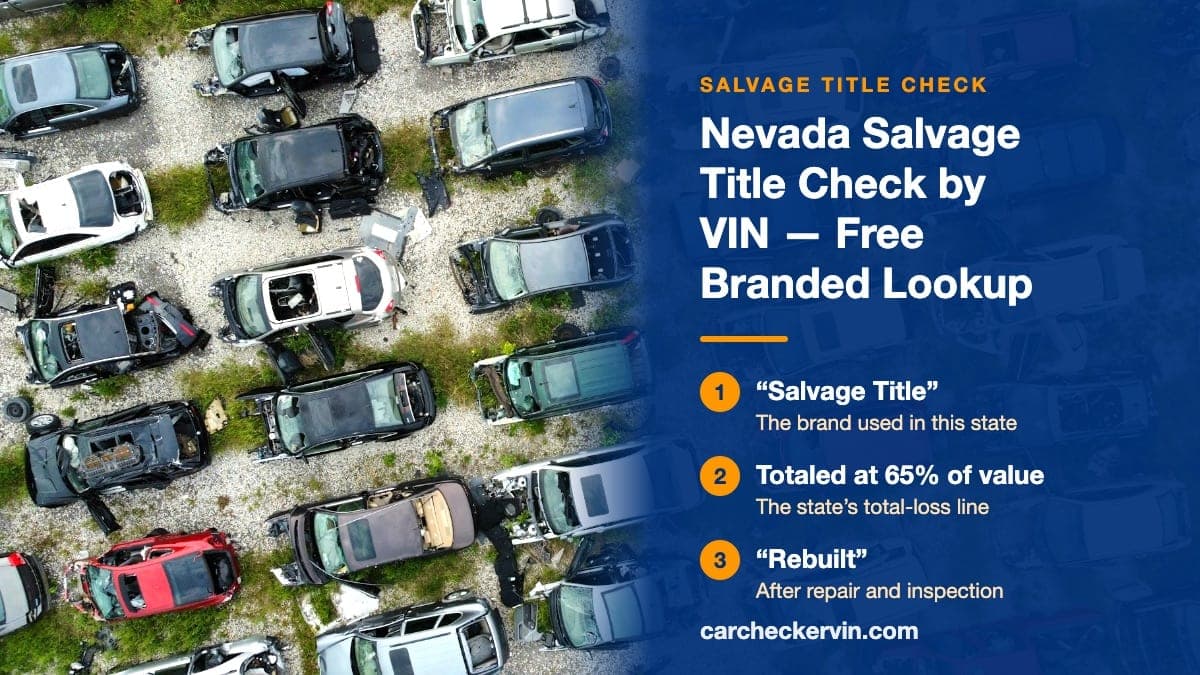
What Counts as a Total Loss in Nevada
A total loss is an accounting decision, not a verdict on whether the car can be fixed. Almost any vehicle can be repaired given enough money. The insurer stops when repairing costs more than the car is worth, writes the owner a cheque for its value, takes the wreck, and notifies the state — and it is that notification, not the crash, that produces the brand.
Nevada draws the line at 65% of the vehicle's pre-loss value. That is the estimated cost of repair set against what the car was worth the morning of the crash. Who that test actually binds is a separate question, and it is worth knowing before you read the figure: in some states the insurer's own total-loss declaration is what brands the car and the percentage never enters into it, while in others the percentage governs only damage that no insurer is paying for.
At 65 percent Nevada has one of the lowest salvage triggers in the country, and NRS 487.790(1)(b) sets it out plainly: a total loss vehicle is one "wrecked, destroyed or otherwise damaged to such an extent that the cost of repair is 65 percent or more of the fair market value of the vehicle immediately before it was wrecked, destroyed or otherwise damaged." Note the denominator is fair market value rather than book retail, and the comparison is "or more" rather than "exceeds" — so a repair estimate landing exactly on 65 percent brands the car.
The exclusions are where Nevada gets interesting, and there are three of them rather than the one most summaries mention. The cost of repair "does not include the cost of: (1) Painting any portion of the vehicle; (2) Replacing electronic components in accordance with the specifications of the manufacturer; or (3) Towing the vehicle." The middle one is the sleeper. On a modern car the electronics are a large share of a serious repair bill — modules, sensors, wiring, the screens — and Nevada takes all of it out of the numerator so long as the replacement follows the manufacturer's specifications. Combine that with paint, and a late-model Nevada car can absorb a genuinely heavy hit and still finish under the line. The 65 percent figure sounds severe; the arithmetic underneath it is considerably more forgiving than the number suggests.
Nevada salvage rules at a glance
- Titling agency: Nevada Department of Motor Vehicles
- Total-loss test: Fixed percentage of pre-loss value
- Salvage threshold: 65% of pre-loss value
- Governing statute: NRS §§ 487.100, 487.103, 487.480, 487.520, 487.740, 487.760, 487.770, 487.790, 487.795, 487.800, 487.810, 487.830, 487.840, 487.850, 487.860, 487.870, 487.880, 487.890, 487.6883, 487.6885; NRS §§ 482.098, 482.553; NRS § 445B.805
- Salvage brand wording: Salvage
- Rebuilt brand wording: Rebuilt
- Never-road-legal brand: Non-Repairable
- Out-of-state brand carried forward: Yes
Check this NV VIN for a brand:
NRS 487.890 then fixes how the estimate itself is built, and it contains a lever the strict states do not give. Parts must be priced at "the current published actual retail price of original manufacturer equipment, retail price of new alternative equipment or the actual cost of used parts," and labour at "[r]ates for labor which are commonly charged in the community in which the repairs will be performed." That third option — the actual cost of used parts — lets a legitimate estimate be written against salvage-yard prices rather than new ones, which can move a borderline car below the threshold without anybody doing anything improper.
Three categories sit outside the definition entirely. A vehicle ten model years old or older is not a total loss vehicle, "regardless of cost," if restoring it requires the replacement of only the hood, the trunk lid, a fender, two or fewer of doors, a grill assembly, a bumper assembly, a headlight assembly or a taillight assembly, or any combination of those. Read "regardless of cost" carefully: on an older car those bolt-on panels can exceed the whole value of the vehicle and the brand still does not attach. A nonrepairable vehicle is excluded because it is handled under a harsher regime rather than a softer one. And under § 487.790(2)(d) a stolen-and-recovered car escapes if it "[h]as no structural damage" and "[i]s missing only tires, wheels, audio or video equipment, or some combination thereof" — so a car stripped in a theft comes back unbranded provided the shell was not hurt.
One timing detail that decides whether an old car is inside the scheme: § 487.790(3) says the model year "is calculated based on a year beginning on January 1 of the calendar year in which the damage occurs" — the clock runs from the damage, not from the day you are reading the record.
The practical warning for a buyer is about lag rather than arithmetic. Where an insurer takes the car, NRS 487.800(1) gives the owner 30 days to endorse the title over, and then gives the insurance company "180 days after receipt of the endorsed certificate of title" to forward it to the state with the salvage application. That is up to six months in which the vehicle is a known total loss and the Nevada record still shows nothing. A VIN check run inside that window can come back clean on a car that is already written off. Where the owner keeps the car and holds the title, the deadline is much shorter — 30 days after the vehicle becomes a salvage vehicle under § 487.800(3)(a) — and where a lienholder holds the title the owner must tell them within 10 days and the lienholder has 30.
The rule sits in NRS §§ 487.100, 487.103, 487.480, 487.520, 487.740, 487.760, 487.770, 487.790, 487.795, 487.800, 487.810, 487.830, 487.840, 487.850, 487.860, 487.870, 487.880, 487.890, 487.6883, 487.6885; NRS §§ 482.098, 482.553; NRS § 445B.805.
What follows from that: the brand records an economicevent. A ten-year-old car with a book value of a few thousand dollars can be totalled by a shunt that would barely register on a new one, and it is the cheap car that gets branded. Read a salvage brand as “the repair bill was large relative to this car”, then go and find out what the damage actually was.
The Three Total-Loss Regimes, and Why They Matter to You
There is no national rule for when a damaged car becomes a salvage car. Each state picks one of three tests, and the choice decides whether an identical wreck leaves the body shop with a brand or without one.
Percentage of value
The most common test. The state fixes a percentage of the car's pre-loss actual cash value, and an insurer whose repair estimate reaches it must report a salvage. Thresholds run from about half the value to the whole of it, so the same $6,000 estimate on a $10,000 car is a mandatory brand in one state and a routine repair in another.
Total loss formula (TLF)
Repair cost plus salvage value, measured against actual cash value. TLF is sensitive to the parts market — a truck with hungry demand for its doors and tailgate totals on less damage than a car whose panels nobody wants.
Insurer discretion
No statutory trigger. The carrier decides when repair stops making commercial sense, on internal thresholds that are neither published nor binding. Two insurers can look at the same photographs and reach different answers, and neither is breaking a rule.
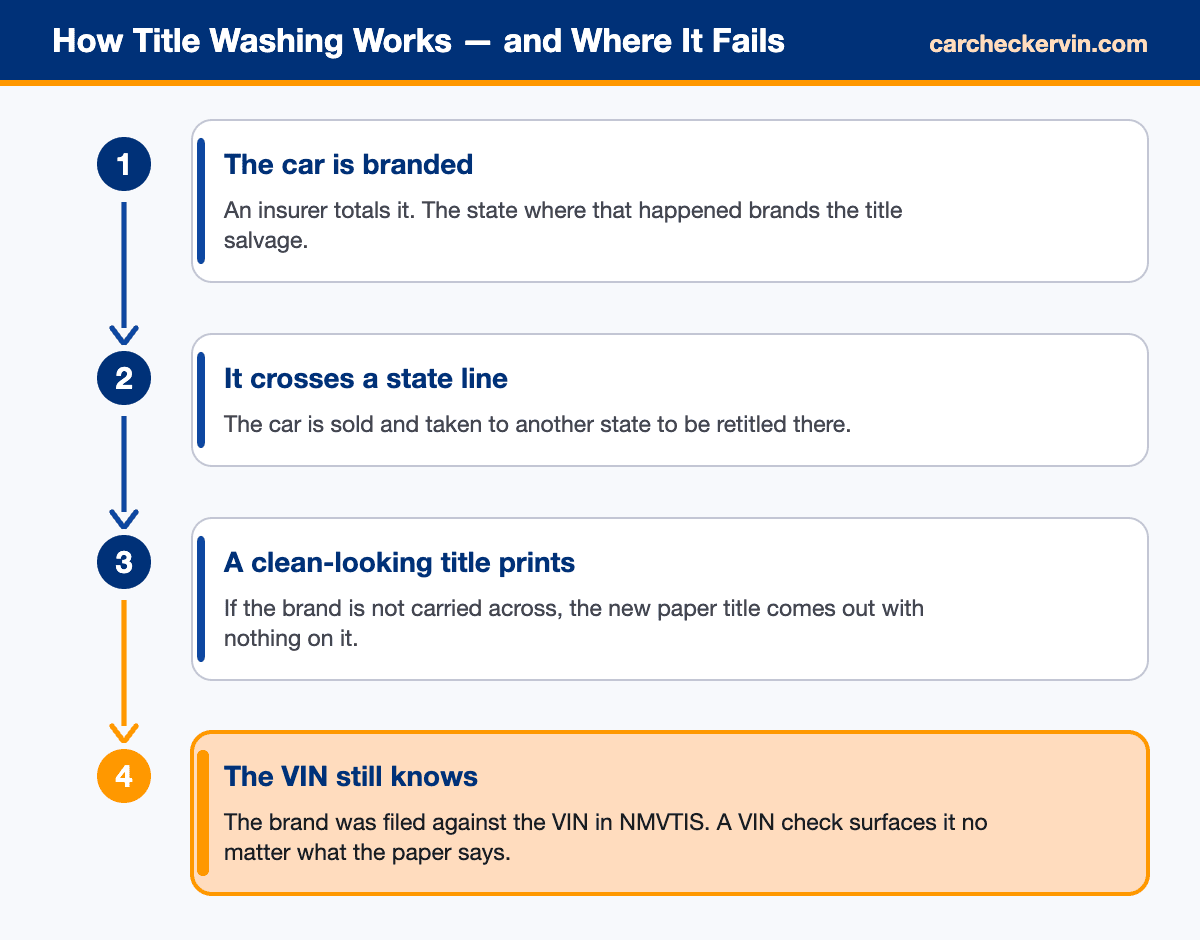
The consequence cuts both ways, and it is the reason to check the record rather than the paperwork. A cheap salvage car from a low-threshold state is not necessarily badly wrecked — it may have been branded on arithmetic another state would never have applied. An unbranded car from a high-threshold or discretionary state is not necessarily undamaged. It also makes moving damaged cars between states a business: a rebuilder who buys a wreck, repairs it and re-titles it where the brand does not carry across ends up holding a clean-looking certificate on a written-off car, without forging anything. That is title washing, and it is the same route by which a mileage brand gets left behind — which is why the two are worth checking together.
NMVTIS is the answer to that gap. Every state titling agency, insurer, salvage yard and recycler reports into it, and it is keyed to the VIN rather than to any document. A second state can print a fresh certificate; it cannot delete the record of the first one. The title is produced by the person selling you the car. The record is not.
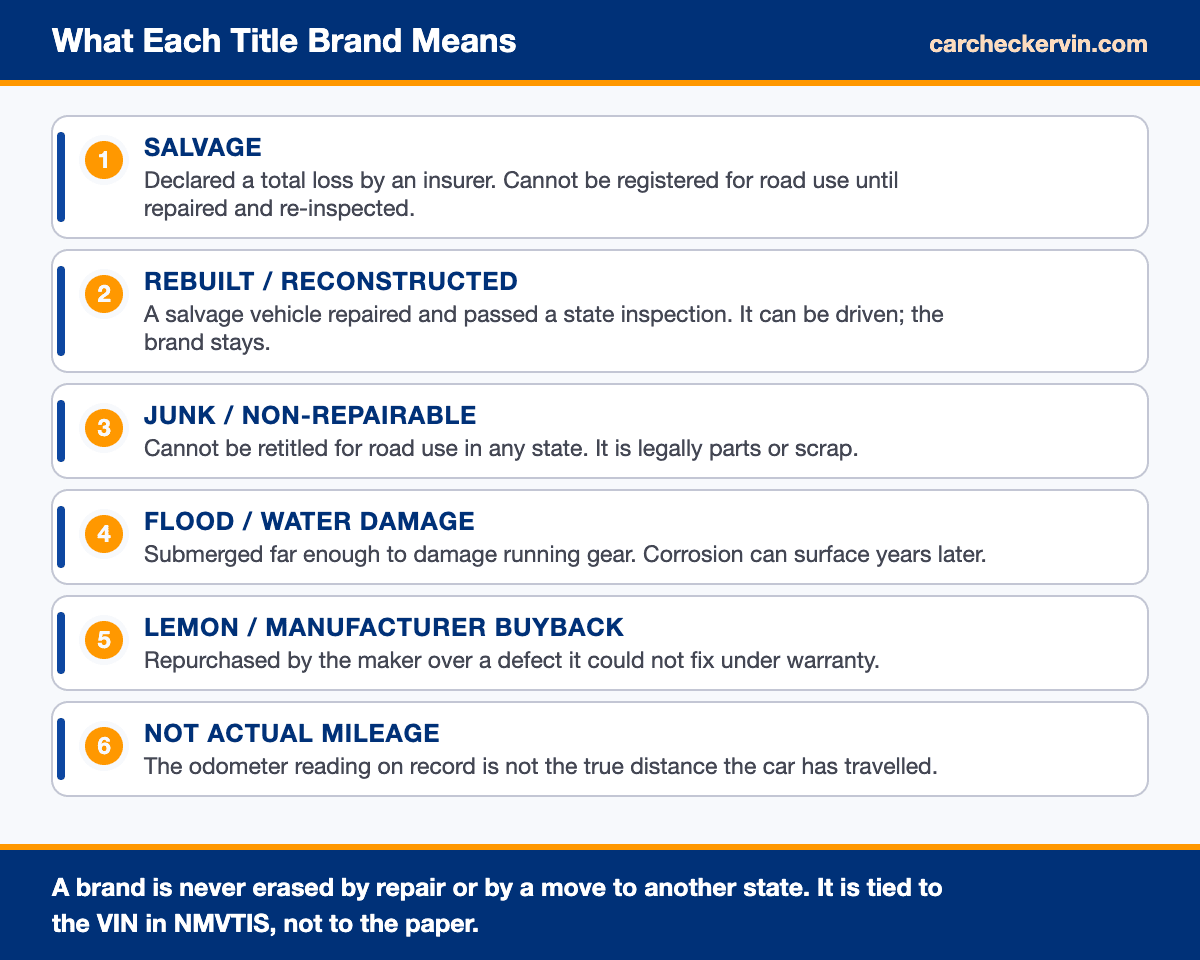
Nevada Title Brand Vocabulary
States do not use the same words for the same thing, and the words are not decoration — they decide what you are allowed to do with the car. These are the brands the Nevada Department of Motor Vehicles applies. Each one surfaces in a VIN check no matter which state later issues the title.
Issued when an insurer declares a vehicle a total loss — usually when repair costs reach roughly 65–100% of its value, depending on the state. A salvage vehicle cannot legally be driven until it is repaired, inspected, and re-titled.
A salvage vehicle that has been repaired and passed a state inspection to legally return to the road. The prior total-loss damage permanently lowers its value and can complicate insurance and resale.
Means the vehicle is too damaged to ever be legally returned to the road. It can be sold only for parts or scrap — never re-titled for driving.
A title brand for vehicles damaged by flooding or storm water. These cars carry long-term corrosion and electrical risk and are commonly shipped across state lines for resale.
A vehicle rebuilt from a salvage or significantly damaged base and re-inspected for road use. Reconstructed vehicles often combine parts from multiple cars, so a full history check is essential.
A brand meaning the vehicle cannot legally be operated on state or local roads. It is easy to miss because it never uses the word "salvage" — a buyer scanning a record for the usual vocabulary can read straight past a car that is barred from the road. Nevada is one state that lists it as a distinct title brand, alongside the separate "Non-Rebuildable" marker.
Start with the thing you can see across a car park. Nevada prints salvage titles on orange stock, and the DMV's own guidance leads with it: "Do not buy a vehicle with an orange-colored salvage title." It is not merely unwise, it is not a sale the law permits — an owner may sell a salvage vehicle "only to a salvage pool, automobile auction, rebuilder, automobile wrecker, or a new or used automobile dealer," so a private individual cannot lawfully be on the receiving end until the car has been rebuilt, inspected and re-titled. If a private seller is showing you an orange title, the transaction itself is the warning, whatever the explanation offered.
Nevada's brand vocabulary is much wider than the four names most sites list. The Department's Salvage Title and Non-Repairable Vehicle Certificate Guide enumerates twelve: Bonded Title, Flood Damage, Lemon Law Buy Back, Non-Rebuildable, Non-Repairable, Non-US Vehicle, Not Street Legal, Rebuilt, Reconstructed, Salvage, Specially Constructed and Total Loss. Two of those repay attention. "Not Street Legal" and "Non-Rebuildable" are quiet terminal markers that a buyer scanning for the word "salvage" will skate straight past. And the Bonded Title brand splits: an ordinary bonded title needs a bond of one and a half times MSRP under NRS 482.2605, but a Salvage Bonded Title needs only twenty-five per cent of MSRP under NRS 487.820 — a cheaper route onto the road for a car whose ownership history could not be documented.
Now the single most important sentence in the Nevada guide, and the one a buyer is least likely to know. On the meaning of the brand field it says: "When more than one brand applies, each brand will be listed (maximum of four most current brands listed)." Four. A Nevada title is not a complete history — it is a window onto the four most recent brands, and a car that has collected more than four can push an older one off the face of the document. A vehicle carrying, say, Flood Damage, Total Loss, Salvage and Rebuilt has already filled the field. Never treat the absence of a brand on a Nevada title as proof the brand was never applied; check the VIN record, which does not truncate.
The flood definition is unusually physical and worth holding in mind, because it tells you what to look for rather than what to take on trust. Under NRS 487.740 a flood-damaged vehicle is one "submerged in water to a point that the level of the water is higher than the door sill of the vehicle and the water has entered the passenger, trunk or engine compartment of the vehicle and has come into contact with the electrical system" — or, alternatively, one taken or kept as part of a total loss settlement for water damage. Door sill, passenger compartment, electrical system: that is a description of where to put your hands and your nose.
Non-Repairable is genuinely terminal here, and Nevada polices the border rather than just the definition. NRS 487.880 says such a vehicle "[m]ust be processed as parts or scrap metal by a licensed automobile wrecker" and "[m]ay not be rebuilt, reconstructed or restored for operation on the highways of this State." NRS 487.760 reaches a car that has "been stripped of all body panels, doors, hatches, substantially all interior components and substantially all grill and light assemblies" as well as one burned or destroyed beyond legal operation. More usefully for an out-of-state buyer, the guide states the department's position on brand-washing in terms: "Nevada will not issue a salvage title for any vehicle that has or has had a status from any state denoting the vehicle cannot or should not be repaired for use on public highways or roads" — and, in the same breath, warns that "[s]ome states will issue a salvage title for vehicles that have been issued a junk or non-repairable designation in another state." That is a state DMV telling you plainly that title-washing across state lines is a live practice.
One last trap, and it is the reverse of the usual one. Under NRS 482.098(1)(b) a Nevada car must be titled Rebuilt if one or more major components have been replaced — the cowl assembly, rear clip assembly, roof assembly, floor pan assembly, the complete front inner structure of a unibody, or a conventional frame coupled with one additional major component — whether or not the car was ever a total loss and whatever the repair cost. "Replaced" is defined broadly as "the substitution, or change in whole, of a new, used or after-market part." So a Nevada Rebuilt brand does not tell you an insurer wrote the car off; it may mean only that somebody changed a roof or a floor pan. The single exclusion is narrow and specific: a vehicle whose only change is the installation of a truck cab assembly is not rebuilt.
Finally, the part of Nevada law most worth knowing before you hand over money, because it is stronger than what most states give a private buyer. NRS 487.830(1) imposes the disclosure duty on everybody, not just dealers: "Any person who transfers an interest in a motor vehicle in this State shall, before the transfer, disclose in writing to the transferee any information that the transferor knows or reasonably should know concerning whether the vehicle is a salvage vehicle, a rebuilt vehicle or a reconstructed vehicle." In writing, before the transfer, by any seller including a neighbour selling a car off a driveway — and the standard is "knows or reasonably should know," so studied ignorance is not a defence. Breach is not a paperwork foul: § 487.830(3) makes the violator "guilty of obtaining property by false pretenses" under NRS 205.380.
Concealing the brand is charged separately. NRS 487.840 forbids removing or concealing a salvage or rebuilt marking on a title, and where that is done knowingly and with intent to defraud it is a category D felony if the vehicle's fair market value is $650 or more, a misdemeanour below that, with restitution to the victim ordered on top. Taking the car out of state to sell it before the Nevada salvage title has been applied for is its own offence under § 487.870 — a gross misdemeanour at $650 or more.
And there is a civil remedy with real teeth, which is rare in this area. Under NRS 487.850 a person who violates the disclosure or concealment sections with intent to defraud is liable to the buyer for the greater of treble actual damages, $5,000, or actual damages plus such punitive damages as the court allows — plus costs and reasonable attorney's fees, and the section adds that the remedy "is in addition to and is not a substitute for any other legal or equitable remedy" the buyer has. The $5,000 floor is what makes it usable: it means a claim over a cheap car is still worth a lawyer's time. If you are buying privately in Nevada, get the seller's answer about salvage history in writing before you pay, because that piece of paper is what converts a bad car into a claim.
One correction to the state's own consumer guidance, since a buyer relying on it would be misinformed. The DMV's salvage page states that "[i]f the vehicle is worth $250 or more, violating these laws is a felony offense." The statute says $650 — NRS 487.840(2) draws the felony line at "$650 or more" and makes anything below it a misdemeanour, and § 487.870 uses the same $650 figure. The $250 on the DMV page is the pre-2011 figure: chapter 41 of the 2011 Statutes of Nevada (A.B. 142) struck "$250" and inserted "$650" in both sections, at sections 41 and 42 of the act, and the page has never been updated to match. It is the department understating its own enforcement bar rather than overstating it, but if you are relying on the page for anything that matters, rely on the statute instead.
There is one more Nevada route that produces an unbranded car out of a wrecking yard, and it is new enough that almost nothing written about Nevada salvage law mentions it. NRS 487.103, added by the 2023 Legislature, lets a licensed automobile wrecker sell a car outright rather than dismantle it: "A person who is licensed as an automobile wrecker may, after acquiring a vehicle that possesses minor damage and is not scheduled to be salvaged, sell such a vehicle," and on sale the wrecker "shall provide the certificate of title for the vehicle to the person who purchased the vehicle." The definition doing the work is subsection 4: "'minor damage' means damage to a motor vehicle that can be repaired with the use of common repair materials." That is not a percentage, not a dollar figure and not a list of parts. It is a judgement, and the person making it is the wrecker who wants to sell the car.
What matters is the step that no longer happens. Ordinarily a wrecker who buys a registered Nevada vehicle must forward the last-issued certificates of title and registration to the Department under NRS 487.100(1), and that surrender is how a car which entered a wrecking yard leaves a mark on the state record. The 2023 act added subsection 3, which switches it off: "An automobile wrecker is not required to provide the Department with the certificate of title and certificate of registration last issued for a motor vehicle that the automobile wrecker sells pursuant to NRS 487.103." The car leaves on its original clean title and the Department never learns it was there. None of this is a loophole in the pejorative sense — the Legislature wrote it on purpose, and a lightly damaged car should not have to be crushed to satisfy a filing rule. But it means "clean Nevada title" and "never sat in a wrecking yard" are two different statements, and only the first one is on the paper.
The same act reached into the emissions law, which is what gives you something concrete to ask about. NRS 445B.805(6) exempts exactly this sale from the evidence-of-compliance requirement NRS 445B.800 otherwise imposes on a used-vehicle transfer in the areas where Nevada runs its inspection programme, provided the wrecker informs the buyer on a departmental form that any required testing "must be obtained by" the buyer, and posts a conspicuous notice at the business, on its website, and in any document listing the vehicles it has for sale. So a car sold this way arrives with no smog certificate and the testing is your problem. Two useful consequences for a buyer: if a Nevada wrecking yard hands you a title and a form saying you must obtain the emissions test, that form is telling you the sale was made under NRS 487.103; and if you are buying from a wrecker at all, ask outright whether the sale is under that section, because the answer decides whether the vehicle's time in the yard will ever appear in a record you can check.
The one to memorise is Non-Repairable. That brand is not a discount — it is a permanent bar on the vehicle ever being titled for road use again in Nevada. A car carrying it is a parts source and nothing else, and anyone offering to sell you one as a driveable project is either mistaken or lying.
Nevada carries a brand applied by another state forward onto its own title, so a washed document from a neighbouring state does not survive a transfer into NV.
Has This Nevada Car Ever Been Written Off?
A re-issued title can look clean over a total loss recorded in another state. Run the VIN and see every brand on the record, free, in seconds.
Salvage to Rebuilt: The Nevada Inspection
A salvage title is not a licence to drive. It is closer to a receipt for a wreck: the car is legally off the road until somebody repairs it, submits it for inspection, and gets a new certificate issued in the rebuilt category. Buying a salvage-titled car and driving it home is not a grey area — it is an unregistered, uninsurable vehicle on a public road, and Nevada will not put plates on it until the rebuilt certificate exists.
In Nevada the inspection is carried out by the Nevada DMV and a Nevada-registered garage, licensed body shop or licensed rebuilder. Nevada is at the opposite end of the spectrum from the anti-theft-only states, and it is the clearest example in the country of a state that checks both things. Two separate certifications are required before a salvage car can be registered, and they are made by two different parties who are answerable for different questions.
The first is a genuine safety inspection, and — unusually — it is not performed by the state. NRS 487.860(1) says a salvage-titled vehicle may not be registered until it has been inspected by a garage operator registered under NRS 487.560, the owner of a body shop licensed under NRS 487.630, a rebuilder licensed under NRS 482.325, or a qualified employee of one, "and is certified to be in a safe mechanical condition and equipped with all safety equipment required by the manufacturer." Subsection 2 then spells out what the certificate must say, and this is the sentence to read twice: it "must indicate that the motor vehicle has been repaired to the standards of the manufacturer and any safety equipment, including, without limitation, any occupant restraint devices, that were present in the vehicle at the time the vehicle was manufactured are present and operational to the specifications of the manufacturer." Airbags, by name, in the statute. A signed Nevada certificate of inspection is an affirmative professional statement that the restraint system the car left the factory with is back in it and works. Very few states ask anyone to say that.
The second is the state's own check, and it is the anti-theft half. NRS 487.800(6) requires, before a rebuilt salvage car may be "licensed for operation, displayed or offered for sale, or the ownership thereof transferred," an affidavit from the state agency "attesting to the inspection and verification of the vehicle identification number and the identification numbers, if any, for parts used to repair the motor vehicle." Part III of Form VP-64 is where that happens: a DMV representative verifies the VIN recorded in Part I, writes down the VIN and description of every donor component, requires copies of title or purchase documents for those components, records the odometer and any odometer brand, and assigns a replacement VIN where one is needed. Part II sits between the two, a sworn owner's affidavit taken before a notary or a DMV representative.
The form is stricter than most in a way that is easy to miss. Every inspection item must be marked "PASS"; the instructions say a new form and a new inspection are required "if any inspection items are marked fail, not marked, improperly marked, or if corrections were made to the form," and corrections or white-out void it. "N/A" is permitted only in tightly drawn circumstances — for air bags, mudguards, reflectors and safety belts or shoulder harnesses only if the item was not original equipment, and for glass and windshield only if not present. So an N/A against the airbag line on a Nevada certificate is a claim that the car never had one, which on most modern vehicles is a claim worth testing.
There is a step before all of this that catches newer cars. NRS 487.480(1) bars the Department from issuing a registration or title for a vehicle "manufactured in the 5 years preceding the date on which the salvage title was issued" unless the Department has authorised the restoration — which is what Form VP-209, Authorization for Vehicle Restoration, records: a DMV representative certifying "I, the undersigned, have inspected the above-described vehicle and authorize its restoration." On a late-model car the state is therefore supposed to see the wreck before the repairs start, not only the finished result, which is a materially better check than a post-hoc look.
Supposed to. The honest caveat is printed on the DMV's own form, and it undercuts the warning on the DMV's own web page. The web page tells owners that if they repair the car without the pre-repair authorisation they "may not be able to title or register it." But Part III of Form VP-64 carries a checkbox reading: "This vehicle was restored prior to authorization. The undersigned is authorizing restoration after the fact on this form in lieu of form VP-209." The department has built a routine mechanism for blessing a rebuild that nobody inspected beforehand. So on a Nevada car of five model years or newer, the useful question is not whether it was authorised but when — ask to see the VP-209, and if there isn't one, understand that the pre-repair inspection which was meant to document the original damage never took place.
One further thing Nevada does well, and one it does not do at all. NRS 487.520 is more specific about repair quality than most states manage. Subsections 1 and 2 require repairs, rebuilding and any restored safety equipment to meet "the standards published and commonly applied in the motor vehicle repair industry," and subsection 3 then drops the generality: where a car has been in a crash, a deployed airbag must be replaced "in a manner that complies with the standards set forth in 49 C.F.R. § 571.208, Standard No. 208," and a seatbelt assembly needing work repaired or replaced to Standard No. 209. A named federal specification in a state statute is a much harder thing to argue with than a gesture at good practice. Subsection 4 then requires the shop to "retain a written record of the work, including, without limitation, the date of the repair, rebuilding or replacement, and any identifying information regarding any parts or equipment used in the repair, rebuilding or replacement."
That record is the single document a used-car buyer would most like to read, and the section gives you no way to obtain it. It fixes no retention period and creates no right of access — it simply says the record must be kept. Compare NRS 487.6885, which does set a period for the estimates and statements a shop gives its own customer, and a short one: copies must be retained "for a period of not less than 1 year after the date the estimate, statement or waiver is signed." A rebuilt salvage car often reaches its second or third retail buyer well beyond that year, so the paperwork behind the rebuild may lawfully have been discarded before you ever see the car. NRS 487.6883 gives a right to have replaced parts returned, but read who holds it and when: it belongs to the customer, "at the time of service." That is the rebuilder's right, or the previous owner's. It is never yours.
So the practical sequence is to work backwards from the form rather than forwards from the seller. Take the inspecting party and the donor-part VINs off Part III of the VP-64 rather than accepting a verbal account, and ask for the repair file while the seller still wants the sale. If the rebuild is recent the shop is still required to be holding its records and a request costs you nothing. If it is older, a seller who cannot produce an invoice may be perfectly honest and simply out of luck, and you are back to what an independent inspection of the car itself can tell you — which, for a salvage rebuild, is where the decision should have rested anyway.
Nevada DMV and a Nevada-registered garage, licensed body shop or licensed rebuilder
Inspection fee: not published as a single number, because the largest part of it is not a state charge at all. The safety inspection is performed by a Nevada-registered garage, a licensed body shop or a licensed rebuilder, and those are private businesses that set their own price; the statute fixes neither a fee nor a ceiling. What Nevada itself charges is small and sits either side of that inspection. A salvage title costs $10 under NRS 487.810(4), and the department's guide sets out who pays it: $10 for an out-of-state automobile wrecker, a licensed Nevada salvage pool, an insurance company or an out-of-state dealer, and "No Fee" for a licensed Nevada automobile wrecker. A non-repairable vehicle certificate is free — the guide says in terms, "No fee is assessed for a Non-Repairable Vehicle Certificate." The DMV's own check adds a vehicle inspection fee, and a VIN assignment fee where a replacement number has to be issued; both appear as checkboxes on Part III of Form VP-64 rather than as published amounts in the salvage guide, so ask the inspection station for the current figures rather than budgeting from a number found online
Official NV rebuilt-title inspection pageUnderstand what these inspections are usually for, because buyers routinely misread them. The primary purpose in most states is anti-theft verification — confirming the VIN plates are original and untampered, and that the parts bolted onto the car were bought rather than stolen, which is why receipts for major components are demanded. A rebuilt inspection is not a structural engineering assessment, and passing it is not a statement that the repair was done well.
So the certificate on the wall tells you the car is legal. It does not tell you the frame was pulled straight, the airbag module was replaced rather than reset, or the welds are where a factory would have put them. That is what your own independent pre-purchase inspection is for, and on a rebuilt car it is not optional.
What to ask for before you agree a price
- 1Photographs of the car before repair. A rebuilder who did honest work kept them; one who did not will find a reason they are unavailable.
- 2The parts invoices, especially for airbags, structural components and safety restraints. Salvaged airbags are a known and dangerous shortcut.
- 3The Nevada inspection paperwork in the seller's name, matching this VIN, not a photocopy of somebody else's.
- 4The insurance total-loss settlement, if the seller has it — it names the damage the carrier actually paid out on.
- 5An independent inspection from a shop that does collision work, on a lift, before money changes hands. Budget for it as part of the purchase.
Then put the sale itself on paper. Write the brand into your Nevada bill of sale in the seller's own words — a rebuilder who will not describe the car in writing as what its title says it is has told you something. And before the money moves, check whether anyone still holds a security interest in it. Rebuilt cars are bought at auction and repaired on credit far more often than clean ones are, and a lender's claim survives the repair, the inspection and the new certificate.
What a Rebuilt Title Actually Costs You
The sticker discount is real. What people underestimate is that the brand keeps charging you — every year you own the car, and again on the day you sell it.
Insurance is narrower and sometimes unavailable
Liability cover is normally fine. Physical damage is where the problem lives: several large insurers decline comprehensive and collision on a rebuilt vehicle outright, and those that write it settle any future claim against the reduced branded value. Get a quote against the actual VIN before you agree a price.
Most lenders will not finance it
Branded collateral is hard to value and hard to move on repossession, so banks and captive finance arms generally decline. Some credit unions lend at a shorter term and a higher rate. In practice it is a cash purchase — which also removes the lender's appraisal, one of the few independent checks in a normal transaction.
The resale discount does not fade
A branded car trades well below a comparable clean one, commonly quoted around 20% to 40% depending on the vehicle and the documentation. The gap does not close with age, because every future buyer runs the same VIN you are running now. Most dealers will not take one in part-exchange at all.
Repair quality is the real variable
A car repaired with new OEM panels on a jig can be entirely sound. One straightened by eye with junkyard parts and a reset airbag light shows up later as pulling under braking, doors that stop sealing, or restraints that do not fire. Nothing on the title separates the two — only the documentation and a lift.
Should You Ever Buy a Salvage or Rebuilt Car?
Sometimes, yes. The honest answer is that it depends on what the car was hit by and what you need the car to do — and it is a judgement most buyers can make for themselves once they know what to separate. Two lists, and they are not close calls.
Cases where the discount is genuinely worth it
- Hail damage on an otherwise untouched car. It is cosmetic, it totals cars on paint cost alone, and the mechanical vehicle underneath is exactly what it was.
- A recovered theft with no collision damage, where the write-off happened because the insurer had already paid the claim before the car turned up.
- An older, low-value car totalled by modest damage. On a $4,000 car it takes very little to cross a threshold, and the repair may be one panel.
- A car you intend to keep for a decade and run into the ground. The resale penalty only bites if you plan to sell.
- A repair you can fully document — pre-repair photographs, parts invoices, and a shop you can phone.
Cases where the discount is a warning, not a bargain
- Any flood history. Water gets into loom connectors, control modules and seat-belt pretensioners, and the failures arrive months later in an order nobody can predict.
- Deployed airbags with no invoice for the replacement modules. A reset light over a spent or salvaged restraint system is the most dangerous shortcut in the trade.
- Structural or unibody repair without documented frame measurements. If the shell is out of alignment the car will never track, brake or crash correctly.
- A rebuilder who cannot produce pre-repair photographs, or who bought and re-titled the car in the last few weeks.
- Anything you need to finance, insure comprehensively, or resell within a couple of years — the brand blocks all three.
The flood exception is not a preference. Every other category on these lists is a matter of price and documentation. Flood is the one where a well-presented car and a ruined car look identical for the first year, and where the damage is distributed through the electrical system rather than concentrated somewhere a mechanic can look. Flood cars also travel: they are bought cheaply after a storm, cleaned, and sold hundreds of miles away, which is why the state on the current title tells you very little about where the water was.
What a Salvage Check Does Not Tell You
A title brand is a fact about the car's damage history as reported by an insurer. It is silent on who owns the car, what the odometer has done, and whether anyone is looking for it. Those live in different systems and are different searches — a car with a spotless brand record can still be encumbered, clocked, or stolen.
More Nevada Vehicle Guides
Everything else worth checking before you put a Nevada car in your name.
Salvage Title Check in Other States
Worth comparing if the car you are looking at was titled somewhere else before it reached Nevada— the threshold that branded it, or failed to, was that state's rather than this one's.
View the full salvage title check hubNevada Salvage Title Check — Frequently Asked Questions
How do I check for a salvage title in Nevada?+
Enter the 17-character VIN in the search box on this page. Title brands are recorded against the VIN, not against the paper title the seller is holding, so a VIN search reaches a brand the document does not show. We cross-reference NMVTIS — which aggregates title-brand records from the Nevada Department of Motor Vehicles and every other state titling agency — along with insurance total-loss feeds and salvage-auction records.
What counts as a total loss in Nevada?+
Nevada uses a percentage threshold: the salvage line sits at 65% of what the vehicle was worth before the damage. Who that test binds varies by state — sometimes the insurer's own total-loss declaration brands the car and the percentage never applies, and sometimes the percentage governs only damage no insurer is covering. The rule is set by NRS §§ 487.100, 487.103, 487.480, 487.520, 487.740, 487.760, 487.770, 487.790, 487.795, 487.800, 487.810, 487.830, 487.840, 487.850, 487.860, 487.870, 487.880, 487.890, 487.6883, 487.6885; NRS §§ 482.098, 482.553; NRS § 445B.805. Whichever test applies, what triggers the brand is the insurer's decision, not the severity of the damage as a mechanic would judge it — which is why a lightly damaged older car and a badly damaged newer one can end up carrying the same title.
What title brands does Nevada use?+
Nevada records these brands through the Nevada Department of Motor Vehicles: Salvage, Rebuilt, Non-Repairable, Flood Damage, Reconstructed, Not Street Legal. The wording matters more than it looks — the word for a repaired total loss differs between states, and a seller describing the car in a neighbouring state's vocabulary is either careless or moving cars across a state line.
How does a salvage car get a rebuilt title in Nevada?+
It has to be repaired and then cleared by the Nevada DMV and a Nevada-registered garage, licensed body shop or licensed rebuilder before it can be re-titled and driven; the section on the Nevada inspection above covers what that involves, and whether a physical inspection is guaranteed or only happens on the cars the state picks. The inspection fee is not published as a single number, because the largest part of it is not a state charge at all. The safety inspection is performed by a Nevada-registered garage, a licensed body shop or a licensed rebuilder, and those are private businesses that set their own price; the statute fixes neither a fee nor a ceiling. What Nevada itself charges is small and sits either side of that inspection. A salvage title costs $10 under NRS 487.810(4), and the department's guide sets out who pays it: $10 for an out-of-state automobile wrecker, a licensed Nevada salvage pool, an insurance company or an out-of-state dealer, and "No Fee" for a licensed Nevada automobile wrecker. A non-repairable vehicle certificate is free — the guide says in terms, "No fee is assessed for a Non-Repairable Vehicle Certificate." The DMV's own check adds a vehicle inspection fee, and a VIN assignment fee where a replacement number has to be issued; both appear as checkboxes on Part III of Form VP-64 rather than as published amounts in the salvage guide, so ask the inspection station for the current figures rather than budgeting from a number found online. Passing it is not a statement that the repair was done well — in most states the inspection is an ownership and anti-theft check, which is why it wants receipts for major parts rather than frame measurements.
Does a salvage brand disappear if the car is re-titled in another state?+
No. The brand is attached to the VIN in NMVTIS, and NMVTIS is fed by every state titling agency, by insurers, and by salvage yards. A paper title issued in a second state can come out looking clean — that is what title washing is — but the VIN record does not reset when the car crosses a state line. Nevada also carries a brand applied elsewhere forward onto its own title.
Can you insure and finance a rebuilt-title car in Nevada?+
Liability cover is usually available. Comprehensive and collision often are not, and most banks will not lend against branded collateral, so rebuilt cars tend to be cash purchases. Get a written quote from your own insurer against the VIN before you agree a price, not after.
Is it safe to buy a rebuilt car in Nevada?+
It depends on what the damage was and who repaired it. Hail, a recovered theft or a rear-end hit on an older car can total a vehicle on economics alone and leave nothing structurally wrong. A flood car, deployed airbags with no documented replacement, or a repaired unibody is a different proposition. Ask for the pre-repair photographs, the parts invoices and the Nevada inspection paperwork, then pay an independent shop to put it on a lift. If the seller cannot produce the repair record, you are buying the repair blind.
Does a clean salvage check mean the car was never damaged?+
No, and this is the limit worth understanding. A brand only exists if an insurer wrote the car off and reported it. Damage repaired privately, out of pocket, or by a driver who never made a claim leaves no brand at all — and on an older car, where repair costs easily exceed a low book value, owners often avoid claiming for exactly that reason. A clean brand record is good news about the paperwork, not a report on the bodywork.
Nevada sources
The Nevada-specific statements above come from these official pages. Thresholds, fees and brand wording do get amended — check the source before relying on a figure in a transaction.
Vérifications VIN connexes
Plus d'outils pour vérifier l'historique de tout véhicule
Run Your Free Nevada Salvage Title Check
One VIN, every brand ever recorded against it, in any state. Two minutes now against a write-off that would otherwise follow the car into your name.
Or get the full VIN history report