What is a title jump?
A sale where the seller never put the car in their own name. You get an “open title” — signed by a stranger, blank where you go — and federal odometer law says that disclosure was never theirs to make.
The record shows every title transfer
Including the odometer reading captured at each one.
No account · Nothing stored · $14.99 only for the full report
Quick Answer
- What is a title jump?
- A sale where the seller never transferred the car into their own name. They take a title signed by the previous owner, leave the buyer section blank, and pass it to you — so on paper the car goes straight from someone you never met to you, and the middleman never appears.
- What is an open title?
- The document that makes a jump possible: a title the registered owner has signed but on which no buyer has been entered. It is the same fraud seen from the paperwork end, and it is the single clearest reason to walk away from a private sale.
- Why is it actually illegal?
- Beyond state transfer rules, 49 CFR Part 580 requires the transferor in whose name the vehicle is titled to disclose the mileage on the title itself, signed and with their printed name. Someone who never titled the car cannot lawfully make that disclosure.
The same fraud, two names
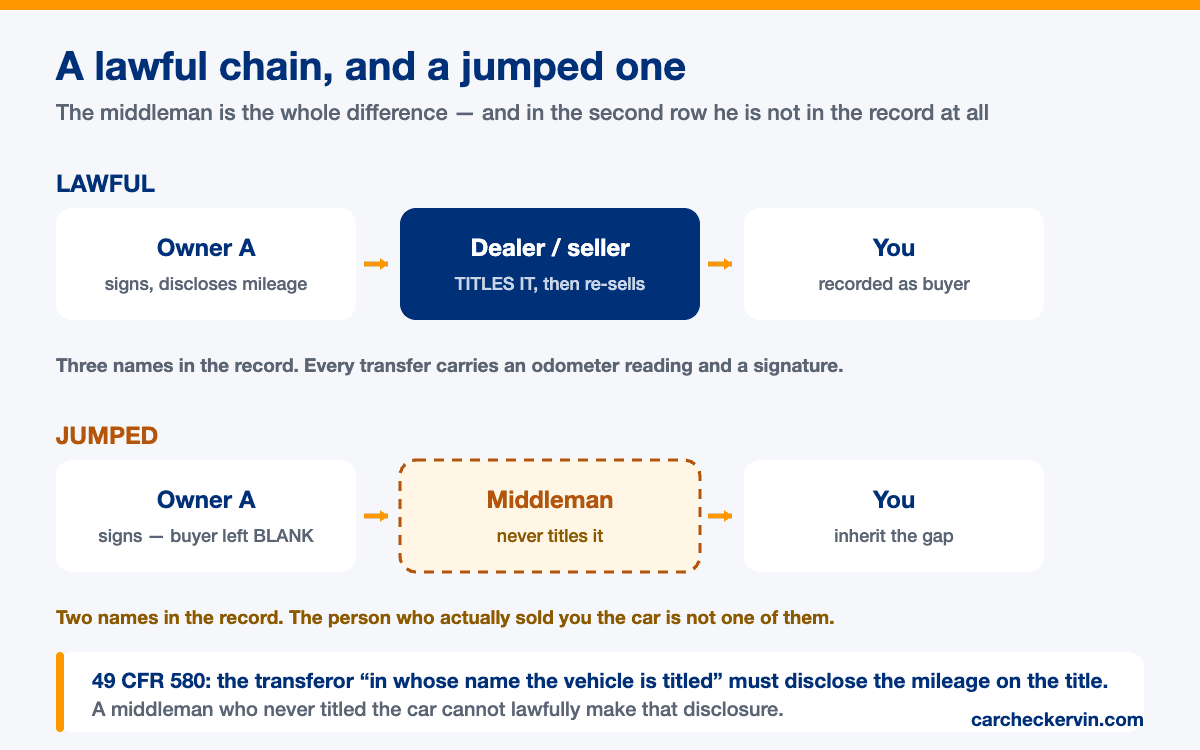
“Title jumping” describes what the seller does. “Open title” describes what they hand you. One person buys a car, never registers it, and sells it on using the title the previous owner already signed — so the public record jumps straight from that owner to you, and the middleman is simply not there.
It is worth being clear about why that is attractive to them. No transfer tax. No registration. No dealer licence. And, most usefully of all, nothing connecting them to a car that may have problems you have not found yet.
The federal rule that makes it unlawful
Most explanations stop at state transfer tax. The firmer ground is 49 CFR Part 580, Odometer Disclosure Requirements, which is explicit about who may make the disclosure:
“In the case of a transferor in whose name the vehicle is titled, the transferor shall disclose the mileage on the electronic title or the physical title, and not on a reassignment document.”
Read that against a title jump and the problem is structural rather than technical. The person selling you the car is not the transferor in whose name it is titled, so the disclosure the rule requires is not theirs to make — and the rule separately forbids signing as sign an odometer disclosure statement as both the transferor and transferee in the same transaction, unless permitted by §§ 580.13 or 580.14.
The record remembers every transfer
Title transfers and the odometer reading captured at each one — $14.99, no account.
When a missing disclosure is perfectly legal
This is where a lot of advice overshoots, so it is worth stating plainly: an older car can lawfully change hands with no odometer disclosure at all. Section 580.17 exempts:
- A vehicle with a Gross Vehicle Weight Rating of more than 16,000 pounds
- A vehicle that is not self-propelled
- A vehicle of model year 2010 or earlier, transferred at least 10 years after 1 January of its model year
- A vehicle of model year 2011 or later, transferred at least 20 years after 1 January of its model year
So the red flag is not a blank mileage box on a thirty-year-old pickup. It is a signature from somebody who is not the person standing in front of you, on a car recent enough for the disclosure to be required.
What it costs you
| What goes wrong | Why |
|---|---|
| You cannot register the car | The chain of ownership has a gap your DMV will not bridge, and you were never recorded as buying from anyone. |
| You need a stranger's cooperation | Completing it can require the last registered owner — someone you have never met and cannot compel. |
| Nobody is accountable for the car | The seller has no recorded link to it, so a hidden brand or undisclosed damage has no one attached to it. |
| Your money is already gone | By the time the DMV explains the problem, the seller's phone number usually no longer works. |
How to spot it before you pay
- 1
Read the name on the title, then the seller's ID
They must match. This one check defeats the entire scheme and costs nothing.
- 2
Look at the buyer section
If the previous owner has signed but no buyer is entered, that is an open title. Stop there.
- 3
Ask how long they have owned it
A vague answer, or a date that does not match the title, is the tell. Genuine owners know.
- 4
Check the transfer history
A record showing transfers the seller has not mentioned — or odometer readings that move oddly between them — contradicts the paperwork in their hand. $14.99.
- 5
Ask them to title it properly first
A legitimate seller can register the car in their name and then sell it to you. Someone who will not, has answered the question.
Sources
- 49 CFR Part 580 — Odometer Disclosure Requirements
Who must make the odometer disclosure, what it must contain, the auction record-retention rule, and the exemptions. Read 19 September 2026.
- NMVTIS — U.S. Department of Justice
The Justice Department's consumer entry point for the National Motor Vehicle Title Information System. Read 19 September 2026.
- FTC — Dealer's Guide to the Used Car Rule
Who counts as a dealer, where the Rule applies, and when the Buyers Guide must be posted. Read 19 September 2026.
- NICB VINCheck
The National Insurance Crime Bureau's free lookup for theft and total-loss records reported by participating member insurers.
Vérifiez toujours le VIN avant d’acheter
L’aperçu gratuit affiche les mentions au titre, le statut de vol et les rappels ouverts en quelques secondes, et signale s’il existe des dossiers d’accident et d’odomètre. L’historique complet est à 21,99 $ CAD — paiement unique, sans abonnement.
Keep reading
Frequently asked questions
Is a title jump just a tax dodge?+
That is the usual explanation and it is part of it — an unregistered middleman pays no transfer tax and files no paperwork. But there is a federal dimension people miss. 49 CFR Part 580 requires that "In the case of a transferor in whose name the vehicle is titled, the transferor shall disclose the mileage on the electronic title or the physical title, and not on a reassignment document." Someone who never put the car in their name is not the titled transferor, so the disclosure the rule demands cannot properly be made at all.
What must a proper odometer disclosure contain?+
Four things beyond the signature: The odometer reading at the time of transfer, not including tenths of miles; The date of transfer; The transferee's name; The transferor's signature AND printed name. If the title you are handed has a signature but no buyer name, no date and no mileage, you are looking at an incomplete transfer rather than a finished one.
Why can't the middleman just sign both sides?+
Because the rule anticipates exactly that. It prohibits signing "…sign an odometer disclosure statement as both the transferor and transferee in the same transaction, unless permitted by §§ 580.13 or 580.14." The narrow exceptions concern powers of attorney, not a reseller papering over a gap.
Is a missing odometer disclosure always a red flag?+
No, and this is where a lot of advice gets it wrong. Section 580.17 exempts several categories, including: A vehicle with a Gross Vehicle Weight Rating of more than 16,000 pounds; A vehicle that is not self-propelled; A vehicle of model year 2010 or earlier, transferred at least 10 years after 1 January of its model year; A vehicle of model year 2011 or later, transferred at least 20 years after 1 January of its model year. On an old enough car, no disclosure is entirely lawful. The red flag is a signature from someone who is not the person selling you the car.
What happens to me if I buy on an open title?+
You can find you cannot register the car, because the chain of ownership has a hole in it that your DMV will not bridge. You may need the original registered owner — a stranger you have no way to contact — to complete paperwork. Meanwhile you have paid for a car you cannot legally use, and the person who sold it to you has no recorded connection to it.
How does a history report help?+
Because the federal record captures title transfers and the odometer reading recorded at each one. A car whose paperwork shows one owner while the record shows several transfers, or whose mileage jumps around between transfers, is telling you something the document in the seller's hand is not. That is the $14.99 check.
What does this have to do with curbstoning?+
Everything — it is the same operator. An unlicensed dealer selling more than a handful of cars a year would otherwise fall under the FTC Used Car Rule, which binds anyone selling more than five used vehicles in a 12-month period. Never taking title is how they stay invisible: no dealer licence, no Buyers Guide, no paper trail leading back to them.
Do auctions have to keep records?+
Yes, and it is a useful backstop. Under § 580.9, auction companies must retain, for 5 years after each sale, the most recent owner's name, the transferee's name, the VIN and the odometer reading when they took possession. A car that passed through an auction has a record somewhere even if the paperwork in front of you is thin.
What should I do if a seller hands me an open title?+
Do not buy, and do not hand over a deposit. The correct response is to ask the seller to title the car in their own name first and then sell it to you properly. A legitimate seller can do that. Someone who cannot, or who explains why it is unnecessary, has told you what they are.
Check the transfer history
Every recorded title transfer, with the odometer reading captured at each — $14.99.
Vérifications VIN connexes
Plus d'outils pour vérifier l'historique de tout véhicule