What is VIN etching?
Etching the VIN into a car's glass so stolen parts can be traced. It is nearly always sold as an add-on — and on covered vehicle lines the manufacturer was already required to mark the major parts for exactly the same reason.
Buying the car this is being sold with?
Check its theft and title record before you sit down in the finance office.
No account · Nothing stored · $14.99 only for the full report
Quick Answer
- What is VIN etching?
- Acid-etching the vehicle identification number into the glass, so that a thief has to replace the glass before the car can be sold on and so recovered parts can be traced. It is usually sold as a dealer add-on, often in the finance office at the end of a purchase.
- Didn't my car come with this?
- Possibly, in a different form. Under the federal theft prevention standard, covered vehicle lines must leave the factory with the VIN marked on major parts — up to 18 of them. That is not the same as glass etching, but it serves the same purpose, and you already paid for it.
- Is it worth buying?
- That depends on what your car already carries and what you are being charged, which is exactly the question a finance office would rather you did not ask. Look at the parts first: the marking is designed to be visible, and this page explains where.
What it is, and what it is for
Aftermarket VIN etching uses acid and a stencil to write the vehicle identification number into the glass. The theory is sound: a car whose windows all carry a traceable number is harder to break up and sell, because the glass has to be replaced before the parts are worth anything.
That theory is not the dealer's invention. It is the stated basis of a federal standard that has been in force since the nineteen-eighties, and which puts the same number on rather more than the windows.
The standard you already bought
The Federal Motor Vehicle Theft Prevention Standard does the same job at the factory. Its scope is narrow and precise:
“This standard specifies performance requirements for identifying numbers or symbols to be placed on major parts of certain passenger motor vehicles.”
And its purpose is the sales pitch you are about to hear, written into federal law: “The purpose of this standard is to reduce the incidence of motor vehicle thefts by facilitating the tracing and recovery of parts from stolen vehicles.”
The number used is not a code or a serial. It is the car's own VIN: “Except as provided in paragraphs (b)(2) and (b)(3) of this section, the number required to be inscribed or affixed by paragraph (a) shall be the VIN of the passenger motor vehicle.”
The 18 parts the regulation names
These are listed individually, in this order, in the standard itself:
- 1Engine
- 2Transmission
- 3Right front fender
- 4Left front fender
- 5Hood
- 6Right front door
- 7Left front door
- 8Right rear door
- 9Left rear door
- 10Sliding or cargo door(s)
- 11Front bumper
- 12Rear bumper
- 13Right rear quarter panel (passenger cars)
- 14Left rear quarter panel (passenger cars)
- 15Right-side assembly (MPVs)
- 16Left-side assembly (MPVs)
- 17Pickup box, and/or cargo box (LDTs)
- 18Rear door(s) (both doors in case of double doors), decklid, tailgate, or hatchback (whichever is present)
“Each passenger motor vehicle subject to this standard must have an identifying number affixed or inscribed on each of the parts specified in paragraphs (a)(1) through (a)(18) inclusive, if the part is present on the passenger motor vehicle.”
That qualifier is why no single car carries all 18. A saloon has no cargo box; a two-door has no rear doors. The list is the union of what could be present across every covered body style, not a checklist for your car.
Markings tell you the parts. The record tells you the car.
Title brands, salvage and theft records, reported mileage and open recalls — $14.99, no account.
Which vehicles are actually covered
This is the part to get right before you tell a dealer their add-on is redundant. The standard does not reach every vehicle on the road. It applies to:
Passenger cars
Multipurpose passenger vehicles with a gross vehicle weight rating of 6,000 pounds or less
Light-duty trucks with a gross vehicle weight rating of 6,000 pounds or less, that NHTSA has determined to be high theft in accordance with 49 CFR 542.1
Light duty trucks with a gross vehicle weight rating of 6,000 pounds or less, that NHTSA has determined to be subject to the requirements of this section in accordance with 49 CFR 542.2
There is a second exit as well: manufacturers can be exempted from the standard when they fit an antitheft device instead. So an unmarked car is not necessarily a suspicious car — check before you conclude anything, and never assume a given model is covered because a similar one is.
How the factory marking behaves
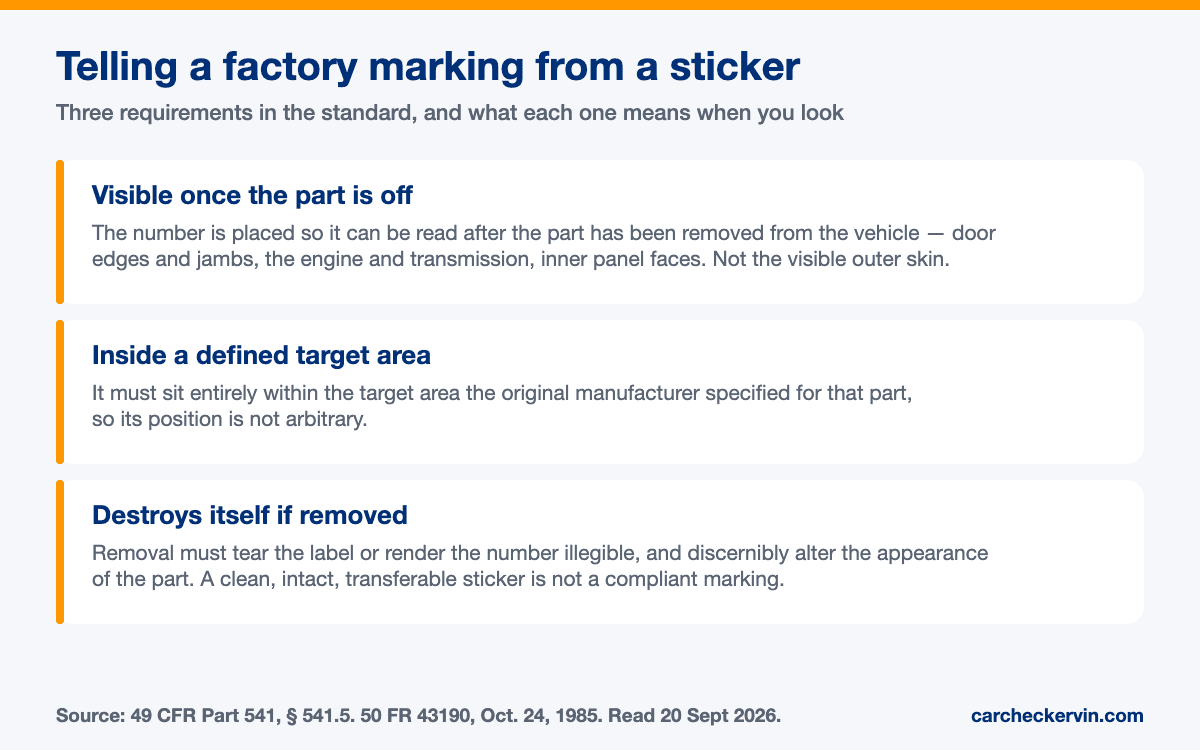
Three requirements together explain where to look and how to tell a real marking from something stuck on afterwards.
1Visible once the part is off
The number must be placed on each part in a location that is visible without further disassembly once the part has been removed from the vehicle.
2Inside a defined target area
The number must be placed entirely within the target area specified by the original manufacturer for that part.
3Destroys itself if removed
Removal of the label must cause the label to self-destruct by tearing or rendering the number on the label illegible, and discernibly alter the appearance of the part.
The last one is the useful test. A compliant label cannot be peeled off intact and moved to another part — it tears, or the number becomes illegible, and the surface underneath is visibly altered. A clean, intact, transferable sticker is not what the regulation describes.
Why some trucks are covered and others are not
Light trucks come into the standard by theft rate rather than by category, and the benchmark is a specific published figure. The regulation defines the 1990/91 median theft rate as 3.5826 thefts per thousand vehicles produced, and lines are selected against it.
The unit of selection is the “line”, which is broader than most people assume:
“Line means a name which a manufacturer applies to a group of motor vehicles of the same make which have the same body or chassis, or otherwise are similar in construction or design. A "line" may, for example, include 2-door, 4-door, station wagon, and hatchback vehicles of the same make.”
What to do when it is offered to you
- 1
Look at the car before you answer
Open a door and look at the edge and the jamb; open the bonnet and look at the engine and transmission. On a covered line the markings are there by law, and they are placed to be readable.
- 2
Ask whether it is already done
Some dealers etch the glass before the car reaches the lot and then present it as an optional extra afterwards. If the glass is already etched, you are being asked to pay for work that exists.
- 3
Separate the product from the price
The technique is not a scam; it does what it claims. Whether it is worth what is being asked, on a car that already carries factory markings, is a different question — and it is yours to answer.
- 4
Check the numbers agree
Every marking should read the same VIN, and it should match the dash plate and the title. Disagreement between them is the single most important thing this inspection can find.
- 5
Run the history separately
Markings tell you about the parts in front of you. They say nothing about whether the car has been stolen and recovered, written off, flooded or retitled in another state — that is the $14.99 check.
Sources
- 49 CFR Part 541 — Federal Motor Vehicle Theft Prevention Standard
The standard that requires the manufacturer to mark major parts on covered vehicle lines, and the list of 18 parts it names. 50 FR 43190, Oct. 24, 1985. Read 2026-09-20.
- 49 CFR § 541.5 — Requirements for passenger motor vehicles
The part list itself, the rule that the number shall be the VIN, and the label behaviour that makes a factory marking self-destruct when removed. Read 2026-09-20.
- 49 CFR Part 543 — Exemption from vehicle theft prevention standard
Why a covered line may carry no marked parts at all: manufacturers can be exempted when they fit an antitheft device instead. Read 20 September 2026.
- NICB VINCheck
The National Insurance Crime Bureau's free lookup for theft and total-loss records reported by participating member insurers.
Vérifiez toujours le VIN avant d’acheter
L’aperçu gratuit affiche les mentions au titre, le statut de vol et les rappels ouverts en quelques secondes, et signale s’il existe des dossiers d’accident et d’odomètre. L’historique complet est à 21,99 $ CAD — paiement unique, sans abonnement.
Keep reading
Frequently asked questions
What does federal law actually require?+
That covered vehicles leave the factory with an identifying number on their major parts. The standard's own scope: "This standard specifies performance requirements for identifying numbers or symbols to be placed on major parts of certain passenger motor vehicles."
Why does that requirement exist?+
For the same reason etching is sold: "The purpose of this standard is to reduce the incidence of motor vehicle thefts by facilitating the tracing and recovery of parts from stolen vehicles." A marked part is hard to sell and easy to trace, which is what makes stealing the car less attractive.
Which parts have to be marked?+
Up to 18, named individually in the regulation: Engine, Transmission, Right front fender, Left front fender, Hood, Right front door, and others including bumpers, quarter panels and the decklid or tailgate. The qualifier matters though — the duty applies "if the part is present on the passenger motor vehicle", so no single car carries every item on the list.
Is the marking the VIN itself?+
Usually. The rule says: "Except as provided in paragraphs (b)(2) and (b)(3) of this section, the number required to be inscribed or affixed by paragraph (a) shall be the VIN of the passenger motor vehicle." There is a long-standing exception for engines and transmissions, where some manufacturers were already using a shortened VIN derivative and were allowed to continue.
Does this cover every car?+
No, and that is the part to be careful about. It covers passenger cars, plus multipurpose passenger vehicles and light-duty trucks rated at 6,000 pounds gross vehicle weight or less that NHTSA has designated or determined to be covered. Some lines are also exempted entirely when the manufacturer fits an antitheft device instead.
How does NHTSA decide which trucks are covered?+
By theft rate, measured against a fixed benchmark. The regulation defines the 1990/91 median theft rate as 3.5826 thefts per thousand vehicles produced, and lines are selected by reference to it.
How do I tell a factory marking from a sticker someone added?+
By what happens when it is disturbed. A compliant label must self-destruct: "Removal of the label must cause the label to self-destruct by tearing or rendering the number on the label illegible, and discernibly alter the appearance of the part." An intact label that peels away cleanly is not a compliant factory marking.
Where should I look for the markings?+
They are placed so they can be read once a part is off the car: "The number must be placed on each part in a location that is visible without further disassembly once the part has been removed from the vehicle." In practice that means door edges and jambs, under the bonnet on the engine and transmission, and the inner faces of panels — not the visible outer surface.
Does etching help me when buying a used car?+
It helps in one specific way: the markings should all read the same number, and that number should match the dash VIN and the title. Mismatched or missing markings on a car that should have them is a reason to stop. The paperwork side — title brands, salvage and theft records — comes from the $14.99 history check.
Check the car's history
Title brands, theft records and open recalls — $14.99.
Vérifications VIN connexes
Plus d'outils pour vérifier l'historique de tout véhicule