Actual cash value? It's an opening offer.
ACV is what the insurer pays when your car is totaled: replacement cost minus depreciation, built from comps on your VIN. It's also negotiable — if you bring the same kind of evidence the adjuster used.
Build your ACV case from the VIN
17 characters in — market benchmarks, odometer timeline and the clean-history proof adjusters actually credit.
Free preview · no card, no account
Quick Answer
- What is the actual cash value of a car?
- Replacement cost minus depreciation— what your car was worth in its condition the moment before the loss, once age, wear, mileage and accident history are counted. It's the number an insurer pays when a car is totaled, minus your deductible, and regulators warn it often won't fully replace what you lost.
- How do insurers calculate my car's ACV?
- With comps, not feelings: adjusters pull recent sales of comparable vehicles in your area from valuation vendors like CCC, Mitchell or Audatex — dealer prices, auction results and private-party listings from the past few weeks — then adjust for your car's mileage, condition and history. The same model can differ by thousands between states.
- Can I dispute a low ACV offer?
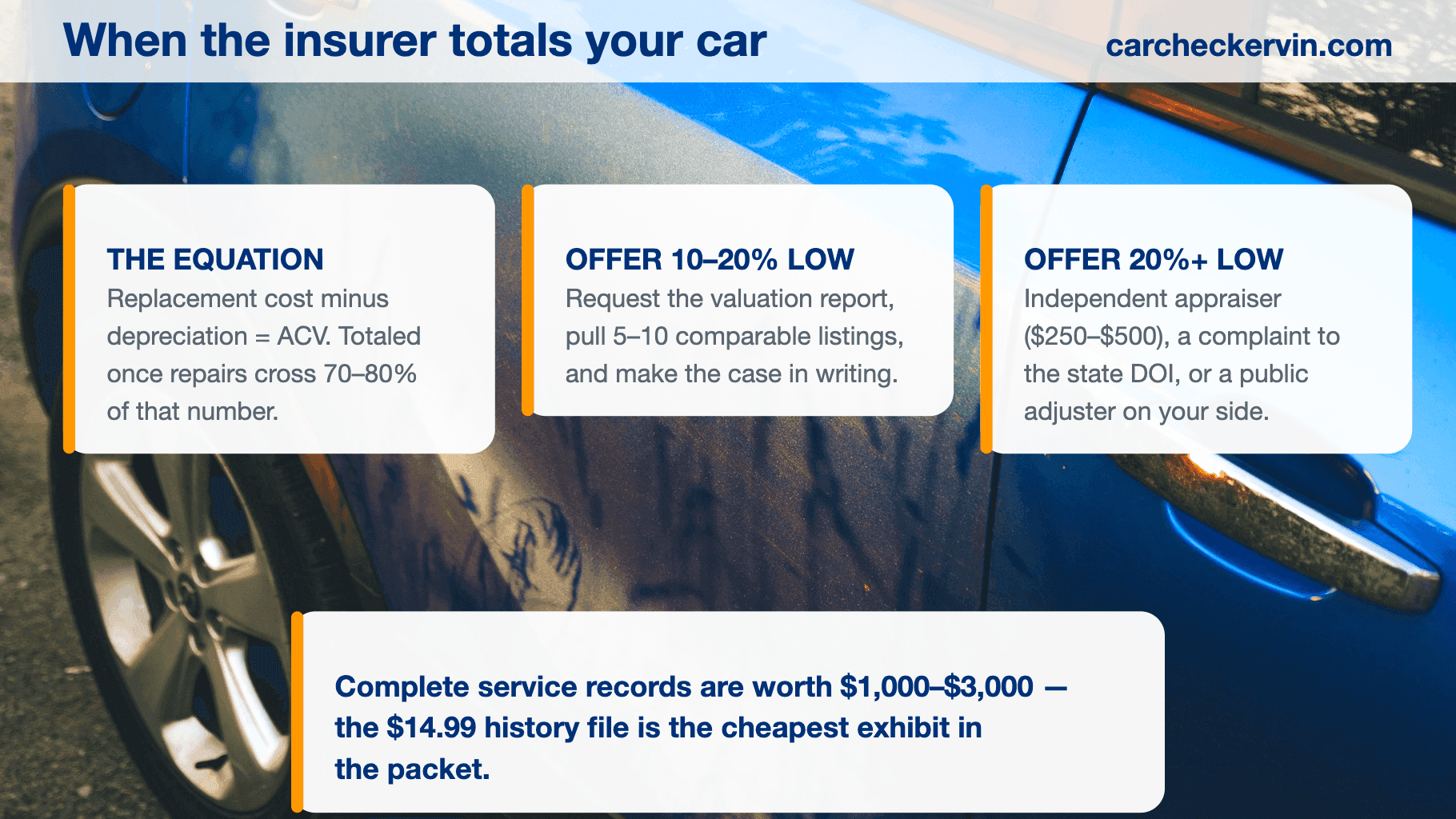
- Yes, and the playbook is standard: request the adjuster's valuation report, pull comparable listings of your own, and put the case in writing — with an independent appraiser, a state insurance department complaint, or a public adjuster as the escalation tier. The evidence file starts at $14.99: history, odometer and market benchmarks for your exact VIN.
What ACV means — and when you meet it
Four facts frame every totaled-car conversation, and every one of them is checkable:
| The question | The answer | Why it matters |
|---|---|---|
| The definition | Replacement cost minus depreciation — the car's worth in its pre-loss condition | Age, wear, mileage and accident history all subtract from it |
| Versus replacement cost | Replacement coverage pays like-for-like without depreciation; ACV doesn't | Regulators warn ACV often won't fully replace what you lost |
| When it triggers | Repairs crossing roughly 70–80% of ACV total the car — thresholds vary by state | Then the payout switches to ACV minus your deductible |
| Who computes it | Valuation vendors — CCC, Mitchell, Audatex — feeding your adjuster comps | Recent local sales, auction results and listings, not a book value |
Note what ACV is not: it isn't the guide value you looked up last year, and it isn't what a replacement will cost you next week. It's a data product about your VIN — which is exactly why it can be argued with.
How the adjuster builds the number
The valuation report behind your offer has three ingredients — all of them reproducible from your side of the table:
Recent local sales, not books
Adjusters pull comparable sales from CCC, Mitchell or Audatex — dealer prices, auction results and private-party listings from the past 30 to 60 days in your area. The engine looks backward a few weeks, not at asking prices.
The VIN does the talking
Specs from the VIN, then adjustments for mileage, condition and accident history. A clean, documented file adjusts up; a spotty one adjusts down — before you've said a word.
Region moves the money
The same car can be worth about two thousand dollars more in one state than another, so out-of-state comps don't rescue a low offer — local ones do. Geography is baked into the number.
The evidence that moves ACV up
Adjusters credit paper, not stories. Three exhibits do most of the lifting:
Service records: real money
Complete service records are worth $1,000–$3,000 on the valuation — the industry's own playbook says so. If you have the folder, submit it; if you're buying, this is why documented cars cost more.
The clean-history proof
Low mileage and a clean accident history push the number up — and both live in the VIN's records. The report that proves your odometer timeline and accident-free file is the cheapest exhibit in the packet.
Your own comps
Five to ten comparable listings — same year, trim, mileage band, your region — turn “that's too low” into a document. Screenshot them with dates; listings vanish faster than claims settle.
The adjuster priced your VIN. Price it back.
Free preview first: history flags and record counts for any 17-character VIN — the $14.99 report adds the odometer timeline, accident records and market benchmarks.
When the offer is low — the playbook
Low offers are common enough that the response ladder is standardized. Match your effort to the gap:
Offer 10–20% under market
Request the adjuster's valuation report, pull five to ten comparable listings, and put the counter-case in writing. Most gaps this size close on paper alone — politely, with exhibits attached.
Offer more than 20% under
Escalate: an independent appraiser runs $250–$500 and many policies include an appraisal clause; a complaint to your state's insurance department costs nothing; a public adjuster takes the fight over entirely.
Either way: the file first
Every tier runs on the same fuel — the valuation report, your comps, and your car's documented history. Assemble the file before the first phone call and the whole ladder gets shorter.
Build the counter-case in three steps
Cheapest exhibit first — most of the file is free.
Benchmark your own VIN
Run the 17-character VIN for the exact build and market benchmarks — trade-in, private-party and dealer-retail context for your specific car, not a generic model average. This is the frame the comps hang on.
Prove the history
The NMVTIS-backed report documents the odometer timeline, accident records and title history in under 60 seconds. Clean history and verified mileage are exactly the adjustments that push ACV up — now they're in writing.
Comps, report, letter
Five to ten local comparable listings, the insurer's own valuation report, your history file, and a short written case. Send it, keep copies, and let the ladder work — most disputes end at this step.
Related checks for the claim file
The rest of the totaled-car homework, in the same plain terms.
Prüfen Sie die Fahrgestellnummer immer vor dem Kauf
Die kostenlose Vorschau zeigt Title Brands (US-Titel-Kennzeichnungen), Diebstahlstatus und offene Rückrufe in Sekunden und meldet, ob Unfall- und Tachodaten vorliegen. Die vollständige Historie kostet 19,95 € — einmalig, ohne Abo.
Actual cash value — the questions people ask
Straight answers, including where the insurer is simply right.
What does actual cash value mean in car insurance?+
It's your car's worth in its pre-loss condition: replacement cost minus depreciation, with age, wear, mileage and accident history all counted — the standard definition insurers and regulators use. When a car is totaled, the settlement is the ACV minus your deductible, which is why the same crash pays different owners very differently.
How is ACV different from replacement cost coverage?+
Replacement cost coverage pays to replace with like kind and quality without deducting depreciation; ACV deducts it. Regulators' own guidance warns that ACV often does not pay enough to fully replace what was lost. For cars, ACV is the default — replacement-cost or new-car replacement coverage exists but is the exception you have to buy.
How do insurance companies calculate a car's ACV?+
Through valuation vendors — CCC, Mitchell or Audatex — that pull recent comparable sales in your area: dealer prices, auction results and private-party listings from the past 30 to 60 days, adjusted for your car's mileage, condition and history. It's a local, data-driven estimate, which is precisely why local comps and documented history can change it.
Can I negotiate the ACV the insurer offers?+
Yes. For an offer 10–20% below market, the standard play is to request the valuation report, pull five to ten comparable listings, and make the case in writing. Beyond 20%, escalate: an independent appraiser ($250–$500), a complaint to your state's Department of Insurance, or a public adjuster. Documentation wins these — feelings don't.
When is a car declared a total loss?+
When repair costs cross a threshold share of the ACV — roughly 70–80%, with the exact percentage set by state law. Past that line the insurer pays ACV instead of repairing. That's also why a low ACV can total a fixable car: the threshold is measured against the very number this page is about.
Do maintenance records really change the payout?+
Materially: the claims-industry playbook puts complete service records at $1,000–$3,000 of additional value, and low mileage with a clean accident history pushes the number further. If your folder is thin, the VIN's own records still document the odometer timeline and accident-free history — that's the $14.99 exhibit.
How do I find my car's ACV before the insurer tells me?+
Approximate it the way the adjuster will: run the VIN for the exact build and market benchmarks, then check recent local listings for comparable cars. You won't see the insurer's vendor data, but a VIN-specific benchmark plus five to ten live comps brackets the honest range — and tells you instantly whether the eventual offer is fair.
The offer is built from data. So is the counter.
History, odometer and market benchmarks for your exact VIN — the evidence file, in under a minute, for $14.99.
Passende VIN-Abfragen
Weitere Tools, um die Historie jedes Fahrzeugs zu prüfen