BidFax VIN Check — What an Auction Record Shows.
BidFax publishes the sale history of damaged American cars sold at insurance auctions: what they sold for, and when. Here is what an auction record can tell you about a car you are thinking of buying, what it cannot, and how to see the auction, title and total-loss history for a VIN in one place.
Check a VIN's Auction and Title History
Enter the 17-character VIN for a free preview of the records on file. The full report adds auction records with photos to title brands and total-loss records.
Free preview · No sign-up · No owner or personal data
Quick Answer
- What is BidFax?
- BidFax describes itself as a site that provides free information on the prices of damaged cars from the USA sold after insurance claims. Its pages list sale history with the final bid, organized by make, for cars sold at insurance auctions.
- Is there an alternative to BidFax?
- Several archive sites publish Copart and IAAI sale records. A vehicle history report goes further: ours shows auction records with photos alongside title brands, NMVTIS salvage records and insurance total-loss records, for $14.99 after a free preview.
- Why check a car's auction history?
- Because a car sold at an insurance auction was usually damaged badly enough for an insurer to pay out. If it is now on a dealer lot looking fine, the auction record shows what it looked like before the repair.
How a damaged car ends up in an auction archive, in five steps
Every record on a site like BidFax starts with an insurance claim. The last step is the one that matters to a buyer: the same car, repaired, back on sale.
- 1The car is damagedA crash, a flood or a storm. The owner claims, and the insurer decides the car is not worth repairing.
- 2It goes to a salvage auctionThe insurer sells the car through an auction house. Copart and IAAI are the two that archive sites name.
- 3The listing is recordedThe auction lists the car with its damage, its odometer reading and photos taken on the lot.
- 4It sells, and the price is keptThe final bid and sale date are recorded. Archive sites such as BidFax publish that sale history afterwards.
- 5It can come back, repairedA rebuilder fixes the car and sells it on. The auction photos still show it as it was on the lot.
What BidFax Is, in Its Own Words
BidFax describes itself plainly: a site that provides free information on the statistics of prices for damaged cars from the USA after insurance claims. Its own pages are organized by make, each listing the sale history with the final bid for cars sold at auction.
Archive sites of this kind are built with importers in mind. bid.cars, which runs a similar Copart and IAAI archive, writes that more and more buyers in Poland, Ukraine and elsewhere import cars from the USA and use its archive to analyze a car's history before buying.
For a US buyer looking at a used car on a lot, the same record answers a narrower question: was this car ever sold as salvage? That is useful, but it is one record among several, and the others do not live on auction sites.
Check which site you are on
- Look-alike names rank for BidFax. On 27 September 2026 the results for “bidfax” included bidfaxi.info, which reuses BidFax's own description, and a bidfax.com.ua Facebook page.
- We cannot tell you who runs them. Whether those sites are connected to BidFax is not something we could verify, so check the address before paying anything.
- BidFax calls its information free. A site asking you to pay for the same records is a reason to stop and look again.
What an Auction Record Shows, and What It Misses
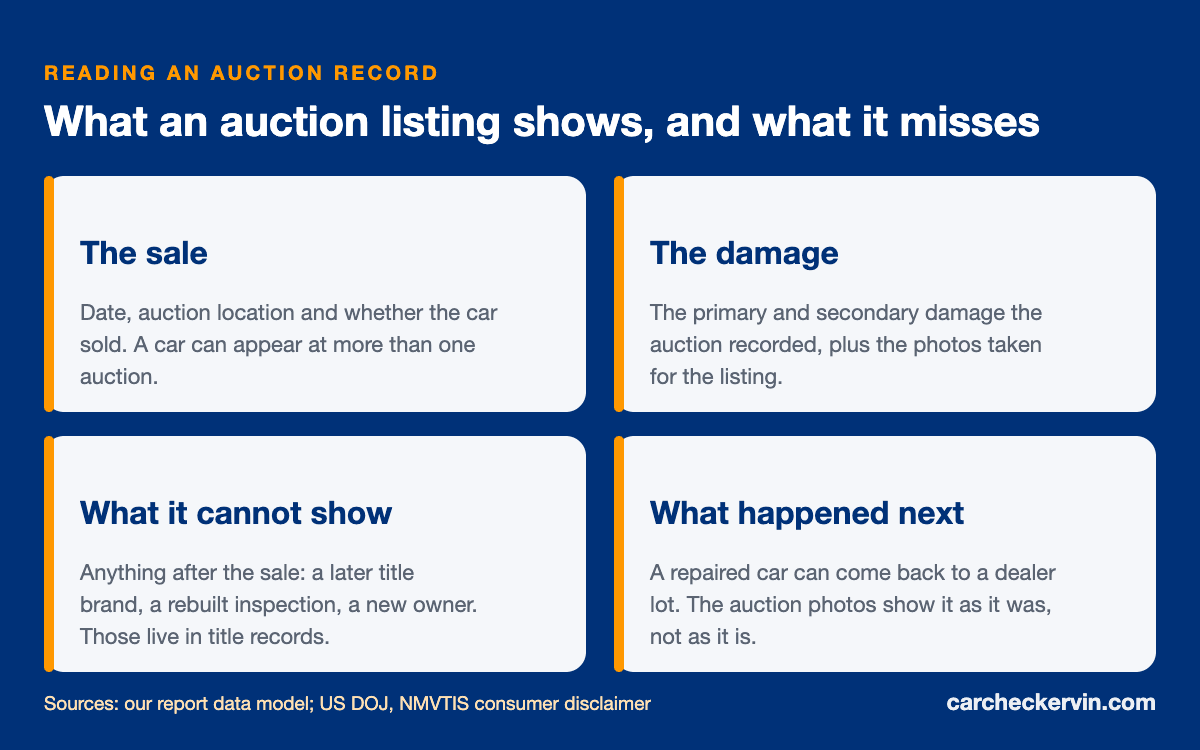
An auction listing is a snapshot. It tells you the date, the lot, whether the car sold, the damage the auction recorded and what the car looked like in the yard. For a car you are thinking of buying, the photos are often the most useful thing in any history report.
What a snapshot cannot show is what happened next. A title brand issued after the sale, a rebuilt inspection, the next owners: those are title records, kept by states and reported to the federal NMVTIS system. The US Department of Justice notes that damage reaches that system when an insurer declares a total loss or a state brands the title.
Why Buyers Look Up a Car's Auction History
Four situations where an auction record changes the decision.
The car looks perfect
Photos from the auction lot show what the car looked like before it was repaired. That is the fastest way to see how serious the damage was.
The title looks clean
A salvage sale followed by a clean title is worth a question. Our title-check guide explains how states differ on branding a totaled car.
The price looks low
A final bid on the archive tells you what the last buyer paid. A retail price far above it after an unexplained repair deserves scrutiny.
You are importing
Importers use sale archives to judge what a damaged US car is worth before bidding or buying from a broker.
See the Auction Record and the Title Record Together
Enter the VIN for a free preview of the records on file. The full report shows auction records with photos next to title brands and insurance total-loss records.
An Auction Archive vs a Full Vehicle History Report
Archive sites and history reports answer different questions. Many buyers use both.
An auction archive (BidFax and similar sites)
- Sale history and final bids from insurance auctions
- Organised by make and by sale
- Covers cars that went through those auctions
- Shows the car as it was on the lot
- Free, by BidFax's own description
Our full report
- Auction records with the recorded damage and photos, where the car was auctioned
- Title brands such as salvage, rebuilt and flood
- NMVTIS junk and salvage records, naming who reported the car
- Insurance total-loss records and odometer readings
- $14.99 after a free preview, or $9.00 each in a 10-pack
Our report does not include police or repair-shop accident entries. Its value next to an auction archive is the title side: what the states and insurers recorded before and after the sale.
When a Car Has No Auction Record
No auction record is good news, but only partly. Many cars are never sold at a salvage auction, including cars that were damaged and repaired through insurance without being written off. An empty result tells you the car was not sold as salvage at the auctions covered; it does not tell you the car was never hit.
That is why the title side matters. A total loss can be recorded, and a title branded, whether or not the car went through Copart or IAAI. Check both before you decide, then have the car inspected by a mechanic.
What to Do Before You Buy a Car With an Auction Past
Four steps, cheapest first.
Run the VIN
Start with the free preview to see which records exist, then read the auction, title and total-loss records together.
Compare the photos to the car
Look at the damaged areas in the auction photos, then look at those same panels, gaps and paint on the car in front of you.
Ask for the repair paperwork
A rebuilt car should come with receipts for parts and labour. A seller who has none is asking you to trust the repair blind.
Get an inspection
A mechanic with the car on a lift can check the frame, the airbags and the welds that photos cannot show.
Related Checks and Guides
This page covers BidFax and auction records. These cover the auction lookups themselves and the title records a salvage sale leads to.
Where These Facts Come From
BidFax's description is its own, as it appears in search results; its site does not respond to requests from our network. The title-record rule comes from the US Department of Justice.
Search results were read on 27 September 2026 and change often. CarCheckerVIN is not affiliated with BidFax, Copart or IAAI.
Prüfen Sie die Fahrgestellnummer immer vor dem Kauf
Die kostenlose Vorschau zeigt Title Brands (US-Titel-Kennzeichnungen), Diebstahlstatus und offene Rückrufe in Sekunden und meldet, ob Unfall- und Tachodaten vorliegen. Die vollständige Historie kostet 19,95 € — einmalig, ohne Abo.
BidFax VIN Check — Frequently Asked Questions
What BidFax shows, how to use an auction record, and what else to check.
What is BidFax?+
BidFax describes itself as a site providing free information on the prices of damaged cars from the USA sold after insurance claims. Its pages list sale history with the final bid, organized by make.
Is BidFax free?+
BidFax describes its information as free. Search results also show similarly named domains; check that you are on the site you meant before paying for anything.
Is bidfaxi.info the same as BidFax?+
We could not verify any connection. On 27 September 2026, bidfaxi.info ranked for “bidfax” using the same description text as BidFax. Treat any look-alike domain with care.
What does an auction record show?+
Typically the sale date, the auction location, whether the car sold, the damage the auction recorded, the odometer reading and photos taken on the lot. It shows the car as it was then, not what happened after.
Does no auction record mean the car was never damaged?+
No. Most cars never go through a salvage auction, including many repaired through insurance. Check title brands and total-loss records too, and have the car inspected.
Does your report show auction photos?+
Where the car went through an auction in our data, yes: the report lists the auction record with the damage recorded and its photos, next to title brands, NMVTIS junk and salvage records, insurance total-loss records, odometer readings, and auction records with the damage the auction recorded and its photos. It does not include police or repair-shop accident entries.
Check a Car's Auction and Title History by VIN
Enter any 17-character VIN for a free preview. The full report lists title brands, NMVTIS junk and salvage records, insurance total-loss records, odometer readings, and auction records with the damage the auction recorded and its photos.
CarCheckerVIN is an independent vehicle-history service and is not affiliated with BidFax, Copart or IAAI. All are trademarks of their respective owners and are referenced here for comparison only. Records in our reports reflect what was reported to our data providers. Our reports do not include police or repair-shop accident entries.
Passende VIN-Abfragen
Weitere Tools, um die Historie jedes Fahrzeugs zu prüfen